

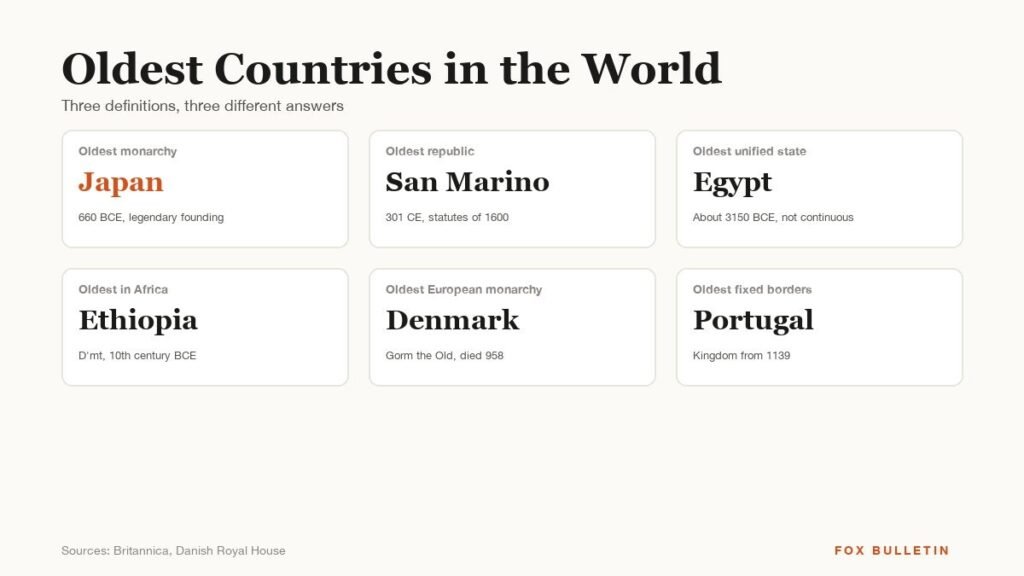
Japan is usually named the oldest country in the world, on the strength of a monarchy that traces itself to Emperor Jimmu in 660 BCE. That date is legend rather than record, which is the problem with every list of the oldest countries in the world: the answer depends entirely on what counts as the same country, and reference works disagree.
This ranking uses one rule. A country’s age runs from the earliest political entity on substantially the same territory that the present state claims as its direct origin, with some continuity of government in between. Egypt therefore ranks below Ethiopia despite older ruins, and San Marino, founded in 301 CE, outranks every European great power. Where a date is traditional rather than documented, the table says so.
| Rank | Country | Founding date or event | Basis for ranking |
|---|---|---|---|
| 1 | Japan | 660 BCE, accession of Emperor Jimmu (legendary) | Continuous monarchy |
| 2 | China | About 1600 BCE, Shang dynasty | First state attested by writing |
| 3 | Ethiopia | 10th century BCE, Kingdom of D’mt | Continuous polity, never colonised |
| 4 | Iran | About 678 BCE, the Medes | First unified Iranian state |
| 5 | Egypt | About 3150 BCE, unification under Narmer | Earliest unified state, civilisational continuity |
| 6 | Greece | 776 BCE, first Olympiad | Cultural continuity, modern state 1830 |
| 7 | San Marino | 301 CE, founded by Saint Marinus (tradition) | Oldest continuous republic |
| 8 | France | 843 CE, Treaty of Verdun | Continuous kingdom to republic |
| 9 | Denmark | Before 958 CE, reign of Gorm the Old | Oldest continuous European monarchy |
| 10 | Portugal | 1139 CE, Afonso Henriques takes the title of king | Near-unchanged borders since |
The 10 Oldest Countries in the World Ranked
1. Japan: 660 BCE
Founding figure: Emperor Jimmu | First written record: Book of Han, 111 CE | National Foundation Day: 11 February
Japan’s imperial line is the oldest continuous hereditary monarchy in the world, and the state dates its own founding to Jimmu’s accession on 11 February 660 BCE, celebrated as National Foundation Day. The Britannica describes Jimmu as the legendary first emperor, and Japan does not appear in a written source until the Chinese Book of Han in 111 CE. The claim rests on continuity rather than documentation, but no other state has an unbroken institutional thread anything like as long.
2. China: About 1600 BCE
Earliest attested state: Shang dynasty | Traditional first dynasty: Xia, about 2070 BCE | Unification: Qin, 221 BCE
The Shang is the first Chinese dynasty confirmed by contemporary writing, on the oracle bones of Anyang. The Xia that tradition places before it has no such evidence. Chinese statehood has passed through dozens of dynasties, foreign conquests and the 1949 revolution, but each successor governed the same core territory and claimed the same inheritance, which is the continuity this list rewards. The People’s Republic itself is 77 years old.
3. Ethiopia: 10th Century BCE
Earliest kingdom: D’mt | Successor: Aksum, from the 1st century CE | Colonial history: Occupied 1936 to 1941 only
Ethiopia is the oldest independent country in Africa and one of very few states anywhere never to have been colonised, having defeated Italy at Adwa in 1896. Its lineage runs from the kingdom of D’mt through Aksum, one of the great powers of late antiquity, to the Solomonic emperors and the modern federal republic. The Britannica’s country entry calls it one of the world’s oldest countries.
4. Iran: About 678 BCE
First Iranian state: Median kingdom | First empire: Achaemenid Persia, 550 BCE | Earlier civilisation: Elam, from about 3200 BCE
Elam was building cities in south-western Iran five thousand years ago, but the first state recognisably Iranian was the kingdom of the Medes, followed within a century by Cyrus the Great’s Achaemenid Empire. Persian statehood survived Alexander, the Arab conquest, the Mongols and the 1979 revolution, each time reasserting the same territory and name.
5. Egypt: About 3150 BCE
Unification: Narmer, also called Menes | Modern independence: 28 February 1922 | Basis: Civilisational continuity
Egypt has the oldest unified state on the list by a wide margin, and on a civilisational definition it would be first. It ranks fifth here because the thread of self-government broke for more than two thousand years: Persians, Greeks, Romans, Arabs, Ottomans and the British ruled the Nile valley in turn, and the modern state dates its independence to 1922. The territory and the name are ancient; the state is not continuous.
6. Greece: 776 BCE
Traditional marker: First Olympiad | Modern state: London Protocol, 1830 | War of independence: From 6 March 1821
Greek city-states were writing constitutions in the eighth century BCE, but there was no single Greek state until 1830, when the great powers recognised independence from the Ottoman Empire. Greece makes the list for the same reason as Egypt, unbroken cultural and linguistic continuity, and ranks above it because Greek self-rule was interrupted for a shorter span.
7. San Marino: 301 CE
Founder: Saint Marinus, by tradition | Constitution: Statutes of 1600, oldest still in force | Status: Oldest surviving republic
San Marino is the one entry with a plausible claim to being the oldest continuous state under any strict definition. The Britannica’s history dates its founding to the early fourth century by tradition and notes its claim to be the world’s oldest republic. Its 1600 statutes are the oldest written constitution still in effect, and its two Captains Regent have been elected every six months since 1243.
8. France: 843 CE
Origin: West Francia, Treaty of Verdun | Earlier marker: Clovis unites the Franks, about 481 | Present republic: Since 1870
France can point to Clovis in the fifth century, but the Treaty of Verdun in 843, which split Charlemagne’s empire and created West Francia, is the first entity with roughly French borders and a French crown. Hugh Capet’s accession in 987 began a royal line that lasted, with interruptions, until 1848, and the present Fifth Republic is the latest of more than a dozen constitutions since 1791.
9. Denmark: Before 958 CE
Founding figure: Gorm the Old | Evidence: The Jelling stones | Status: Oldest continuous European monarchy
The Danish Royal House traces the monarchy to Gorm the Old, who died in 958, and the Jelling runestones raised by Gorm and his son Harald Bluetooth are the first documents to name Denmark as a country. Some lists push the date back to the early eighth century on the basis of Frankish chronicles, but the royal house’s own date is the defensible one, and it still makes Denmark the oldest continuous monarchy in Europe.
10. Portugal: 1139 CE
Founding king: Afonso Henriques | Recognition: Zamora 1143, papal bull 1179 | Borders: Largely fixed since 1249
Afonso Henriques took the title of king after the Battle of Ourique in 1139, Castile accepted Portuguese autonomy at Zamora in 1143 and the pope recognised the kingdom in 1179, dates the Britannica gives in full. Portugal’s frontiers have barely moved since the Algarve was taken in 1249, which makes it the oldest country in Europe with essentially its present borders.
Why Every List of the Oldest Countries Is Different
Three definitions produce three different tables. By earliest civilisation, Egypt, Iran, Iraq and India lead. By continuous monarchy, Japan is first and Denmark second. By continuous republic or constitution, San Marino wins and the United States, at 250 years, ranks surprisingly high. The Wikipedia list of sovereign states by date of formation, often cited on this topic, tracks current sovereignty instead, which gives China 1616, Egypt 1922 and Bulgaria 1908, and it warns in its own introduction that a formation date usually cannot be objectively determined.
Several countries miss this top ten only because of the rule chosen. Armenia’s Urartu dates to 860 BCE, Vietnam’s traditional founding to 2879 BCE, Bulgaria’s to 681, Hungary’s coronation of Stephen I to the year 1000, and Andorra’s charter to 1278. Rankings of this kind, like our list of the largest islands in the United States, are only as good as the definition stated up front.
What Continuity Actually Requires
The test used here has three parts: the same territory, a present government that claims the earlier one as its origin, and no long gap in self-rule. Japan, China, Ethiopia and Iran pass all three. Egypt and Greece fail the third but are so central to the question that leaving them out would mislead. San Marino, France, Denmark and Portugal pass all three with dates that are documented rather than traditional, which is why they appear despite being far younger.
The oldest states are also, with the exception of San Marino, large ones with defensible cores: an archipelago, a river valley, a highland plateau. Small states that survive tend to do so by treaty rather than geography, as our ranking of the most Premier League titles shows in a different arena, where the wealthy few dominate any table that starts the clock late.
Frequently Asked Questions
What is the oldest country in the world?
By continuous monarchy, Japan, which dates its founding to 660 BCE, though that date is legendary. By documented continuous statehood, San Marino, founded by tradition in 301 CE and governed under statutes written in 1600. By earliest civilisation, Egypt, unified around 3150 BCE.
Is Egypt the oldest country?
Egypt has the oldest unified state, but it was ruled by outside powers for most of the last 2,300 years and gained modern independence only in 1922. It is the oldest civilisation still recognisable as a country, not the oldest continuous state.
What is the oldest republic?
San Marino, founded by tradition in 301 CE. Its 1600 statutes are the oldest written constitution still in force, and its heads of state, the two Captains Regent, have been elected every six months since 1243.
Which is the oldest country in Europe?
San Marino by foundation date, Denmark by continuous monarchy, and Portugal by unchanged borders. France, whose origin is usually placed at the Treaty of Verdun in 843, is the oldest of the large European states.
Related Articles

Get the Fox Bulletin briefing
The stories that matter, in your inbox. No spam, unsubscribe anytime.
Newsletter signup will be available soon.
Related stories

Best Vacuum Cleaner: 7 Uprights and Sticks Compared
Seven vacuum cleaners compared on type, weight and filtration, with the difference between HEPA, cyclonic and washable filters explained.

Best Mattresses: 7 Boxed Queens Compared on Feel and Cooling
Seven boxed queen mattresses compared on feel, cooling and support, with the foam certifications and the federal fire rule explained.

Halloween Party Ideas: 10 Themes, Food and a Timeline
Ten party themes with the decor, food and costume rule for each, a running order for the evening, and the food, drink and budget decisions that make or break a Halloween party.