

No standards body defines bra sizes. The European standard EN 13402-2 says only that cup size is the difference between the underbust girth and the bust girth, and it lists underbust as the primary dimension for a bra. It prints no cup letters and no band numbers, and neither do ISO 8559-1 or the ASTM body-measurement tables, which cover dress sizes. The 34C or 70E on a label is a convention that the brand set for itself.
What that leaves is a set of conventions that mostly agree. The cup grid below runs from a 0 inch gap to a 15 inch gap and gives the letter each system puts against it, in the US, the UK, Europe and France, Australia and New Zealand, and Japan. Italy uses UK letters throughout.
Bra Cup Sizes by Bust Minus Band Measurement, 0 to 15 Inches
| Bust minus band (in) | US cup | UK / AU / IT cup | EU / FR cup | JP cup |
|---|---|---|---|---|
| Less than 1 | AA | AA | AA | A |
| 1 | A | A | A | B |
| 2 | B | B | B | C |
| 3 | C | C | C | D |
| 4 | D | D | D | E |
| 5 | DD/E | DD | E | F |
| 6 | DDD/F | E | F | G |
| 7 | DDDD/G | F | G | H |
| 8 | H | FF | H | I |
| 9 | I | G | I | J |
| 10 | J | GG | J | K |
| 11 | K | H | K | L |
| 12 | L | HH | L | M |
| 13 | M | J | M | N |
| 14 | N | JJ | N | O |
| 15 | O | K | O | P |
Read across from the gap between your bust measurement and your band number. In the US rule one inch is one letter, so a 3 inch gap is a C.
Letters A to D read the same in the US, UK and EU columns. From the 5 inch row the columns separate, and the Japanese column runs one letter ahead of the UK and EU columns throughout, so Japanese A sits at the UK AA position.
What Bra Sizes Actually Measure: Band Number and Cup Letter
The band number is a ribcage measurement
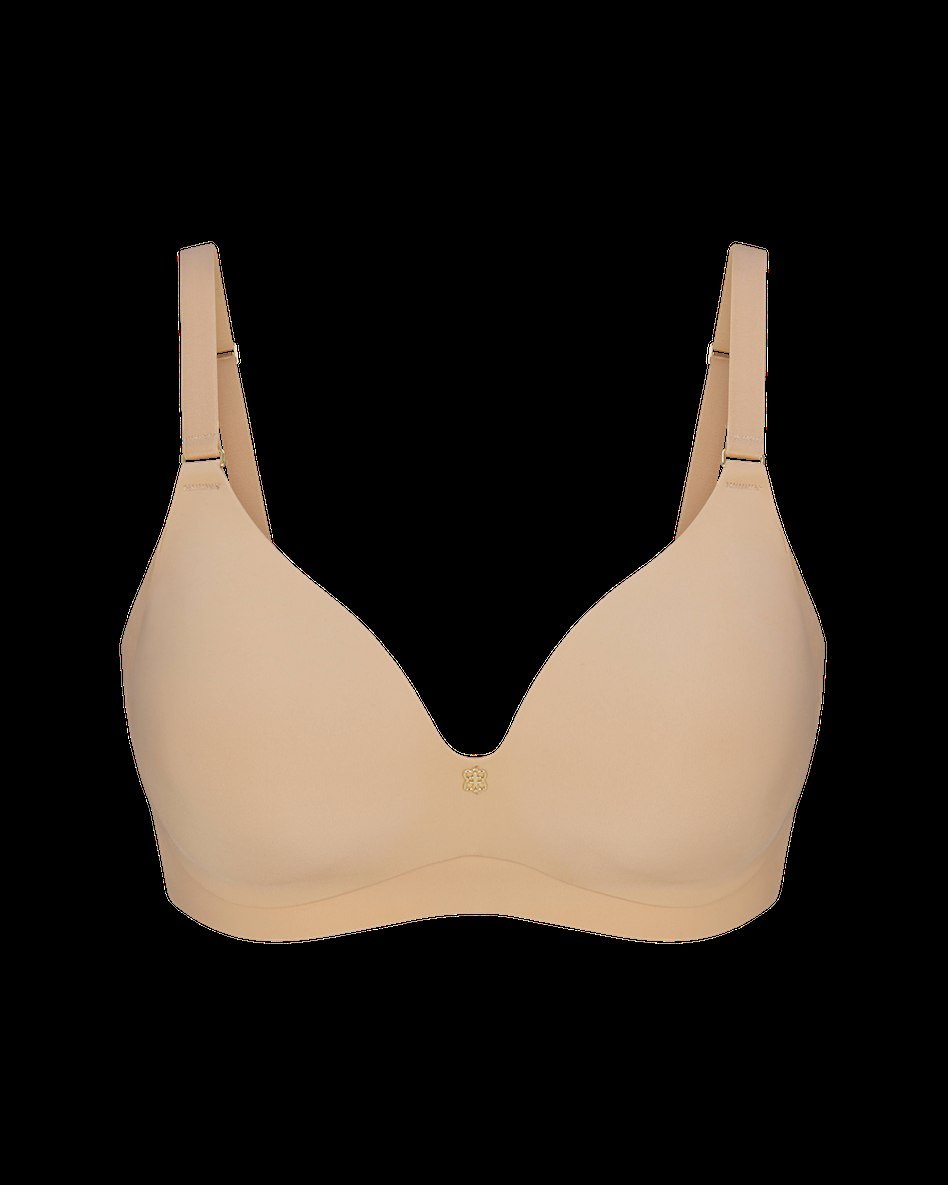
The number is the circumference around the ribcage directly under the bust, where the band sits. In US and UK sizing it is an even number of inches: 32, 34, 36 and so on. In EU labelling it is the underbust in centimetres in 5 cm steps, so EU 70 covers an underbust of 68 to 72 cm. That is 26.8 to 28.3 inches, yet the US and UK label for the same band is 32. The gap is the arithmetic behind the old add-4-inches instruction.
The cup letter is a difference, not a size
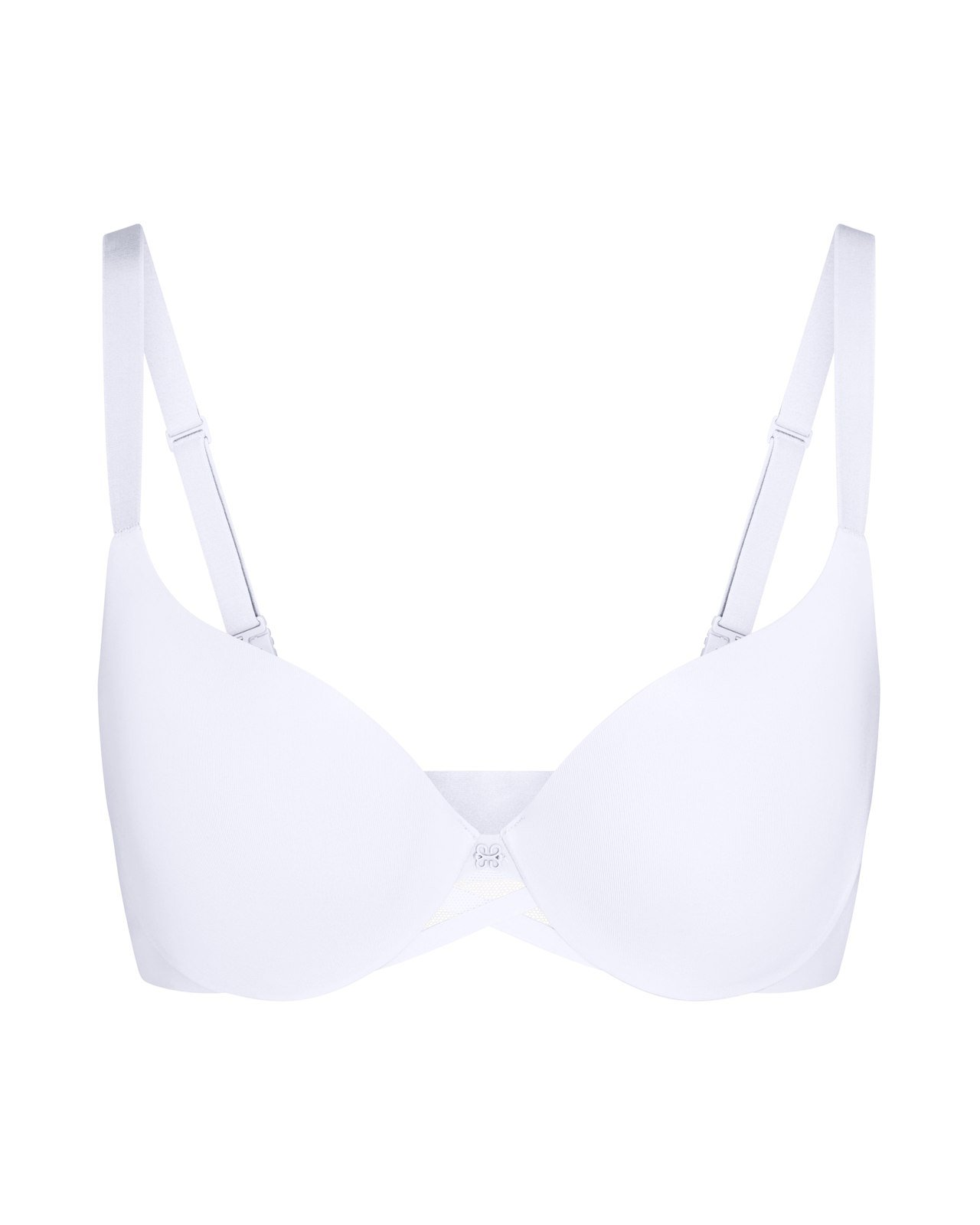
The letter records how far the bust measurement sits above the band. Because it is a difference, a D on a 30 band and a D on a 40 band share the same 4 inch gap but sit on very different frames.
Band Size Conversion for US/UK 28 to 46
| US / UK band | EU band | FR band | AU / NZ band | JP band |
|---|---|---|---|---|
| 28 | 60 | 75 | 6 | 60 |
| 30 | 65 | 80 | 8 | 65 |
| 32 | 70 | 85 | 10 | 70 |
| 34 | 75 | 90 | 12 | 75 |
| 36 | 80 | 95 | 14 | 80 |
| 38 | 85 | 100 | 16 | 85 |
| 40 | 90 | 105 | 18 | 90 |
| 42 | 95 | 110 | 20 | 95 |
| 44 | 100 | 115 | 22 | 100 |
| 46 | 105 | 120 | 24 | 105 |
The pattern holds in every row. UK equals US, EU rises 5 for each 2 inch step starting from US 32 = EU 70, FR is EU plus 15, AU and NZ is the US band minus 22, and JP matches EU.
One Body, Four Sizes: How Measuring Instructions Disagree
Take an underbust of 31 inches and a bust of 36.25 inches. ThirdLove uses exactly those numbers as its worked example and calls the result 34C. Apply the published rules of three other brands to the same two numbers and the label changes each time. The arithmetic below is an illustration worked out here, not a published statistic, and it is not a recommendation.
| Method | Band step | Cup step | Result |
|---|---|---|---|
| ThirdLove | 31 in falls in the 30.5 to 32.5 range | Band-specific table | 34C (its own worked example) |
| Bare Necessities (no add) | 31 rounds up to 32 | Bust 36.25 rounds up to 37; 37 – 32 = 5 | 32DD (or 32E) |
| PerfectDD (no add) | 31 rounds up to 32 | Bust rounds to 36; 36 – 32 = 4 | 32D |
| Honeylove (tiered add) | 31 is odd, add 5, band 36 | Bust 36 minus (31 + 2) = 3 | 36C |
The add-inches rule is where the paths split. Bare Necessities and PerfectDD add nothing and round an odd underbust up to the next even number. Honeylove adds 4 or 5 inches at the low end, then 2 or 3, then 0 or 1 as the underbust grows. La Vie en Rose maps 27 to 28 inches to a 32 band. ThirdLove’s band ranges work out to roughly 2.5 inches on the midpoint.
Littlewomen.com dropped the add-4 method altogether, calling it outdated, designed for rigid fabrics and narrow size ranges, and prone to producing a band that is too loose.
Tape position and tension are not settled either. Victoria’s Secret Thailand has readers measure the band above the bust, near where the straps meet the cups, while every other brand here puts the tape under the bust. For the bust measurement, ThirdLove’s chart page says the tape “fits snugly” while its blog says to measure loosely. Honeylove says somewhat loosely. Bare Necessities rounds up to whole inches, PerfectDD and Honeylove round to the nearest, and ThirdLove says not to round.
Sister Sizes: Same Cup Volume on a Different Band
The rule: one band down, one letter up
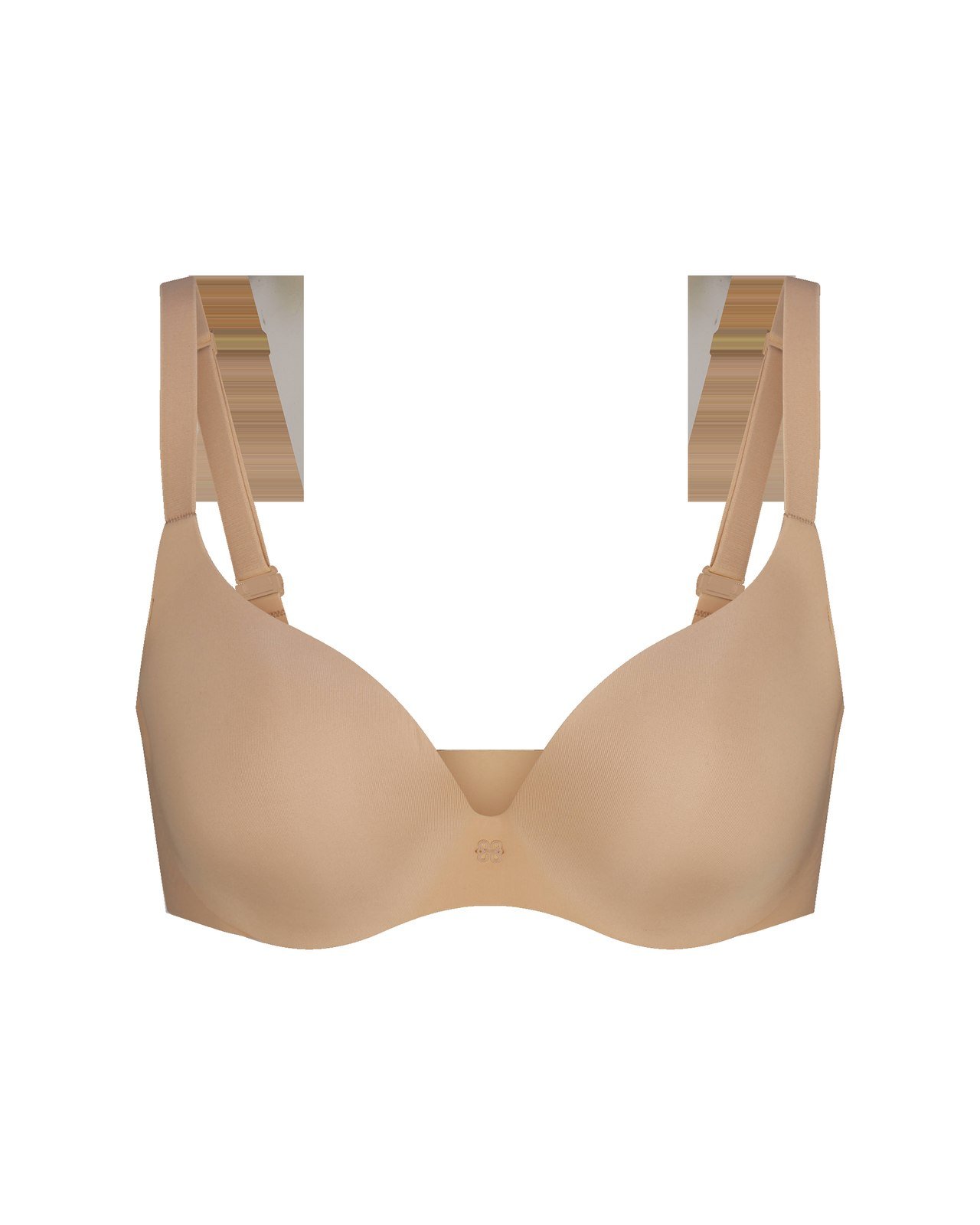
A sister size keeps the cup volume and changes the band. Go down one band size and up one cup letter for a tighter band, or up one band and down one letter for a looser one. Marks & Spencer gives the example that a 34C has the same cup volume as a 32D or a 36B, and Bravissimo, ThirdLove, Soma and Honeylove state the same rule.
Worked examples in US and UK lettering
- 34C: tighter 32D, looser 36B, then further along 30DD, 38A and 40AA in the Honeylove matrix.
- 36C: 38B and 40A at ThirdLove, or 34D, 32DD and 30E in US lettering.
- 40DD in UK lettering: 38E, 36F, 34FF, 32G and 30GG, from Bravissimo’s body text.
- 34FF in UK lettering: 32G for a tighter band, 36F for a looser one.
Sister sizes share cup capacity, not a tape reading. On the classic one-inch-per-letter rule a 34C implies a bust of 37 inches and a 36B a bust of 38, so each step along the chain moves the bust figure by about 1 inch. That is arithmetic shown here, not a published figure.
The equivalence is also approximate. A 2017 study by King and colleagues in Plastic and Reconstructive Surgery found that bras with narrower bands needed about 130 cc to move up a cup size and wider bands about 150 cc. The band carries the load by the brands’ account: Wacoal UK says the underband supports 90 percent of breast weight, while Soma and Curvy Australia say 80 percent. ThirdLove says the straps do about 10 percent of the work. These are brand statements, not measured values.
Where Bra Cup Letters Split Between the UK, US and EU
Letters A to D match across the US, UK, EU, Australian and Italian columns. At 5 inches the US prints DD or DD/E, the UK prints DD and the EU prints E. At 6 inches the US prints DDD or DDD/F, the UK prints E and the EU prints F. At 7 inches it is US DDDD/G, UK F and EU G.
The same printed letter therefore means different volume depending on the country. UK DD equals US DD and EU E, but UK E equals US DDD/F and EU F, and UK F equals US G and EU G. A UK F sits at a 7 inch gap, while a US F sits at 6, one cup lower.
US labels split too. Wacoal, Freya and Fantasie print DDD at 6 inches and then jump to G, so the Wacoal US row never shows an F. Bare Necessities, Bravissimo and Honeylove print DDD/F in that position. At 5 inches Wacoal, Honeylove and La Vie en Rose print DD where Bare Necessities and PerfectDD print DD/E, and Honeylove prints DDD/E in its sister-size matrix where its measuring table says DDD/F.
From 8 inches the US and EU columns agree letter for letter, with H, I, J, K and on to O, while the UK doubles letters. UK has FF at 8 inches, no I at all, then G, GG, H, HH, J, JJ and K. So US and EU H is UK FF, US and EU K is UK H, and US and EU M is UK J.
What Studies Found When Researchers Put Bras on Sizers
A Yale study published in Aesthetic Plastic Surgery in 2025 filled bras from seven manufacturers, sizes 36A to 36DD, with sizers and measured the volume. Cup volume differed significantly between manufacturers at every size, with the standard deviation rising from 30.9 cc at A to 122.8 cc at DD. At 36C and 36D, Wacoal ran larger than Hanes and Calvin Klein.
The King study tested five cup sizes from three brands and found an average step of about 135 cc between sizes. Its authors concluded that there is no standardization within the bra manufacturing industry. Both papers measured sizer volume, not people wearing the bras.
Studies of wearers use small groups. Wood and colleagues in 2008 studied 30 women with thoracic pain and found that 80 percent wore incorrectly sized bras, 70 percent too small and 10 percent too large. In a 2022 study by Haworth of 24 larger-breasted women without symptoms, all failed a bra-fit assessment in their usual bra and 67 percent still failed in a professionally fitted one.
Bra Fit Checks: Nine Signs and What Each Means

- The band rides up the back or moves: the band is probably too big, so go down a band size and possibly up a cup. M&S and Wacoal UK both say this. La Vie en Rose allows two fingers under the band on the middle hooks, and Curvy in Australia says a band that pulls out more than 3 inches means going down two band sizes.
- The band digs in or hurts: the band is too small, so go up a band and down a cup, which is the sister size.
- A new bra only fits on the tightest hooks: the band should feel snug on the loosest hooks, so there is room to tighten as it stretches. ThirdLove and Curvy in Australia say this.
- The cups spill over the top or sides, or the underarm bulges: the cup is too small, so go up a cup.
- The cups gape or wrinkle: the cup is too big, or the style does not suit the shape. M&S says a smaller cup might fit better, and ThirdLove reads puckering as cups that are too large.
- The centre gore lifts away from the breastbone: M&S and ThirdLove read cups that are too small, while Wacoal UK reads a wire sitting away from the chest as too big, so check the style as well as the size.
- The straps dig in or do all the work: the band is probably too big. M&S, La Vie en Rose and ThirdLove point to the band.
- The straps slide off: tighten them first. If that does not help, ThirdLove blames a cup that is too big and La Vie en Rose a band that is too big, and M&S adds that the style may be the cause.
- The underwire pokes or sits on breast tissue: the wire should lie flat against the breastbone below the tissue. Wacoal UK links poking to a cup that is too small, and ThirdLove says a cup that is too large can cause it too.
Measuring at Home and Reading the Result Against a Brand Chart
- Wear a non-padded bra and stand with the tape level all the way round, parallel to the floor.
- Measure the band directly under the bust, snug but not uncomfortable. Round to the even number your brand’s rule asks for.
- Measure the bust at its fullest point with the tape level, then subtract the band to get the gap in inches.
- Look the gap up in the cup grid above, then check the brand’s own table, since its letters at 5 inches and beyond may not match.
- If you land between sizes, try the neighbouring sister size before changing the cup.
Treat the tape as a starting point and use the fit checks above to settle it. Wacoal UK and Bare Necessities both recommend refitting every six months. For another size reference that depends on the maker and the label, see the ring size chart, and for a garment that is sized loosely on purpose, the oversized t-shirts for women.
Frequently Asked Questions
Is a bra size the same in every brand?
No. The Yale study found significant cup-volume differences between seven manufacturers at every size from 36A to 36DD, and the King study found an average step of about 135 cc between cup sizes. UK, US and EU letters also separate from DD upward, so the same label can mean a different cup.
What size is a US 32DD in the UK, EU, France, Australia and Japan?
It is a UK 32DD, EU 70E, French 85E, Australian 10DD and Japanese 70F. A US DD is a 5 inch gap, which is UK DD, EU E and JP F.
What if I am between sizes?
Bare Necessities rounds an odd underbust up, Honeylove rounds to the nearest inch and Wacoal Canada says not to round down. ThirdLove sells half cups instead. Try the sister size either side, such as 32D and 36B for a 34C.
How often do bra sizes change?
Wacoal UK recommends a fitting every 6 months, and Bare Necessities says the same. Weight change, breastfeeding and menopause can each shift the size.
Related Articles

Get the Fox Bulletin briefing
The stories that matter, in your inbox. No spam, unsubscribe anytime.
Newsletter signup will be available soon.
Related stories

Beer Types: 17 Styles Sorted by Ale and Lager Family
Every beer type sits on one side of a yeast line: ale yeast working warm, or lager yeast working cold. This page groups 17 styles by family and gives each its strength, bitterness, colour and origin, with Kolsch as the one style that straddles the line.
Cheese Types: 7 Classes and How to Spot Each One
Every cheese at the counter belongs to one of seven classes: fresh, soft-ripened, semi-soft, semi-hard, hard, blue or processed. This guide shows how to recognise each by feel, rind and age, with milk, moisture limits and ageing times for 16 familiar cheeses.
How Many Bones in the Human Body: 206, Region by Region
The adult human skeleton has 206 bones, and this page counts every one by region in a single chart. It then walks through the skull, spine, ribs, arms and legs, explains why babies have roughly 270 to 300 bones, and covers the longest and smallest bones and the extra bones some adults carry.