


The ASL alphabet is a set of 26 handshapes, one for each letter of the English alphabet, made with a single hand. Signers use it to fingerspell words that have no sign of their own: names of people and places, brands, titles and technical terms. It is the first part of American Sign Language most learners pick up, and the one that stays useful even if you learn nothing else.
Every handshape is shown below with a plain description of how the fingers sit. Two letters involve movement, six are variations on a closed fist, and several pairs differ only in which way the hand is pointing. Those are the three things that trip people up, so each gets its own section.
The Full ASL Alphabet, A to Z
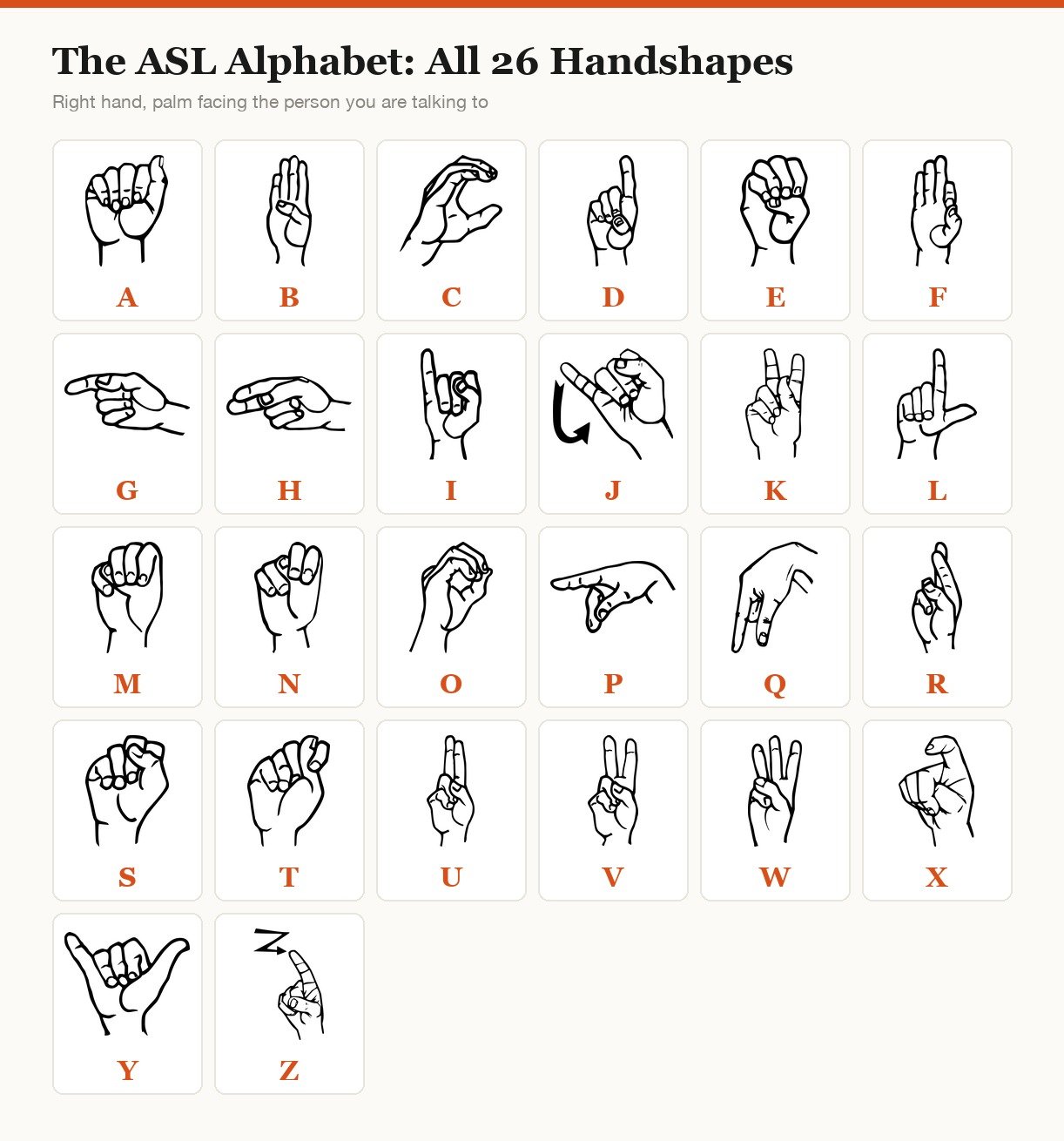
Hold your dominant hand up at about chest height with the palm facing the person reading you. Keep the hand still: in fingerspelling the hand stays in one place and only the fingers change.
| Letter | How the hand is formed |
|---|---|
| A | Closed fist, thumb flat against the side of the index finger |
| B | Flat hand, four fingers straight up and together, thumb folded across the palm |
| C | Whole hand curved into the shape of the letter, fingers together |
| D | Index finger straight up, the other three fingertips meeting the thumb |
| E | Fingers curled down so the fingertips rest on the thumb |
| F | Index finger and thumb touch to make a circle, other three fingers straight up |
| G | Index finger and thumb extended parallel, hand turned to point sideways |
| H | Index and middle fingers extended together, hand turned to point sideways |
| I | Little finger straight up, the rest closed into a fist |
| J | Little finger up, then traced downwards and hooked to the left |
| K | Index finger up, middle finger angled out, thumb pressed between the two |
| L | Index finger up and thumb out at a right angle |
| M | Thumb tucked under the index, middle and ring fingers |
| N | Thumb tucked under the index and middle fingers only |
| O | Fingers and thumb curve together to close a round shape |
| P | The K handshape rotated so the middle finger points at the floor |
| Q | The G handshape rotated so index and thumb point at the floor |
| R | Index and middle fingers crossed over each other |
| S | Closed fist with the thumb crossing the front of the fingers |
| T | Fist with the thumb pushed up between the index and middle fingers |
| U | Index and middle fingers straight up, held together |
| V | Index and middle fingers straight up, spread apart |
| W | Index, middle and ring fingers up, thumb holding the little finger down |
| X | Index finger raised and bent into a hook |
| Y | Thumb and little finger extended, the three middle fingers closed |
| Z | Index finger extended and drawn through the shape of a Z in the air |
Left-handed signers use their left hand throughout. What matters is consistency, not which hand, because a reader follows the shape rather than the side.
Six Letters That Are All a Closed Fist
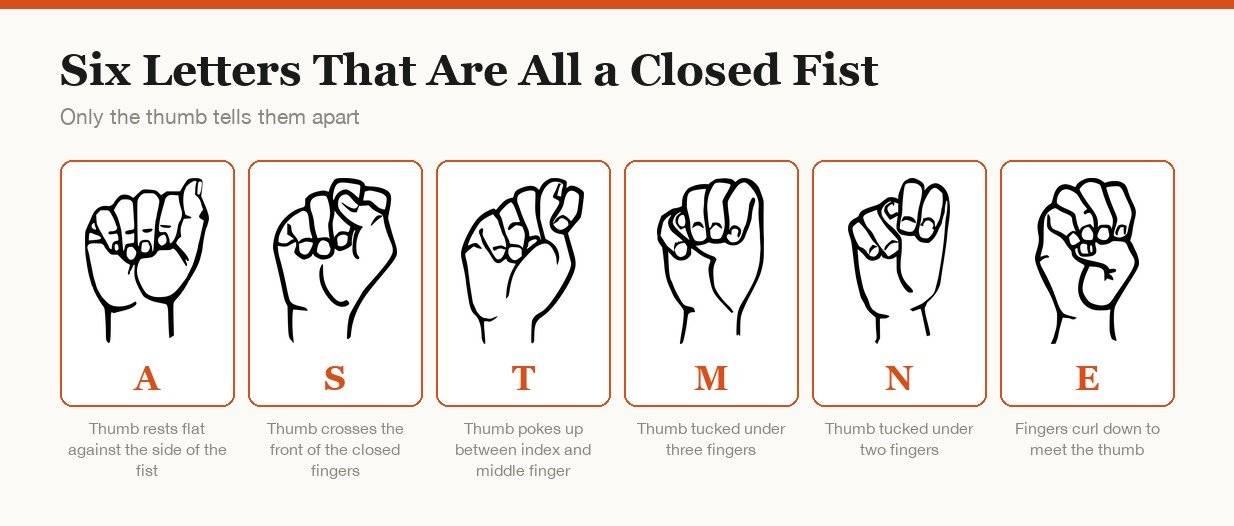
A, S, T, M, N and E all start from a closed hand. The thumb is the only thing that separates them, which is why beginners read them as the same letter and why experienced signers make the thumb deliberately visible.
- A. Thumb lies flat along the outside of the index finger.
- S. Thumb crosses the front of the closed fingers.
- T. Thumb pushes up between the index and middle fingers.
- M. Thumb is tucked under three fingers.
- N. Thumb is tucked under two fingers.
- E. Fingers curl down and rest on top of the thumb.
A useful habit is to turn the hand slightly outward on these six so the thumb is not hidden behind the knuckles. The difference between M and N is two fingers against three, and from the front at a bad angle that is almost nothing.
J and Z, the Only Two Letters That Move
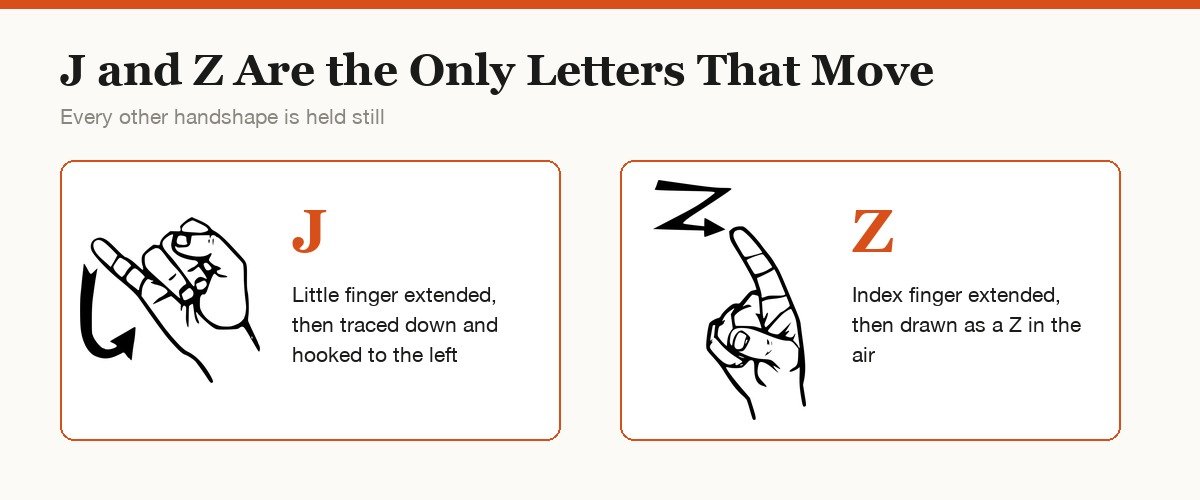
Twenty-four letters are static shapes. J and Z are traced, which makes them the only two that cannot be captured in a single still photograph.
- J. Start in the I handshape with the little finger up, then draw the finger down and hook it towards your own left. The path is the shape of the letter.
- Z. Start with the index finger extended and draw a Z in the air, three strokes, moving away from your body.
Because they take longer than the other letters, J and Z are the usual place a fast fingerspelled word slows down, which is a helpful cue when you are reading rather than signing.
Letter Pairs That Get Mixed Up
Most reading mistakes come from six pairs. Learn what separates each one and the rest of the alphabet becomes much easier to follow at speed.
| Pair | What tells them apart |
|---|---|
| G and Q | Same handshape. G points sideways, Q points down at the floor. |
| K and P | Same handshape. K points up, P points down. |
| U and V | Both are two fingers up. U keeps them touching, V spreads them. |
| D and F | D has one finger up and three down. F has three up and a circle below. |
| I and Y | I is the little finger alone. Y adds the thumb. |
| M and N | Count the fingers over the thumb: three for M, two for N. |
Orientation does the work in half of these. G, H, K and P are the same shapes as each other in two positions, so if a letter looks wrong, check which way the fingers are pointing before deciding you have misread the shape.
When Signers Actually Fingerspell
Fingerspelling is part of ASL rather than a substitute for it. The National Institute on Deafness and Other Communication Disorders describes it as the part of the language used to spell out English words, with each letter matched to a distinct handshape, and it is used mostly for proper names or to give the English word for something.
- Names of people and places. There is no sign for a stranger’s surname, so it gets spelled, which is why learners practise on common last names first.
- Brands and titles. Company names, film titles and product names are spelled out.
- Words with no established sign. New technical vocabulary arrives spelled before a sign settles on it.
- Emphasis and clarification. A signer may spell a word to be precise about which English term they mean.
- Lexicalised signs. Some spelled words have worn down into signs of their own, where a few letters are kept and the rest are dropped.
A regular ASL conversation is not spelled. Fingerspelling is threaded through signing in short bursts, usually a few words at a time, in the way a speaker might spell an unusual name aloud mid-sentence.
How to Practise Without a Partner
- Learn the fist group first. A, S, T, M, N and E together, so the differences are obvious from the start rather than confusing later.
- Add the pointing pairs. G with Q, K with P, U with V.
- Spell what is in front of you. Street signs, the spines of books, number plates.
- Spell your own name until it is automatic. It is the first thing anyone asks for.
- Practise reading, not just signing. Reading someone else’s hand is the harder half and the one people skip.
Speed comes last. Accuracy at a slow pace reads perfectly well; a fast hand with a sloppy thumb does not, which is the same trade every spelling convention makes, from the military alphabet used on radio to the plain labels in our guide to USB types.
The ASL Alphabet Is Not Universal
There is no single worldwide sign language. British Sign Language is a different language from ASL, and its alphabet is two-handed rather than one-handed, so an American signer and a British signer cannot simply fingerspell at each other. Some countries have adopted features of ASL into their own sign languages, which makes for partial overlap rather than mutual intelligibility.
ASL itself was not invented by any one person or committee. It is thought to have emerged more than 200 years ago from local sign languages mixing with French Sign Language, and modern ASL and modern French Sign Language are now distinct enough that their users cannot understand each other. It is a complete natural language with its own grammar, word order and regional accents, which is worth keeping in mind when comparing it against the most spoken languages in the world.
Nine out of ten children born deaf are born to parents who hear, so for most families ASL is learned rather than inherited, often by the parents alongside the child. That is one reason the alphabet gets taught first: it is the part of the language a beginner can use correctly within a week.
Frequently Asked Questions
How long does it take to learn the ASL alphabet?
Most people can form all 26 handshapes within a few days and spell slowly within a week. Reading someone else fingerspelling at conversational speed takes considerably longer, usually months of regular practice.
Which hand should you use for the ASL alphabet?
Your dominant hand, and the same one every time. Right-handed signers use the right, left-handed signers use the left. Swapping mid-word is what makes spelling hard to read.
Is the ASL alphabet the same as British Sign Language?
No. ASL fingerspelling uses one hand and BSL uses two, and the two languages are unrelated. Someone fluent in ASL will not understand BSL fingerspelling without learning it separately.
Do you need facial expressions when fingerspelling?
Facial expression carries grammar in ASL, including how questions are marked, but the alphabet itself is made entirely with the hand. Keeping a neutral face while spelling is fine.
Related Articles

Get the Fox Bulletin briefing
The stories that matter, in your inbox. No spam, unsubscribe anytime.
Newsletter signup will be available soon.
Related stories
Birth Flowers by Month: All 12 and What They Mean
Every month has a birth flower, and most have two. Here are all twelve, the meanings attached to them, and why most months ended up with two flowers instead of one.

Types of Pasta: 25 Shapes and What Each One Suits
Long strands, tubes, twists and soup shapes: 25 types of pasta shown and named, with the cooking time for each and the kind of sauce its surface is built to hold.
Mattress Sizes: All Six Standard Beds, Measured
Twin through California King, measured in inches and square feet, with the room each size needs and the gap between the size on the label and the mattress that turns up.