

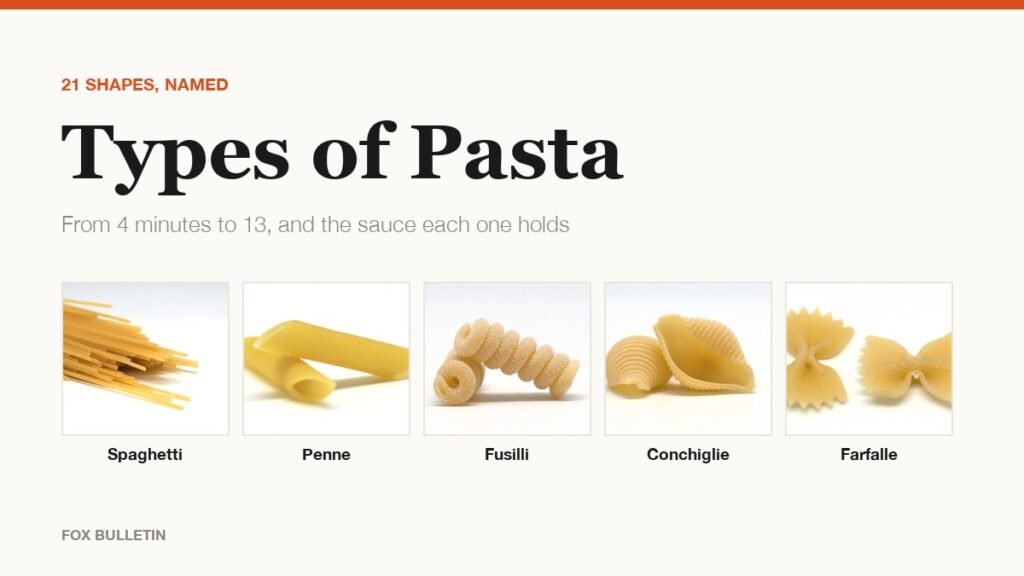
There are hundreds of named types of pasta, and almost all of them fall into four groups: long strands and ribbons, short tubes, twisted or folded shapes, and the tiny shapes made for soup. Once you can place a shape in its group, what to do with it follows, because the group is really a description of how much sauce the surface can hold.
Below are 25 shapes photographed and named, the family each belongs to, how long each takes to cook, and the sauces each is built for. Cooking times run from four minutes for angel hair to thirteen for rigatoni, which is a wider spread than most people expect.
Long Pasta: Strands, Ribbons and Sheets

Long shapes are judged by thickness and by whether the cross-section is round or flat. A round strand sheds a heavy sauce; a flat ribbon carries it.
- Spaghetti. The round reference point, named from the Italian for lengths of cord. It takes almost any sauce, from plain tomato to carbonara.
- Bucatini. Spaghetti with a hole down the middle, so sauce travels inside the strand as well as around it.
- Linguine. Flattened into a narrow oval. Traditionally the shape for pesto, and a standard for seafood.
- Fettuccine. A flat ribbon roughly a quarter inch wide, wide enough for cream and butter sauces to stay put.
- Tagliatelle. The northern Italian ribbon, slightly narrower than fettuccine and the traditional partner for a long-cooked meat ragu.
- Pappardelle. The widest ribbon of all, built for sauces with large pieces in them.
- Lasagne. Flat sheets, layered rather than tossed.
The rule that holds across this group: the thinner the strand, the lighter the sauce. Angel hair under a heavy ragu turns into a clump, and pappardelle under a thin oil sauce has nothing to carry.
Tube Pasta: Shapes With a Hole

Tubes trap sauce inside as well as outside, which doubles the surface in contact with it. Ridges, marked rigate on an Italian packet, add more grip again.
- Penne. Cut on the diagonal and usually ridged. The large diameter and the ridges are what let it hold sauce across the whole surface.
- Rigatoni. Wider than penne, cut straight, always ridged. The shape for the heaviest meat sauces, and the slowest to cook at 12 to 13 minutes.
- Tortiglioni. Rigatoni with the ridges twisted into a spiral down the tube.
- Ziti. Smooth and straight, traditionally snapped before cooking. Best with light tomato or olive oil, and the backbone of baked ziti, which fits a countertop toaster oven as easily as a full oven.
- Paccheri. Very large smooth tubes that collapse slightly when cooked, often stuffed rather than sauced.
- Sedani. A slightly curved ridged tube, named for celery stalks.
- Elbow macaroni. The short curved tube behind macaroni cheese and most pasta salad.
- Ditalini. Tiny thimbles, used in the bean soup pasta e fagioli rather than sauced.
Twists, Spirals and Shells

This family exists for one reason: folds and spirals physically hold onto sauce that a smooth surface would shed. They are the most forgiving shapes to cook because a slightly soft twist still looks right.
- Fusilli. A tight corkscrew. The version with a hollow centre is sold as fusilli bucati.
- Cavatappi. A wide hollow corkscrew, sold under the trade name Cellentani. The hollow plus the spiral makes it one of the best shapes for thick cheese sauces.
- Casarecce. A short rolled length with a groove down the middle, from Sicily.
- Trofie. Thin hand-rolled twists from Liguria, the traditional pesto shape alongside linguine.
- Farfalle. Pinched in the centre into a bow. The pinch stays firm while the wings go soft, which gives the shape two textures at once.
- Conchiglie. Shells, which work as scoops. The large ones are stuffed and baked.
- Radiatori. Short ruffled shapes with a comb of ridges, designed specifically to hold thick sauce.
- Rotelle. Wheels with spokes, mostly used in cold salads where the shape stays visible.
Small Pasta for Soup

Soup pasta, pastina in Italian, is any shape small enough to be eaten with a spoon. It is cooked in the broth rather than drained.
- Orzo. Shaped like a large grain of rice. It also works in place of arborio rice in a risotto, and in cold salads.
- Stelline. Tiny stars, the classic childrens soup pasta.
- Ditalini and acini di pepe cover the same ground at slightly larger and smaller sizes.
Cooking Times From Four Minutes to Thirteen
Shape decides cooking time far more than brand does, and the spread is wide enough to ruin a dish if you swap one shape for another and keep the timer. These are the times Barilla prints for each shape in its standard range, ordered fastest to slowest.
| Shape | Family | Minutes | What it suits |
|---|---|---|---|
| Angel hair | Long | 4 to 5 | Light, delicate sauces |
| Pastina | Soup | 6 to 7 | Broth and childrens soup |
| Thin spaghetti | Long | 6 to 7 | Oil and tomato sauces |
| Elbow macaroni | Tube | 7 to 8 | Macaroni cheese and pasta salad |
| Mini farfalle | Shape | 7 to 8 | Light vegetable sauces |
| Rotini | Shape | 7 to 8 | Refined and simple sauces alike |
| Medium shells | Shape | 8 to 9 | Pasta salad and baked dishes |
| Pipette | Shape | 8 to 9 | Macaroni cheese and salads |
| Linguine | Long | 9 to 10 | Pesto, then seafood |
| Orzo | Soup | 9 to 10 | Soup, salad or in place of risotto rice |
| Spaghetti | Long | 9 to 10 | Almost anything, including carbonara |
| Campanelle | Shape | 10 to 11 | Cheese and bechamel sauces |
| Ditalini | Tube | 10 to 11 | Pasta e fagioli and other bean soups |
| Mezzi rigatoni | Tube | 10 to 11 | Chunky meat and vegetable sauces |
| Mostaccioli | Tube | 10 to 11 | Olive oil and fresh tomato |
| Cavatappi | Shape | 11 to 12 | Thick sauces that catch in the spiral |
| Penne | Tube | 11 to 12 | Sauces that cling to a ridged surface |
| Ziti | Tube | 11 to 12 | Light tomato, and baked dishes |
| Gemelli | Shape | 12 to 13 | Refined and simple sauces alike |
| Rigatoni | Tube | 12 to 13 | The heaviest meat ragus |
Two practical consequences. Soup shapes and angel hair are finished before a sauce reheats, so start the sauce first. Rigatoni and gemelli need thirteen minutes, which is long enough to make a sauce from scratch while they boil.
Matching a Shape to a Sauce
- Thin oil sauces want thin long shapes: spaghetti, thin spaghetti, angel hair.
- Pesto and other thick coatings want flat or twisted shapes: linguine, trofie, fusilli.
- Cream and cheese want ridges and hollows: cavatappi, penne rigate, shells.
- Chunky meat ragu wants wide tubes or wide ribbons: rigatoni, paccheri, pappardelle.
- Soup wants anything you can eat with a spoon: orzo, ditalini, stelline.
- Cold salad wants shapes that keep their outline: farfalle, rotelle, elbows.
The underlying principle is surface area against sauce weight. A heavy sauce needs somewhere to sit, and a light one needs a shape that will not swamp it.
What Dried Pasta Is Made Of
Standard Italian dried pasta is semolina and water. Semolina is milled from durum wheat, which is harder than the wheat used for bread flour, and that hardness is what lets a shape hold its edges through boiling.
Fresh pasta is a different product rather than a better one. It usually contains egg, cooks in two to four minutes, and suits delicate butter and cream sauces. Dried semolina pasta holds up to heavier sauces and is the correct choice for most of the shapes above.
Bronze-drawn pasta, sold as trafilata al bronzo, is extruded through bronze dies rather than teflon. The rougher surface it produces grips sauce noticeably better, which matters most on smooth shapes like ziti where there are no ridges doing that job.
Boiling, Salting and Draining
Shape and sauce decide most of the result, but a few mechanical points change how any of these shapes turn out.
- Use enough water. Roughly four quarts per pound. Too little and the starch concentration rises, the water stops boiling when the pasta goes in, and the shapes stick.
- Salt the water, not the pasta. It is the only point at which the pasta itself gets seasoned, and a sauce cannot put salt back inside a cooked tube.
- Start from a hard boil. Bringing four quarts up on a hob is slow, so pouring in water already boiled in an electric kettle saves several minutes.
- Set the timer short. Take a minute off the packet time and taste. Pasta finished in the sauce keeps cooking after it leaves the water.
- Keep a cup of the water. The starch in it is what binds a sauce to the shape, and it is gone the moment you drain into the sink.
Oil in the water is the one piece of common advice worth ignoring. It floats on the surface, does nothing to stop sticking, and coats the shapes on the way out so the sauce slides off whatever grip the ridges were supposed to give.
Frequently Asked Questions
How many types of pasta are there?
Several hundred named shapes exist, with regional names for near-identical ones. The 25 above cover what is sold in most supermarkets, and every one of them belongs to one of four families: long, tube, shaped or soup.
What is the difference between penne and ziti?
Penne is cut on the diagonal and usually ridged. Ziti is cut straight across and smooth. Penne holds more sauce on its surface; ziti is better in baked dishes where the sauce surrounds it anyway.
Which pasta shape is best for thick sauce?
A wide ridged tube or a hollow spiral. Rigatoni and cavatappi both hold thick sauce inside and outside at once, which is why they are used for ragu and for cheese sauces.
What does rigate mean on a pasta packet?
Ridged. Penne rigate is ridged penne, and penne lisce is the smooth version. The ridges exist to hold sauce, so rigate is the safer choice with anything thicker than olive oil.
Related Articles

Get the Fox Bulletin briefing
The stories that matter, in your inbox. No spam, unsubscribe anytime.
Newsletter signup will be available soon.
Related stories

Birth Flowers by Month: All 12 and What They Mean
Every month has a birth flower, and most have two. Here are all twelve, the meanings attached to them, and why most months ended up with two flowers instead of one.
Mattress Sizes: All Six Standard Beds, Measured
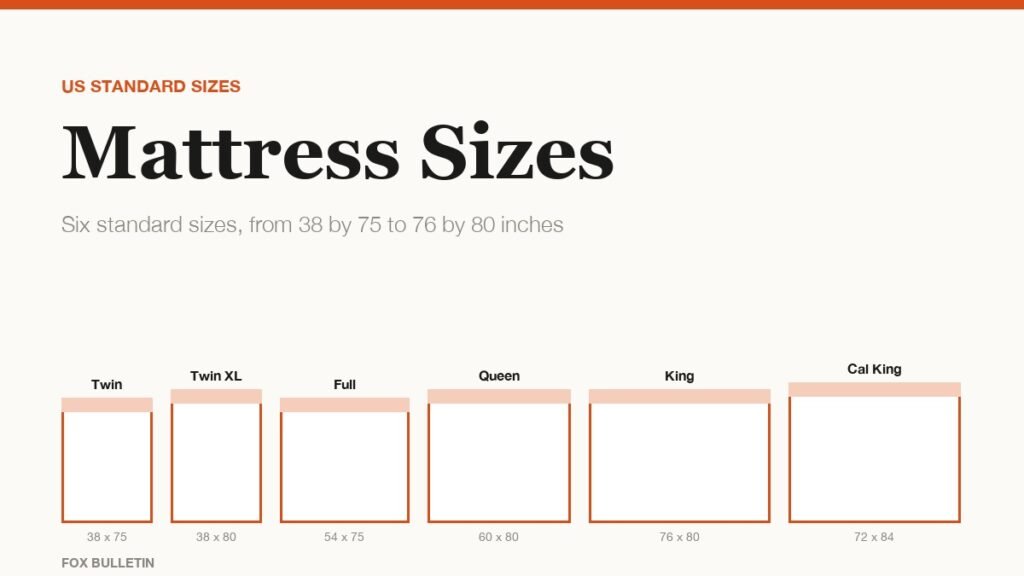
Twin through California King, measured in inches and square feet, with the room each size needs and the gap between the size on the label and the mattress that turns up.

ASL Alphabet: All 26 Hand Signs and How to Form Them
The ASL alphabet is 26 handshapes made with one hand. This guide shows every letter, explains the six that are all variations of a fist, and covers the two that need movement.