
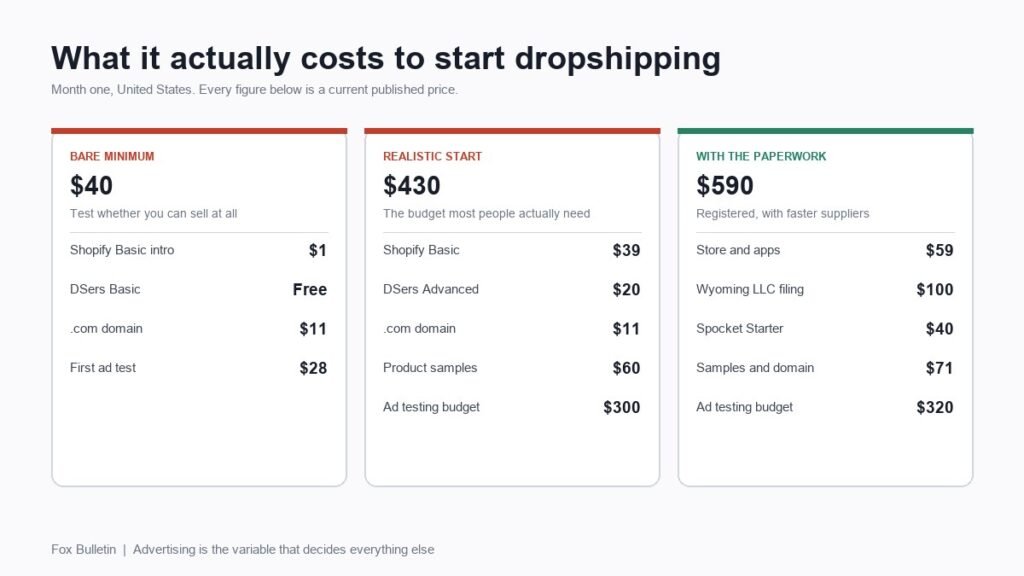
You can open a functioning dropshipping store for about $40 in the first month. You can also spend $3,000 and never make a sale. Both statements are true, and the gap between them is the single most useful thing to understand before you spend anything, because it is not the software that decides which end you land on.
The fixed costs of this business are small, published and easy to look up. The variable cost, advertising, is unbounded and is where almost all the money goes. This guide separates the two, prices every fixed item from the vendor’s current page, and gives three honest budgets rather than one optimistic number.
What Starting a Dropshipping Store Costs in Month One
| Item | Bare minimum | Realistic start | With the paperwork |
|---|---|---|---|
| Store platform | $1 intro month | $39 | $39 |
| Supplier app | Free | $20 | $20 |
| Domain name | $11 | $11 | $11 |
| Product samples | Skipped | $60 | $60 |
| Faster supplier network | Skipped | Skipped | $40 |
| LLC registration | Skipped | Skipped | $100 |
| Advertising test budget | $28 | $300 | $320 |
| Month one total | $40 | $430 | $590 |
Notice what dominates the middle and right columns. Advertising is 70% of the realistic budget and 54% of the registered one. Everything else combined is less than the ad spend, which is why treating this as a software-cost question gives the wrong answer.
The Fixed Costs You Cannot Design Around
Three things are genuinely unavoidable, and all three have published prices.
- A store platform. Shopify’s pricing page lists Basic at $39 a month billed monthly or $29 billed annually, with an introductory offer of three days free and then $1 a month for three months. That intro offer is why the bare-minimum column reads $1 rather than $39.
- A domain name. A .com is $11.08 a year to register and renew at Porkbun, and Cloudflare Registrar sells at cost with no markup at all. Registrars that advertise a $1 first year usually renew far higher, so compare the renewal price rather than the first year.
- A supplier app. DSers has a genuinely usable free tier covering three stores, 3,000 products, one supplier account, bulk ordering and automatic tracking sync. Its Advanced plan is $19.90 a month, and the free plan is enough to find out whether you can sell anything.
That is $50 a month at the realistic end and close to $12 if you use the Shopify intro offer and the free DSers tier. The software is not what makes this business expensive.
Costs That Are Optional Until Suddenly They Are Not
These four are skippable on day one and become necessary at fairly predictable points.
- Product samples, roughly $20 to $30 each. Skip them and you are selling something you have never seen, which is how stores end up with refund rates that destroy the margin. Budget for two or three.
- A faster supplier network, from $39.99 a month. Spocket connects to suppliers in the United States and Europe rather than Asia. You do not need it while you are testing. You need it the moment delivery times start generating refund requests.
- Business registration, $100 in Wyoming. The state’s official fee schedule puts LLC Articles of Organization at $100 with a $60 minimum annual report thereafter. Other states differ considerably, and our guide to LLC formation services covers who files it for you and at what cost.
- Email and apps, $0 to $50 a month. Review widgets, upsell apps and email tools are where subscription creep happens. None of them create demand that was not already there.
Advertising Is the Budget, Everything Else Is Rounding
A new dropshipping store has no traffic. No search rankings, no email list, no returning customers, no brand anyone has heard of. Traffic has to be bought, and buying it is the experiment.
The reason a meaningful test costs $300 rather than $30 is that advertising platforms need data before they perform. A few dollars a day produces too few conversions for the system to learn from and too small a sample for you to draw any conclusion. You are not buying sales with that first $300. You are buying the information about whether the product, the price and the audience work together at all, and a large share of tests come back negative, which is a useful answer rather than a wasted month.
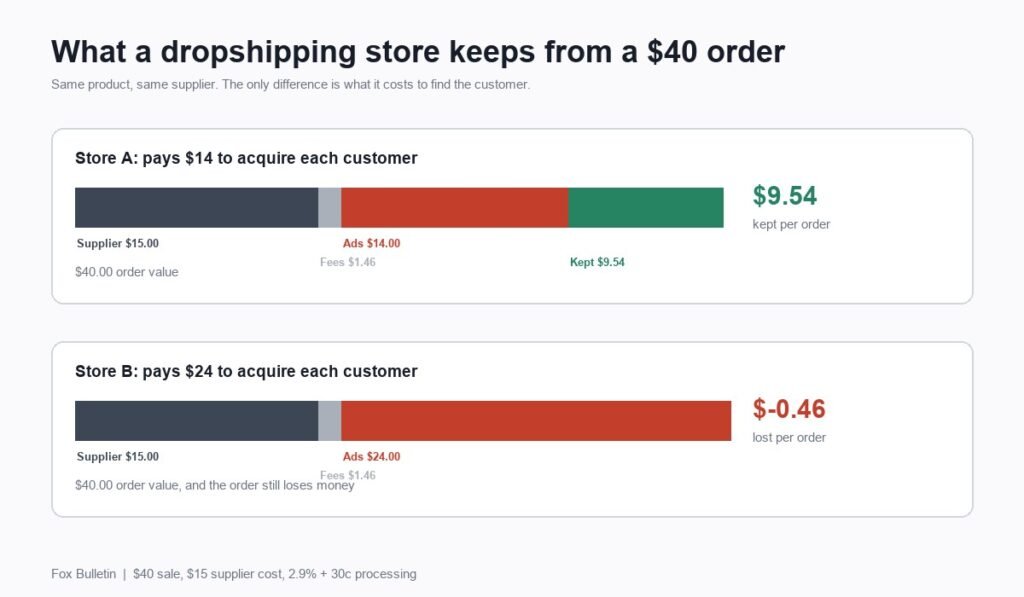
Work the arithmetic before you spend it. If your product sells for $40 and costs $15 delivered, with roughly $1.46 going to card processing at the common 2.9% plus 30 cents rate, you have about $23.50 to spend acquiring each customer before you break even. If your ads cost $28 per sale, the store loses money on every order no matter how many it takes. Our explainer on how dropshipping works goes through that margin calculation in full.
Can You Start Dropshipping With No Money At All?
Almost, but the version that is genuinely free is a different business from the one people imagine.
The free route is to sell on a marketplace rather than your own store, or to build an audience organically on short-form video and sell to it. Both remove the platform fee and the ad budget. Neither removes the work: organic traffic is paid for in months of content rather than dollars, and marketplaces take a cut of every sale plus impose their own rules.
- What can be genuinely free: a marketplace listing, a DSers Basic account, organic social traffic, and a supplier who does not charge for access.
- What cannot: product samples, a domain if you want your own brand, and time, which is the real currency in the organic version.
The honest framing is that you can start with almost nothing and you cannot scale with nothing. Stores that grow reinvest early profit into ads, and the ones that never spend anything stay very small.
What It Costs Every Month After the First One
Startup cost is the question people ask. Monthly cost is the one that decides whether the store survives, because it is the number your margin has to clear before you have earned anything.
- Store platform, $29 to $39. The $1 introductory rate ends after three months, and Basic reverts to $39 billed monthly or $29 if you commit annually.
- Supplier app, $0 to $19.90. DSers Basic stays free indefinitely. The Advanced plan becomes worth it when you pass its store and product limits rather than on a schedule.
- Domain, about $0.92 a month. An $11.08 annual renewal, spread across the year.
- Faster suppliers, $39.99 upward. Only once slow delivery is costing you refunds.
- Card processing, 2.9% plus 30 cents per order. Not a subscription, but it scales directly with revenue and comes out of the same margin.
A store running Shopify Basic and free DSers carries roughly $40 a month in fixed costs. At a $9 net profit per order, that is about five orders a month purely to cover the overhead, before the business has paid you anything. Adding Spocket takes it to roughly $80 a month, or nine orders. Those are the real breakeven numbers, and they are worth writing down before adding any optional app.
Where Beginners Reliably Waste Money
Every one of these is avoidable, and all of them are common.
- Buying a done-for-you store. Packages selling a pre-built store for several hundred dollars deliver a theme and a product list you could assemble in an afternoon, with no traffic attached.
- Paying for a course before making a sale. The information in most courses is the same information in vendor documentation. Spend the money on ad testing instead, where at least the outcome is data about your own product.
- Starting on the Grow or Advanced plan. Shopify’s higher tiers lower the card rate, which is worthless at zero sales. Start on Basic and move up when transaction volume makes the maths work.
- Stacking apps before launch. Ten apps at $10 a month is $1,200 a year, spent on features for customers you do not have yet.
- Using a third-party payment gateway on Basic. Shopify adds 2% on top of the processor’s own fee on the Basic plan. On dropshipping margins, that is a meaningful slice for no benefit.
One more cost belongs on this list rather than in a footnote. Getting registered, keeping the money separate and understanding your tax position is cheap at the start and expensive to fix later, which our guide to dropshipping legality and tax covers in detail.
Frequently Asked Questions
How much does it cost to start dropshipping realistically?
Around $400 to $600 for a first month that gives the business a fair test. About $50 of that is software and a domain, $60 buys product samples, and the rest is the advertising budget you need to generate enough data to judge whether the product works. Spending only on software and skipping the ad budget produces a store with no visitors.
What is the cheapest way to start a dropshipping store?
Take Shopify’s introductory offer of $1 a month for three months, use the free DSers Basic plan, register a .com for about $11 a year, and put everything else into a small ad test. That brings month one to roughly $40. The trade-off is that you are selling products you have not sampled, which raises your refund risk.
Do you need an LLC before you start dropshipping?
No. You are a sole proprietor by default and that is lawful. An LLC costs $100 to file in Wyoming with a $60 minimum annual report, and other states vary. Most sellers form one once revenue justifies it, since its value is liability separation rather than permission to trade.
How long before a dropshipping store makes money?
Plan on the first months costing money rather than making it. Early advertising spend is buying information about which products and audiences convert, and most tested products fail. Stores that reach consistent profit usually do so after several rounds of testing, not from the first product they list.
Related Articles
- Best Payment Processors for Small Business
- Shopify Dropshipping: Setting Up a Store That Takes Orders
- Amazon Dropshipping: The Policy, the Fees and What Gets You Suspended
- How to Start Dropshipping: The Nine Steps in the Right Order
- Dropshipping Niches: How to Choose One You Can Actually Advertise
- Is Dropshipping Profitable? The Numbers Behind the Answer

Get the Fox Bulletin briefing
The stories that matter, in your inbox. No spam, unsubscribe anytime.
Newsletter signup will be available soon.
Related stories
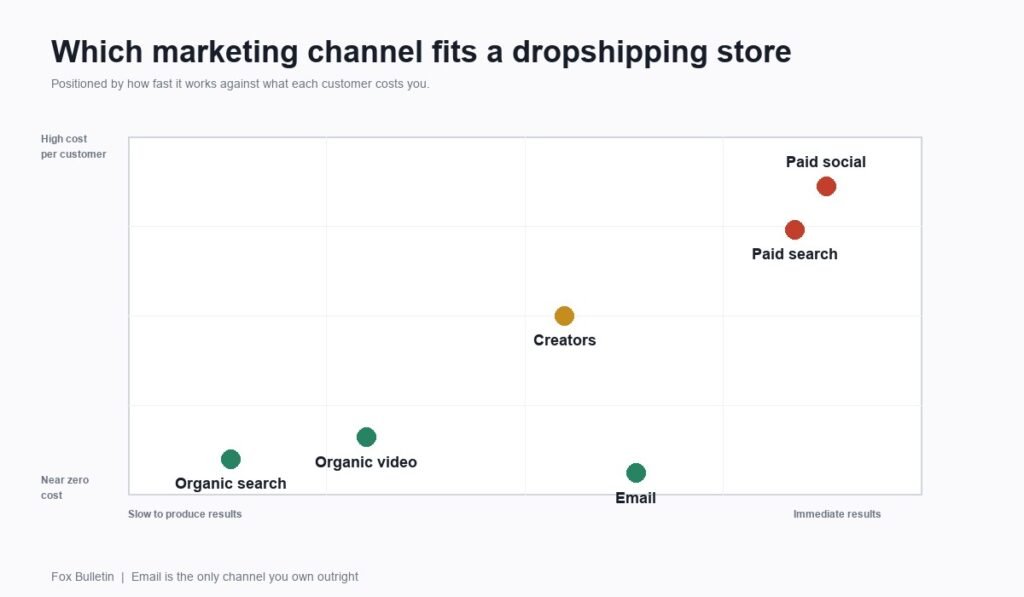
Dropshipping Marketing: The Numbers That Decide Every Channel
Dropshipping marketing is arithmetic, not creativity. The two numbers that decide everything, what each channel costs and delivers, and why scaling is usually an order-value problem.
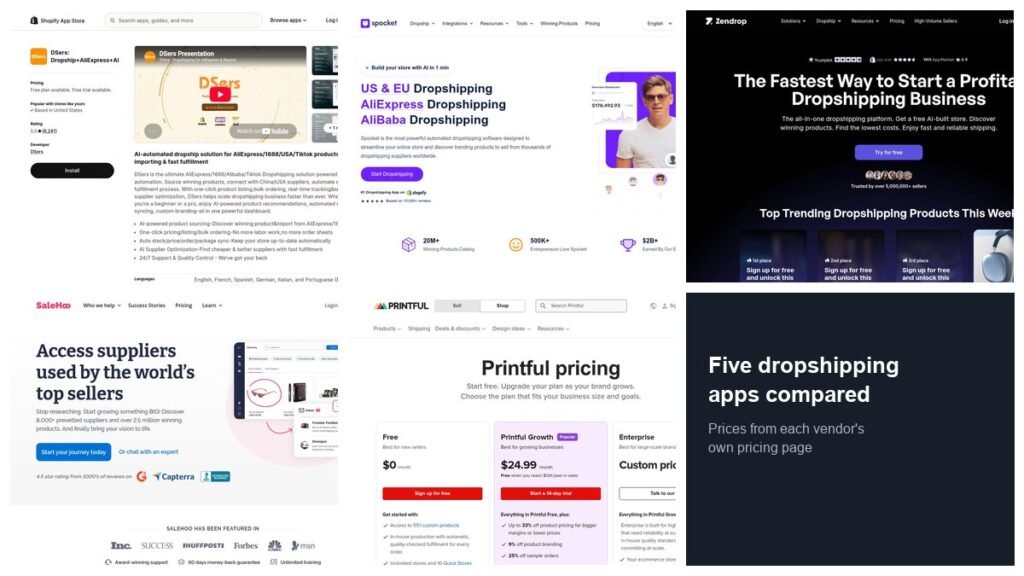
Dropshipping Apps: What Each One Does and What It Costs
Dropshipping apps do four different jobs and most stores need one, not four. Five apps compared on current pricing, what each is actually for, and how many you really need.
Is Dropshipping Profitable? The Numbers Behind the Answer
Dropshipping is profitable and most dropshipping stores are not. The margin arithmetic that decides which, what stores really earn, the costs that eat it, and the four levers that fix it.