

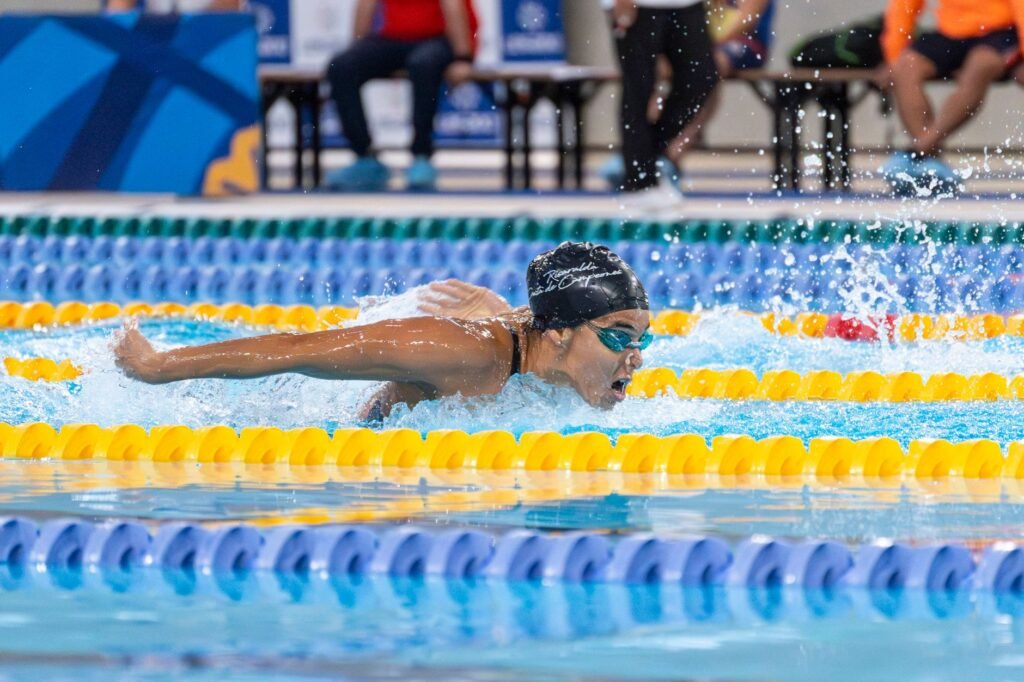
Michael Phelps has won 23 Olympic gold medals, more than double the tally of anyone else in history. The gap between first and second place on this list is the largest in any major sporting record.
Second place changed hands in 2026. Johannes Høsflot Klæbo swept all six cross-country skiing events at the Milan Cortina Winter Games, lifting his career total to 11 golds and moving him past every Olympian except Phelps. Below are all 19 athletes who have won eight or more Olympic gold medals.
| Rank | Athlete | Country | Sport | Gold | Total Medals |
|---|---|---|---|---|---|
| 1 | Michael Phelps | United States | Swimming | 23 | 28 |
| 2 | Johannes Høsflot Klæbo | Norway | Cross-country skiing | 11 | 13 |
| 3 | Larisa Latynina | Soviet Union | Gymnastics | 9 | 18 |
| 3 | Katie Ledecky | United States | Swimming | 9 | 14 |
| 3 | Paavo Nurmi | Finland | Athletics | 9 | 12 |
| 3 | Mark Spitz | United States | Swimming | 9 | 11 |
| 3 | Caeleb Dressel | United States | Swimming | 9 | 10 |
| 3 | Carl Lewis | United States | Athletics | 9 | 10 |
| 9 | Marit Bjørgen | Norway | Cross-country skiing | 8 | 15 |
| 9 | Ole Einar Bjørndalen | Norway | Biathlon | 8 | 14 |
| 9 | Isabell Werth | Germany | Equestrian | 8 | 14 |
| 9 | Bjørn Dæhlie | Norway | Cross-country skiing | 8 | 12 |
| 9 | Birgit Fischer | Germany | Canoeing | 8 | 12 |
| 9 | Sawao Kato | Japan | Gymnastics | 8 | 12 |
| 9 | Jenny Thompson | United States | Swimming | 8 | 12 |
| 9 | Matt Biondi | United States | Swimming | 8 | 11 |
| 9 | Lisa Carrington | New Zealand | Canoeing | 8 | 9 |
| 9 | Usain Bolt | Jamaica | Athletics | 8 | 8 |
| 9 | Ray Ewry | United States | Athletics | 8 | 8 |
The Athletes With the Most Olympic Golds
1. Michael Phelps: 23 Golds
Phelps won 23 golds and 28 medals across four Games from 2004 to 2016, both all-time records that are not seriously threatened. His eight golds at Beijing in 2008 remain the most won at a single Olympics by any athlete in any sport.
The scale is easier to grasp in comparison. Phelps alone has won more Olympic golds than most countries have managed in their entire history, and his total is 12 clear of the next athlete on this list.
2. Johannes Høsflot Klæbo: 11 Golds
Klæbo took three golds in 2018, two in 2022, and then all six available cross-country events at Milan Cortina in 2026, reaching 11 career titles. He is the first athlete to win six golds at a single Winter Olympics.
That performance broke a record that had stood since 1980, when speed skater Eric Heiden won five in a single Winter Games. Klæbo is now the most successful Winter Olympian in history and second only to Phelps overall.
3. Larisa Latynina: 9 Golds
The Soviet gymnast won nine golds between 1956 and 1964, and her 18 total medals stood as the all-time record for 48 years until Phelps passed it in 2012. She remains second in total medals behind only Phelps.
Latynina medaled in every event she entered across three Games, a consistency record that none of the athletes below her approach.
3. Katie Ledecky: 9 Golds
Ledecky reached nine golds and 14 total medals at Paris in 2024, making her the most decorated American female Olympian. Her dominance in distance freestyle events has been sustained across four Games since 2012.
She is one of the few athletes on this list still competing, meaning her position is among the more likely to change.
3. Paavo Nurmi: 9 Golds
The Finnish distance runner won nine golds between 1920 and 1928, six individually and three in team events. Known as the Flying Finn, he set world records at distances from 1,500 meters upward and dominated middle and long distance running for a decade.
His haul came in an era with fewer events, which makes nine titles across three Games a particularly demanding achievement.
3. Mark Spitz: 9 Golds
Spitz won seven golds at Munich in 1972, a single-Games record that stood for 36 years until Phelps won eight in Beijing. He added two more from Mexico City in 1968 for nine career titles.
Every one of his seven Munich victories came with a world record, a detail that still separates his week from most others in Olympic history.
3. Caeleb Dressel: 9 Golds
Dressel reached nine golds across the 2016, 2020, and 2024 Games, built on sprint freestyle and butterfly events plus relays. He took five golds at Tokyo alone.
His ratio stands out, since nine of his 10 total medals are gold, the highest proportion of anyone on this list apart from Bolt and Ewry.
3. Carl Lewis: 9 Golds
Lewis won nine golds across four Games from 1984 to 1996 in sprints and long jump. He won the long jump at four consecutive Olympics, spanning 12 years.
His four golds at Los Angeles in 1984 deliberately matched Jesse Owens’ 1936 haul in the same four events.
The Eleven Athletes Tied at Eight Golds
Eleven athletes share eight golds each, and the group spans more than a century. Marit Bjørgen leads them on total medals with 15, the most of any Winter Olympian, while Isabell Werth’s 14 came in equestrian events across an exceptional career running from 1992 to 2024.
Ole Einar Bjørndalen took eight biathlon golds and 14 medals, and Bjørn Dæhlie added eight in cross-country skiing, making Norway’s presence in this tier as strong as anywhere. Birgit Fischer won canoeing golds for East Germany and then a unified Germany, while Sawao Kato and Jenny Thompson reached eight in gymnastics and swimming respectively.
Matt Biondi, Lisa Carrington, Usain Bolt, and Ray Ewry complete the group. Bolt and Ewry are the only athletes here who never won anything but gold, going eight for eight. Ewry’s total is sometimes given as 10, because he won two further titles at the 1906 Intercalated Games, which the International Olympic Committee does not count as official.
Swimming and Skiing Produce the Biggest Hauls
Six of the 19 athletes are swimmers and three are cross-country skiers, and that is not a coincidence. Both swimming and cross-country skiing offer many medal events at a single Games across different distances, strokes, and relays, so one dominant athlete can collect several golds per Olympics.
Athletics accounts for four despite being the largest Olympic sport, because its events are far more specialized. A sprinter cannot realistically contest distance races, whereas a swimmer competes across strokes and relays within a single week. That medal-rich structure is the single biggest reason the top of this list looks the way it does, and our breakdown of the most Olympic medals by country shows the same effect at national level.
Two Countries Dominate the List
The United States accounts for eight of the 19 athletes and Norway for four, meaning these two nations produced 12 of the 19. Germany contributed two, and the Soviet Union, Finland, Japan, New Zealand, and Jamaica one each.
The split follows the seasons. Every American on the list is a Summer Olympian, and every Norwegian is a Winter Olympian competing in cross-country skiing or biathlon. Depth in a small number of medal-rich disciplines, rather than breadth across many sports, is what puts athletes here. Elite success concentrates in few hands at national level too, as our look at the most World Cup wins by country shows, where only eight nations have ever won.
Most Golds Is Not the Same as Most Medals
Ranking by total medals produces a different order. Phelps still leads with 28, but Latynina’s 18 puts her second, ahead of Klæbo’s 13, and Bjørgen’s 15 would move her from ninth to third.
Isabell Werth’s 14 medals from eight golds reflect a long career of consistent podium finishes rather than total dominance. Bolt’s eight-for-eight record is the opposite profile, since he never once finished second or third at a Games. Neither pattern is better, but total medals and gold medals measure different things.
How We Ranked Olympic Gold Medalists
Athletes are ranked by career Olympic gold medals, combining Summer and Winter Games and including team events. Tied athletes share a rank, so the six with nine golds all rank third and the next group ranks ninth.
Within each tier, athletes are listed by total medals and then alphabetically. Figures are current through the 2024 Paris Summer Games and the 2026 Milan Cortina Winter Games. Only medals recognized by the International Olympic Committee are counted, which is why Ray Ewry’s 1906 titles are excluded.
Frequently Asked Questions
Who has won the most Olympic gold medals?
Michael Phelps, with 23 golds and 28 total medals across four Games from 2004 to 2016. Both figures are all-time records.
Who has the most Winter Olympic gold medals?
Johannes Høsflot Klæbo of Norway, with 11 after winning all six cross-country events at Milan Cortina in 2026. He is second only to Phelps among all Olympians.
How many golds can one athlete win at a single Olympics?
Phelps holds the overall record with eight at Beijing in 2008. Klæbo set the Winter Games record with six in 2026, breaking Eric Heiden’s mark of five from 1980.
Which woman has won the most Olympic golds?
Larisa Latynina and Katie Ledecky are tied at nine each. Latynina holds more total medals, with 18 to Ledecky’s 14.
Has anyone won every event they entered?
Usain Bolt and Ray Ewry both finished with eight golds and no other medals. Klæbo went six for six at a single Games in 2026, the first athlete to do so at a Winter Olympics.
Related Articles

Get the Fox Bulletin briefing
The stories that matter, in your inbox. No spam, unsubscribe anytime.
Newsletter signup will be available soon.
Related stories

Best Soccer Players of All Time: Top 10 Ranked
Pele won three World Cups, a feat no other player has matched. Lionel Messi holds eight Ballon d'Or awards. This ranking of the ten greatest players is built on countable honours rather than highlight reels.

How Long Is a Soccer Game? Halves, Stoppage and Extra Time
Ninety minutes is the scheduled figure, not the real one. What the referee adds, when extra time applies, and how much of a match is actually live football.
NFL Salary Cap: How It Works, Dead Money and Franchise Tags
The cap is a cash flow puzzle, not a spending limit. Proration, dead money, void years and the 89 percent floor, with the current numbers.