

A phone that gets hot is not broken, it is busy. Every chip inside it turns electricity into work and waste heat, and a slab of glass and metal five millimetres thick has nowhere to put that heat except into your hand. The problem starts when the heat outruns what the body can shed, because at that point the phone starts switching things off to protect itself, and you lose charging speed, screen brightness, signal and frame rate in roughly that order.
Almost all of it traces back to four things: screen brightness, what the phone is doing in the background, whether it is charging while you use it, and where it is sitting. Work through those and the heat goes away without buying anything. The fixes below are ordered by how many phones they actually help, with the emergency steps first for anyone holding something uncomfortably hot right now.
Warm is normal, hot enough to throttle is not
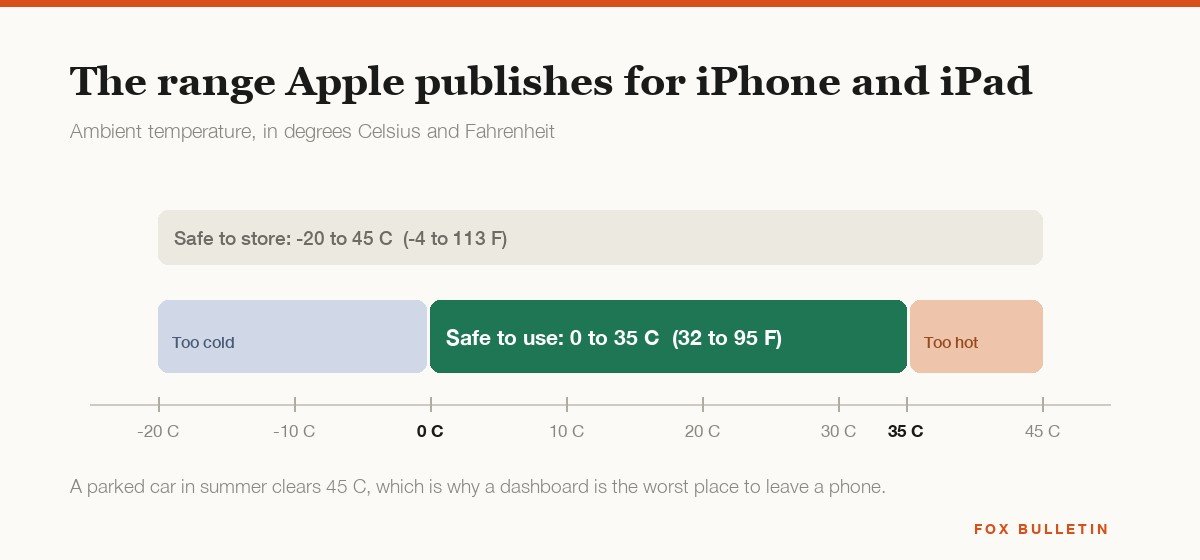
There is a published number to measure against. Apple designs iPhone and iPad for an ambient temperature of 0 to 35 degrees Celsius, which is 32 to 95 Fahrenheit, and its guidance on an iPhone that gets too hot or too cold lists storage as -20 to 45 Celsius. Those are air temperatures around the phone, not the temperature of the phone itself, so a device working hard in a 30 degree room is already close to the edge before you open anything.
Warmth on its own means nothing. A phone is expected to get warm while it sets itself up, restores a backup, installs an update, charges wirelessly, records high-quality video, runs a demanding game or streams for an hour, and warmer still doing any of those while plugged in. What matters is whether the phone is merely warm or warm enough that it has started taking features away from you.
| What you notice | What it usually means | What to do |
|---|---|---|
| Warm back panel during a long video call | Normal processor load | Nothing, it will settle |
| Hot while charging on a wireless pad | Wireless charging waste heat | Switch to a cable for that session |
| Frame rate drops after 20 minutes of play | Thermal throttling | Lower graphics settings or cool it |
| Charging stalls at the same percentage | Heat protection paused the charge | Unplug, cool, plug back in |
| Screen dims and will not brighten | The phone is protecting the display | Move out of the sun |
| Hot in your pocket doing nothing | A background app or a failing battery | Check battery use, then service |
What your phone shuts off before it shuts down
Both platforms degrade in stages rather than cutting out at once, and recognising the stages tells you how serious the heat is. On iPhone, charging slows or stops first, including wireless charging, then the display dims and can go black, the cellular radios drop into a low-power mode so your signal weakens, the camera flash and some camera features stop working, and apps run at lower frame rates.
Pixel phones do the same job with their own wording. Google says a phone that senses it is too hot may reduce processor performance, slow charging, turn off the flash or the camera entirely, switch off mobile data or Wi-Fi in part or in full including 5G, and drop into low power mode. On a Pixel 6 or later you can read the device temperature yourself by opening Settings, tapping Battery, then Battery diagnostics and choosing the option for a phone that is very warm.
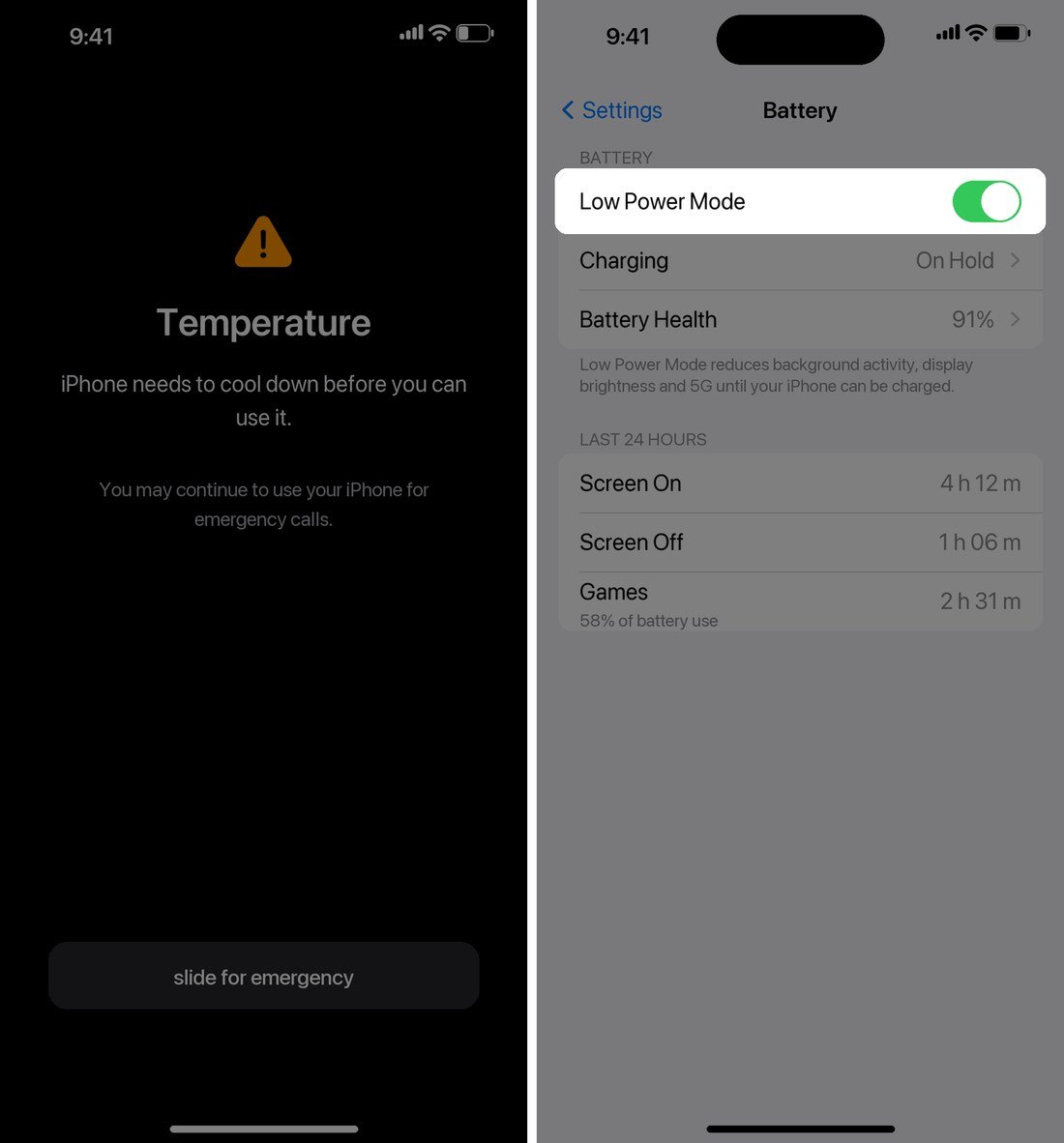
The last stage is the temperature screen. The phone stops, shows a warning and refuses to do anything except emergency calls until it has cooled. If it happens while you are navigating, audio directions keep playing and the screen lights up only at turns, which is deliberate and not a fault.
Cool a hot phone down in the next ten minutes
If the phone is hot in your hand right now, the order matters. Remove the heat sources before you try to add cooling, because a phone that is still rendering a game will not cool no matter where you put it.
- Unplug it. Charging while hot is the single worst combination, and it is also the thing the phone will refuse to do for you once the protection kicks in.
- Close the game, camera or navigation app rather than switching away from it, since several of those keep working in the background.
- Take the case off. A thick case is an insulating layer between the metal frame and the air, and Samsung lists removing the cover as one of its first steps for a Galaxy phone that has heated up.
- Turn the screen brightness down or lock the phone entirely, because the display is usually the largest single draw.
- Move it out of the sun and off any warm surface, which means off the car dashboard, out of a pocket and off the arm of a sofa, onto something hard and cool.
- Switch it off for five minutes if it is still too hot to hold comfortably. A phone that is powered down sheds heat several times faster than one that is idling.
What not to do is put it anywhere cold quickly. A fridge, a freezer or a bag of frozen peas drops the surface temperature far faster than the inside, and the water that condenses on and inside the phone as it warms back up does more damage than the heat ever would. Room temperature air and patience is the whole method.
Nine fixes that stop it overheating again
Cooling a hot phone is the easy part. Keeping it cool is a handful of settings and two or three habits, and most people need only the first three.
- Drop the brightness and turn off the always-on screen. The display is the biggest consumer of power in normal use, and an OLED panel at full brightness in sunlight is working extremely hard. Leave automatic brightness on so it is not fighting you indoors.
- Turn on Low Power Mode or Battery Saver before a long session, not after the phone is already hot. It trims background activity, brightness and 5G behaviour, which is exactly the set of things generating the heat.
- Turn off background app refresh for anything that does not genuinely need it. Social and shopping apps waking up every few minutes to download content keep the radios and the processor busy while the phone sits in your pocket.
- Stop using it as a hotspot while it charges. Tethering runs the cellular radio and Wi-Fi flat out at the same time, and Google lists it alongside gaming as a normal cause of a hot phone. Doing it on a charger stacks two heat sources on one body.
- Take the case off when the phone is working hard, not permanently. A case is fine for everyday use and a liability during a long game, a long video record or a fast charge.
- Keep it out of direct sun and off the dashboard. A parked car in summer clears 45 degrees Celsius easily, which is past the storage limit, never mind the operating one.
- Do not charge and game at the same time. The battery warms as it charges and the processor warms as it renders, both in the same sealed space, and the phone ends up throttling the game and pausing the charge.
- Switch off 5G where coverage is poor. A radio hunting for a weak signal transmits at higher power, and in a basement or a rural dead spot that shows up as a warm phone and a flat battery by lunchtime.
- Install updates and restart weekly. A single misbehaving app pinned to the processor is a common cause of a phone that is hot while doing nothing, and a restart clears it in seconds.
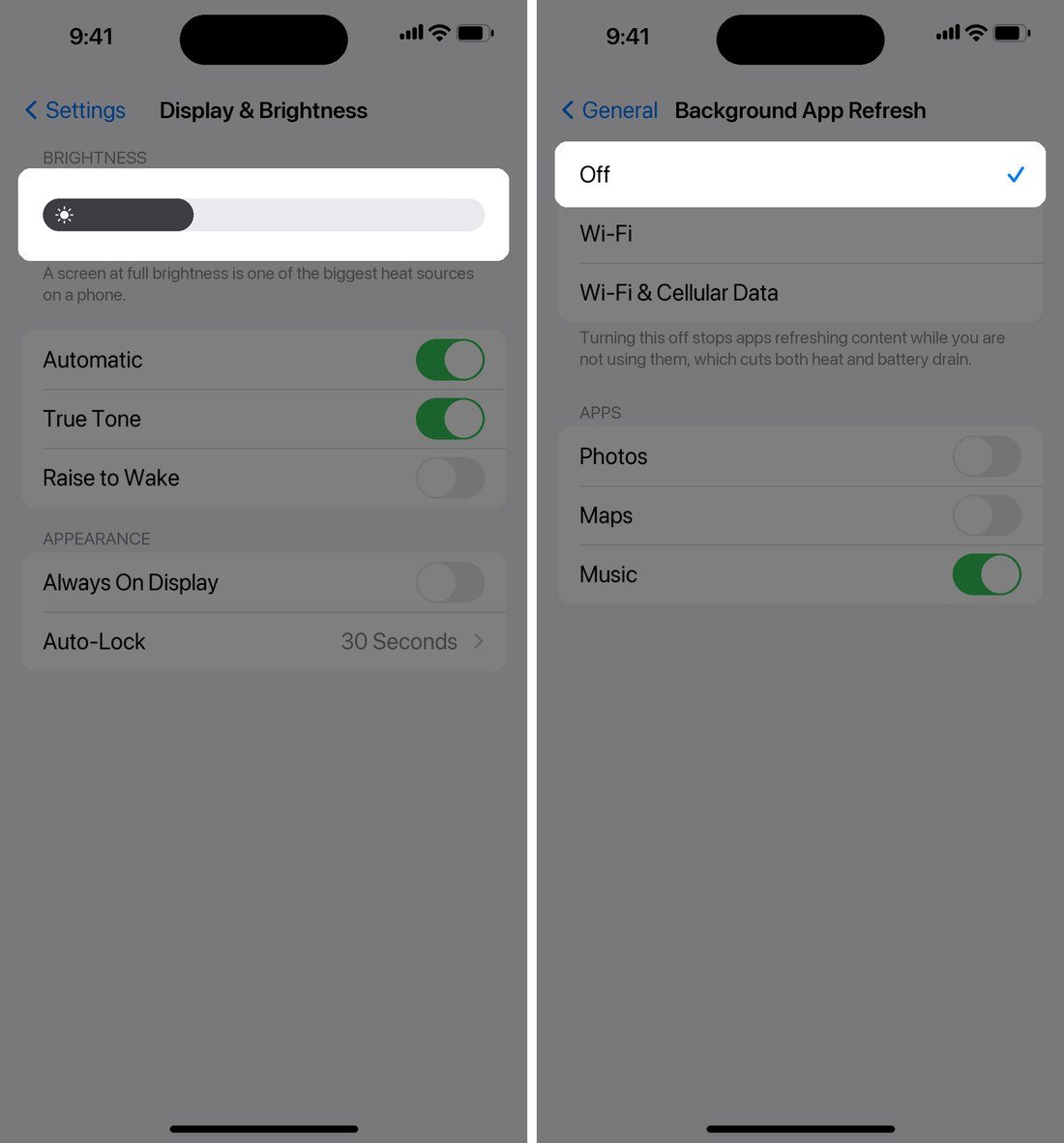
On an iPhone the two that matter most sit in Settings. Brightness and the always-on screen are under Display & Brightness, and Background App Refresh is under General, where setting it to Off applies to everything at once or you can leave it on Wi-Fi only and switch individual apps off below.
Where these switches live on Android
The names change by manufacturer but the controls are the same four. Battery Saver is in Settings under Battery, and on recent Pixels it can be set to come on automatically at a percentage you choose. Brightness and the always-on display sit under Display, and adaptive brightness is worth leaving on. Background activity is handled per app rather than globally: open Settings, then Apps, choose the app, tap Battery and set it to Restricted for anything you do not need notifications from.
Samsung adds a few of its own. Its guidance for a phone that has heated up points at closing unused apps, lowering brightness, removing the cover, turning off the mobile hotspot, charging only with a certified charger and cable, and checking Settings then Software update before assuming the hardware is at fault. Galaxy phones also expose a Game Booster panel during play, where you can cap the frame rate and resolution for a specific game rather than throttling everything.
Phone coolers, cases and the gaming question
Gaming is the one case where the settings run out of road. A demanding title holds the processor and the graphics core near their limits for as long as you play, so the phone warms steadily and then throttles, which is why frame rates often feel fine for the first fifteen minutes of a session and ragged after half an hour. Console ports make it worse: our roundup of the best AAA games on iPhone covers titles that were built for hardware with a fan attached.
Two things genuinely help. The first is free: drop the in-game graphics preset by one step and cap the frame rate at 60 rather than letting it chase 120, which cuts the work the chip has to do without changing how the game plays. The second is a clip-on or magnetic cooler, a small fan and a cold plate that sits against the back of the phone and gives the heat somewhere to go. We compared seven of them in our guide to the best mobile cooler for gaming, and the short version is that they work, they need a power source, and the quiet ones cost more.
Charging accessories matter here too. A fast wireless charger generates noticeably more waste heat than a cable at the same wattage, so if a phone always runs hot overnight on a pad, moving it to a cable is the first test. Our picks for the best MagSafe chargers note which ones include a fan for exactly this reason.
When the heat is the battery, not the software
Most overheating is behavioural. A small share is hardware, and it looks different. These are the signs that no setting will fix.
- The phone is hot while idle, with the screen off and nothing installed recently, for more than a day after a restart.
- Battery health has fallen below about 80 per cent, which on an iPhone appears under Settings, Battery, Battery Health and on most Android phones in the battery diagnostics screen.
- The back panel or the screen is lifting, or the phone rocks on a flat table. A swollen battery is a safety issue and the phone should be powered down and taken in.
- It gets hot and shuts down repeatedly, which Google treats as the point to stop troubleshooting and contact support.
- Charging is hot and slow with more than one cable and plug, which points at the port or the battery rather than the accessory.
Heat is also what ages a battery in the first place. Lithium-ion cells lose capacity faster the warmer they are kept, which is why a phone that spends every summer on a car mount in the sun tends to need a battery two years in while an identical one kept in a bag does not. Fixing the heat today is also the cheapest way to avoid a battery replacement later.
Frequently Asked Questions
Why does my phone get hot when I am not using it?
Something is running that you did not open. The usual causes are an app refreshing in the background, a cloud photo or backup upload, an app update downloading over cellular, or a weak signal forcing the radio to transmit at full power. Restart the phone, then check which app is at the top of the battery usage list over the last 24 hours.
Is it bad for a phone to get hot?
Occasional warmth is harmless and designed for. Sustained heat is not, because high temperatures permanently reduce battery capacity, and Apple warns that using a device in very hot conditions can shorten battery life for good. The performance you lose to throttling comes back when the phone cools; the battery capacity does not.
Should I use a phone cooler or just a fan?
A desk fan pointed at the phone does most of the job for free and is the right answer at home. A clip-on cooler earns its place if you play away from a desk, because it contacts the back panel directly rather than moving air past the case, and it keeps working in a 30 degree room where ambient air does not.
Does charging overnight make a phone overheat?
Not usually, because the phone stops drawing meaningful current once it is full. The two things that do cause it are charging on a wireless pad, which wastes more energy as heat than a cable does, and charging under a pillow or a duvet where the heat has nowhere to escape. Both are easy to change.
Related Articles

Get the Fox Bulletin briefing
The stories that matter, in your inbox. No spam, unsubscribe anytime.
Newsletter signup will be available soon.
Related stories

Amazon Prime Benefits: Everything Included for $14.99 a Month
Amazon Prime costs $14.99 a month and covers ten benefit categories, including a fuel discount, Grubhub+ and pharmacy savings most members never use. Everything included, and the cheaper tiers.

How to Cancel Amazon Prime and When You Get a Refund
Cancel Amazon Prime at amazon.com/mc in about a minute. The exact steps, when the charges stop, and the rule that decides whether you get a refund.

What Is Amazon Haul? Prices, Shipping and the Catch
Amazon Haul caps everything at $20, ships free over $25 and adds 10% off at $75. What it costs, how slow delivery really is, and why items under $3 cannot be returned.