

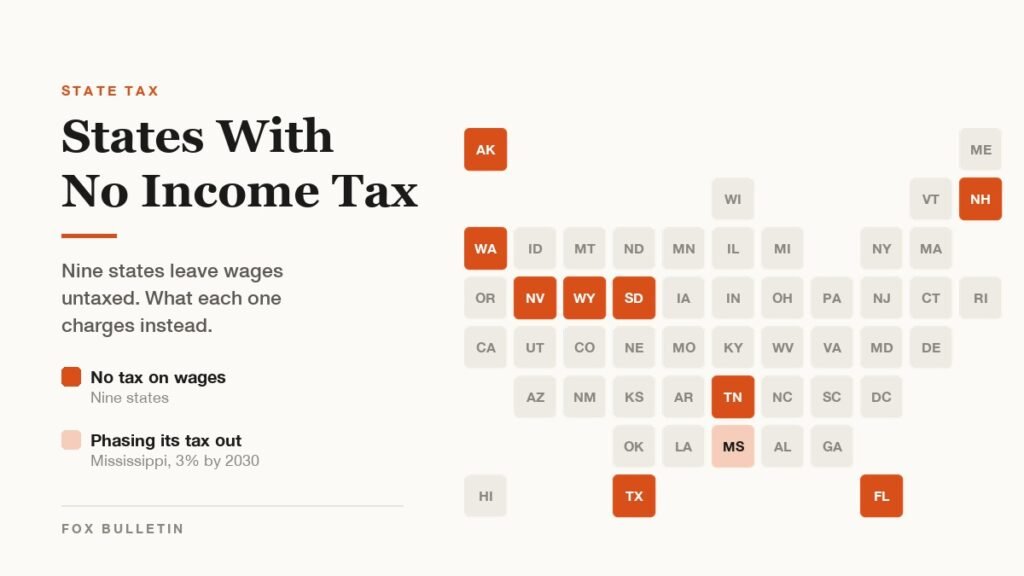
Nine states levy no income tax on wages: Alaska, Florida, Nevada, New Hampshire, South Dakota, Tennessee, Texas, Washington and Wyoming. The states with no income tax do not collect less money because of it; they collect it somewhere else, through sales tax, property tax, severance taxes on minerals or taxes on business receipts.
Two of the nine come with an asterisk, and one more state is on a statutory path to joining them. Here is the full list and what each one charges instead:
| State | Tax on wages | What funds the state instead | Note |
|---|---|---|---|
| Alaska | None | Oil and gas revenue, local sales taxes | Individual income tax repealed in 1980; no statewide sales tax either |
| Florida | None | Sales tax and tourism receipts | The state constitution bars a tax on the income of natural persons |
| Nevada | None | Sales tax, gaming and live entertainment taxes | No personal, business or corporate income tax |
| New Hampshire | None | Property tax and business taxes | The interest and dividends tax ended for periods beginning after December 31, 2024 |
| South Dakota | None | Sales and use tax, contractor excise tax | No corporate, unitary or personal income tax |
| Tennessee | None | Sales tax at one of the highest combined rates | The Hall tax on interest and dividends ended on January 1, 2021 |
| Texas | None | Sales tax, local property tax, franchise tax | Sole proprietors are exempt from the franchise tax |
| Washington | None on wages | Sales tax, business and occupation tax | A 7 percent excise tax applies to large long-term capital gains |
| Wyoming | None | Mineral severance taxes, sales tax, property tax | No individual or corporate income tax |
The Nine States With No Income Tax on Wages
Three of the nine put the prohibition beyond the reach of an ordinary legislature. Florida is the clearest case: Article VII of the state constitution says no tax upon the income of natural persons who are residents or citizens of the state shall be levied by the state, or under its authority, beyond what can be credited against a similar federal or state tax. Changing that takes a constitutional amendment rather than a budget vote.
The rest arrived at the same place by different routes. Alaska repealed its individual income tax in 1980, during the construction of the trans-Alaska pipeline and the oil revenue that came with it. Nevada, South Dakota, Texas and Wyoming never built one, and each leans on a different substitute: gaming and sales tax in Nevada, sales and contractor excise tax in South Dakota, sales and local property tax in Texas, and mineral severance in Wyoming.
Tennessee is the newest full member of the group. The Hall income tax, enacted in 1929 and named for the senator who sponsored it, applied only to interest from bonds and notes and dividends from stock. The state stopped collecting it for tax periods beginning on or after January 1, 2021, which left Tennessee with no individual income tax of any kind.
New Hampshire and Washington: The Two Asterisks
Neither state taxes a paycheck, and both have been described as having no income tax for years. The detail that matters is what happens to investment income:
| State | What is and is not taxed |
|---|---|
| New Hampshire | The state never taxed wages, but it did tax interest and dividends. That tax was charged at 5 percent, then 4 percent for periods ending on or after December 31, 2023, and 3 percent for periods ending on or after December 31, 2024, and it is repealed for taxable periods beginning after December 31, 2024. Returns for earlier years are still due. |
| Washington | Wages are untaxed, and have no state tax at all. Long-term capital gains are a separate matter: the 2021 legislature created a 7 percent excise tax on the sale of long-term assets such as stocks, bonds and business interests, with a standard deduction of 278,000 dollars for 2025 and a 9.9 percent rate on gains above 1 million dollars starting with tax year 2025. Real estate and retirement accounts are exempt. |
Washington is the one to watch, because the structure is unusual. The Department of Revenue treats the capital gains tax as an excise tax rather than an income tax, which is how it coexists with a state constitution that has long been read to block a graduated income tax. For most households it changes nothing, since wages, real estate sales and retirement accounts are all outside it. For someone selling a business, it is the single largest state tax they will meet.
What Replaces the Income Tax
A state without an income tax is not a state without taxes. The revenue comes from a narrower set of sources, and that shapes who actually pays:
- Sales tax does the heaviest lifting in Tennessee, Washington, Nevada and South Dakota, where the combined state and local rate is among the highest in the country and reaches almost every purchase.
- Property tax carries New Hampshire and Texas, both of which fund schools and local government from real estate rather than from paychecks.
- Severance taxes on oil, gas and coal carry Alaska and Wyoming, which is why both states feel the commodity cycle in their budgets in a way the others do not.
- Tourism and gaming broaden the base in Florida and Nevada, where a large share of sales tax is paid by people who do not live there.
- Business taxes fill part of the gap in Washington, through a tax on gross receipts rather than profit, and in New Hampshire through its business profits and business enterprise taxes.
The trade is mostly about who bears the cost rather than how much is collected. Sales tax takes a larger share of a low income than a high one, because a bigger share of that income is spent. Property tax follows the house rather than the paycheck, which is why a retired homeowner in New Hampshire or Texas can face a large annual bill with no earned income at all. Our rundown of property taxes by state covers the other side of that trade, and the five states with no sales tax shows how rarely the two exemptions overlap.
Mississippi Is on a Statutory Path to Zero
Mississippi passed House Bill 1 in 2025, which sets the individual income tax rate at 4.0 percent for 2026 and steps it down to 3.75, 3.5, 3.25 and then 3.0 percent for 2030. The bill text goes further than the schedule: it provides that once no tax is levied on individual taxable income under that provision, the individual income tax shall stand repealed. The same act cut the sales tax on groceries to 5 percent from July 1, 2025.
What makes it different from the usual promise of future cuts is the trigger. Reductions after 2030 are tied to conditions on the state rainy-day fund and on revenue collections exceeding appropriations by a set margin, so they happen automatically when the test is met rather than requiring a new vote each year. Whether Mississippi actually reaches zero depends on those revenue conditions, not on the schedule already in statute.
What Moving to a No-Income-Tax State Actually Saves
The headline saving is easy to calculate and usually wrong, because it compares one tax in isolation. Five checks give a more honest number:
- Count the property tax bill, not the rate. A no-income-tax state with high assessed values can cost a homeowner more each year than a modest income tax would have.
- Price the sales tax against how you actually spend. A household that buys a car, appliances and building materials in a year pays far more under a high sales tax than a household that does not.
- Check whether retirement income was taxed where you live now. Many states with an income tax already exempt Social Security and some pension income, which narrows the gap before you move.
- Look at what the state does not fund. Lower state revenue often shows up as local fees, school levies, toll roads and higher insurance costs rather than as savings.
- Treat commodity-funded budgets as variable. Alaska and Wyoming raise much of their revenue from minerals, and that revenue moves with prices.
The comparison that matters is total state and local tax paid by a household like yours, including property tax, sales tax, vehicle fees and local levies. A renter with a modest income and few large purchases keeps more of the benefit than a homeowner with children in a district funded almost entirely by property tax. For retirees the arithmetic shifts again, since Social Security and pension treatment varies widely, and our guide to the best places to retire in the US weighs those alongside housing and health care.
Residency Rules: When the Old State Still Has a Claim
Moving to a state with no income tax does not end the old state claim by itself. Two tests decide it, and a taxpayer can fail the second while passing the first:
- Domicile is where you intend to remain and return to, and it does not change because you bought a second home. States look at where your family lives, where your valuables are, where you are registered to vote and where your business is run from.
- A day count is the second test. New York, for example, treats someone who is not domiciled there as a resident anyway if they keep a permanent place to live in the state and spend more than 183 days there in the tax year.
- Part days usually count as full days under day-count rules, which is what catches commuters who keep an apartment in the old state.
- Selling or giving up the old home, changing your driver license and voter registration and moving professional advisers all help, and none of them is decisive on its own.
- Keep contemporaneous records of where you were. In a residency audit, the burden of showing the day count usually falls on the taxpayer.
High-tax states audit departures, and the pattern is consistent: the taxpayer who kept an apartment, a club membership, a car registration and a doctor in the old state loses, regardless of where the mail now goes. Anyone splitting a year across two states should treat the day count as evidence to be collected at the time rather than reconstructed later.
Frequently Asked Questions
How many states have no income tax?
Nine: Alaska, Florida, Nevada, New Hampshire, South Dakota, Tennessee, Texas, Washington and Wyoming. All nine leave wages untaxed. Washington taxes large long-term capital gains through a separate excise tax, and New Hampshire taxed interest and dividends until that tax was repealed for periods beginning after December 31, 2024.
Which state has no income tax and no sales tax?
Alaska is the only state with neither an individual income tax nor a statewide sales tax, though local governments there levy their own sales taxes. New Hampshire has no sales tax and no income tax, and funds itself largely through property and business taxes instead.
Do states with no income tax have higher property taxes?
Often, but not uniformly. New Hampshire and Texas both rely heavily on property tax to fund schools and local services, while Nevada and Florida lean more on sales tax and visitor spending, and Alaska and Wyoming draw a large share of revenue from mineral production.
Is any other state getting rid of its income tax?
Mississippi has the only live statutory path. House Bill 1 of 2025 steps the rate down to 3 percent by 2030 and provides that the individual income tax is repealed once no tax is levied under that schedule, with further reductions tied to revenue and reserve-fund triggers.
Related Articles

Get the Fox Bulletin briefing
The stories that matter, in your inbox. No spam, unsubscribe anytime.
Newsletter signup will be available soon.
Related stories

Richest People in the World: All 10 Ranked
Elon Musk is the richest person in the world at $936 billion, more than double second-placed Jeff Bezos. All 10 of the wealthiest people are American, six are worth more than $200 billion, and together they hold $3.1 trillion.

Amazon Business Prime: What Each Plan Costs and Who Needs One
Amazon Business Prime runs from free to $10,099 a year across five plans. What each tier costs, how it differs from the free Amazon Business account, and when the shipping alone pays for it.
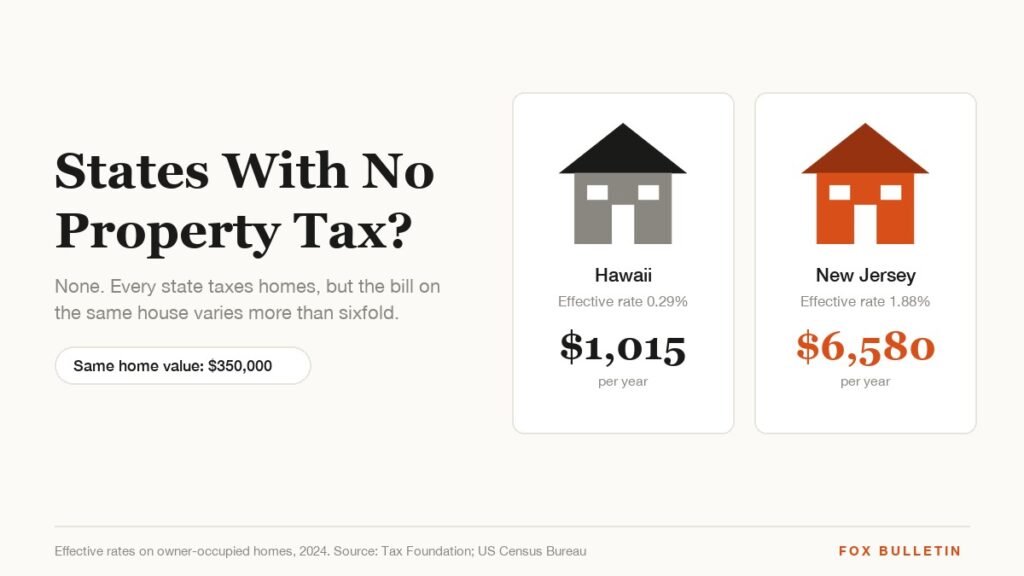
States With No Property Tax: Why None Exist, Plus Property Tax by State
There are no states with no property tax. Effective rates run from 0.29% in Hawaii to 1.88% in New Jersey and Illinois. Every state's rate, and the exemptions that can cut a bill to zero.