

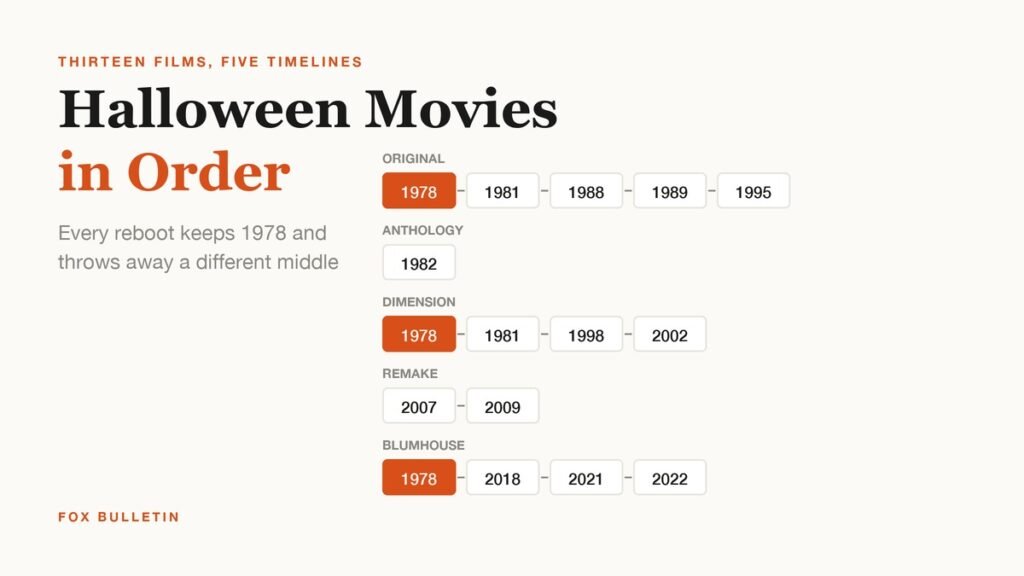
Watching the Halloween movies in order is harder than it should be, because the series does not have one order. There are 13 films released between 1978 and 2022, and they split into five separate timelines that contradict each other. Three of those timelines start with the same 1978 original and then go somewhere different.
The simplest route is release order, which is the table below. The route most people actually want is one timeline at a time, picking whichever version of Laurie Strode’s story they prefer. Both are laid out here, along with which sequels each continuity throws away.
| Film | US release | Director |
|---|---|---|
| Halloween | October 25, 1978 | John Carpenter |
| Halloween II | October 30, 1981 | Rick Rosenthal |
| Halloween III: Season of the Witch | October 22, 1982 | Tommy Lee Wallace |
| Halloween 4: The Return of Michael Myers | October 21, 1988 | Dwight H. Little |
| Halloween 5: The Revenge of Michael Myers | October 13, 1989 | Dominique Othenin-Girard |
| Halloween: The Curse of Michael Myers | September 29, 1995 | Joe Chappelle |
| Halloween H20: 20 Years Later | August 5, 1998 | Steve Miner |
| Halloween: Resurrection | July 12, 2002 | Rick Rosenthal |
| Halloween | August 31, 2007 | Rob Zombie |
| Halloween II | August 28, 2009 | Rob Zombie |
| Halloween | October 19, 2018 | David Gordon Green |
| Halloween Kills | October 15, 2021 | David Gordon Green |
| Halloween Ends | October 14, 2022 | David Gordon Green |
Why the Halloween Movies in Order Is a Trick Question
The series has been rebooted three times without ever being renumbered. Every reboot keeps the 1978 original, discards some middle section of what came after it, and writes a new ending for Laurie Strode. Scott Mendelson of Forbes called it the Choose Your Own Adventure of horror franchises, which is the most accurate description anyone has managed.
The spine never changes. In 1963, six-year-old Michael Myers kills his older sister Judith on Halloween night in Haddonfield, Illinois, and is committed to Smith’s Grove Sanitarium. Fifteen years later he escapes, and his psychiatrist Dr. Sam Loomis goes after him. Jamie Lee Curtis plays Laurie Strode in seven of the 13 films and Donald Pleasence played Loomis in five.
One film has no Michael Myers in it at all, which is the single most useful thing to know before you start. Everything else is a question of which sequels you accept.
The Five Halloween Timelines
Here is the whole structure in one place. Each line is a complete, self-consistent run:
- Original continuity: Halloween (1978), Halloween II (1981), Halloween 4 (1988), Halloween 5 (1989), The Curse of Michael Myers (1995).
- Anthology: Halloween III: Season of the Witch (1982), which stands alone.
- Dimension Films continuity: Halloween (1978), Halloween II (1981), H20 (1998), Resurrection (2002).
- Remake continuity: Halloween (2007), Halloween II (2009).
- Blumhouse continuity: Halloween (1978), Halloween (2018), Halloween Kills (2021), Halloween Ends (2022).
Note what that means in practice. The 1978 film is the first entry in three of the five runs, the 1981 sequel is in two of them, and the 2007 remake belongs to a continuity that shares nothing with any of the others. Films 4, 5 and 6 appear in exactly one run and are ignored by everything made after 1998.
Original Continuity: 1978 to 1995
The longest run, and the one that goes furthest into mythology. Halloween II picks up on the same night the first film ends and adds the detail that defined the next two decades: Laurie is Michael’s younger sister, given up for adoption as an infant.
Halloween 4 jumps ten years, kills Laurie off screen in a car accident and gives Michael a niece, Jamie Lloyd, to pursue. Halloween 5 continues directly from it and ends with a stranger in black breaking Michael out of jail. The Curse of Michael Myers resolves that cliffhanger with the Cult of Thorn, a druidic curse that compels Michael to kill his own bloodline, and features Paul Rudd as a grown-up Tommy Doyle, the boy Laurie was babysitting in 1978.
Watch these five in numerical order or not at all. They are the only films in the series that form an unbroken chain, and the Thorn explanation makes no sense arriving from any other direction.
Halloween III: The Sequel With No Michael Myers
Season of the Witch was an attempt to turn the series into an anthology, with a different Halloween story every year. Michael Myers does not appear. Instead, Dr. Dan Challis investigates a murder that leads him to Santa Mira, California, and the Silver Shamrock Novelties mask company, whose owner Conal Cochran plans to use fragments of Stonehenge and a television commercial to kill every child wearing one of his masks on Halloween night.
The plot turns on Samhain, the Gaelic festival that sits under the holiday itself, which our history of Halloween covers in more depth. Audiences in 1982 wanted Michael, the experiment ended immediately, and film 4 was titled The Return of Michael Myers to make the point. It has since become the most defended entry in the series, and it slots in anywhere because it connects to nothing.
Dimension Films Continuity: H20 and Resurrection
In 1998 the series restarted from Halloween II and skipped films 4, 5 and 6 entirely. H20 opens 20 years after 1978 with Laurie living under the name Keri Tate as the headmistress of a private school, having faked her own death. Josh Hartnett plays her son, Michelle Williams his girlfriend. The film ends with Laurie decapitating Michael with a fire axe, which looked final at the time.
Resurrection undoes it in the opening minutes: the man Laurie killed was a paramedic whose larynx Michael had crushed after swapping clothes. Michael then kills Laurie and returns to the family home, where a group of students are filming an internet reality show. Busta Rhymes is in it. If you want Laurie’s story to end with her winning, stop after H20.
Rob Zombie’s Remake Continuity: 2007 and 2009
These two share no continuity with anything else and are best treated as a separate series that happens to use the same names. The 2007 film spends its first act on Michael’s childhood and the abuse that shaped it, establishes Laurie as his sister early rather than saving it for a sequel, and is substantially more violent than any of the films before it.
The 2009 sequel goes further from the original template again. Watch them back to back or skip both: nothing in the other four timelines depends on them, and nothing in them depends on the other four.
Blumhouse Continuity: 2018 to 2022
The most aggressive reset. The 2018 Halloween keeps the original and throws away all nine films between 1981 and 2009, including the sister reveal. Laurie is simply a woman who survived one night in 1978 and spent 40 years preparing for a rematch, with a daughter and granddaughter shaped by that preparation.
Halloween Kills picks up the same night, and Halloween Ends jumps four years forward to close the trilogy. David Gordon Green directed all three, Danny McBride co-wrote all three, and Jamie Lee Curtis returned for all three. If you have seen one Halloween film and want the story finished in three sittings, this is the run to take.
Which Halloween Order to Watch
For a first pass through the series, the four-film Blumhouse route is the cleanest: 1978, 2018, Halloween Kills, Halloween Ends. It is one continuous story with one ending and no contradictions inside it.
For the version the series was actually built on, take the original five in numerical order, then add Halloween III whenever you like. For completists, release order works, provided you accept that the story resets three times along the way. The official Halloween site publishes the series listing, and Michael Myers mask replicas turn up in most costume guides, if the viewing leads where it usually does.
Three practical notes before you start:
- Halloween II (1981) and Halloween II (2009) are different films with the same title, 28 years apart.
- There are three films simply called Halloween, from 1978, 2007 and 2018.
- Halloween III is the only one with no Michael Myers, so it is never a continuity error.
Frequently Asked Questions
How many Halloween movies are there?
Thirteen, released between 1978 and 2022. All but one feature Michael Myers; Halloween III: Season of the Witch from 1982 is the exception.
Do I need to watch the Halloween movies in order?
Only within a timeline. Across timelines the films contradict each other, so watching all 13 in release order means seeing Laurie Strode’s story start over three times. Pick one continuity and follow it start to finish.
Is Laurie Strode Michael Myers’ sister?
It depends on the timeline. Halloween II established it in 1981 and the original and Dimension runs keep it. The 2007 remake states it early. The 2018 film removes it completely, which is the single biggest difference between the Blumhouse trilogy and everything before it.
Which Halloween movie should I watch first?
The 1978 original, in every case. It opens three of the five timelines, it is the only film all the reboots agree on, and at 91 minutes it is the shortest route into the series. Its influence on the slasher format is the reason the rest exists.
Related Articles

Get the Fox Bulletin briefing
The stories that matter, in your inbox. No spam, unsubscribe anytime.
Newsletter signup will be available soon.
Related stories
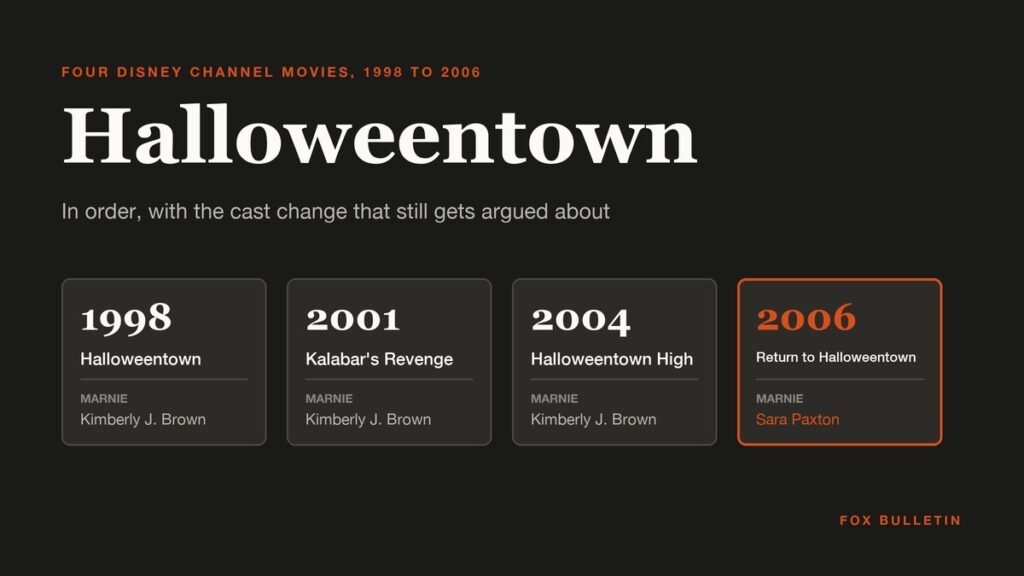
Halloweentown: All Four Movies, the Cast and the Recast
Four Disney Channel movies between 1998 and 2006, one family of witches, and a lead actress swapped out for the finale. Here is the order, the cast and what each film actually did in the ratings.
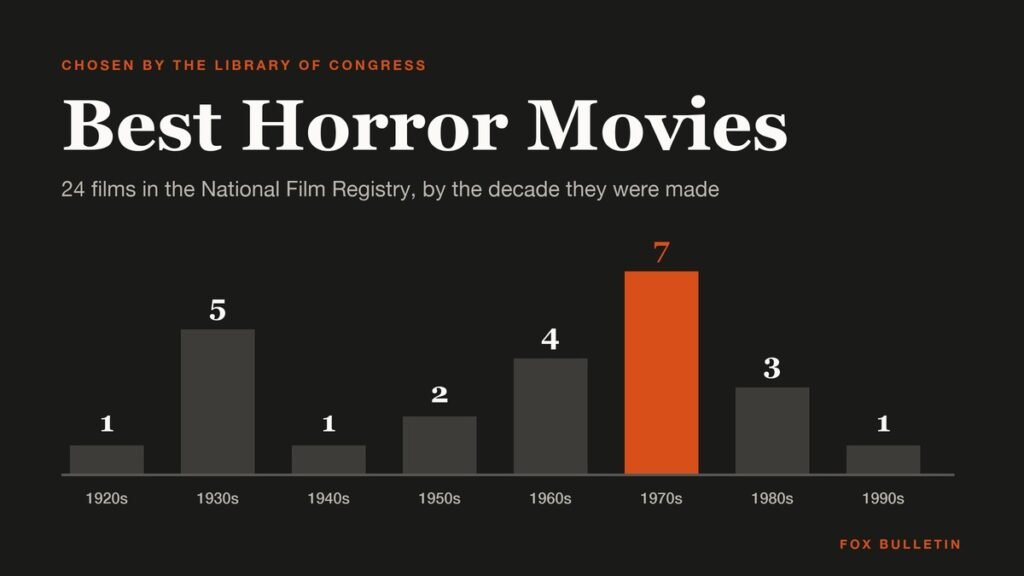
Best Horror Movies: The 24 Preserved by the Library of Congress
Every best-of list is somebody's opinion. This one is not: these are the horror films the Library of Congress has selected for permanent preservation, with the year each entered the registry.
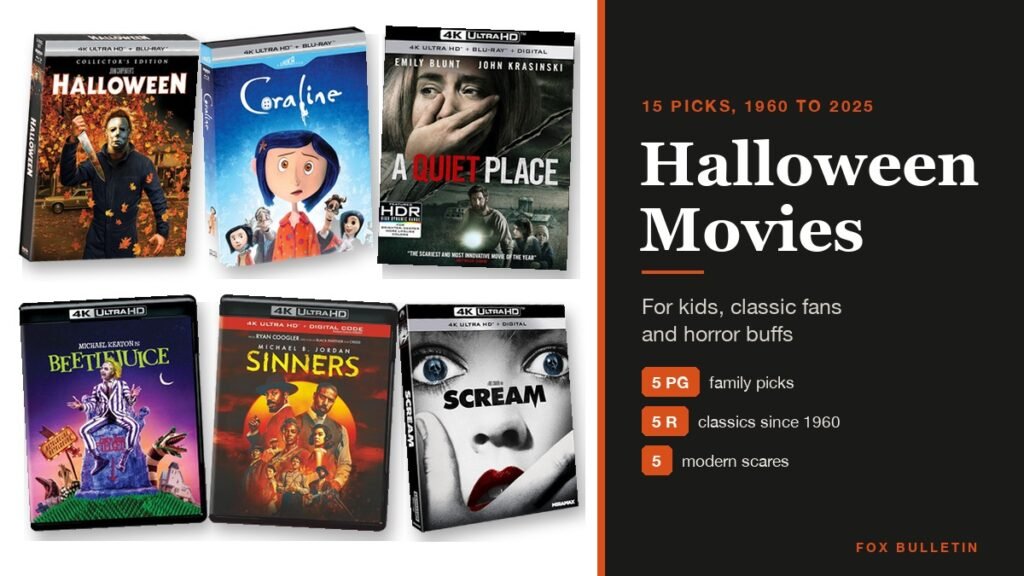
Best Halloween Movies: 15 Family, Classic and Modern Horror Picks
Fifteen Halloween movies for kids, classic horror fans and modern horror buffs, each with its MPA rating, runtime, director and a 4K, Blu-ray or DVD edition.