


Twenty-six US states have right-to-work laws, meaning no worker can be required to join a union or pay union dues as a condition of employment. That number fell from 27 in February 2024, when Michigan became the first state in nearly 60 years to repeal one.
Eight states adopted these laws in 1947 alone, the year Congress passed the Taft-Hartley Act and made them possible. Here is every right-to-work state, when each adopted its law, and what the rule actually means for workers.
| State | Year Adopted | Era |
|---|---|---|
| Florida | 1944 | Pre-Taft-Hartley |
| Arizona | 1946 | Pre-Taft-Hartley |
| Nebraska | 1946 | Pre-Taft-Hartley |
| South Dakota | 1946 | Pre-Taft-Hartley |
| Arkansas | 1947 | Taft-Hartley year |
| Georgia | 1947 | Taft-Hartley year |
| Iowa | 1947 | Taft-Hartley year |
| North Carolina | 1947 | Taft-Hartley year |
| North Dakota | 1947 | Taft-Hartley year |
| Tennessee | 1947 | Taft-Hartley year |
| Texas | 1947 | Taft-Hartley year |
| Virginia | 1947 | Taft-Hartley year |
| Nevada | 1951 | Post-war wave |
| Alabama | 1953 | Post-war wave |
| Mississippi | 1954 | Post-war wave |
| South Carolina | 1954 | Post-war wave |
| Utah | 1955 | Post-war wave |
| Kansas | 1958 | Post-war wave |
| Wyoming | 1963 | Post-war wave |
| Louisiana | 1976 | Late adopter |
| Idaho | 1985 | Late adopter |
| Oklahoma | 2001 | Late adopter |
| Indiana | 2012 | Modern wave |
| Wisconsin | 2015 | Modern wave |
| West Virginia | 2016 | Modern wave |
| Kentucky | 2017 | Modern wave |
What Right to Work Actually Means
The name is misleading and causes more confusion than almost any other term in US employment law. A right-to-work law does not guarantee anyone a job, and it does not protect against being fired.
It does one specific thing: it prohibits union security agreements, the contracts that require employees at a unionized workplace to join the union or pay dues as a condition of keeping their job. In a right-to-work state, a worker at a unionized employer can decline to join and decline to pay, while still receiving the wages and conditions the union negotiated.
This is separate from at-will employment, which is the rule in 49 states and means either side can end the relationship at any time for almost any reason. People routinely confuse the two, but they address entirely different things.
The Taft-Hartley Act Made These Laws Possible
Before 1947, federal law did not clearly allow states to ban union security agreements. The Taft-Hartley Act changed that, and Section 14(b) explicitly authorized individual states, though not cities or counties, to outlaw the union shop.
The response was immediate. Eight states adopted right-to-work laws in 1947 itself, and 12 of the current 26 had them in place by the end of that year, meaning nearly half the list was settled within four years of the federal door opening. Florida had moved even earlier, in 1944, before the federal position was clear.
A Second Wave Arrived Sixty Years Later
After Idaho in 1985 the movement stalled for 16 years, the longest gap in the law’s history, broken only by Oklahoma in 2001. Then four states adopted in six years: Indiana in 2012, Wisconsin in 2015, West Virginia in 2016, and Kentucky in 2017.
That cluster matters because of where it happened. The earlier waves were concentrated in the South and Plains, regions with historically low union membership. The modern wave hit the industrial Midwest and Appalachia, traditional union strongholds where manufacturing and mining had organized workforces for generations. Wisconsin in particular was the birthplace of public sector collective bargaining in the United States.
Michigan Reversed Course in 2024
Michigan adopted a right-to-work law in 2012, the same year as Indiana, and repealed it in February 2024. It is the first state to reverse such a law in nearly six decades.
The repeal returned Michigan to allowing union security agreements in the private sector, so employees at unionized workplaces there can again be required to pay dues. Public sector workers are treated differently because of a separate federal constitutional protection. Michigan’s reversal is the reason the total is 26 rather than 27, and it is the only recent movement in either direction.
Two States Tried and Did Not Succeed
Michigan is not the only state to have moved away from these laws. New Hampshire adopted one in 1947 during the first wave and repealed it in 1949, making it the earliest reversal on record.
Missouri passed right-to-work legislation in 2017, but the law never took effect. Voters rejected it in a 2018 referendum before implementation, an unusual case of a state legislature and its electorate reaching opposite conclusions on the same question within a year.
What It Means for Workers and Employers
For a worker in a right-to-work state, the practical effect is a choice. If your workplace is unionized, you can opt out of membership and dues while still being covered by the collective agreement, since the union is legally obliged to represent everyone in the bargaining unit regardless of whether they pay.
That obligation is the core of the dispute. Supporters argue no one should have to fund an organisation they did not choose to join. Opponents call it a free-rider problem, since unions must spend resources representing people who contribute nothing, which weakens them over time. Both descriptions are accurate; they simply weigh the same mechanism differently.
For employers, the practical difference is smaller than the debate suggests. Right-to-work does not prevent unionisation, block collective bargaining, or change wage law. It affects the funding model of labor unions rather than the rules of employment itself, though states often cite it when courting employers, as our ranking of the best states to start a business reflects.
The Split Is Almost Even
Twenty-six states have these laws and 24 do not, one of the closest splits on any major state-level policy question. There is no national consensus in either direction.
The geography is more consistent than the count suggests. Right-to-work states cluster heavily in the South, the Plains, and the Mountain West, while the states without them concentrate in the Northeast, the Pacific coast, and the upper Midwest. The modern wave blurred that map, which is precisely why the Michigan repeal drew the attention it did.
The 24 States Without Right-to-Work Laws
The other half of the map is just as clear-cut. These 24 states have no right-to-work law, so union security agreements remain lawful in each: Alaska, California, Colorado, Connecticut, Delaware, Hawaii, Illinois, Maine, Maryland, Massachusetts, Michigan, Minnesota, Missouri, Montana, New Hampshire, New Jersey, New Mexico, New York, Ohio, Oregon, Pennsylvania, Rhode Island, Vermont, and Washington.
Three of them have direct history with the question. Michigan had a law from 2012 until its 2024 repeal, New Hampshire briefly had one from 1947 to 1949, and Missouri passed one in 2017 that voters overturned before it took effect. The remaining 21 have never adopted one.
The concentration is geographic rather than random. The Northeast accounts for a large share, the entire Pacific coast appears, and the upper Midwest is well represented. Between them these states contain most of the country’s remaining union density, which is why the modern wave of adoptions in Indiana, Wisconsin, West Virginia, and Kentucky was treated as significant rather than routine.
How We Compiled This List
States are listed by the year each adopted its current right-to-work law, ordered from earliest to most recent, and are current as of 2026. Michigan is excluded because its law was repealed in February 2024.
Several states later strengthened their provisions after first adopting them, with Florida, Texas, and Tennessee among those that subsequently wrote the rule into their state constitutions rather than leaving it in statute. This list uses the original adoption year in each case. Territories are not included, though Guam also has such a law.
Frequently Asked Questions
How many right-to-work states are there?
Twenty-six, as of 2026. The number dropped from 27 when Michigan repealed its law in February 2024.
Does right to work mean I can be fired for any reason?
No. That is at-will employment, a separate doctrine that applies in 49 states. Right-to-work only concerns whether you can be required to join a union or pay dues.
Do I still get union benefits if I do not pay dues?
Yes. In a right-to-work state, the union must represent everyone in the bargaining unit, including those who do not join or pay. This obligation is the central point of contention in the debate.
Which state adopted right to work first?
Florida, in 1944, three years before the Taft-Hartley Act authorized the practice nationally. Eight more states followed in 1947 alone.
Has any state other than Michigan repealed one?
New Hampshire adopted a law in 1947 and repealed it in 1949. Missouri passed one in 2017, but voters rejected it in a 2018 referendum before it took effect.
A Note on Legal Advice
This article is general information rather than legal advice. Right-to-work rules interact with federal labor law, collective bargaining agreements, and sector-specific rules in ways that vary by workplace.
Workers with questions about dues, membership, or representation should consult their union, their employer’s HR department, or an employment attorney licensed in their state. Employment structures generally are covered in our guide to business structures compared.
Related Articles

Get the Fox Bulletin briefing
The stories that matter, in your inbox. No spam, unsubscribe anytime.
Newsletter signup will be available soon.
Related stories
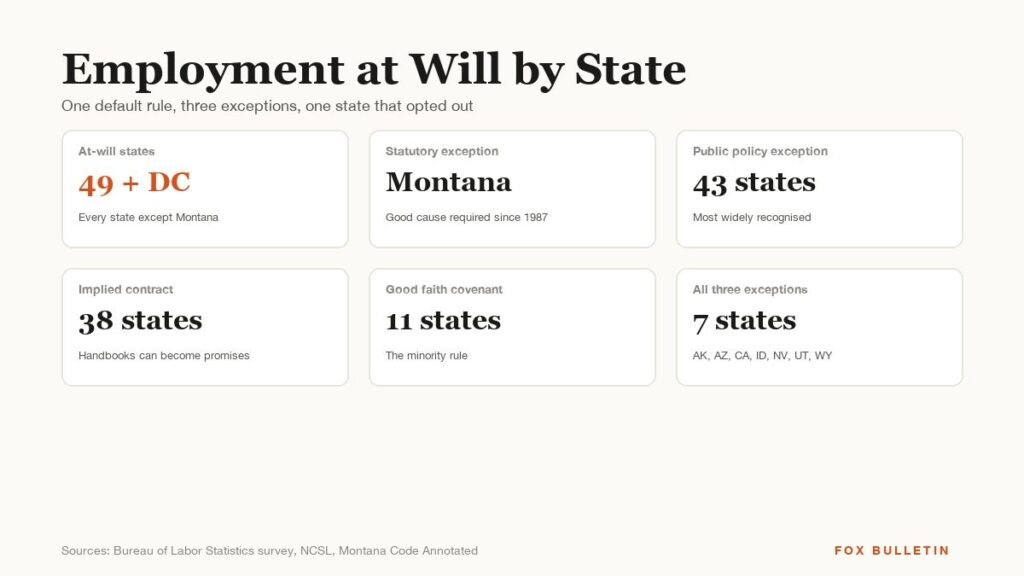
Employment at Will Explained by State: Which Exceptions Apply Where
Every state but Montana presumes employment at will, yet most limit it through public policy, implied contract and good faith exceptions. A state-by-state table and what each exception means.

Italy Moves Toward Paid Leave for Workers With Sick Pets
Italy is set to approve paid leave for workers caring for sick pets, marking a rare step in European labor law. The government plans to introduce a minimum of three days of paid sick‑pet leave, with t

Common Law Marriage States: Where It Still Exists
Only seven US states and the District of Columbia still allow couples to enter a common law marriage.