

A statute of limitations is a law that sets a deadline for bringing a legal claim. Miss it, and a court will usually throw the case out no matter how strong it was. The deadline is often just one year for a defamation suit, and for murder there is usually no deadline at all.
The exact length depends on two things: where the claim arises and what kind of claim it is. This guide shows the real deadlines in California, New York, Texas and Florida with the code section behind each one, explains the federal criminal rules, and covers the clock rules that catch people out, including what happens with old debts.
What a Statute of Limitations Means in Plain Terms
Cornell Law School's legal dictionary defines it as any law that bars claims after a set period passes following an injury. Both civil lawsuits and criminal prosecutions have them. The period is usually written into a statute by the legislature, and it differs from state to state and from one type of claim to the next.
The idea is old. Classical Athens set a five-year limit for almost all cases. Modern courts give three reasons for keeping these deadlines:
- Diligence: someone with a valid claim can reasonably be expected to pursue it within the period.
- Fair defense: evidence is lost, documents are thrown away and memories fade as years pass.
- Finality: people and businesses should not live under the threat of a decades-old claim.
One detail surprises many people. In a civil case the deadline is a defense the defendant has to raise. Federal Rule of Civil Procedure 8(c) lists the statute of limitations among the affirmative defenses a party must plead, and the Consumer Financial Protection Bureau warns that a court can still enter a judgment on an expired debt if the person sued does not show up and point it out.
Statute of Limitations by Claim Type in Four Big States
The table below compares six common civil claims in the four most populous states. Every figure comes from the state's own code: the California Code of Civil Procedure (CCP), New York's Civil Practice Law and Rules (CPLR), the Texas Civil Practice and Remedies Code (CPRC) and Florida Statutes chapter 95.
| Claim | California | New York | Texas | Florida |
|---|---|---|---|---|
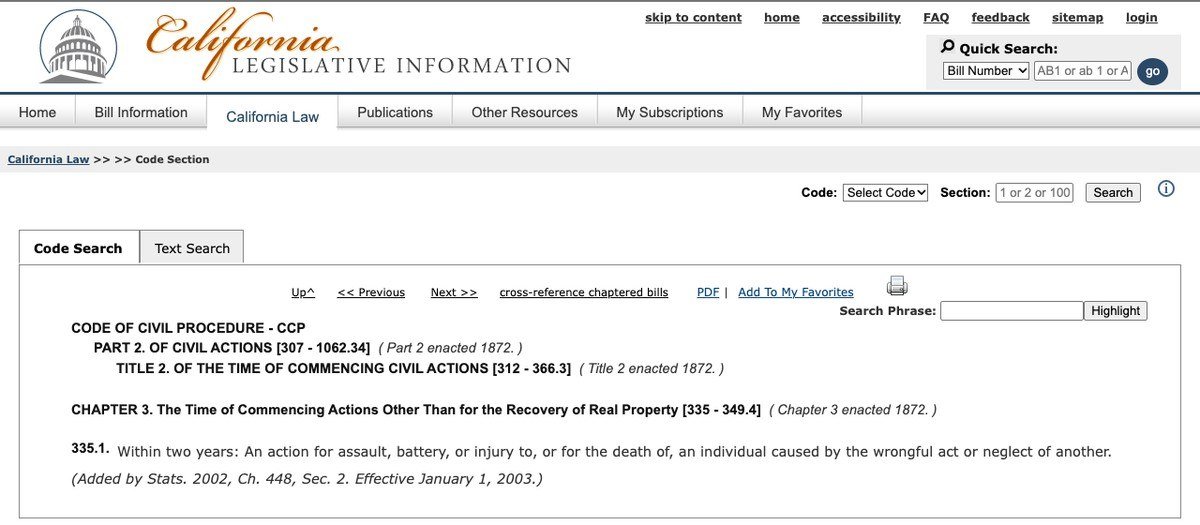
| Personal injury | 2 years (CCP 335.1) | 3 years (CPLR 214(5)) | 2 years (CPRC 16.003) | 2 years for negligence (95.11(5)(a)) |
| Written contract | 4 years (CCP 337(a)) | 6 years (CPLR 213(2)) | 4 years (CPRC 16.004, 16.051) | 5 years (95.11(2)(b)) |
| Oral contract | 2 years (CCP 339) | 6 years (CPLR 213(2)) | 4 years (CPRC 16.004, 16.051) | 4 years (95.11(3)(j)) |
| Property damage | 3 years (CCP 338) | 3 years (CPLR 214(4)) | 2 years (CPRC 16.003) | 4 years, or 2 if pleaded as negligence (95.11) |
| Medical malpractice | 3 years from injury or 1 from discovery, whichever is first (CCP 340.5) | 2 years 6 months (CPLR 214-a) | 2 years, 10-year outer limit (CPRC 74.251) | 2 years, 4-year outer limit (95.11(5)(c)) |
| Libel or slander | 1 year (CCP 340(c)) | 1 year (CPLR 215(3)) | 1 year (CPRC 16.002) | 2 years (95.11(5)(h)) |
A few of these numbers need context:
- Texas does not split written and oral contracts. A claim for money owed falls under the four-year debt provision in section 16.004, and anything without its own period gets the four-year residual rule in section 16.051.
- Florida halved its negligence deadline in 2023. House Bill 837, effective March 24, 2023, cut the general negligence period from four years to two for claims that arise after that date.
- New York treats contracts generously. CPLR 213 gives six years for any contractual obligation, written or oral, and six years is also its catch-all when no other period applies.
- Medical malpractice has two clocks. Texas allows two years, then shuts the door completely 10 years after the act or omission behind the claim. California allows three years from the injury or one year from discovery, whichever comes first.
Outside these four states the range is wide. Kentucky gives only one year for most personal injury suits under KRS 413.140, though car crash injury claims get two years under KRS 304.39-230, while Maine sets six years for all civil actions unless another statute says otherwise. Car crash claims add another layer in states with special insurance rules, which our guide to no-fault insurance states explains.
Criminal Statute of Limitations: The Federal Five-Year Rule
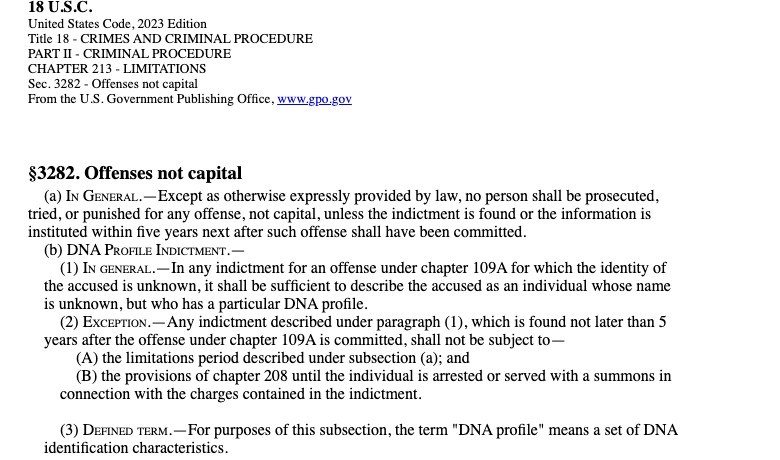
For federal crimes the default is five years. Under 18 U.S.C. 3282, no one can be tried for a non-capital federal offense unless the indictment is found within five years of the crime. Congress raised that default from three years to five in 1954.
Several federal crimes have longer limits or none at all:
- Capital offenses: any crime punishable by death can be charged at any time (18 U.S.C. 3281).
- Child kidnapping and sex crimes: kidnapping of a minor and any federal sexual abuse felony, whatever the victim's age, have no limit (18 U.S.C. 3299). Other child abuse offenses can be charged during the child's life or within 10 years, whichever is longer.
- Bank fraud: 10 years, including mail and wire fraud that affects a financial institution.
- Terrorism: eight years for certain offenses, and no limit where the act caused or risked death or serious injury.
- Fugitives: under 18 U.S.C. 3290, no statute of limitations extends to anyone fleeing from justice.
States write their own criminal deadlines. California Penal Code 799 allows prosecution at any time for crimes punishable by death or life in prison and for embezzlement of public money. New York allows any time for class A felonies such as murder, five years for other felonies, two years for misdemeanors and one year for petty offenses.
When the Clock Starts and When It Stops
Most deadlines start when the claim "accrues," which usually means the day of the injury or the breach. Some claims use the discovery rule instead, starting the clock when the victim found the harm or reasonably should have. New York's fraud deadline, for example, is six years from the fraud or two years from discovery, whichever is later.
The discovery rule has limits. In 2013 the U.S. Supreme Court ruled unanimously in Gabelli v. SEC that it does not apply to penalty suits the SEC brings for investment adviser fraud. And for the sale of goods, the Uniform Commercial Code starts the four-year clock at the breach even if the buyer has no idea anything is wrong.
Tolling pauses a clock that has already started. The common triggers:
- Age: in California and Texas, time generally does not run while the injured person is a minor, though medical malpractice and, in California, claims against public entities have their own rules.
- Incapacity: New York generally gives three years after an infancy or insanity disability ends, capped at 10 years after the claim arose; the cap does not apply to minors except in medical, dental or podiatric malpractice cases.
- Absence: California and Texas statutes both stop the clock while the defendant is out of state, though courts can narrow this when the defendant can still be served.
A statute of repose works differently. It counts from the defendant's act, not the victim's injury, and it ends the claim even if the harm has not shown up yet. California bars suits over hidden construction defects 10 years after the work is substantially complete.
The Statute of Limitations on Old Debt
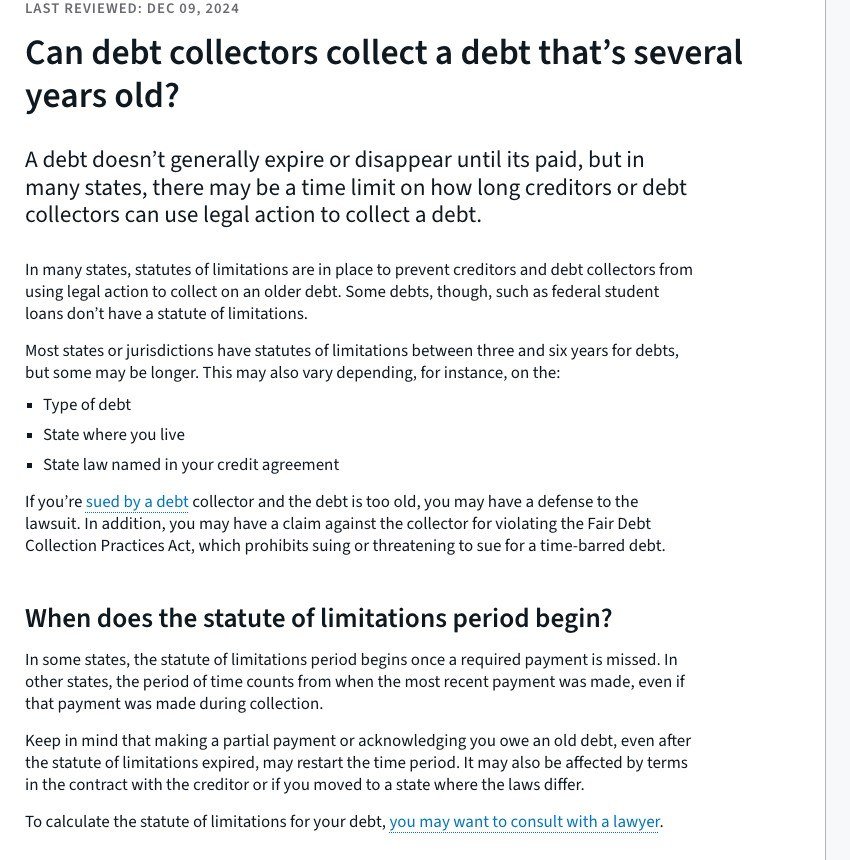
A debt does not disappear when its statute of limitations expires, but the borrower gains a defense that defeats a lawsuit if they raise it, and federal rules bar debt collectors from suing at all. The CFPB says most states set limits of three to six years for debts, and the length can depend on the type of debt, the state you live in and the state law named in your credit agreement. Federal student loans have no limit at all.
Collectors can still call or write about an expired debt in most states. What they cannot do is sue. Regulation F, the federal rule for debt collectors, says plainly in 12 CFR 1006.26 that a collector must not bring or threaten to bring a lawsuit to collect a time-barred debt.
Whether a payment restarts the clock depends on the state:
- California: a payment on a promissory note starts a new period, but a payment alone cannot revive a claim that has already expired (CCP 360).
- New York: consumer credit suits must be filed within three years, and no later payment or promise to pay revives or extends that deadline (CPLR 214-i).
- Texas: a debt buyer cannot sue on an expired debt, and a payment or reaffirmation does not revive it (Finance Code 392.307).
Your credit report runs on a separate clock. Under the Fair Credit Reporting Act, a collection account can stay on your report for seven years, counted from 180 days after the delinquency began. That seven-year window has nothing to do with your state's lawsuit deadline, so a debt can be too old to sue on and still show up on your report, or the other way round.
How to Work Out Your Own Deadline
Finding the right number takes a few steps, and the order matters:
- Name the claim. Injury, written contract, oral agreement, property damage and fraud each carry their own period, even in the same state.
- Pick the state. Usually it is where the event happened, but a contract may name another state's law.
- Read the statute itself. Every state publishes its code online. The section numbers in the table above are a starting point for four states.
- Fix the start date. Decide whether the claim accrued on the day of the event or on discovery.
- Check for tolling and short notice rules. Claims against a government often need a written notice first. In New York a claim against New York City needs a notice of claim within 90 days.
Employment claims run on especially short federal deadlines, often months rather than years, which matters even under the at-will employment rules most states follow. Smaller money disputes still run on the same statute of limitations when they go to small claims court, so a cheap claim filed late fails just like a big one.
This guide explains how the law works. It is not legal advice, and when a deadline is close, a licensed attorney in your state can confirm the exact date.
Frequently Asked Questions
Is there a statute of limitations on murder?
Generally no. Federal law allows a capital offense to be charged at any time, California allows prosecution at any time for crimes punishable by death or life in prison, and New York has no limit for class A felonies. New York classes second-degree murder as a class A-I felony.
Does paying an old debt restart the statute of limitations?
It depends on your state. The CFPB warns that a partial payment or acknowledgment may restart the clock in some states. New York says a payment does not revive an expired consumer debt, Texas says the same for debts held by debt buyers, and California says a payment cannot revive a claim that has already run out.
Can the statute of limitations be paused?
Yes. This is called tolling. Common reasons include the injured person being a minor, the defendant leaving the state, and, for federal crimes, the suspect fleeing from justice.
Is the statute of limitations the same as how long a debt stays on my credit report?
No. The lawsuit deadline is set by state law, usually three to six years. The credit report limit is set by the Fair Credit Reporting Act: seven years for a collection account, starting 180 days after the delinquency began.
Related Articles

Get the Fox Bulletin briefing
The stories that matter, in your inbox. No spam, unsubscribe anytime.
Newsletter signup will be available soon.
Related stories

Lemon Law: How a Car Qualifies and What You Get Back
A lemon law makes the manufacturer buy back or replace a new car it cannot fix. Here are the real tests in nine states, the refund formulas, and the steps to file a claim.
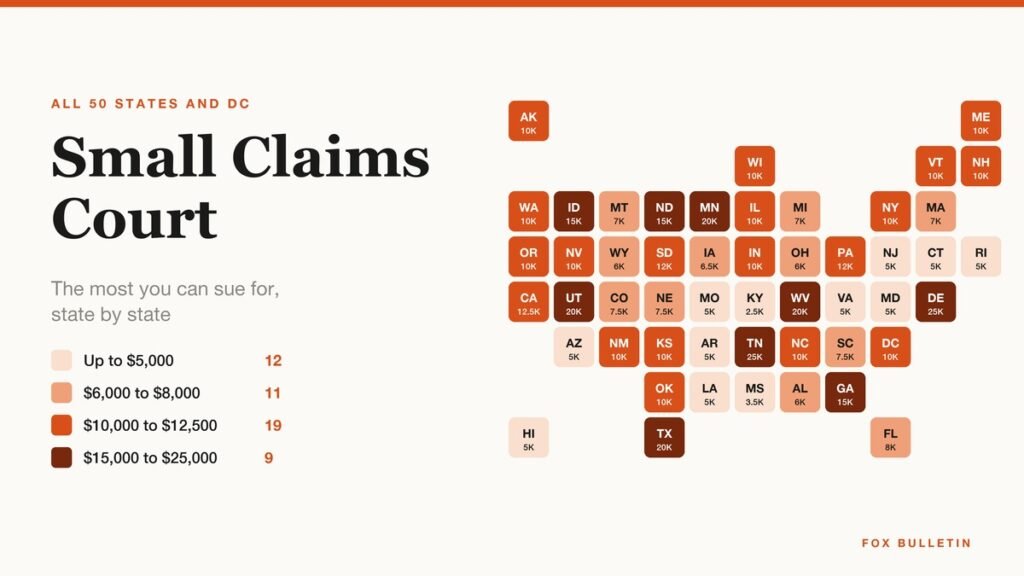
Small Claims Court: Limits in Every State and How It Works
Small claims court settles money disputes quickly and cheaply. Here is the dollar limit in every state, what it costs to file, who can bring a lawyer, and how collection works.
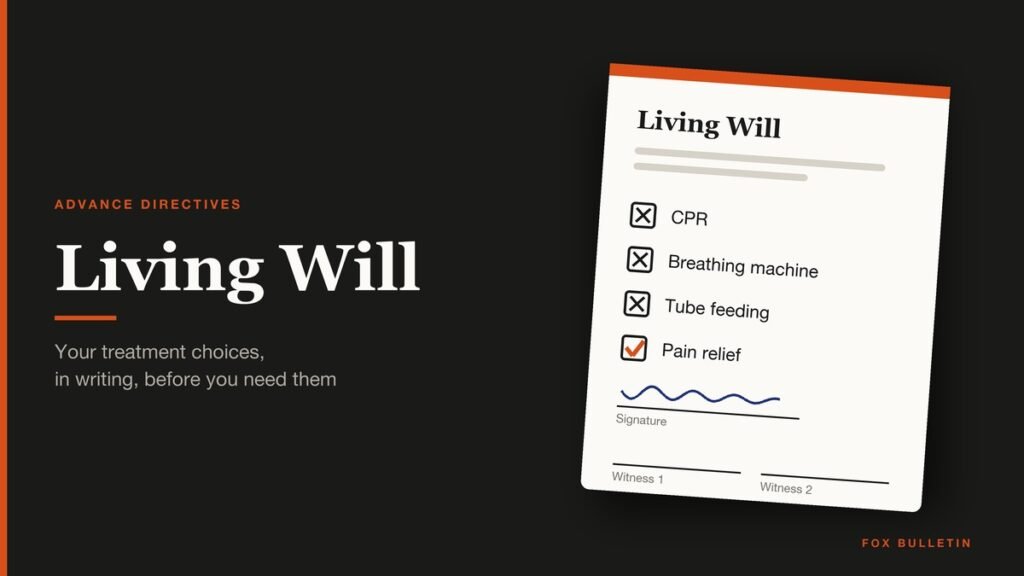
Living Will: What It Covers and How to Make One
A living will tells doctors which treatments you want if you cannot speak for yourself. Here is what it covers, how signing rules differ by state, and how to make one.