

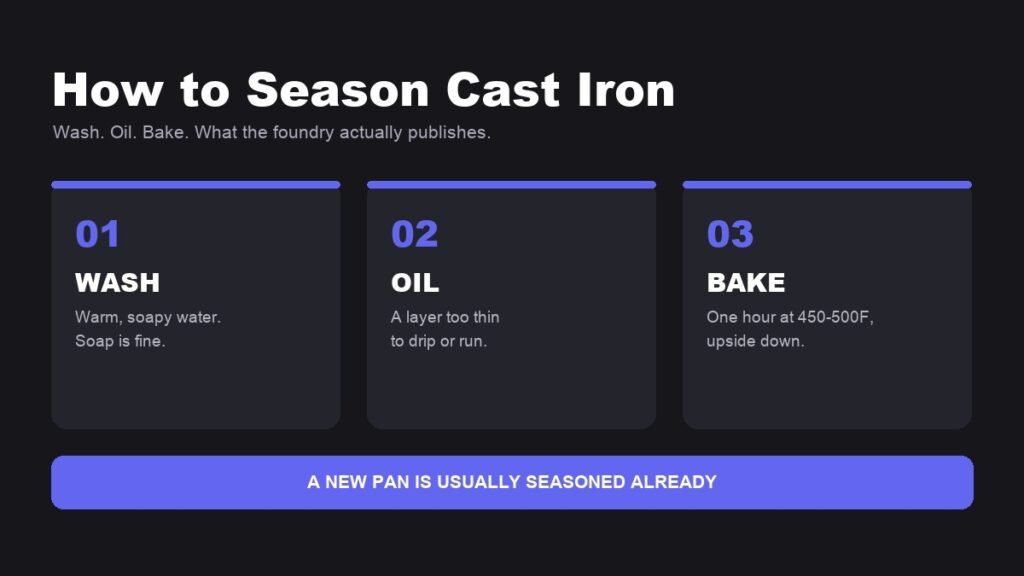
The advice on how to season cast iron has drifted a long way from what the manufacturers say. Soap is not the enemy, a new pan is usually seasoned already, and the oven step is a repair job rather than something you owe your skillet every month.
Every figure below comes from Lodge, which has cast iron in Tennessee since 1896 and publishes its own care instructions. Where kitchen lore and the foundry disagree, this follows the foundry.
Seasoning Is Polymerised Oil, Not a Coating
Lodge describes seasoning as oil baked onto the pan through polymerization. Heat oil or fat in cast iron hot enough and it stops being a liquid and becomes a slick, hardened surface bonded to the iron at a molecular level.
- It is bonded, not applied, which is why it survives washing.
- Cooking builds it, since every oily pan adds a layer.
- Patchiness is expected early on and corrects itself.
- Lodge’s own image is puzzle pieces: uneven layers interlock into one surface.
Which means the most effective thing you can do for a skillet is use it. Lodge calls regular cooking the best and easiest way to maintain seasoning, and explicitly tells owners not to worry about uneven early layers caused by hot spots or what they happened to cook.
New Pans Usually Need Nothing
Skip this step and you lose nothing. Lodge seasons every piece in its South Pittsburg foundry and ships it ready to cook, with no seasoning required at home.
If a new pan has a mark that looks unfinished or rusty, that is the manufacturing process showing. The cookware is seasoned on a hanging conveyor, so a spot or bubble can form where it hung. When it chips and shows brown underneath, that is oil which has not fully carbonised, not rust, and it is safe. It disappears with use.
The Oven Method, Step by Step
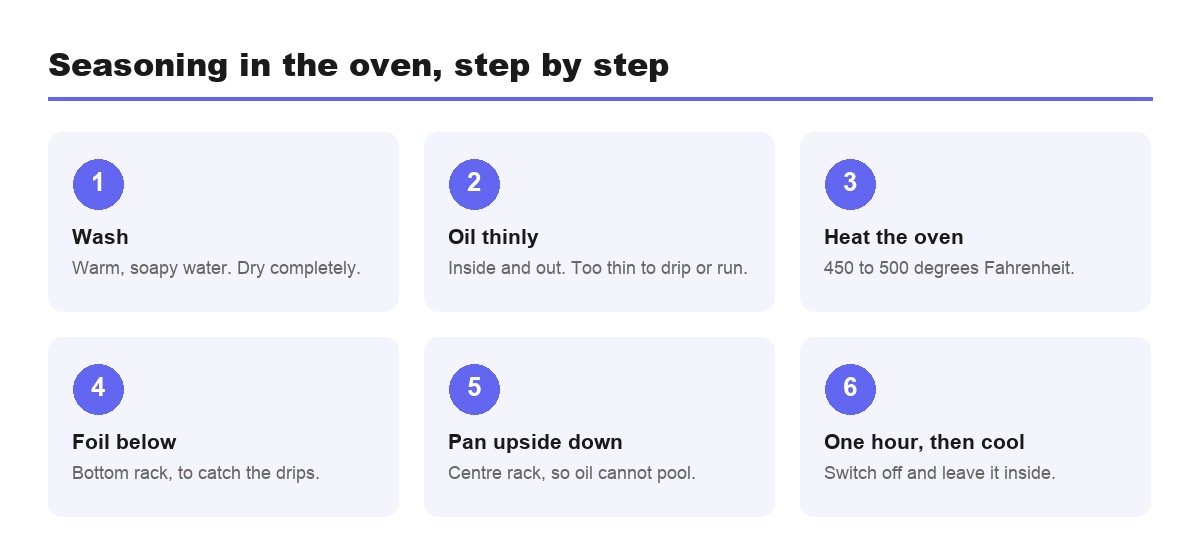
Use this on a pan that has been stripped, scoured or rescued from rust. It takes about an hour and a quarter and almost none of that is hands-on.
- Wash in warm, soapy water and dry completely with a paper towel or lint-free cloth.
- Rub a very thin layer of cooking oil over the pan, inside and out. Lodge’s test: not enough to drip or run when you tilt it.
- Heat the oven to 450 to 500 degrees Fahrenheit.
- Put foil on the bottom rack to catch excess oil.
- Place the pan upside down on the centre rack, so oil cannot pool on the cooking surface.
- Bake one hour, then turn the oven off and let the pan cool inside it.
Upside down and thin are the two instructions that decide whether this works. A pan seasoned face up with a generous coat of oil comes out tacky, because pooled oil cannot polymerise properly. Cooling in the switched-off oven is the final step rather than an optional one, since that is when the seasoning finishes adhering.
Choosing an Oil
- High smoke point for re-seasoning, because the oven goes to 450 degrees or beyond.
- Vegetable oil, melted shortening or canola, which is what the Lodge test kitchen uses.
- Whatever suits the dish when cooking, since that oil is also adding seasoning.
- Always thinly, whichever you choose.
Flaxseed oil comes up constantly in online guides as the superior choice. Lodge does not name it, and the three oils its own test kitchen uses are the ordinary ones already in most kitchens. A pan seasoned with vegetable oil and used weekly ends up in better condition than one seasoned with an expensive oil and left in a cupboard.
There is no magic oil. The variable that changes the result is quantity, not brand, and the failure people describe as a bad oil is almost always too much of a perfectly good one.
Washing Up: Soap Is Fine, Soaking Is Not
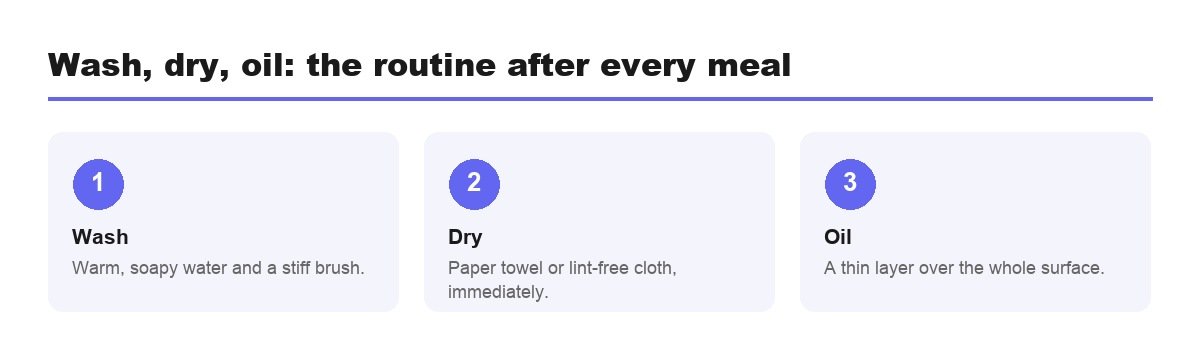
Lodge’s routine is three steps and takes about a minute after dinner.
- Wash in warm, soapy water with a stiff-bristled brush or scrubbing pad.
- Dry completely with a paper towel or lint-free cloth.
- Oil with a thin layer worked over the whole surface.
Lodge answers the soap question directly: soap is totally okay, because modern dish soap is no longer strong enough to remove seasoning, and washing prevents buildup. The rule dates from lye soaps that have not been in domestic kitchens for generations. What actually damages a pan is water left sitting on it, which is a drying problem rather than a detergent one.
Rust: Four Causes and the Fix
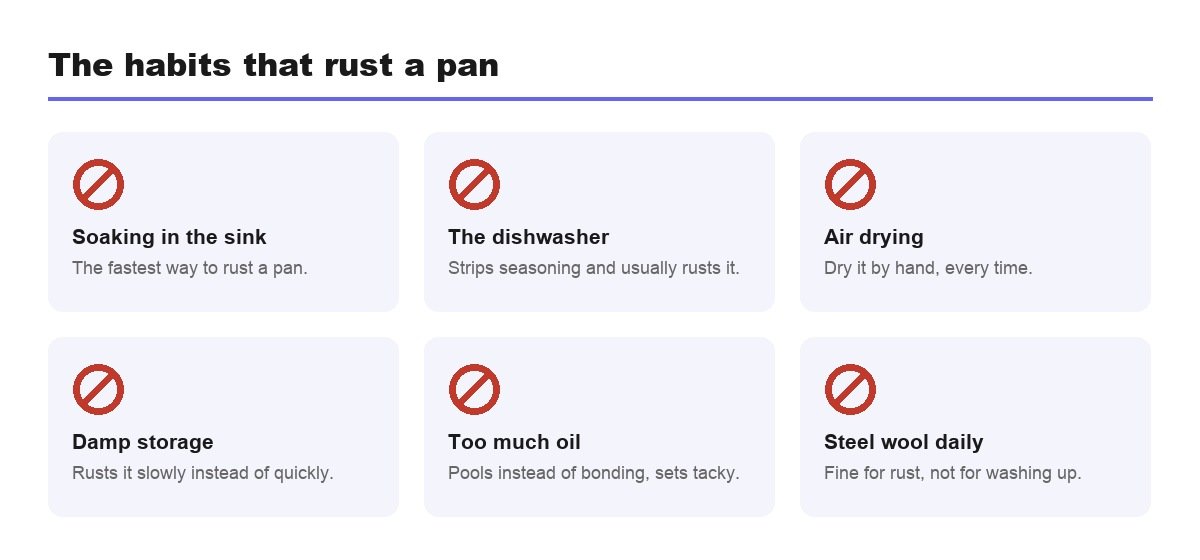
Lodge lists exactly four ways a pan rusts, and every one is water and time.
- Left to soak in the sink. Use a nylon brush or a pan scraper and rinse under warm water instead.
- Put in the dishwasher, which removes the seasoning and usually causes rust.
- Left to air dry rather than dried by hand.
- Stored somewhere damp, which does it slowly.
Reversing it is easier than the internet suggests. Scour the rust with a rust eraser or steel wool, scrubbing in warm soapy water and drying completely, then apply a very thin even layer of oil inside and out. Light rust ends there. Heavy rust needs the full oven cycle. Steel wool is fine for this job specifically, even though Lodge does not recommend it for everyday washing.
Enamelled Pans Follow Different Rules
The two products share a name and nothing else where care is concerned. Enamelled cast iron is iron under a glass coating, it has no seasoning, and Lodge says to hand wash it in warm, soapy water.
- Never oil enamel after washing, because no iron is exposed to bond with it.
- Never season it in the oven, which does nothing useful.
- It chips rather than rusts, usually from heating empty or cooling too quickly.
- If it is coloured rather than black throughout, treat it as enamel.
Bare iron is still the one that lasts longest and takes the most heat, which is why it turns up on hobs, in ovens and over fires. It sits at the opposite end of the kitchen from the appliances in our roundup of air fryers, and it will outlive all of them.
Stuck-On Food Without Wrecking the Seasoning
The moment that tempts people into soaking is a pan with something welded to it. There is a faster route that does not cost you the seasoning.
- Tackle it while the pan is still warm, not cold the next morning.
- Use a pan scraper or a nylon brush and rinse under warm running water.
- Wash normally in warm, soapy water once the debris has lifted.
- Dry immediately and oil it thinly, which is the standard finish to every wash.
Lodge recommends exactly this for stuck-on food and rules out soaking in the same breath. A plastic pan scraper costs a few dollars and removes what a night in the sink would, without leaving the iron sitting in water for eight hours. If something truly will not shift, simmering a little water in the pan for a minute loosens it, and that is different from leaving it submerged.
Habits That Keep a Pan Alive
- Cook in it, which Lodge rates above every other maintenance step.
- Dry it on a warm hob for half a minute if you want to be sure.
- Store it dry, with a paper towel between stacked pans.
- Ignore the colour, because brown and patchy is a stage rather than a fault.
Descaling a kettle, cleaning a filter, seasoning a skillet: the kitchen jobs that get skipped are the ones nobody sees the result of straight away. This one pays back fastest, because a well-used pan releases food better every month. Our guide to electric kettles covers the other one worth putting on a schedule.
Frequently Asked Questions
Is a rusty cast iron pan ruined?
Almost never. Lodge treats rust as routine and reversible: scour it off with a rust eraser or steel wool, wash and dry the pan, then oil it thinly. Light rust needs nothing more. Heavy rust needs one oven cycle afterwards, and the pan goes back into service.
Can you wash cast iron with soap?
Yes. Lodge states plainly that soap is fine, because the dish soap sold today cannot strip seasoning, and washing with it prevents buildup. Soaking the pan and putting it in the dishwasher are the real problems.
What temperature should you season cast iron at?
450 to 500 degrees Fahrenheit for one hour, pan upside down on the centre rack with foil below to catch drips, then cooled in the switched-off oven.
Why did my cast iron come out sticky?
Too much oil. The layer should be too thin to drip or run when the pan is tilted. Anything heavier pools and sets tacky instead of polymerising. Wipe most of it back off and bake the pan upside down.
How often should you season cast iron?
For a pan in regular use, rarely or never. Cooking with oil adds seasoning continuously, which Lodge calls the best method available. The oven cycle is for pans that have been stripped, scoured or rusted rather than a routine.
Related Articles

Get the Fox Bulletin briefing
The stories that matter, in your inbox. No spam, unsubscribe anytime.
Newsletter signup will be available soon.
Related stories

Happiest Countries in the World: All 10 Ranked
Finland tops the World Happiness Report 2026 at 7.764, its ninth consecutive year at number one. Iceland edges Denmark by 0.001 points, Costa Rica reaches fourth, and no English-speaking country makes the top 10 for a second straight year.

Best Oversized T-Shirts for Women: 7 Compared
The best oversized t-shirts for women differ from each other in three places: what the fabric is made of, where the shoulder seam sits and how the hem is shaped. Those three…

Best Oversized T-Shirts for Men: 7 Picks Compared
The best oversized t-shirts for men are not simply large t-shirts. The shape comes from where the shoulder seam sits and how much the fabric weighs, which is why a Pro Club…