

Halloween games are the difference between a party and a room full of costumes standing around a candy bowl. The sixteen below cover a classroom hour, a backyard after dark, a toddler party and a room of adults who will not play anything that involves a blindfold, with the rules, the player count and the supplies each one takes.
Most need things you already have: a tub, some string, a bag of candy corn, a speaker. The oldest of them is older than Halloween in America. Start here and pick by who is coming:
| Game | Players | What you need | Ages |
|---|---|---|---|
| Apple bobbing | 1 at a time | Deep tub, water, 8 to 10 small apples, towels | 5 and up |
| Snap apple | 2 to 8 | Apples on strings tied to a broom handle or doorway | 5 and up |
| Doughnut on a string | 2 to 10 | Ring doughnuts, string, a rail or two chair backs | 4 and up |
| Mummy wrap | Teams of 2 | One roll of toilet paper per team | 5 and up |
| Pumpkin bowling | 2 or more | 6 bottles with sand in the base, one small pie pumpkin | 3 and up |
| Pin the nose on the jack-o-lantern | 2 or more | Paper pumpkin on a wall, paper noses, tape, blindfold | 3 and up |
| Halloween bingo | 4 to 24 | Printed cards, candy corn or buttons as markers | 4 and up |
| Candy corn straw relay | Teams of 3 to 6 | Drinking straws, 2 cups per team, a bag of candy corn | 6 and up |
| Eyeball spoon race | 2 or more | Ping pong balls drawn as eyes, one spoon each | 4 and up |
| Monster freeze dance | Any number | A speaker and a playlist | 2 and up |
| Witch hat ring toss | 2 or more | 3 traffic cones or party hats, glow bracelets as rings | 3 and up |
| Guess the jar | Any number | Sealed jar of candy corn, slips of paper, a pen | 5 and up |
| Glow stick hunt | 4 or more | 30 to 50 cracked glow sticks, a dark yard | 4 and up |
| Mystery feel boxes | 1 at a time | 4 shoeboxes with hand holes, peeled grapes, cooked spaghetti, dried apricots | 6 and up |
| Werewolf | 7 to 20 | A deck of cards or printed role slips, one moderator | 12 and up |
| Costume charades | 6 to 20 | Slips of paper, a timer | 10 and up |
Classic Halloween Games That Still Work at a Party
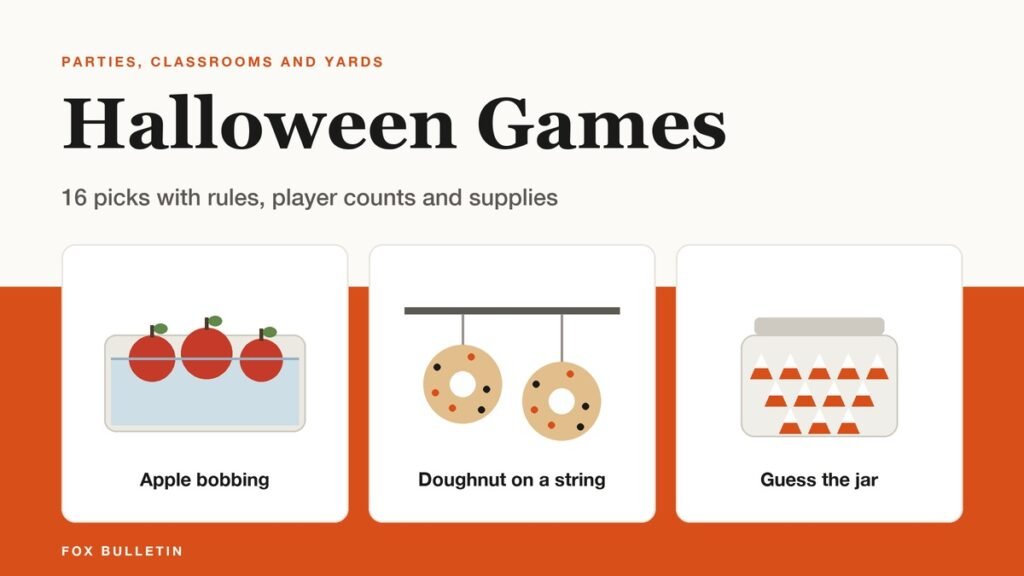
Apple bobbing, snap apple and the doughnut on a string are the three that survived, and they survived because they are funny to watch. In apple bobbing, apples float in a deep tub of water and players try to catch one in their teeth with their hands behind their backs. The game is known as dooking in Scotland and as duck-apple in northern England, and both it and the hanging-apple version were recorded in Ireland by Charles Vallancey in 1786.
Snap apple is the same idea turned upright: apples hang on strings from a beam or a broom handle held across two chairs, hands stay behind backs, and the first to eat a whole apple wins. Spinning the apple before a turn makes it much harder. A young woman who put the apple she had caught under her pillow was supposed to dream of the man she would marry, which is how a party game ended up carrying a fortune with it.
The doughnut on a string is the modern replacement for both and the one to pick for a mixed-age party. Ring doughnuts hang at chin height from a rail, hands go behind backs, and nobody puts their face in shared water. It is quicker to set up, quicker to reset between rounds and far easier to clean up.
Classroom Games for a School Halloween Party
A classroom party has three constraints a home party does not: everyone plays at once, nothing may stain and the whole thing ends on a bell. Games that need a queue, water or a dark room are out. These five fit a 45-minute slot:
- Halloween bingo, because it runs for a whole class at once, needs no movement and stops the moment the bell goes.
- Monster freeze dance, which burns off ten minutes of energy and needs nothing but a speaker.
- Pin the nose on the jack-o-lantern, taped to the whiteboard, with a scarf as the blindfold.
- Guess the jar, set up on the teacher desk in the morning and judged at the end of the party.
- Costume charades for older grades, with the slips written by the class in the first five minutes.
Halloween bingo carries the hour on its own if you let it. Print cards with pictures rather than words for the youngest grades, call items from a bag so the pace stays slow enough to follow, and hand out candy corn as markers that get eaten at the end. One pack of cards covers a class of 24 and comes back out next year.
Outdoor Games for a Yard, Driveway or Trunk or Treat
Outdoors you get space and dark, which are the two things a Halloween game can use that a living room cannot. The constraint changes to wind, lighting and how fast a game resets when thirty children are moving past. These hold up on grass or asphalt:
- Pumpkin bowling on a driveway or a flat strip of lot, with a tape line and six weighted bottles.
- Witch hat ring toss, which takes three cones and resets in one second when a throw goes wide.
- Glow stick hunt after dusk: crack 30 to 50 sticks, scatter them across the yard and give every child a bucket.
- Spider web limbo, using stretch cobweb strung between two cones and lowered one notch each round.
- Snap apple hung from a tree branch or a porch beam, which keeps the mess outside.
A glow stick hunt is the one worth planning the evening around. Crack the sticks at dusk, scatter them while the children are inside, and send everyone out with a bucket. It costs a few dollars, scales to any number of players and solves the visibility problem at the same time. The same games move straight to a parking lot event, where they turn a candy stop into a stall people queue for; our guide to trunk or treat ideas covers the layout that keeps those lines moving.
Games for Toddlers and Preschoolers
Under five, a game works when it has no losing condition and no waiting. Monster freeze dance, pumpkin bowling, witch hat ring toss and a bucket hunt for plastic spiders all qualify, because every round ends in success and the next one starts immediately.
Pin the nose on the jack-o-lantern needs one change for this age: skip the blindfold, which small children dislike more than adults expect, and have them close their eyes instead. Tape the pumpkin low enough that a three-year-old can reach the middle of it without being lifted, and let everyone go twice.
Party Games for Teens and Adults
A room of adults will not bob for apples, but it will play a social deduction game for two hours. These four need almost no supplies and scale from six people to twenty:
- Werewolf. A moderator deals secret roles, the village sleeps and wakes, and the group argues its way to a daily vote. It needs seven players to work and twelve to be good, runs 15 minutes a round and absorbs a whole room with no props at all.
- Murder wink. One guest is secretly the murderer and eliminates others by catching their eye and winking. Victims count to five and then die theatrically. It runs quietly under a party rather than stopping it, which is the point.
- Costume charades. Each guest writes a horror character on a slip, and teams act them out against a two-minute timer. Writing the slips is half the game, so keep the bowl open all evening.
- Scary movie bingo. Cards filled with the stock moments of the genre, marked while a film plays in the background. It gives the people who are not watching something to do.
Werewolf is the one that turns a party into an event, and the only real skill is in the moderator, who keeps the night phase moving and cuts the discussion off while people still have something to say. If the group would rather watch than play, a horror film with a bingo card does the same work; our list of the best Halloween movies has family picks and genuine horror in one place.
Timed Challenges for a Game Table
Timed challenges are the filler that keeps a party moving between the big games. Each one takes 60 seconds, uses supplies from the same box and can be judged by anyone standing nearby:
- Stack five mini pumpkins into a tower that stands for three seconds.
- Move six candy corn from one cup to another using a straw and suction only.
- Unroll a toilet paper mummy from a teammate and roll it back into a usable ball.
- Fish ten plastic spiders out of a bowl of water with chopsticks.
- Keep two balloons off the floor using only a paper plate as a bat.
Set them up as five stations on one long table with an index card and a timer at each, and let guests rotate at their own pace. A sheet on the wall with names and times does the work of a tournament without anyone having to organize one.
Prizes, Pacing and Running the Game Table
The games fail for logistical reasons far more often than for design reasons: a queue that never moves, a prize nobody wants, an adult who wandered off with the rules in their head. Five habits fix almost all of it:
- Run two games at once in different corners so no child waits longer than one turn, and keep one of them free of a queue entirely, such as the jar guess.
- Budget 10 minutes per game for under-sevens and 20 for older children, then stop while they still want another round.
- Have every prize visible from the start. A table of small prizes drives more participation than a single grand prize nobody can picture.
- Keep prizes non-food where you can: glow bracelets, stickers, pencils, bubbles and spider rings cost less per child than candy and sidestep every allergy question.
- Write the rules of each game on an index card and tape it to the table, so any adult can take over the station.
Non-food prizes are worth a second look even at a party with no allergy you know about. The Teal Pumpkin Project, run nationally by Food Allergy Research and Education since 2014, exists because candy excludes a share of children at every Halloween event, and the organization puts the number of people affected by food allergy in the United States at 33 million. A bowl of glow bracelets beside the candy covers it. If candy is the prize, the sweets that disappear first are predictable, and our state-by-state ranking of Halloween candy shows which ones.
Scale the plan to the crowd you will actually get. The National Retail Federation expects 74 percent of consumers to celebrate Halloween in 2026, with 50 percent dressing in costume and 42 percent carving a pumpkin, so a neighborhood party will usually draw more children than the invitations suggest. Print more bingo cards than you need and buy the second bag of candy corn.
Frequently Asked Questions
What Halloween games work for a large group?
Halloween bingo, monster freeze dance, a glow stick hunt and werewolf all scale past twenty players without becoming a queue. Bingo and freeze dance run with everyone at once, the hunt spreads players over a yard, and werewolf gets better the more people are in the circle.
What can I use instead of apple bobbing?
Hang ring doughnuts from a rail at chin height and play it with hands behind backs. It has the same shape as the original, takes two minutes to set up, avoids a tub of shared water and suits a mixed-age party.
How long should each game last at a children party?
Plan about 10 minutes per game for children under seven and up to 20 for older ones, and end each game while there is still enthusiasm for another round. Two games running in parallel in different corners keeps the waiting down.
What are good non-candy prizes for Halloween games?
Glow bracelets, stickers, bubbles, spider rings, mini notebooks, pencils and bouncy balls all cost less per child than chocolate and work for every guest regardless of allergies. Put them out where children can see them before the first game starts.
Related Articles

Get the Fox Bulletin briefing
The stories that matter, in your inbox. No spam, unsubscribe anytime.
Newsletter signup will be available soon.
Related stories

Most Expensive House in the World: Top 10, Sold or Valued
Ten of the most expensive houses in the world, split into those with a recorded or reported sale price and those valued only by estimate, with the deed, auction or accounts behind each figure.
Best Stocking Stuffers for Adults 2026: 12 Small, Useful Gadgets
The best stocking stuffers for adults are small gadgets that fix an everyday annoyance, like lost keys or a dying phone. Our top pick is the Chipolo POP, a bright Bluetooth tracker…
Self Care Gifts for Women 2026: 10 Relaxing Gift Ideas for Her
The best self care gift for a woman is one that makes an ordinary part of her day calmer, like the Himalayan Glow Salt Lamp for a soft amber glow at bedtime…