

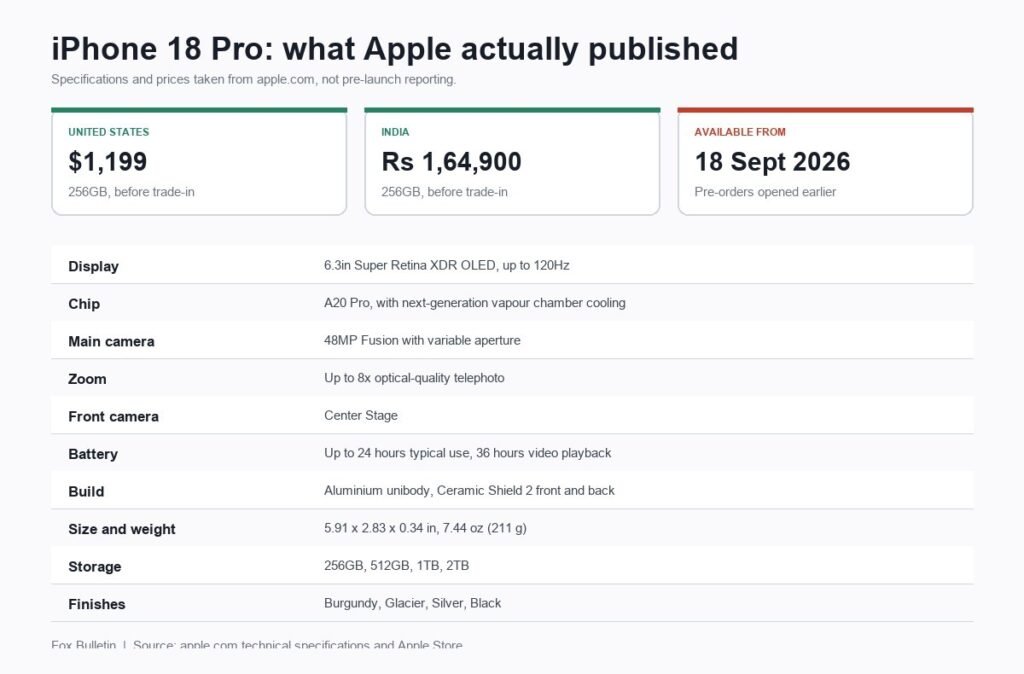
The iPhone 18 Pro is Apple’s smaller flagship for 2026, starting at $1,199 in the United States and ₹1,64,900 in India for 256GB, and available from 18 September 2026. It shares its chip, camera system and materials with the larger iPhone 18 Pro Max, so the choice between them comes down to screen size and battery rather than capability.
Apple’s own summary of the phone runs: total AI powerhouse, 48MP Main camera with variable aperture, big leap in battery life, next-generation vapour chamber, A20 Pro chip. Two of those are genuinely new to the iPhone line rather than incremental, and they are the parts of this release worth understanding properly. Everything below comes from Apple’s published specifications and store listings rather than pre-launch reporting, which for this model turned out to be wrong on several counts.
iPhone 18 Pro Specifications and Price
| Specification | iPhone 18 Pro |
|---|---|
| Display | 6.3in Super Retina XDR OLED, up to 120Hz |
| Chip | A20 Pro |
| Cooling | Next-generation vapour chamber |
| Main camera | 48MP Fusion with variable aperture |
| Other rear cameras | 48MP Fusion Ultra Wide, 48MP Fusion Telephoto |
| Additional focal lengths | 12MP optical-quality 2x and 8x telephoto |
| Front camera | Center Stage |
| Video | 4K Dolby Vision at 24, 25, 30, 60 and 100 fps |
| Battery, typical use | Up to 24 hours |
| Battery, video playback | Up to 36 hours |
| Materials | Aluminium unibody, Ceramic Shield 2 front and back |
| Dimensions | 5.91 x 2.83 x 0.34 in |
| Weight | 7.44 oz (211 g) |
| Storage | 256GB, 512GB, 1TB, 2TB |
| Connectivity | 5G sub-6GHz and mmWave, Wi-Fi 7, Bluetooth 6 |
| Finishes | Burgundy, Glacier, Silver, Black |
| Price | From $1,199 (US), ₹1,64,900 (India) |
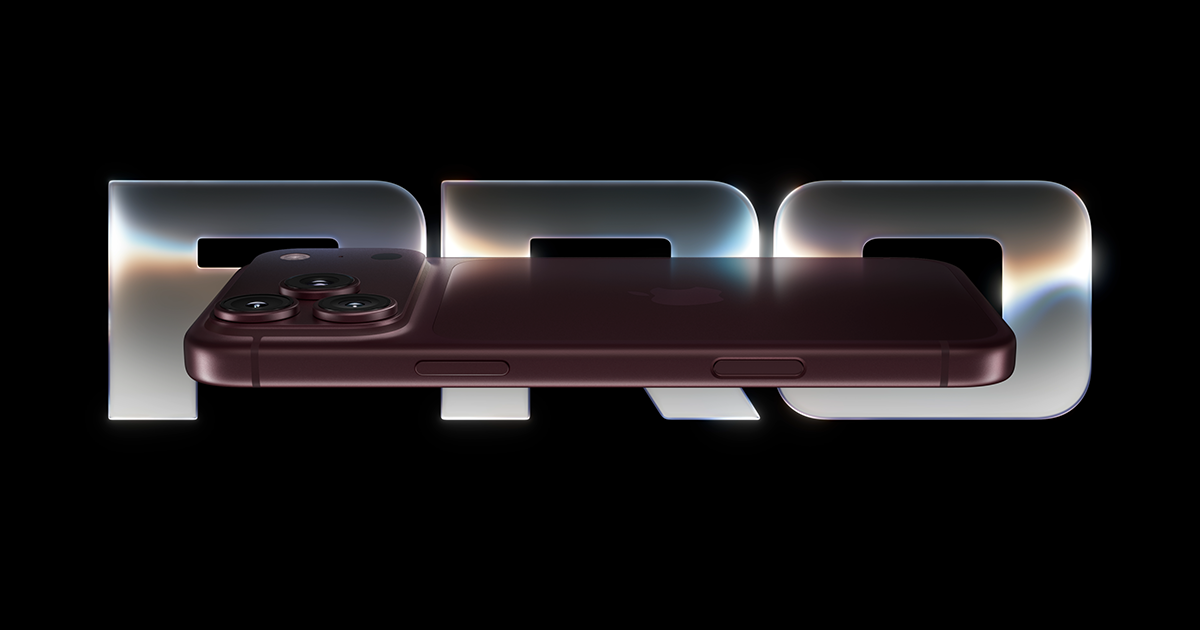
The Variable Aperture Camera Is the Actual Headline
Every iPhone since the 4S has had a fixed aperture. The lens opening was decided at the factory, and every depth-of-field effect you saw in Portrait mode was computational, assembled from depth data rather than produced optically. The iPhone 18 Pro changes that: Apple lists a variable aperture on the 48MP Fusion Main camera.
The practical consequences are worth spelling out, because this is a real optical change rather than a software feature.
- Genuine depth of field control. A wider opening produces background blur created by physics rather than estimated by an algorithm, which means no more soft edges around hair and glasses where the depth map guessed wrong.
- Better performance in bright light. A narrower aperture lets you avoid the extremely fast shutter speeds a fixed lens forces in direct sun, which is where iPhone footage has historically looked unnaturally crisp.
- More control for video. Combined with 4K Dolby Vision at up to 100 fps, aperture control gives anyone shooting seriously a lever they have never had on an iPhone.
Alongside it, the camera system covers five focal lengths rather than three: the 48MP Fusion Main, a 48MP Fusion Ultra Wide, a 48MP Fusion Telephoto, and 12MP optical-quality 2x and 8x telephoto options. The front camera is Center Stage, which frames and follows subjects automatically rather than requiring you to hold the phone still.
A20 Pro and the Vapour Chamber
The A20 Pro is the year’s new silicon, and it is identical across the iPhone 18 Pro and Pro Max, so choosing the smaller phone costs you nothing in performance. That has not always been true of Apple’s lineup and is worth knowing before paying $100 more for the larger model.
The more interesting entry is the next-generation vapour chamber. Cooling is not a specification Apple has historically advertised on iPhone, and its appearance signals what sustained performance has become the limiting factor for: recording 4K at 100 frames per second, running on-device machine learning for Apple Intelligence, and long gaming sessions all generate heat that throttles a phone long before the battery runs out. A vapour chamber spreads that heat across a larger surface instead of letting it concentrate on the chip.
What that means in use is less about peak benchmark scores and more about the tenth minute of recording, or the fortieth minute of a game, still running at the same speed as the first. Connectivity moves forward too, with Wi-Fi 7 and Bluetooth 6 alongside 5G on both sub-6GHz and mmWave bands.
Battery Life and the Size Trade
Apple quotes two battery figures for each model. The iPhone 18 Pro is rated for up to 24 hours of typical use and up to 36 hours of video playback. The Pro Max is rated for up to 30 hours and up to 45 hours respectively.
That is a 25% gap in claimed typical use between the two sizes, which is unusually wide, and it reframes the choice. The larger phone is not mainly a bigger screen with a battery bonus attached. For many buyers the battery is the reason to take it and the screen is the side effect, and the extra 1.34 ounces is the cost.
Design, Build and the Four Finishes
The iPhone 18 Pro is an aluminium unibody with Ceramic Shield 2 on both the front and the back. The previous generation paired a Ceramic Shield front with an aluminium back, so covering both faces is a genuine durability change rather than a marketing revision, and it is the main reason the phone gained weight.
At 5.91 by 2.83 by 0.34 inches and 7.44 ounces, it is a dense object by modern standards. Apple offers it in four finishes: Burgundy, Glacier, Silver and Black. Storage runs from 256GB to 2TB, and there is no expandable option, so the capacity you buy is the capacity you keep for the life of the phone.
iPhone 18 Pro vs iPhone Air vs iPhone 17
Apple now sells six iPhones, and the two models closest to the 18 Pro in price pull in opposite directions.
| iPhone 18 Pro | iPhone Air | |
|---|---|---|
| Price | From $1,199 | From $1,099 |
| Display | 6.3in Super Retina XDR | 6.5in Super Retina XDR |
| Chip | A20 Pro | A19 Pro |
| Rear cameras | Three 48MP lenses | 48MP Main and 12MP Telephoto |
| Thickness | 0.34 in | 0.22 in (5.64 mm) |
| Weight | 7.44 oz (211 g) | 5.82 oz (165 g) |
| Battery | Up to 36 hours video | Up to 27 hours video |
| Storage | 256GB to 2TB | 256GB to 1TB |
The iPhone Air is the more striking object. At 5.64 millimetres and 165 grams it is dramatically thinner and lighter, and for $100 less. What you give up is the current chip, two camera lenses and nine hours of video playback. It is a deliberate trade rather than a cheaper Pro, and anyone choosing on feel rather than specification should handle both.
The iPhone 17, at $899, remains the sensible option for anyone who does not need Pro cameras. The gap between it and the 18 Pro is $300, and most of that money buys camera hardware rather than everyday speed.
Price in the US, India and What Trade-In Changes
The list price is only part of the cost, and Apple’s trade-in programme moves the real figure substantially.
- United States: from $1,199, with trade-in credit listed between $35 and $885 depending on the device you hand in. Apple also lists financing from $49.95 a month over 24 months and leasing from $34.99 a month.
- India: from ₹1,64,900, with trade-in credit listed between ₹4,500 and ₹81,500, plus No Cost EMI from ₹26,316 a month with instant cashback.
- iPhone 18 Pro Max: from $1,299 in the US and ₹1,79,900 in India.
The spread on trade-in matters more than any discount. The difference between handing in a four-year-old phone and last year’s model is most of the price of the upgrade, so it is worth checking your specific device before deciding the phone is unaffordable.
Should You Upgrade to the iPhone 18 Pro?
- From an iPhone 17 Pro: difficult to justify at full price. You gain the A20 Pro, variable aperture and a ceramic back, on the same size screen.
- From an iPhone 15 Pro or older: a clear upgrade. The chip, the battery figures and the camera system are all substantially ahead, and trade-in credit is still meaningful on those models.
- If you photograph people: the variable aperture is the single best reason on this list to move, because optical depth of field is something no software update will bring to an older phone.
- If battery is your complaint: look at the Pro Max instead. Six extra hours of typical use for $100 is the better answer to that specific problem.
- If you want the lightest phone: the iPhone Air is 46 grams lighter for $100 less, and you should handle one before committing to the Pro.
Whichever you choose, order protection at the same time. Ceramic Shield 2 on both faces is tougher than the previous generation, but a 211 gram phone still concentrates a lot of force on one corner when it lands.
Frequently Asked Questions
How much does the iPhone 18 Pro cost?
It starts at $1,199 in the United States and ₹1,64,900 in India, both for the 256GB model, with 512GB, 1TB and 2TB options above that. The larger iPhone 18 Pro Max starts at $1,299 and ₹1,79,900. Apple lists trade-in credit of $35 to $885 in the US and ₹4,500 to ₹81,500 in India.
When does the iPhone 18 Pro go on sale?
Apple lists it as available from 18 September 2026, with pre-orders having opened ahead of that date in both the US and India. Pre-order timing generally decides whether a unit arrives in the first wave or several weeks later.
What is new on the iPhone 18 Pro camera?
The significant change is a variable aperture on the 48MP Fusion Main camera, which is the first time an iPhone has been able to change its lens opening. That produces optical depth of field rather than computational blur. The system also covers five focal lengths in total, adding 12MP optical-quality 2x and 8x telephoto options, and the front camera is Center Stage.
What colours does the iPhone 18 Pro come in?
Four finishes: Burgundy, Glacier, Silver and Black. The same four are offered on the iPhone 18 Pro Max.
Is the iPhone 18 Pro or the iPhone Air the better buy?
They answer different questions. The Air is 5.64 millimetres thick and 165 grams, against the Pro’s 0.34 inches and 211 grams, and costs $100 less. The Pro has the newer A20 Pro chip, three 48MP rear cameras against the Air’s two lenses, and nine more hours of video playback. Choose the Air for the object and the Pro for the camera.
Related Articles
- Best Mobile Cooler for Gaming: 7 Phone Coolers Compared on Power and Noise
- How to Update to iOS 27: Step by Step, Plus Fixes if It Won’t Install
- Best Smartwatches
- Best Noise Cancelling Headphones
- AirPods 5: Price, Specs and How They Compare to AirPods Pro 3
- Apple Watch Series 12: Price, Specs and Which Case to Choose
- MacBook Neo: Specs, Price and Whether $699 Buys a Real Mac
- Foldable iPhone: The iPhone Duo’s Price, Specs and Release Date
- iPhone 18 Pro Max Cases: Every Option Available at Launch
- Best AAA Games on iPhone: 10 Console Ports and What They Cost
- iOS 27 Supported Devices: iPhone List and Which Models Get Siri AI
- Best iPhone 18 Pro Cases: 7 Compared on Drops, Magnets and Style
- iPhone Recovery Mode: How to Enter and Exit It

Get the Fox Bulletin briefing
The stories that matter, in your inbox. No spam, unsubscribe anytime.
Newsletter signup will be available soon.
Related stories

Apps Gone Free for Mac Today: October 7, 2026
Which paid Mac apps are free in the US Mac App Store today, why Mac price cuts are so much rarer than iPhone ones, and the Apple apps that went free for good.

Apps Gone Free for iPhone and iPad Today: October 7, 2026
Every paid iPhone and iPad app that is free in the US App Store today, with the price it normally costs, what it does, who it suits, and whether it carries in-app purchases.

Best AirPods Pro Ear Hooks: 7 Compared on Fit and Models
Seven AirPods Pro ear hooks compared on fit, material and model compatibility, including which ones work with the Pro 3 and why none of them charge.