

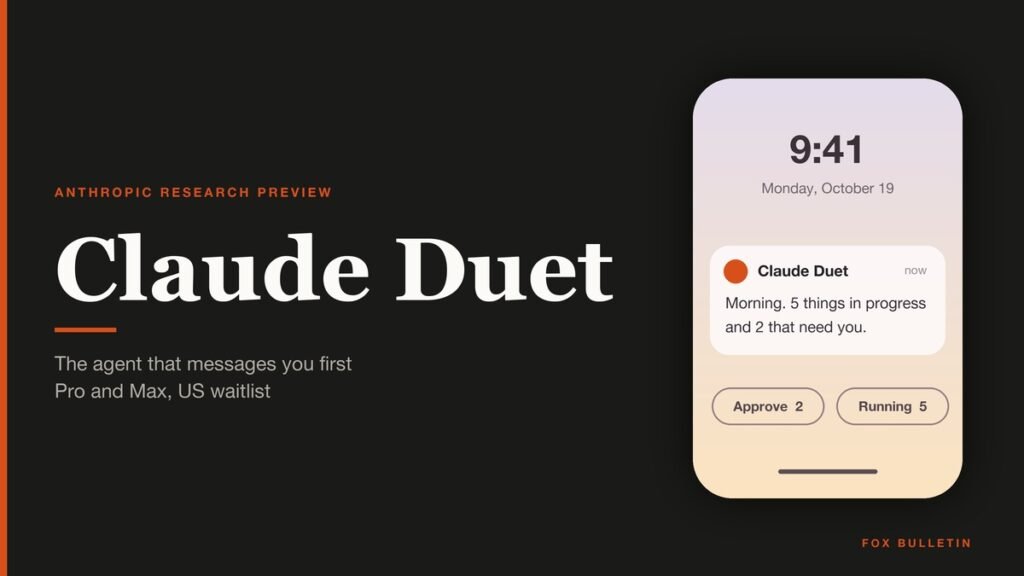
Anthropic opened a research preview of Claude Duet on October 21, 2026, and it is a different shape of product from the chat window most people associate with the company. The Claude app waits for you to start a conversation. This one starts the conversation itself, sends a brief every morning, and keeps running tasks on a machine in Anthropic’s cloud while your laptop is shut.
Access is gated. It is a waitlist, limited to Pro and Max subscribers in the United States, and the background work it does comes out of the usage allowance you already pay for rather than a separate fee. Below is what the agent actually does, the point at which it stops and asks permission, and the short list of actions it refuses outright.
What Claude Duet Is
Claude Duet is a standalone software agent app from Anthropic that monitors the apps you connect to it, messages you when something needs a decision, and completes work in the background on its own virtual machine. It runs on Claude Opus 5.5 and reuses the memory, skills and connectors already attached to your Claude account.
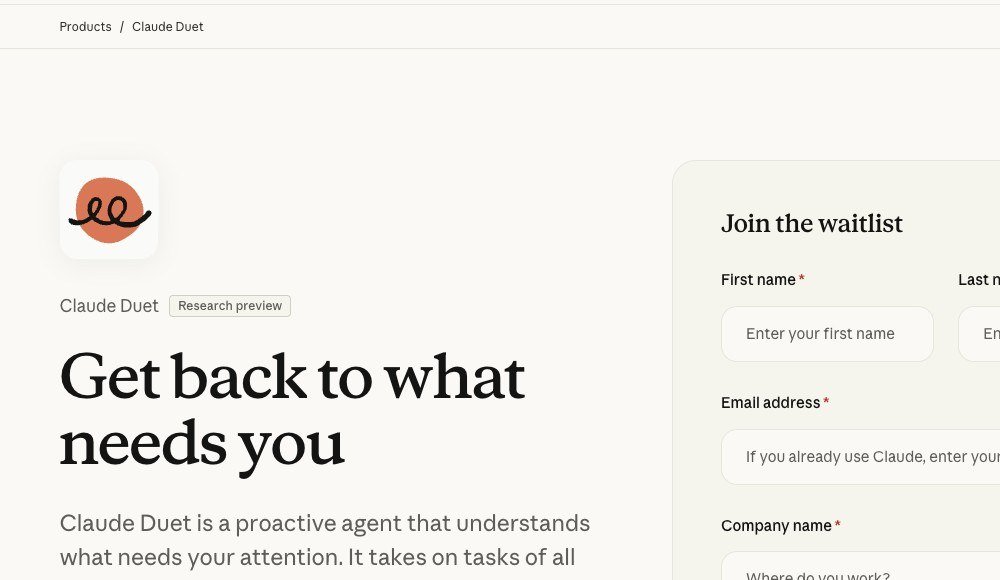
The target user is narrower than a general assistant. Anthropic built it for professionals and small business owners carrying more threads than they can hold in their heads, and the launch examples lean that way: unpaid invoices, payroll runs, contract signatures and client call prep rather than personal errands. You talk to it by text or voice in one continuous thread, so a one-line question and a project that runs for a week both land in the same place.
The Work It Takes On in Connected Apps
The agent reaches the tools your business already runs on through the Claude Marketplace, which carries more than 6,000 connectors and plugins. These are the examples Anthropic published at launch.
| # | App | What the agent does |
|---|---|---|
| 1 | Gmail and Slack | Finds messages you missed and drafts replies for you to approve |
| 2 | QuickBooks and Stripe | Checks for unpaid invoices and writes the reminder emails |
| 3 | Gusto | Prepares and runs payroll with hours, bonuses and reimbursements filled in |
| 4 | Drafts a job posting and publishes it once you edit and approve it | |
| 5 | Docusign | Prepares agreements and sends them out for review and signature |
| 6 | HubSpot | Writes follow-up emails using the contact and deal history already in the record |
| 7 | Canva | Turns a product launch into a social campaign |
| 8 | Shopify | Sets up, designs and manages a storefront |
Beyond those integrations, it handles the kind of work that used to mean blocking out an afternoon: scheduling meetings, building dashboards that pull from dozens of tools, assembling financial or sales forecasts, prototyping, and building small web apps. The output comes back as a finished document, sheet or deck for you to review rather than as a transcript you have to read through.
If you have used a team communication tool that only notifies and never acts, the difference is the virtual machine. It has its own browser, so a task keeps progressing after you close the app, and a notification arrives when the work is finished or stuck on your answer.
The Morning Brief and the Check-In Rhythm
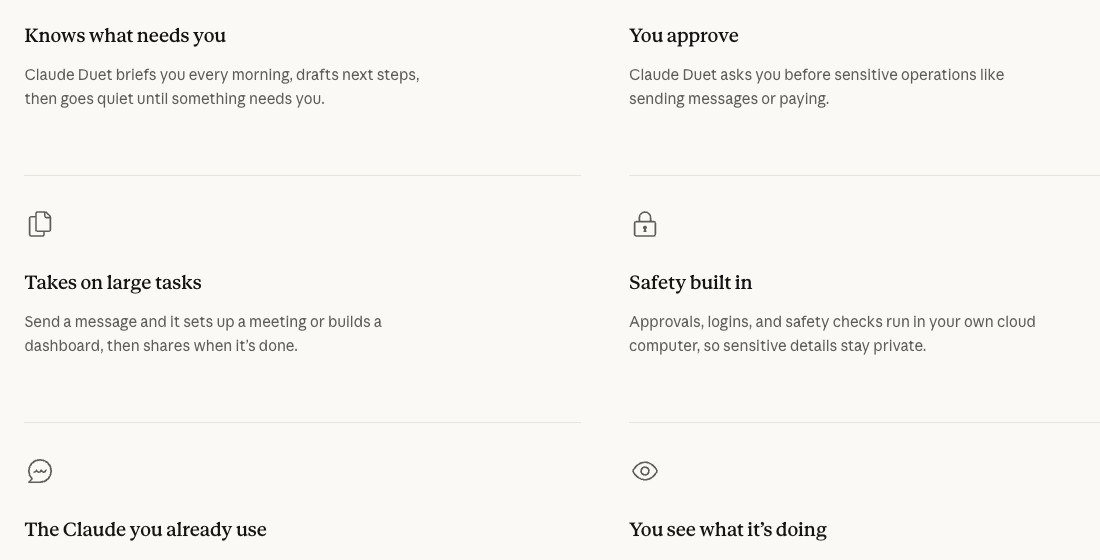
Every morning the agent sends one short brief covering the most important items across your connected accounts. After that it goes quiet. During the day it polls those accounts every few hours and messages you only when it judges that something needs you.
The gap between checks is a deliberate cost decision. Anthropic states plainly that checking nonstop would burn through your plan limits much faster, so the agent trades a little latency for a lot of headroom. You can tell it which subjects you want raised and how often, which is the main lever you have over how talkative it becomes.
That judgment is also the part the company is least confident about. The launch note says the team is still testing when the agent should interrupt and will keep tuning it on feedback from early users, which is a fair description of the hardest problem in this product category.
Where It Stops and Asks You First
The agent reads, drafts and prepares freely. Before it sends a message, makes a payment, signs a document or deletes anything, it shows you exactly what it is about to do and waits. You can also disconnect any app it has access to at any moment.
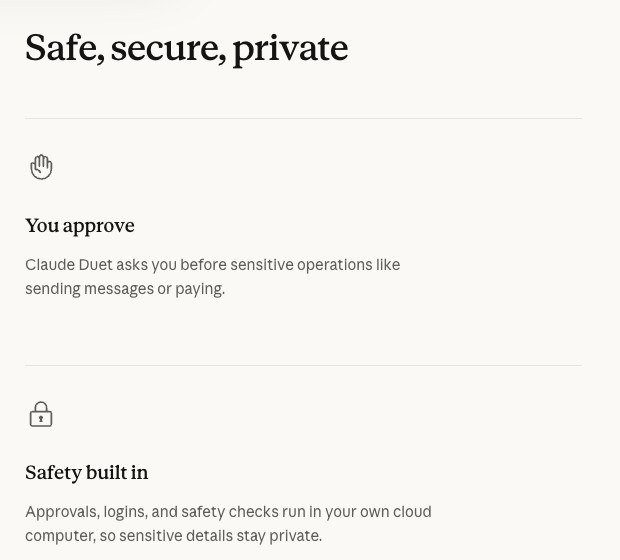
Credential handling follows the design Anthropic uses for its managed agents, so the system never directly sees your passwords or sign-in tokens. Approvals, logins and safety checks run inside the agent’s own cloud computer rather than passing through the model. Actions are screened by the same auto mode classifier that guards Claude and Claude Code against steps you did not ask for, and the defences against hidden instructions and prompt injection come out of Anthropic’s browser-use research.
A separate classifier and safety system prompt check each outgoing message for leaks. The strictest tier, credit card numbers and government identification, is rejected by default. Health details and personal finances are passed along only when you have explicitly told the agent to send them. Red teams and an outside penetration testing firm went at the infrastructure before launch, and it falls under Anthropic’s public bug bounty.
What It Refuses Even With Your Approval
A short list of actions is blocked outright, approval or not. Trading securities and moving money between accounts are the two Anthropic named. That is a meaningful boundary for a product pitched at business owners, because it rules out the agent touching brokerage or transfer rails even when you tell it to.
Purchases work differently. The agent can buy things for your business through Link, Stripe’s digital wallet. It confirms the item with you, Link asks you to approve the spend, and payment goes out on a virtual card so your real card number is never shared. Shop Pay handles checkout at Shopify stores. Signing in to sites with credentials saved in 1Password is listed as coming later, with your permission.
Getting Access to Claude Duet and What It Costs
There is no separate subscription. Access runs through a waitlist on the product page, and the research preview is open to Pro and Max subscribers in the United States. Team and Enterprise plans are not included yet.
Pro costs $17 a month on the annual plan, billed as $200 up front, or $20 billed monthly. Max starts at $100 a month. Claude Duet is included at both tiers and shares your existing usage limits with the rest of Claude, so nothing new appears on the bill.
The catch is in how those limits get spent. Background checks count against them, and heavier jobs such as building a financial model or a deck take more model turns and more background work than a normal chat. Running the agent across a busy set of connected apps will move you through your allowance faster than typing questions into the Claude app ever did.
It ships as a standalone app on iOS and Android, and on a computer you open it on the web at claude.ai. Read the full Claude Duet announcement for the launch detail.
The Rough Edges Anthropic Admits To
The company published its own list of weak spots, which is worth reading before you hand the agent anything sensitive. It may misread a thread or misjudge what counts as urgent. It can miss something that lands between two of its check-ins. Personal errands such as booking tickets are weaker than work tasks, because the core was built around business workflows.
Two structural gaps stand out. The agent cannot yet show you its browser as it works, so you see the result rather than the steps. And it lives in a separate app from the main Claude app, with no stated date for when the two converge. Anthropic says what it learns from early users will shape how they fit together.
If you are assembling an AI stack rather than picking one tool, the same caution applies here as to AI image generators and AI video tools: a research preview is a product that will change under you.
Frequently Asked Questions
Is Claude Duet free?
No. It is included with Claude Pro and Max rather than sold separately, so you need one of those plans. Pro is $17 a month billed annually or $20 monthly, and Max starts at $100 a month. The free Claude tier does not include it.
Which model does Claude Duet run on?
Claude Opus 5.5. Anthropic designed the product around that model specifically for its judgment about what needs your attention, what can wait and when to check with you before acting.
Can it send emails without asking me?
No. Reading and drafting happen on its own, but sending a message, making a payment, signing a document or deleting anything triggers an approval screen that shows you the exact action before it goes ahead.
Can I use it outside the United States?
Not during the research preview. The waitlist opened to Pro and Max subscribers in the US on October 21, 2026, and Anthropic has not published a date for other countries or for Team and Enterprise plans.
Related Articles

Get the Fox Bulletin briefing
The stories that matter, in your inbox. No spam, unsubscribe anytime.
Newsletter signup will be available soon.
Related stories
Best Tech Gifts for Men 2026: 10 Gadgets From Earbuds to Dash Cams
The best tech gift for most men is the Sony WF-1000XM6, a pair of noise cancelling earbuds he will use on every commute, call and flight. If he already has earbuds, the…

Best Gifts for Gamers 2026: 10 Gaming Gifts From Headsets to Chairs
The best gift for a gamer is a wireless headset that works on the console they already own, and the Turtle Beach Stealth 700 (Gen 3) is the safest choice when you…
Best Gifts for Car Lovers 2026: 10 Car Gadgets and Accessories
The best gift for a car lover is a good dash cam, because it records the road at the moments that matter, including at night. The VIOFO A229 Pro 2CH suits the…