
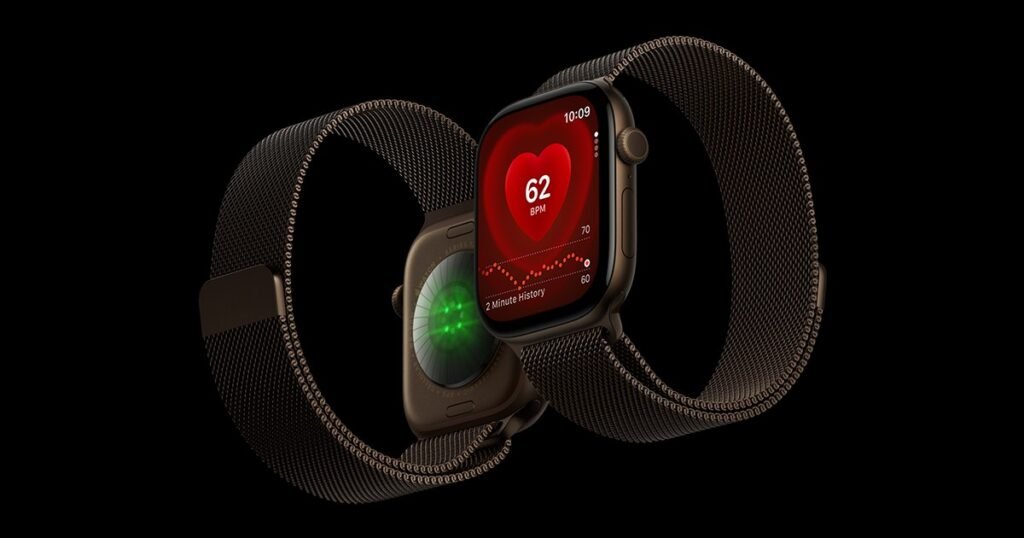
Apple Watch Series 12 starts at $399 for the aluminium model and was listed as available from 18 September 2026. The headline numbers are a 2000-nit display, the S11 chip and up to 24 hours of battery life, but the more interesting change is at the top of the range: ceramic is back as a case material for the first time in years, at $899.
Series 12 sits between the $249 Apple Watch SE 3 and the $799 Apple Watch Ultra 4, and for most people it is the one to buy. This guide covers the specifications Apple published, what each case material costs and what it actually changes, how the battery holds up, and when the Ultra is worth the extra $400.
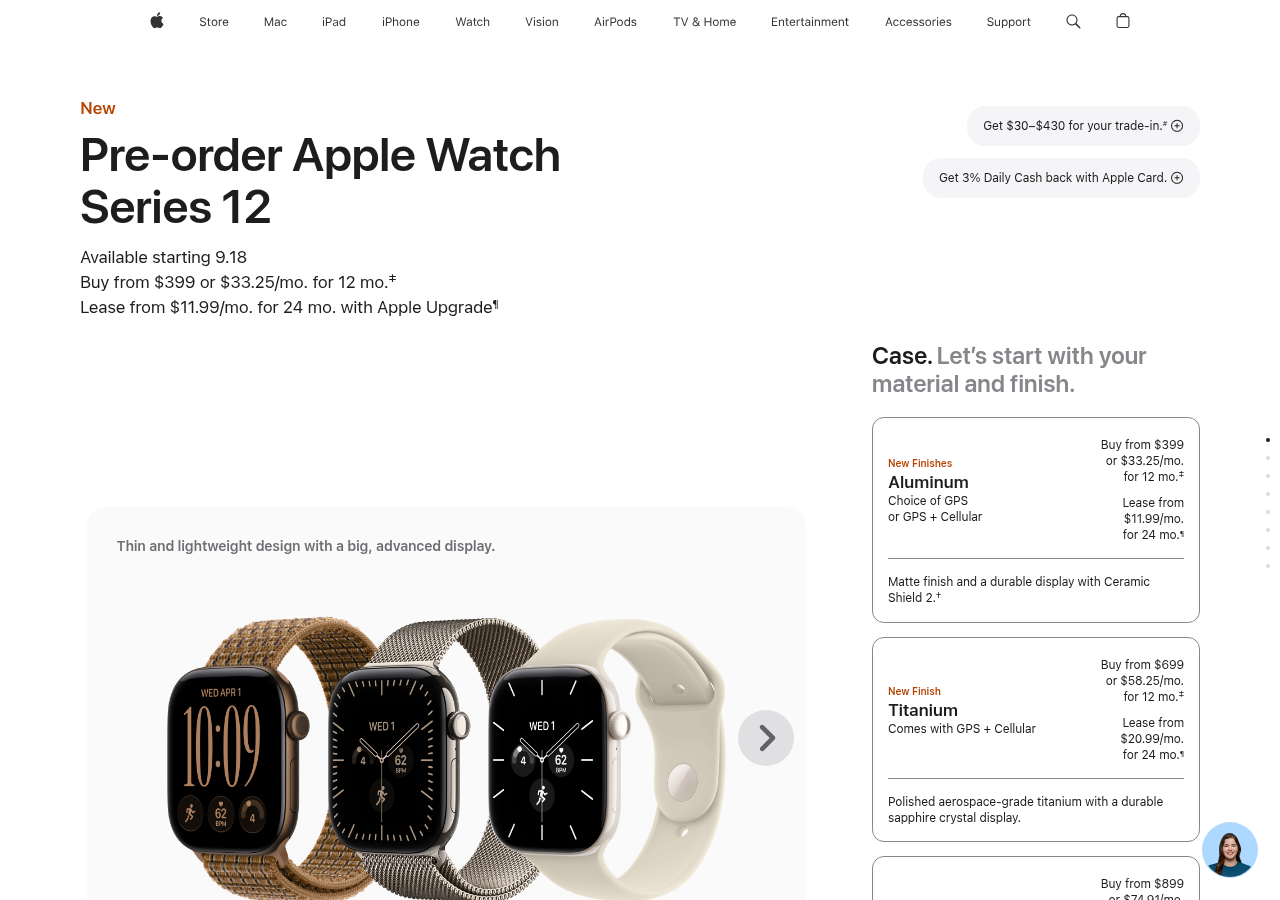
Apple Watch Series 12 Price by Case Material
Apple prices Series 12 by material rather than by feature, and the watch inside each case is the same.
| Case material | From | Finish and display | Connectivity |
|---|---|---|---|
| Aluminium | $399 | Matte finish, Ceramic Shield 2 display | GPS, or GPS + Cellular |
| Titanium | $699 | Polished aerospace-grade titanium, sapphire crystal display | GPS + Cellular included |
| Ceramic | $899 | Polished ceramic | GPS + Cellular included |
Two details matter when choosing. The aluminium model is the only one where cellular is optional, so the $399 figure is for the GPS-only version. And the display glass differs by material: aluminium uses Ceramic Shield 2, the same generation of cover glass Apple put on the iPhone 18 Pro, while titanium gets sapphire crystal, which is harder and more scratch-resistant but heavier.
Apple lists trade-in credit of $30 to $430 against an existing Apple Watch, which on the aluminium model can cover most of the price.
Full Specifications
All figures below come from Apple’s published technical specifications.
| Specification | Apple Watch Series 12 |
|---|---|
| Case sizes | 42mm and 46mm |
| Display, 46mm | 1.9 inches, 416 by 496 pixels |
| Display, 42mm | 1.8 inches, 374 by 446 pixels |
| Peak brightness | 2000 nits |
| Chip | S11 with 64-bit dual-core processor |
| Battery, normal use | Up to 24 hours |
| Battery, Low Power Mode | Up to 38 hours |
| Water resistance | 50m, swimproof under ISO standard 22810:2010 |
| Dust resistance | IP6X |
| Depth gauge | To 6 metres |
| Connectivity | Bluetooth 5.3, Wi-Fi, GPS, GLONASS, Galileo, QZSS, BeiDou |
| Other | Apple Pay, GymKit |
| Price | From $399 |
The Sensor Array Is the Real Product
A smartwatch is mostly a collection of sensors with a screen attached, and Series 12 carries a long list.
- Second-generation electrical heart sensor. The one that produces an ECG rather than a pulse reading.
- Always-on optical heart sensor. Continuous heart rate, which drives resting rate trends and high and low heart rate notifications.
- Blood oxygen sensor.
- Temperature sensor. Used for overnight wrist temperature tracking rather than as a thermometer.
- Depth gauge to 6 metres and a water temperature sensor. Features that used to be Ultra exclusives, now on the standard watch.
- Always-on altimeter, compass, high-g accelerometer, high dynamic range gyroscope and ambient light sensor.
The depth gauge and water temperature sensor are the notable inclusions. They are not diving instruments at 6 metres, but they cover snorkelling and pool use, and their presence narrows the practical gap between Series 12 and the Ultra for anyone who is not actually diving.
Battery Life and the 2000-Nit Display
Apple rates Series 12 at up to 24 hours of normal use and up to 38 hours in Low Power Mode. In practice the 24-hour figure means charging daily, usually while showering or at a desk, and the Low Power figure is what gets you through a night of sleep tracking followed by a full day without a charger.
The display peaks at 2000 nits, which is a specification that only matters outdoors. Indoor brightness has been sufficient on Apple Watches for years; the reason peak brightness keeps climbing is direct sunlight, where a dimmer screen forces you to shade the watch with your other hand to read it. At 2000 nits that stops being necessary in most conditions, though the Ultra 4 goes further at 3000 nits.
Series 12 vs Ultra 4 vs SE 3
Apple sells three watches, and the decision is less about features than about what you are willing to wear.
| SE 3 | Series 12 | Ultra 4 | |
|---|---|---|---|
| From | $249 | $399 | $799 |
| Case | Aluminium | Aluminium, titanium or ceramic | Titanium, 49mm |
| Peak brightness | Lower | 2000 nits | 3000 nits |
| Battery, normal | Shorter | Up to 24 hours | Up to 50 hours |
| Battery, Low Power | Shorter | Up to 38 hours | Up to 84 hours |
| Water resistance | 50m | 50m | 100m |
| Satellite | No | No | Yes |
The Ultra 4 more than doubles the battery and adds satellite communication and a 100 metre rating, for $400 more and a 49mm case that does not suit every wrist. The SE 3 saves $150 and gives up display brightness and battery. Series 12 is the middle option in the literal sense: it is what most people should buy unless they have a specific reason not to.
Which Case Material Should You Choose?
- Aluminium at $399 is the right answer for the overwhelming majority. It is the lightest, the cheapest, and it uses the same Ceramic Shield 2 glass as Apple’s newest iPhone.
- Titanium at $699 buys a polished aerospace-grade case, a sapphire crystal display and cellular as standard. The sapphire resists scratches better than any cover glass, which matters if you knock your wrist against things.
- Ceramic at $899 is a materials choice rather than a functional one. Ceramic is extremely scratch-resistant and holds its finish, and it is heavier and more brittle than metal under a sharp impact.
Nothing about the watch itself changes between them. The processor, sensors, display resolution and battery are identical, so the $500 spread between aluminium and ceramic buys appearance, glass and cellular, not capability.
What the S11 Chip Changes Day to Day
Apple puts the S11 with a 64-bit dual-core processor in both Series 12 and the Ultra 4, so the two watches perform identically. Watch silicon rarely produces a dramatic year-on-year difference in how fast apps open, and the honest summary is that the chip matters less here than it does on a phone.
Where it does show up is in the things that run continuously. Always-on heart rate monitoring, wrist temperature tracking overnight, sleep staging and the processing behind fall and crash detection all run in the background, and a more efficient processor is what allows those to stay on without destroying the 24-hour battery figure. The chip is buying endurance rather than speed.
Connectivity is Bluetooth 5.3 plus Wi-Fi, with GPS supported alongside GLONASS, Galileo, QZSS and BeiDou. That multi-constellation support is what keeps a running route accurate between tall buildings, where a single satellite system loses the plot.
What Series 12 Does Not Have
Three absences are worth knowing before buying, because each is a reason some people should look at the Ultra 4 instead.
- No satellite communication. Series 12 cannot send messages without cellular or Wi-Fi coverage. If you hike or sail beyond network coverage, that is the single strongest argument for the Ultra.
- 50 metres rather than 100. Fine for swimming and snorkelling, not rated for recreational diving.
- One day of battery. Every multi-day trip means carrying the charger, where the Ultra’s 50-hour rating can cover a weekend outright.
None of those affect ordinary daily use, which is precisely why Series 12 rather than the Ultra is the right watch for most buyers.
Should You Upgrade to Series 12?
- From a Series 10 or 11: hard to justify. The generational changes are incremental and your existing bands, charger and apps all continue to work.
- From a Series 7 or older: a real upgrade. Brightness, battery, the sensor array and the processor have all moved on substantially, and trade-in credit is still available.
- From no Apple Watch at all: Series 12 at $399 is the sensible entry point rather than the SE, because the display and battery are where cheaper watches feel cheap day to day.
- If you swim, hike or run long: compare against the Ultra 4 before deciding. The battery difference is the thing you will notice, not the specification sheet.
If you are looking across brands rather than only at Apple, our roundup of the best smartwatches covers what the competition offers at each price.
Frequently Asked Questions
How much is the Apple Watch Series 12?
From $399 for aluminium, $699 for titanium and $899 for ceramic. The aluminium model is the only one where cellular is optional, so $399 buys the GPS-only version. Apple lists trade-in credit of $30 to $430 against an existing Apple Watch.
What is the battery life of the Apple Watch Series 12?
Up to 24 hours of normal use and up to 38 hours in Low Power Mode. That means charging daily in ordinary use, and Low Power Mode is what carries you through overnight sleep tracking plus a full following day.
What sizes does the Apple Watch Series 12 come in?
Two: 42mm and 46mm. The 46mm has a 1.9-inch display at 416 by 496 pixels, and the 42mm has a 1.8-inch display at 374 by 446 pixels. Both peak at 2000 nits and share the same S11 chip, sensors and battery rating.
Is the Apple Watch Series 12 waterproof?
It is water resistant to 50 metres and swimproof under ISO standard 22810:2010, with IP6X dust resistance and a depth gauge that reads to 6 metres. That covers swimming and snorkelling. For diving, the Ultra 4 is rated to 100 metres.
Is Series 12 or Ultra 4 the better buy?
Series 12 for most people, Ultra 4 if battery life or the outdoors are the reason you are buying. The Ultra 4 runs up to 50 hours normally and 84 hours in Low Power Mode against 24 and 38, peaks at 3000 nits against 2000, is rated to 100 metres, and adds satellite communication. It costs $400 more and only comes in a 49mm case.
Related Articles

Get the Fox Bulletin briefing
The stories that matter, in your inbox. No spam, unsubscribe anytime.
Newsletter signup will be available soon.
Related stories
Apps Gone Free for Mac Today: October 7, 2026
Which paid Mac apps are free in the US Mac App Store today, why Mac price cuts are so much rarer than iPhone ones, and the Apple apps that went free for good.
Apps Gone Free for iPhone and iPad Today: October 7, 2026
Every paid iPhone and iPad app that is free in the US App Store today, with the price it normally costs, what it does, who it suits, and whether it carries in-app purchases.
Best AirPods Pro Ear Hooks: 7 Compared on Fit and Models
Seven AirPods Pro ear hooks compared on fit, material and model compatibility, including which ones work with the Pro 3 and why none of them charge.