

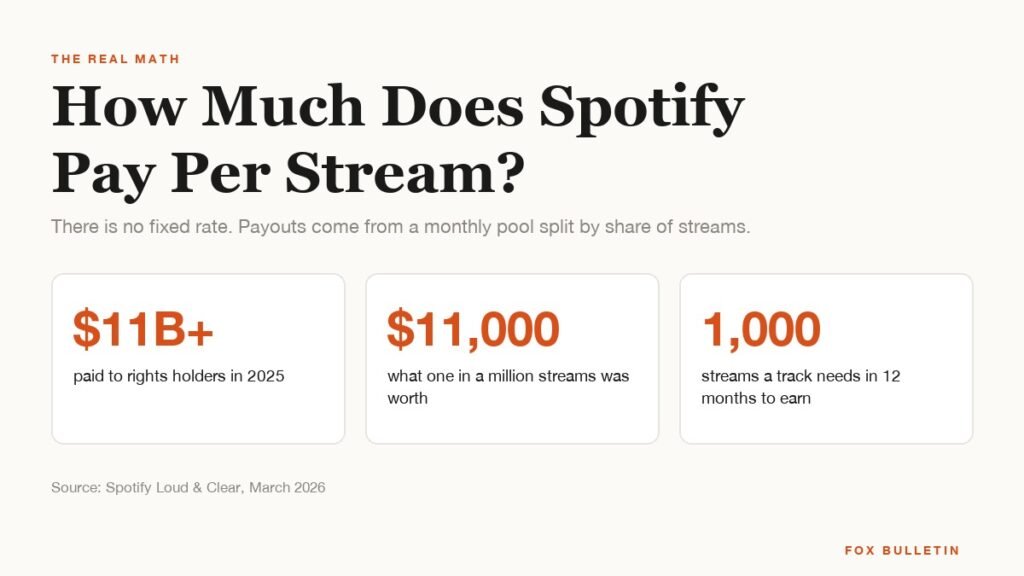
How much does Spotify pay per stream? Officially, nothing per stream: Spotify pays rights holders a share of a monthly revenue pool in each market, sized by their share of that market’s streams, a method it calls streamshare. Industry estimates that work backwards from those payouts put the average at roughly $0.003 to $0.005 per stream, before the label or distributor takes its cut.
The figures Spotify publishes in its Loud & Clear report each March are the only official numbers. Spotify paid more than $11 billion to rights holders in 2025, and capturing one in every million streams on the service was worth about $11,000 that year. This guide explains how the pool works, what an artist actually receives, and why the per-stream figure keeps changing.
Spotify Payouts in 2025: The Key Figures
| Figure | Spotify’s 2025 number |
|---|---|
| Total paid to rights holders in 2025 | More than $11 billion |
| Total paid since launch | Nearly $70 billion |
| Share of music revenue paid out | About two-thirds |
| Value of one in a million streams | About $11,000 in 2025, up from $1,000 in 2014 |
| Artists generating $10,000 or more | More than 81,000 |
| Artists generating $100,000 or more | 13,800 |
| Artists generating $1 million or more | More than 1,500 |
| Minimum streams for a track to earn | 1,000 in the previous 12 months |
Why There Is No Per-Stream Rate
Spotify’s Loud & Clear FAQ puts it plainly: fans pay for unlimited access, not per track, so there is no fixed per-stream payment. Each month the net revenue from Premium subscriptions and ads in a given country goes into a pool. A rights holder’s payment is that pool multiplied by their streamshare, which is their streams in that market divided by the total streams in that market.
That design means the implied rate per stream moves with three things: how much revenue the market produced, how many streams it took to divide that revenue, and whether the streams came from paying or ad-supported listeners. A stream in a country with high subscription prices and few total streams is worth more than one in a market with low prices and heavy free-tier listening.
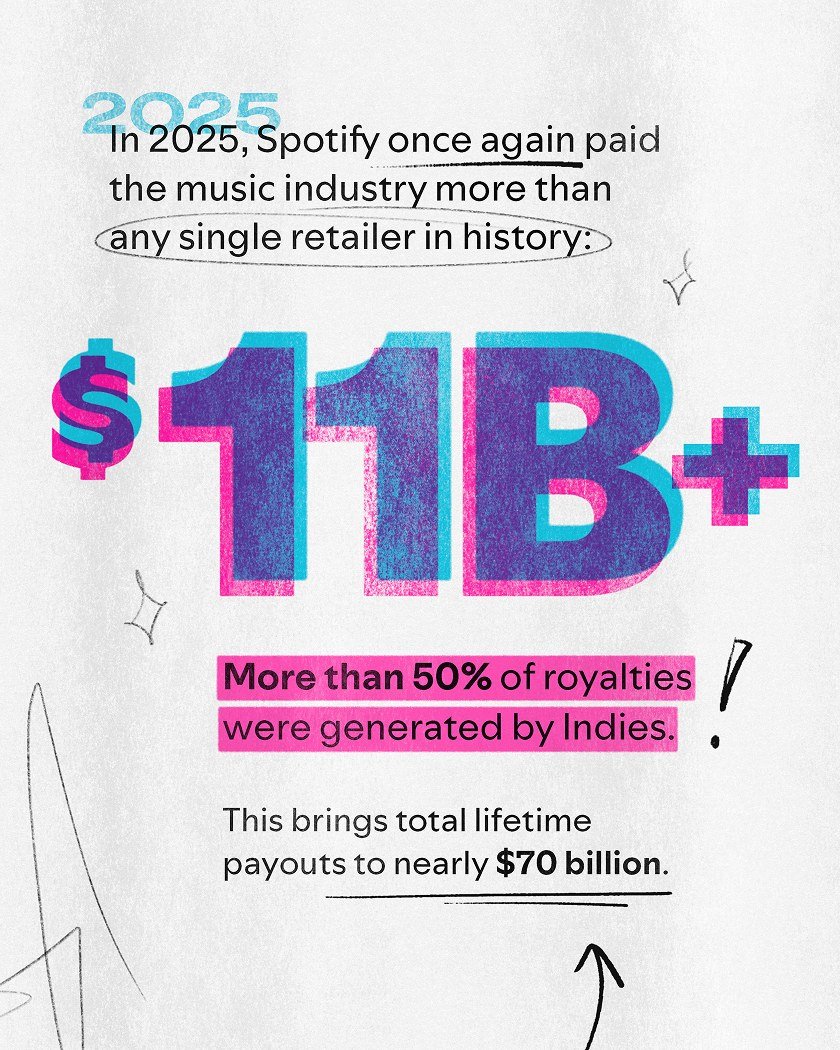
Spotify says it pays out roughly two-thirds of its music revenue to rights holders, and it reports the total rather than a rate: more than $11 billion in 2025, which it calls more than any single retailer has paid the music industry in a year, and nearly $70 billion since launch.
What the Estimates Say Spotify Pays Per Stream
Because the payouts and the stream counts are both large and partly public, analysts and distributors publish per-stream averages. Most land between $0.003 and $0.005 for a global average, with US streams at the top of that range and streams in lower-priced markets well below it. These are gross figures, calculated before anyone between Spotify and the artist is paid.
Apple Music is the one rival that has put a number in writing. In an April 2021 letter to labels, reported by the Wall Street Journal, it said its payouts averaged $0.01 per play on individual paid plans in 2020. Apple also pays on a stream-share basis, so that cent is an average, not a rate, and it reflects a service with no free tier.
Spotify’s own framing is that the per-stream comparison is misleading because its free tier adds streams that generate less revenue, lowering the average while adding money to the pool. The FAQ links to a separate explanation of why its per-stream figure appears lower than services without ads.
From Spotify to the Artist: Who Takes What
Spotify pays rights holders, not artists. Its royalties guide describes two streams of money. Recording royalties go to whoever owns the recording, usually a label or a distributor, which then pays the artist under their contract. Publishing royalties go to publishers, collecting societies and mechanical agencies on behalf of songwriters.
What reaches the artist depends on that contract. A self-releasing artist through a distributor keeps most of the recording royalty after the distributor’s fee or cut. A signed artist receives the royalty rate in their deal, often after recoupable costs. The songwriter share arrives separately and later, through the publishing chain.
Timing is monthly in many cases, Spotify says, but the exact schedule and amount depend on each agreement. Questions about recording money go to the label or distributor; questions about publishing money go to the publisher or collecting society. Spotify for Artists shows streams, not payments.
- Recording royalty: paid to the label or distributor, then to the artist by contract
- Publishing royalty: paid to the publisher or collecting society, then to the songwriter
- Spotify’s share: roughly a third of music revenue, covering its costs and margin
The 1,000-Stream Rule and the Other 2024 Changes
Since April 1, 2024 a track must have at least 1,000 streams in the previous 12 months to generate recording royalties on Spotify. The company’s announcement said tracks below that line had generated an average of $0.03 a month each, money that was rarely reaching anyone because distributors hold small balances until they clear a withdrawal threshold.
Spotify says 99.5 percent of streams come from tracks that meet the threshold, that 3.5 million artists had at least one qualifying track in 2025, and that the money redirected from sub-threshold tracks amounts to tens of millions of dollars a year that now flows to eligible tracks instead.
Two further rules arrived with it. Functional noise recordings, such as white noise and rain, must now run at least two minutes to earn royalties, and labels and distributors are charged per track when flagrant artificial streaming is detected on their content. Spotify framed the package as moving roughly an additional $1 billion toward emerging and professional artists over five years.
How Many Artists Make Real Money on Spotify
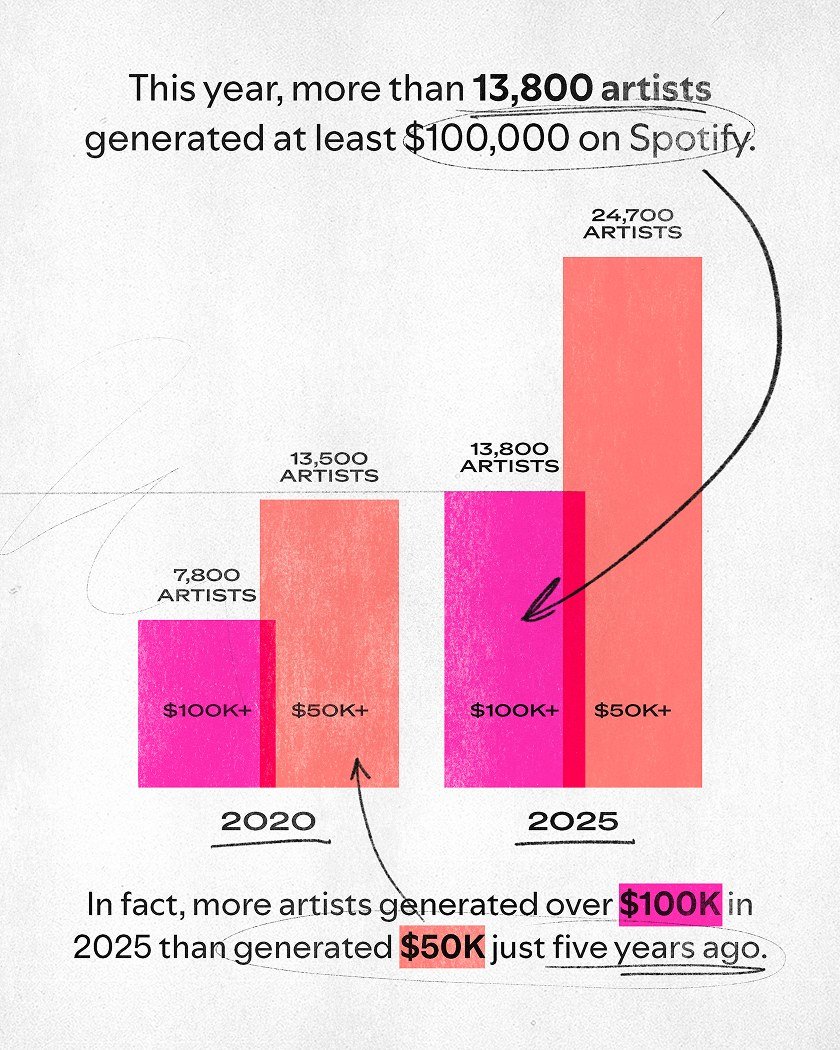
Spotify reports earnings by tier rather than by artist. In 2025 more than 81,000 artists generated at least $10,000 from Spotify alone, 13,800 generated at least $100,000 and more than 1,500 generated at least $1 million. Each of those counts is around three times what it was in 2017.
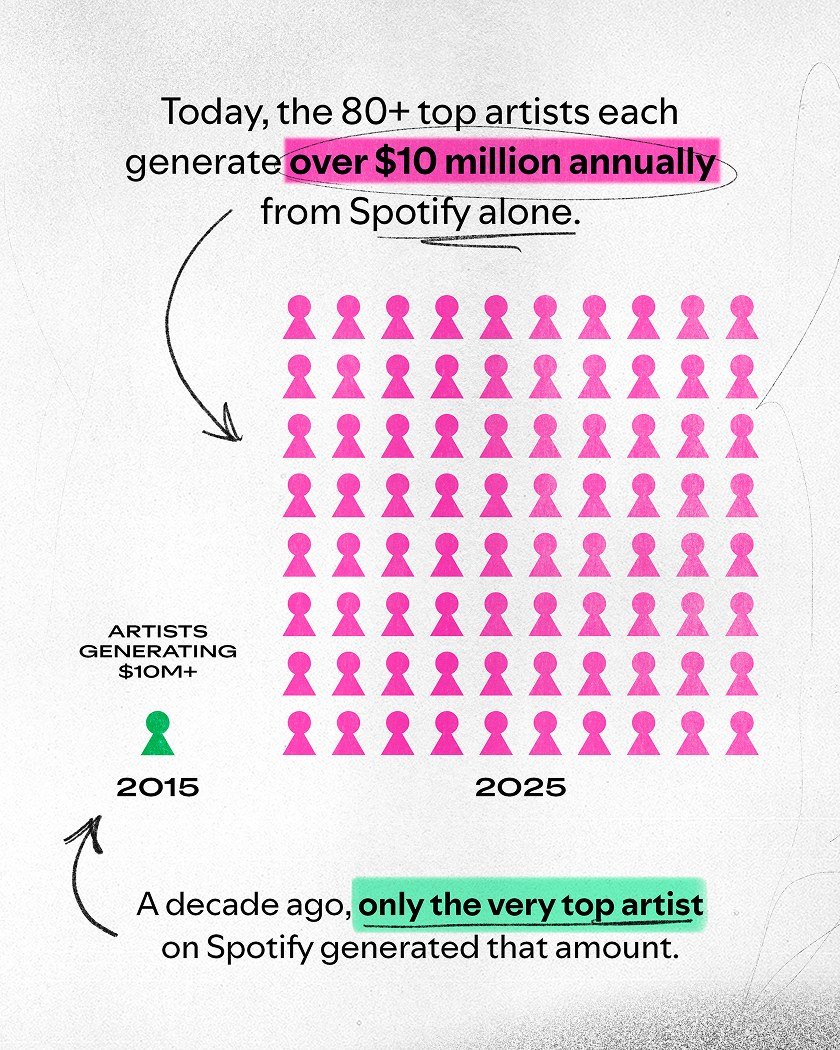
The report also tracks a fixed position in the ranking. The 10,000th-ranked artist on Spotify went from earning $34,000 in 2017 to $147,000 in 2025, and Spotify says more than 30 percent of professional or aspiring professional artists earned $10,000 or more from the service in 2025.
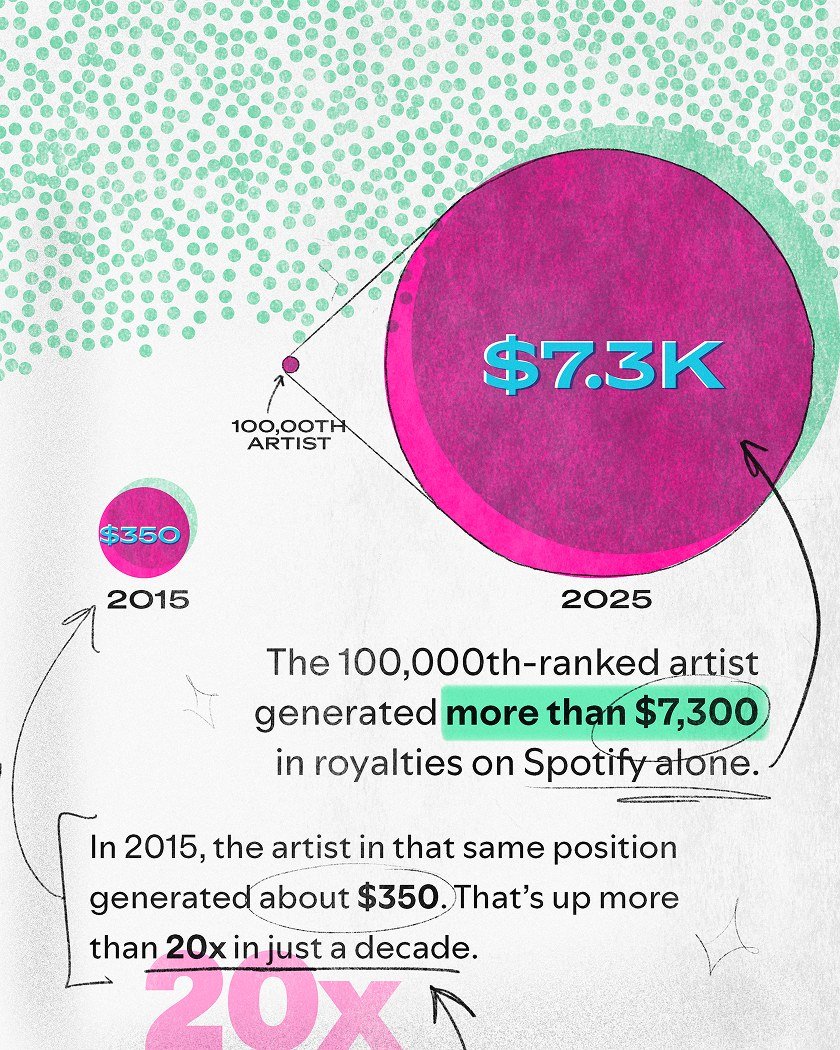
Spotify estimates that it accounts for about a third of global streaming revenue and about 30 percent of recorded music revenue overall, so an artist’s total streaming income is typically around three times their Spotify figure once every other service is counted.
Worked Examples: What a Million Streams Pays
Using Spotify’s one-in-a-million figure, an artist whose catalogue captured exactly one millionth of all streams on Spotify in 2025 generated about $11,000 before splits. That is a share, not a count: the number of streams it took to hold that share is not published.
Using the industry estimate instead, a million streams at $0.003 to $0.005 is $3,000 to $5,000 gross. A self-releasing artist on a distributor that takes no commission keeps most of that; an artist on a traditional deal with a 20 percent royalty rate would see around $600 to $1,000 before recoupment. The songwriter royalty, if they wrote the song, is a separate and smaller payment.
Spotify also reports that 1,580,000 songs have now passed a million streams, with 400,000 of them reaching that mark in 2025 alone. Whether a million streams is a living depends almost entirely on what sits between Spotify and the person who made the record.
How to Raise What You Earn Per Stream
Two levers move the implied rate. The first is where the streams come from: Premium streams in high-priced markets pay more into the pool than ad-supported streams, and the US Individual plan is now $12.99 a month. Listeners on Spotify Free contribute far less per play.
The second is the split. Owning the recording and the publishing keeps both royalty streams; releasing through a distributor that charges a flat fee rather than a percentage keeps the recording share whole. Comparing how each platform pays is part of choosing among the best music streaming services, since the same listener on a different service can be worth double or half as much.
Frequently Asked Questions
How much does Spotify pay per stream in 2026?
Spotify does not publish a per-stream rate. Its 2026 Loud & Clear report says it paid more than $11 billion to rights holders in 2025 and that one in a million streams was worth about $11,000. Third-party estimates put the gross average at roughly $0.003 to $0.005 per stream.
How much is 1 million Spotify streams worth?
Roughly $3,000 to $5,000 gross on the common estimates, before the label, distributor or publisher takes a share. The exact amount depends on which countries the streams came from and whether the listeners were on Premium or the free tier.
Does Spotify pay for streams under 1,000?
Not for recording royalties. Since April 1, 2024 a track needs at least 1,000 streams in the previous 12 months to be included in the royalty pool. Spotify says those tracks had averaged $0.03 a month.
Does Apple Music pay more than Spotify per stream?
Apple said in 2021 that its payouts averaged $0.01 per play on paid plans in 2020, roughly double the estimates for Spotify. Apple has no free tier, which raises its average. Both services pay by share of streams rather than a fixed rate.
Related Articles

Get the Fox Bulletin briefing
The stories that matter, in your inbox. No spam, unsubscribe anytime.
Newsletter signup will be available soon.
Related stories
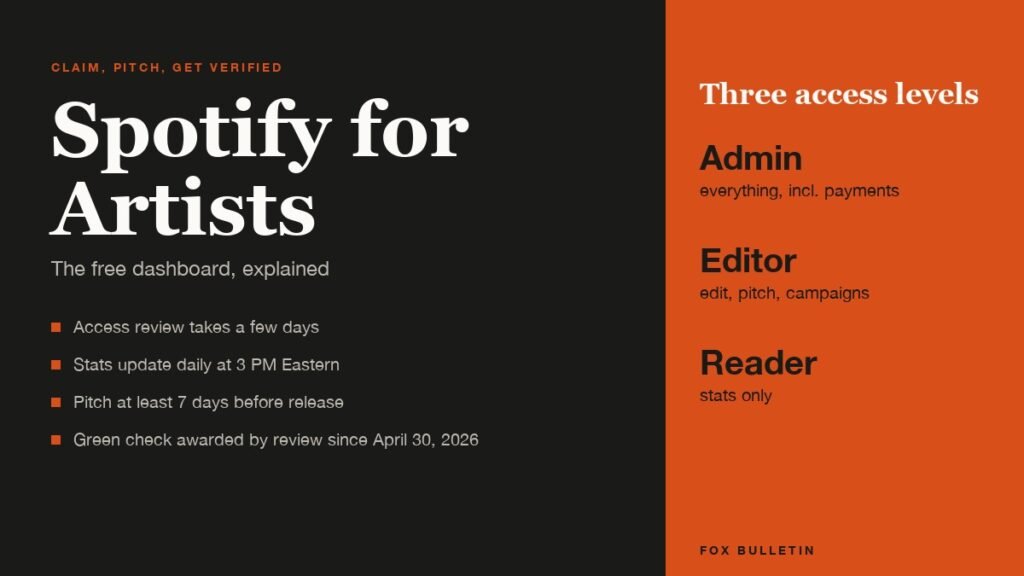
Spotify for Artists: How to Claim, Pitch and Get Verified
Spotify for Artists is the free dashboard that lets a musician control their profile, read their audience stats and pitch unreleased songs to Spotify's editors. Here is how to get access, what each team role can do, and how verification changed in 2026.
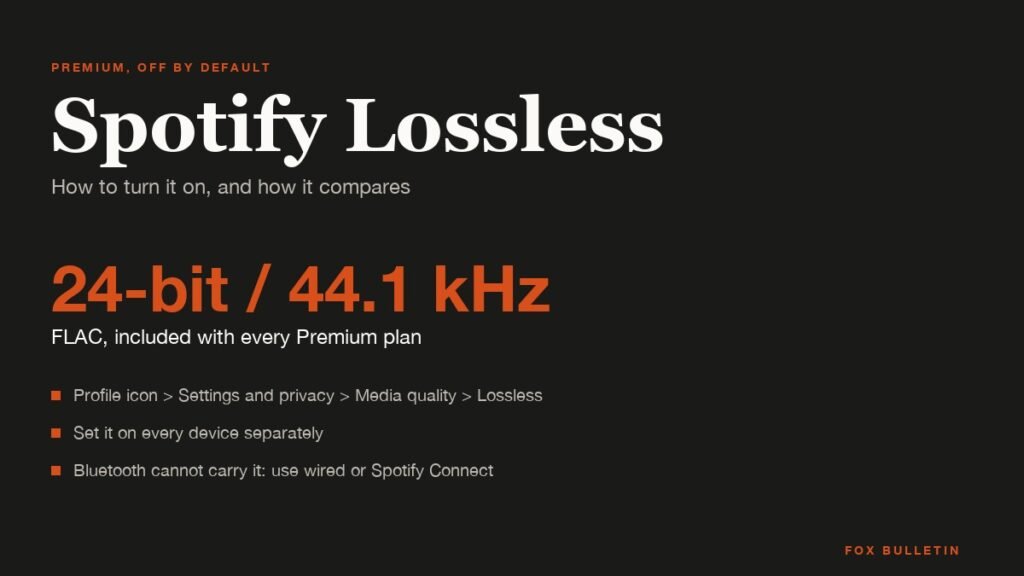
Spotify Lossless: How to Turn It On and How It Compares
Spotify Lossless streams up to 24-bit/44.1 kHz FLAC on Premium at no extra charge, but it is off until you turn it on, device by device. Here is how to enable it, what it needs, and how it stacks up against the hi-res rivals.
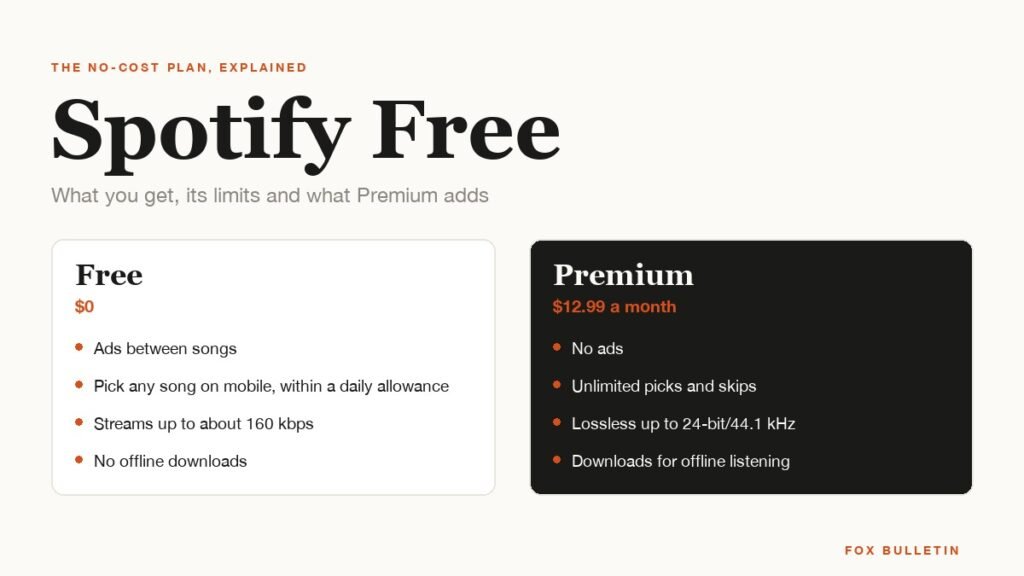
Spotify Free: What You Get, Its Limits and What Premium Adds
Spotify Free is a real plan, not a trial: the full catalogue with ads, a daily allowance of on-demand plays on mobile, and streaming capped at 160 kbps. Here is what it includes, what it blocks and what Premium costs.