
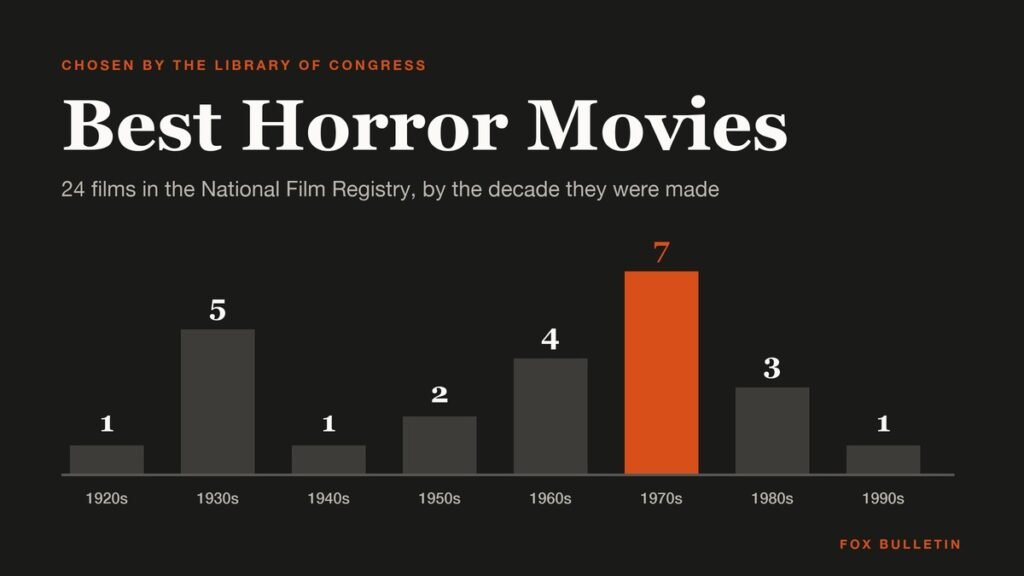
The best horror movies ever made are, on one defensible reading, the 24 the United States government has decided to keep forever. The National Film Registry holds films selected for their cultural, historical and aesthetic significance, and horror has been in it since 1991, when Frankenstein and King Kong went in together.
A film is eligible ten years after release, 25 titles go in each year, and the choices are permanent. That makes the horror shelf of the registry a list nobody can argue with on taste: it runs from a 1925 silent to John Carpenter’s The Thing, inducted in 2025.
| Film | Released | Added to registry |
|---|---|---|
| The Phantom of the Opera | 1925 | 1998 |
| Dracula | 1931 | 2000 |
| Frankenstein | 1931 | 1991 |
| Freaks | 1932 | 1994 |
| King Kong | 1933 | 1991 |
| Bride of Frankenstein | 1935 | 1998 |
| Cat People | 1942 | 1993 |
| The Night of the Hunter | 1955 | 1992 |
| Invasion of the Body Snatchers | 1956 | 1994 |
| Psycho | 1960 | 1992 |
| The Birds | 1963 | 2016 |
| Night of the Living Dead | 1968 | 1999 |
| Rosemary’s Baby | 1968 | 2014 |
| The Exorcist | 1973 | 2010 |
| The Texas Chain Saw Massacre | 1974 | 2024 |
| Jaws | 1975 | 2001 |
| Carrie | 1976 | 2022 |
| Eraserhead | 1977 | 2004 |
| Halloween | 1978 | 2006 |
| Alien | 1979 | 2002 |
| The Shining | 1980 | 2018 |
| The Thing | 1982 | 2025 |
| A Nightmare on Elm Street | 1984 | 2021 |
| The Silence of the Lambs | 1991 | 2011 |
How a Film Gets Into the National Film Registry
Congress created the registry through the National Film Preservation Act of 1988, after a decade of campaigning by filmmakers including Frank Capra and Martin Scorsese against colorization and pan-and-scan editing of older films. The act set up the National Film Preservation Board and defined what it could select.
The registry takes 25 films a year. A title is eligible ten years after its original release, board members ballot on candidates, and the Librarian of Congress makes the final call. Nothing is ever removed. Congress has reauthorized the program five times, in 1992, 1996, 2005, 2008 and 2016.
Horror did not get in early or easily. Of the 24 titles below, six were added in the registry’s first decade and nine have gone in since 2010, including The Texas Chain Saw Massacre in 2024 and The Thing in 2025. The genre’s standing with the board has climbed as the films themselves have aged.
Silent and Universal Horror Movies, 1925 to 1942
The first American horror cycle built the visual grammar everything later borrowed: the reveal, the laboratory, the monster who is more sympathetic than the men chasing him.
The Phantom of the Opera (1925)
Director: Rupert Julian · Runtime: 107 minutes, original cut · Budget: $632,357 · Registry: 1998
Lon Chaney designed his own makeup for the Phantom and Universal kept it secret until the premiere, so the unmasking landed on audiences cold. It is still the sequence the film is remembered for, and the reason Chaney was billed as the man of a thousand faces. Carla Laemmle, niece of producer Carl Laemmle, played a prima ballerina at about 15 and was the last surviving cast member when she died in 2014.
Frankenstein (1931)
Director: James Whale · Runtime: 70 minutes · Budget: $262,007 · Registry: 1991
Universal spent $262,007 and took around $12 million. Boris Karloff plays the creature, Jack Pierce built the flat-headed makeup that is now the default image of the character, and the script came by way of Peggy Webling’s 1927 stage play rather than straight from Mary Shelley’s 1818 novel. It was one of the two horror films in the registry’s 1991 class.
Bride of Frankenstein (1935)
Director: James Whale · Runtime: 75 minutes · Budget: $397,000 · Registry: 1998
Whale came back for the sequel and made the stranger film. Elsa Lanchester plays two parts, Mary Shelley in the prologue and the bride in the finale, and Franz Waxman’s score does more work than most 1930s horror scores attempt. The plot picks up immediately after the first film and draws on a subplot of the original novel that the 1931 adaptation skipped.
Cat People (1942)
Director: Jacques Tourneur · Runtime: 73 minutes · Budget: About $135,000 · Registry: 1993
Producer Val Lewton was handed a lurid title and a tiny budget at RKO and responded by keeping the monster off screen. Simone Simon plays a Serbian fashion illustrator convinced she turns into a panther, and the film gets its scares from shadow, sound and suggestion. It was the first picture from the Lewton unit, and the template for the rest.
Cold War and New Hollywood Horror Movies, 1956 to 1968
Three decades later the genre stopped being about castles and started being about neighbors, motels and apartment buildings.
Invasion of the Body Snatchers (1956)
Director: Don Siegel · Runtime: 80 minutes · Budget: $416,911 · Registry: 1994
Alien spores grow into pods that copy sleeping people down to their memories and leave out every feeling. Set in the fictional California town of Santa Mira and adapted from Jack Finney’s 1954 novel, it has been read as a parable of McCarthyism and of conformity by turns, which is part of why it keeps getting remade.
Psycho (1960)
Director: Alfred Hitchcock · Runtime: 109 minutes · Budget: $806,947 · Registry: 1992
Hitchcock shot it in black and white on a small budget using the crew from his television series, killed his star partway through, and took around $50 million. Bernard Herrmann scored it for strings alone. Critics were split on release and audiences were not, and the film is the hinge between gothic horror and everything that followed.
Night of the Living Dead (1968)
Director: George A. Romero · Runtime: 96 minutes · Budget: $114,000 to $125,000 · Registry: 1999
Romero directed, shot and edited it with a Pittsburgh crew whose day job was commercials and industrial films. The creatures are called ghouls in the script and never zombies, yet this is the film that fixed the modern zombie in popular culture. Duane Jones leads the cast, a casting choice that gave the siege in the farmhouse a charge the script never comments on.
Rosemary’s Baby (1968)
Director: Roman Polanski · Runtime: 137 minutes · Budget: $3.2 million · Registry: 2014
Mia Farrow plays a young wife in a Manhattan apartment building who works out, slowly and alone, what her neighbors and her husband have agreed to. Ruth Gordon won an Academy Award for Best Supporting Actress for it. Most of the shooting was done in Los Angeles in late 1967 despite the New York setting.
1970s Horror Movies That Set the Modern Template
The decade that gave the genre its two most copied machines: the possession film and the slasher. Our guide to the best Halloween movies covers the lighter end of the same shelf.
The Exorcist (1973)
Director: William Friedkin · Runtime: 122 minutes · Box office: $441.3 million · Registry: 2010
William Peter Blatty adapted his own 1971 novel and produced. Casting relative unknowns over stars drew opposition from Warner Bros., the shoot ran to twice its schedule and almost three times its budget, and the run of injuries and deaths around the production fed the belief that the film was cursed. It remains the highest-grossing title on this list after Jaws.
The Texas Chain Saw Massacre (1974)
Director: Tobe Hooper · Runtime: 83 minutes · Budget: $80,000 to $140,000 · Registry: 2024
Made in Texas for under $140,000 and marketed as a true story, which it is not. Hooper co-wrote it with Kim Henkel, co-composed the sound design that carries most of the dread, and shot it in heat that became part of the film’s reputation. It waited fifty years for the registry and went in with the 2024 class.
Jaws (1975)
Director: Steven Spielberg · Runtime: 124 minutes · Box office: $495 million · Registry: 2001
The first major feature shot on the ocean, filmed around Martha’s Vineyard from May to October 1974, over budget and over schedule the whole way. The mechanical sharks kept failing, so Spielberg shot around the animal and let John Williams’ two notes stand in for it. The withholding is the reason the film works.
Halloween (1978)
Director: John Carpenter · Runtime: 91 minutes · Budget: $300,000 to $325,000 · Registry: 2006
Carpenter directed, co-wrote with producer Debra Hill and scored it himself, on a budget around $300,000 that returned about $70 million. Jamie Lee Curtis made her film debut as Laurie Strode and Donald Pleasence plays the psychiatrist chasing Michael Myers. It became the most profitable independent film of its era and the direct model for a decade of imitators.
Alien (1979)
Director: Ridley Scott · Runtime: 116 minutes · Budget: $8.4 million to $14 million · Registry: 2002
Dan O’Bannon wrote it from a story with Ronald Shusett, and the Swiss artist H. R. Giger designed the creature and its environments, which is why nothing in the film looks like anything that came before it. Sigourney Weaver’s Ripley was not written as the obvious survivor. It premiered at the Seattle International Film Festival in May 1979.
1980s and 1990s Horror Movies in the Registry
Four films close the list, two of them rejected on release and later reassessed, one that won the industry’s highest award outright.
The Shining (1980)
Director: Stanley Kubrick · Runtime: 144 minutes, US cut · Budget: $19 million · Registry: 2018
Kubrick shot almost all of it at EMI Elstree Studios in England on sets built from real locations, working with a small crew and running takes to the point of exhaustion. The then-new Steadicam mount gives the corridor sequences their gliding look. Stephen King has never liked the adaptation of his 1977 novel, and the film went into the registry anyway.
The Thing (1982)
Director: John Carpenter · Runtime: 109 minutes · Budget: $15 million · Registry: 2025
Adapted from John W. Campbell Jr.’s 1938 novella Who Goes There?, with Kurt Russell leading an Antarctic research crew who cannot tell which of them is still human. It took $20.9 million against $15 million and was dismissed on release. It is the most recent horror film in the registry, added in 2025, which is as clean a measure of reappraisal as the genre has.
A Nightmare on Elm Street (1984)
Director: Wes Craven · Runtime: 91 minutes · Budget: $1.1 million · Registry: 2021
Craven wrote and directed it for $1.1 million and it returned $57.1 million, money that built New Line Cinema. Robert Englund plays Freddy Krueger, Heather Langenkamp leads, and Johnny Depp makes his film debut. The premise, a killer who works inside dreams, is the one idea in the slasher cycle that nobody had used before.
The Silence of the Lambs (1991)
Director: Jonathan Demme · Runtime: 118 minutes · Box office: $272.7 million · Registry: 2011
At the 64th Academy Awards it became the third film to win the Big Five: Best Picture, Director, Actor, Actress and Adapted Screenplay. It is still the only horror film to have won Best Picture. Jodie Foster plays the FBI trainee and Anthony Hopkins is on screen for a fraction of the running time as Hannibal Lecter.
The Seven Registry Titles Not Covered Above
The remaining seven are in the table and worth a line each:
- Dracula (1931), added 2000: Bela Lugosi’s performance set the accent and the cape.
- Freaks (1932), added 1994: cast with real sideshow performers and banned in the UK for decades.
- King Kong (1933), added 1991: Willis O’Brien’s stop motion, in the registry’s first horror pair.
- The Night of the Hunter (1955), added 1992: Charles Laughton’s only film as director.
- The Birds (1963), added 2016: Hitchcock’s second entry, with no score at all.
- Carrie (1976), added 2022: the first Stephen King adaptation, and still the leanest.
- Eraserhead (1977), added 2004: David Lynch’s debut, made over five years.
If you are building an evening around these rather than studying them, pair the picks with a few party ideas and leave the 1970s block until last.
Frequently Asked Questions
What is the oldest horror film in the National Film Registry?
The Phantom of the Opera, released in 1925 and added in 1998. It is a silent film, and the version most people see today is one of several surviving cuts of different lengths.
Has a horror movie ever won Best Picture?
Once. The Silence of the Lambs won Best Picture at the 64th Academy Awards in 1992, along with Director, Actor, Actress and Adapted Screenplay. No other horror film has taken the top award.
Why are recent horror movies not on this list?
A film cannot be considered until ten years after its original release, so anything from the past decade is not yet eligible. The newest title here is The Silence of the Lambs from 1991, and the most recent addition is The Thing, inducted in 2025.
What counts as a horror film for the registry?
The board does not select by genre at all. It picks 25 culturally, historically or aesthetically significant films a year across every format, so the horror titles are simply the ones a standard genre definition would recognize as belonging to the genre.
Related Articles

Get the Fox Bulletin briefing
The stories that matter, in your inbox. No spam, unsubscribe anytime.
Newsletter signup will be available soon.
Related stories
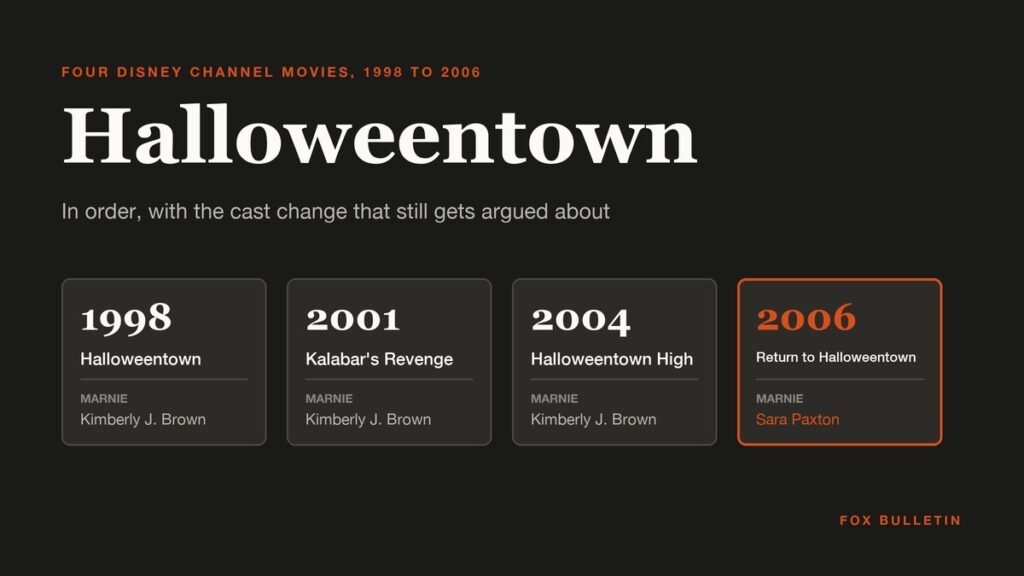
Halloweentown: All Four Movies, the Cast and the Recast
Four Disney Channel movies between 1998 and 2006, one family of witches, and a lead actress swapped out for the finale. Here is the order, the cast and what each film actually did in the ratings.
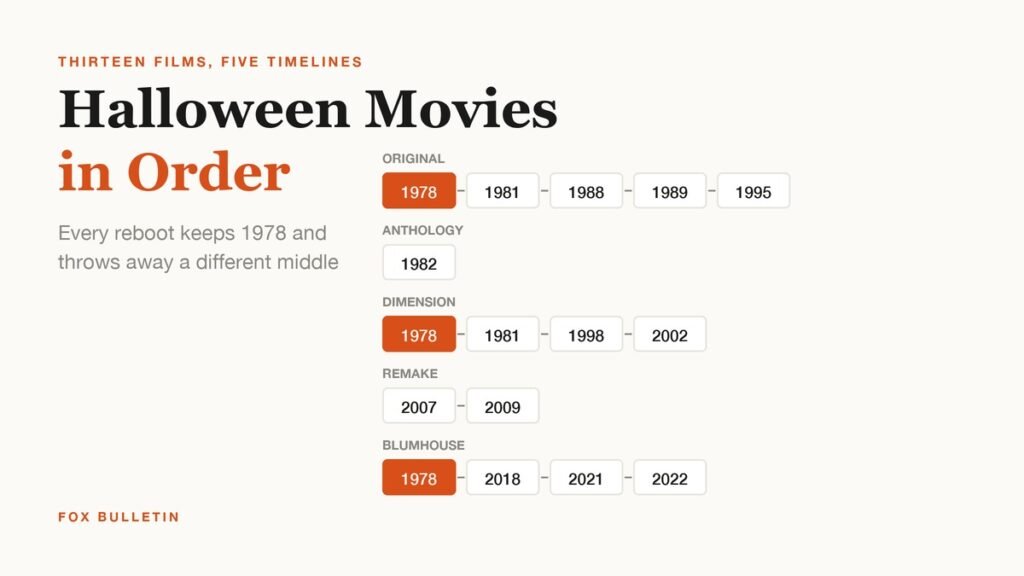
Halloween Movies in Order: All 13 Films and Five Timelines
Thirteen films, five timelines and three different versions of what happened to Laurie Strode. Here is the release order, the story order inside each continuity, and the shortest route through the series.
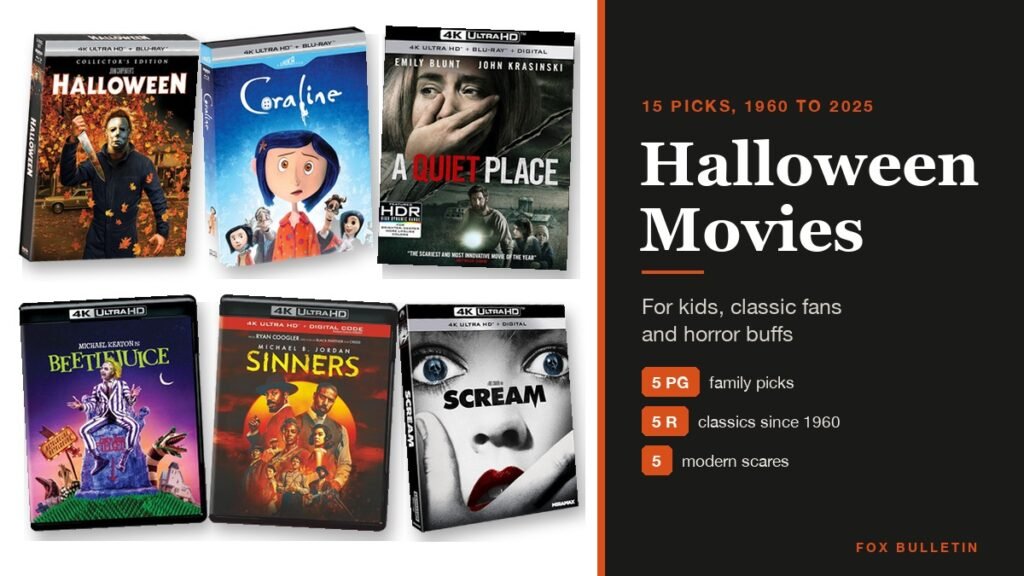
Best Halloween Movies: 15 Family, Classic and Modern Horror Picks
Fifteen Halloween movies for kids, classic horror fans and modern horror buffs, each with its MPA rating, runtime, director and a 4K, Blu-ray or DVD edition.