

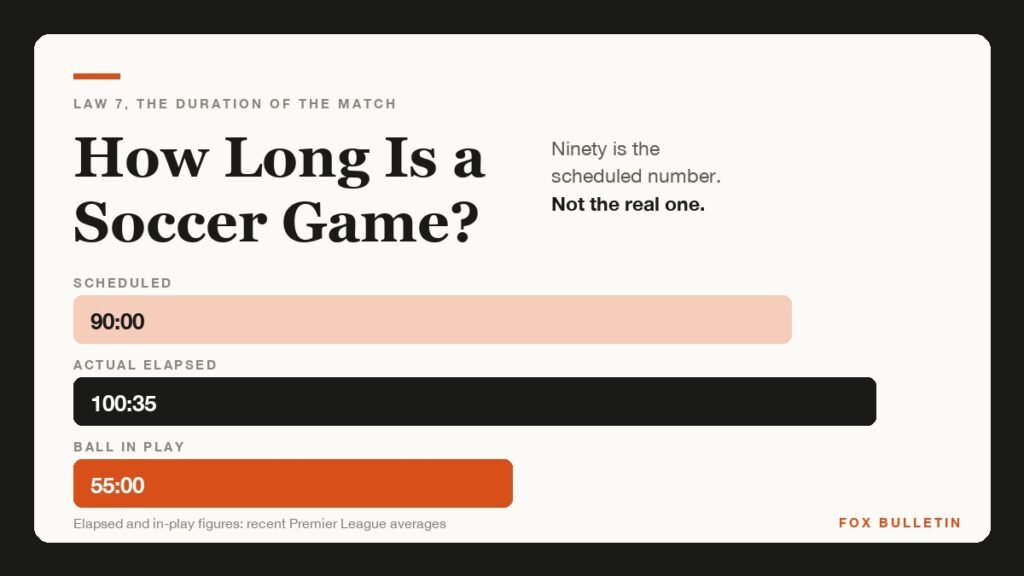
How long is a soccer game? The scheduled answer is 90 minutes, played as two halves of 45, with a half time interval of no more than 15. The honest answer is closer to two hours from kick off to final whistle, and only around 55 minutes of that is live football.
The gap between those numbers is not a scandal, it is how the sport is written. The clock never stops, so instead of pausing for every substitution and injury the referee keeps a tally and adds it back at the end of each half. Knockout matches then have their own extensions on top. Here is the whole structure, and what the stopwatch actually records.
| Phase | Length | Applies to |
|---|---|---|
| First half | 45 minutes plus stoppage time | Every match |
| Half time interval | Not more than 15 minutes | Every match |
| Second half | 45 minutes plus stoppage time | Every match |
| Extra time | Two periods of up to 15 minutes | Knockout matches still level |
| Kicks from the penalty mark | Five each, then sudden death | Still level after extra time |
| Typical elapsed time | About 100 minutes | Recent Premier League average |
| Typical ball in play | About 55 minutes | Recent Premier League average |
How Long Is a Soccer Game in Real Time, Not Scheduled Time
Measured properly, a top flight match is now longer than it has been in years while containing less football. Premier League games have been running an average of 100 minutes and 35 seconds from kick off to the final whistle, with 55 minutes exactly of ball in play across the first 70 matches of the 2025-26 season.
The trend is going the wrong way for anyone who wants to watch football rather than wait for it:
- 2023-24: 58 minutes and 11 seconds of ball in play per match.
- 2024-25: 56 minutes and 59 seconds.
- 2025-26: 55 minutes exactly, with total match length up to 100 minutes 35 seconds from 99 minutes 44 seconds the season before.
Those elapsed figures cover playing time only. Add the half time interval of up to 15 minutes and a match occupies close to two hours of the afternoon before anyone has left their seat, which is the number worth planning around rather than the 90 on the fixture list.
The delays account for the difference. Opta’s match timing data puts stoppages at 45 minutes and 35 seconds per game, up from 42 minutes 45 seconds a year earlier. Longer matches with less play is the direct result: referees are adding more time, and the added time is itself being eaten by further stoppages.
The 90 Minutes: Two Halves and a 15 Minute Interval
Law 7 is short. A match lasts two equal halves of 45 minutes, and that may only be reduced if the referee and both teams agree before kick off and the competition rules allow it. That is the escape clause youth and amateur leagues use to play shorter games; it is not available once a match has started.
Players are entitled to a half time interval of no more than 15 minutes, and competition rules fix its exact length. A short drinks break is also permitted during the interval in extra time, which is the only other scheduled pause the Laws build in.
Stoppage Time: What the Referee Is Actually Counting
Added time is not an estimate of how exciting the half was. The Laws list what the referee allows for, and the list is specific:
- Substitutions and the time taken to complete them.
- Assessment and removal of injured players.
- Time wasting of any kind.
- Disciplinary sanctions, including the time taken to show cards and restart.
- Medical stoppages permitted by competition rules, with drinks breaks counted at one minute and cooling breaks at 90 seconds to three minutes.
- VAR checks and reviews.
- Goal celebrations and any other significant delay.
The fourth official indicates the minimum additional time at the end of the final minute of each half, and the word minimum does the heavy lifting. The referee may add more if play is delayed again during the added time itself, which is why four signalled minutes regularly becomes six.
One rule overrides the clock entirely. If a penalty kick has to be taken or retaken, the half is extended until that kick is completed, however far past the announced time it falls. A penalty awarded in the 98th minute will be taken.
The 2022 World Cup Changed What Added Time Looks Like
Stoppage time used to be a token two or three minutes regardless of what had happened. That changed when FIFA instructed referees at the 2022 World Cup to calculate it accurately rather than conventionally, counting every pause the Laws already listed.
Pierluigi Collina, who chairs FIFA’s refereeing committee, made the arithmetic public at the time: a single goal celebration can run to a minute and a half, so three goals and a couple of substitutions costs four or five minutes that was previously never given back. Several group stage matches in Qatar passed ten minutes of added time, and England’s 6-2 win over Iran reached almost 30 minutes across the two halves once a goalkeeper injury was included.
It worked, by the only measure that counts. Effective playing time at that tournament was 59 minutes and 47 seconds per match, against 55 minutes and 41 seconds four years earlier. The approach has since spread into domestic competitions, which is why announced added time of seven or eight minutes no longer looks unusual, and why the elapsed length of a league match has crept towards 100 minutes while the football inside it has not grown.
Extra Time and Penalties in Knockout Matches
League matches are allowed to finish level. Knockout competitions are not, so when the scores are tied at full time the procedure for deciding the outcome begins: two equal periods of extra time, each no longer than 15 minutes, taking the match to 120 minutes plus stoppages.
If it is still level, the match goes to kicks from the penalty mark. The procedure has more structure than most viewers realise:
- Both teams take five kicks, alternating.
- Each kick must be taken by a different player, and every eligible player has to take one before anyone takes a second.
- If the teams are level after five each, kicks continue until one team has scored one more than the other from the same number of attempts.
- Only players on the field of play at the end of the match, or temporarily off it for an injury or equipment, are eligible to take a kick.
- A player who has been sent off during the match cannot take part at all.
That eligibility rule is why managers make substitutions in the final minutes of extra time. Bringing on a specialist penalty taker, or a goalkeeper known for saving them, only works if the change is made before the whistle. The knockout rounds decided this way are a large part of why the list of countries with the most World Cup wins is as short as it is.
When a Match Finishes Early or Never Finishes at All
A game can also end before the clock does. A match may not start or continue if either team has fewer than seven players on the pitch, so a side reduced by red cards and injuries is finished at the moment the eighth player leaves. The threshold is the same in every competition because it sits in the Laws rather than in competition rules.
Abandoned matches are replayed unless the competition rules say otherwise, which is the usual outcome for a game stopped by weather, floodlight failure or a crowd incident. Whether the replayed match starts from zero or resumes from the minute it stopped is a decision for the competition, not the referee. Knowing where each player is supposed to be in that restart is simpler if you know the standard soccer positions a team lines up in.
Frequently Asked Questions
How long is a soccer game in total, including stoppages?
Around two hours from kick off to final whistle for a top flight league match. Recent Premier League games have averaged 100 minutes and 35 seconds of match time, plus the half time interval of up to 15 minutes on top.
Why does the referee add stoppage time?
Because the clock does not stop during play. The referee keeps a running tally of time lost to substitutions, injuries, cards, VAR checks, goal celebrations and time wasting, then adds the minimum of it back at the end of each half.
How long is extra time in soccer?
Two periods of up to 15 minutes each, played in full rather than as sudden death. There is no golden goal in the current Laws, so both periods are completed even if a team scores in the first.
How much of a soccer match is the ball actually in play?
About 55 minutes of a roughly 100 minute match in the most recent Premier League data, down from 58 minutes and 11 seconds two seasons earlier. Everything else is stoppages, restarts and delays.
Related Articles

Get the Fox Bulletin briefing
The stories that matter, in your inbox. No spam, unsubscribe anytime.
Newsletter signup will be available soon.
Related stories
NFL Salary Cap: How It Works, Dead Money and Franchise Tags
The cap is a cash flow puzzle, not a spending limit. Proration, dead money, void years and the 89 percent floor, with the current numbers.
Soccer Positions: Every Role on the Pitch and What It Does
The Laws of the Game name only one position. Everything else, from the number 6 to the false nine, is a convention coaches built on top of it.
Football Positions: What All 22 Players on the Field Do
Quarterback to long snapper, with the rulebook detail most guides skip: the seven men on the line, the number ranges by position, and how a 53 man roster is split.