

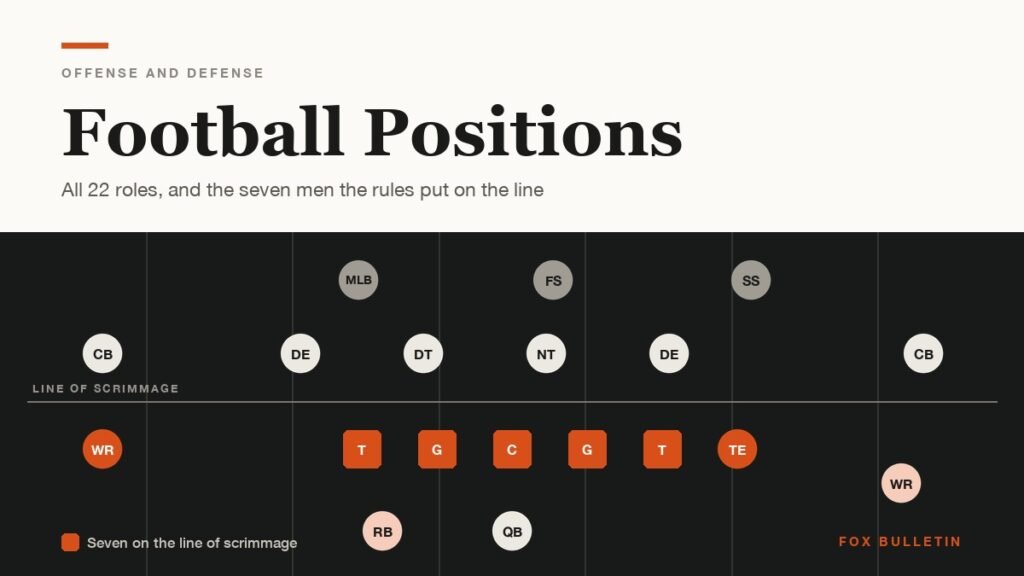
There are 22 football positions on the field at any one time, 11 per side, and the rulebook is blunt about it: the game is played by two teams of 11 players each. Put a twelfth man in the formation and it is a foul before the ball is even snapped.
What those 11 do is not fixed by the rules, though. The league dictates how many players must be on the line of scrimmage and which jersey numbers may catch a pass, and coaches build everything else on top. This guide covers every offensive, defensive and special teams role, what the job actually involves, and the number rules that let an official tell from the sideline who is allowed to run a route.
| Position | Abbr | Side | Core job |
|---|---|---|---|
| Quarterback | QB | Offense | Takes the snap, throws or hands off, runs the play clock |
| Running back | RB | Offense | Carries the ball, catches short passes, picks up blitzers |
| Fullback | FB | Offense | Lead blocker, short yardage carries |
| Wide receiver | WR | Offense | Runs routes and catches passes, usually split wide |
| Tight end | TE | Offense | Blocks like a lineman, catches like a receiver |
| Center | C | Offense | Snaps the ball and sets the protection calls |
| Guard | G | Offense | Interior blocking, pulls across the formation on runs |
| Offensive tackle | T | Offense | Blocks the edge rushers on both ends of the line |
| Defensive end | DE | Defense | Rushes the passer from the edge, sets the edge on runs |
| Defensive tackle | DT | Defense | Occupies interior blockers, collapses the pocket |
| Nose tackle | NT | Defense | Lines up over the center and eats double teams |
| Middle linebacker | MLB | Defense | Calls the defense, fills run gaps, covers the middle |
| Outside linebacker | OLB | Defense | Rushes, sets the edge or drops into coverage |
| Cornerback | CB | Defense | Covers receivers man to man or by zone |
| Free safety | FS | Defense | Plays deep, takes away the long throw |
| Strong safety | SS | Defense | Plays closer to the line, supports the run |
| Nickelback | NB | Defense | Fifth defensive back, usually covers the slot |
| Placekicker | K | Special teams | Field goals, extra points and kickoffs |
| Punter | P | Special teams | Punts on fourth down, holds on placekicks |
| Long snapper | LS | Special teams | Snaps on punts, field goals and extra points |
| Returner | KR/PR | Special teams | Fields kickoffs and punts and runs them back |
Football Positions on Offense: The 11 Who Line Up With the Ball
Five of the eleven are offensive linemen and never touch the ball on purpose. The center snaps it and usually identifies the defensive front so the protection shifts the right way. Two guards work inside him, and on running plays they are the ones who pull and lead the back through a hole. Two tackles handle the edges, and the one lined up on the throwing arm side of a quarterback is the reason left tackles are paid like quarterbacks: he blocks the pass rusher the quarterback cannot see.
The remaining six are the skill positions:
- Quarterback. Receives the snap, reads the defense, and either throws, hands off or runs. Everything else on offense is timed off what he does first.
- Running back. Carries on handoffs, releases into the flat as a receiver, and on passing downs is often the last line of protection against a blitzing linebacker.
- Fullback. A blocking back lined up ahead of the runner. Most teams no longer carry one, having traded the role for an extra tight end or receiver.
- Wide receivers. Usually two or three on the field. Outside receivers win on the sideline, slot receivers work the middle where there is more traffic and more space.
- Tight end. The hybrid. Lined up beside a tackle he is a sixth blocker; flexed out he is a large receiver a safety has to cover.
A standard set is one back, one tight end and three receivers. Swapping one receiver for a second tight end makes the same personnel group look like a running formation without a substitution, which is the whole point of the position.
Defensive Positions: Line, Linebackers and the Secondary
Defenses are described by how many linemen and linebackers they field. A 4-3 puts four hands in the dirt and three linebackers behind them. A 3-4 uses three linemen and four linebackers, which turns one of those linebackers into a stand up pass rusher and makes it harder to tell before the snap who is coming.
- Defensive ends. The primary pass rushers in a four man front. Against the run their job is to keep the play from getting outside them.
- Defensive tackles and nose tackles. Interior players who are graded on how many blockers they tie up rather than on tackles. A nose tackle in a 3-4 lines up directly over the center.
- Middle or inside linebackers. The on-field signal caller, responsible for run fits and short middle coverage.
- Outside linebackers. The most variable job in football. In a 3-4 the position is close to a defensive end; in a 4-3 it is closer to a coverage player.
- Cornerbacks. Cover the wide receivers, usually isolated with no help.
- Safeties. A free safety patrols deep and prevents the long completion. A strong safety plays nearer the line and behaves like a small linebacker against the run.
Because most plays are passes, the eleven on the field rarely match the base defense. In a nickel package a linebacker comes off for a fifth defensive back, and in a dime package a sixth arrives. The nickelback who covers the slot now plays enough snaps that teams draft specifically for it, which is how a sub package quietly became a starting job.
Special Teams: The Third Unit Most Fans Skip
Special teams are on the field for every kickoff, punt, field goal and extra point, and the roster spots are specialised to the point of being irreplaceable:
- Placekicker. Field goals, extra points and often kickoffs.
- Punter. Punts on fourth down and holds the ball for placekicks, which is why punters practise catching a snap with the laces out.
- Long snapper. Snaps the ball between his legs, accurately, backwards, roughly 15 yards, while being hit. Teams carry one purely for this.
- Returners. Field kickoffs and punts. The punt returner also has to decide, in real time, whether to signal a fair catch or take the hit.
- Gunners. Cover men who sprint down the sideline on punts to tackle the returner.
None of these units runs on its own clock. The same 10 minute and 15 minute periods described in our guide to the NFL overtime rules apply, and a missed field goal in that window ends a season as easily as an interception.
Jersey Numbers Tell You Which Position a Player Plays
The league assigns number ranges by position so officials can police pass eligibility without a roster sheet. The official playing rules set them out as follows:
- Quarterbacks: 0 to 19
- Punters and placekickers: 0 to 49 and 90 to 99
- Defensive backs: 0 to 49
- Running backs, fullbacks, tight ends, H-backs and wide receivers: 0 to 49 and 80 to 89
- Offensive linemen: 50 to 79
- Defensive linemen: 50 to 79 and 90 to 99
- Linebackers: 0 to 59 and 90 to 99
The rule that matters on game day sits underneath those ranges: an eligible pass receiver must wear 0 to 49 or 80 to 89. Every other number belongs to an ineligible player unless he reports a change of position to the referee first, which is what a tackle is doing when he jogs over before a goal line play. A player who permanently switches between an eligible and an ineligible position has to be issued a new number.
Why Seven Players Must Be on the Line of Scrimmage
A formation is legal only if it satisfies a short list of conditions at the snap. Seven or more players must be on the line. The men on each end of that line must be eligible receivers, and everyone on the line between them must be ineligible. Nobody may be out of bounds, and only one player may hover in the grey area that is neither clearly on nor clearly off the line, unless he is directly behind the snapper. Break any of it and the offense loses five yards for an illegal formation.
That is the structural reason the positions look the way they do. Five linemen plus a tight end and a receiver gets you to seven, with the quarterback and the remaining skill players in the backfield. It also explains why a receiver glances at the sideline official before the snap: if he is a step too far forward he has covered up the tight end, and the tight end has stopped being eligible. The position names themselves are coaching conventions rather than rules, which is why titles like H-back and nickelback appear and disappear with tactics.
How Many of Each Position a 53-Man Roster Carries
Teams keep 53 players during the regular season but cannot dress all of them. A club may activate 48 for a game only if at least eight of those have a primary position of center, guard or offensive tackle. Carry fewer than eight and the game day limit drops to 47, a rule added in the 2020 collective bargaining agreement to stop teams running short at the most injury prone spots.
That one requirement shapes the whole roster. Nine offensive linemen is the practical floor, the three kicking specialists are locked in, and the quarterback room takes two or three. What remains is split between the positions a coordinator rotates most, which in a passing league means receivers, edge rushers and defensive backs. Teams with the most Super Bowl wins have generally been the ones that kept depth at those three spots rather than at the glamour positions.
Frequently Asked Questions
How many players are on the field in football?
Eleven per team, 22 in total. The rulebook treats a twelfth player as a foul: if the offense holds 12 in its formation for more than three seconds, or the defense has 12 when the snap is imminent, officials stop the play.
Which football position is the hardest to play?
Quarterback, by any measure teams actually use. It is the only position that touches the ball on nearly every offensive snap, carries the pre-snap reads, and is paid accordingly. Left tackle and cornerback are the usual answers for the hardest jobs that do not involve the ball.
What is the difference between a free safety and a strong safety?
A free safety plays deep and is the last defender between a receiver and the end zone. A strong safety lines up nearer the line of scrimmage, on the side with the tight end, and spends more of his day in run support. Many teams now use two interchangeable safeties instead.
Can any player catch a pass?
No. Only players wearing 0 to 49 or 80 to 89 and lined up in an eligible spot may catch a forward pass. An ineligible player can become eligible for a single play, but he has to report the change to the referee before the snap.
Related Articles

Get the Fox Bulletin briefing
The stories that matter, in your inbox. No spam, unsubscribe anytime.
Newsletter signup will be available soon.
Related stories
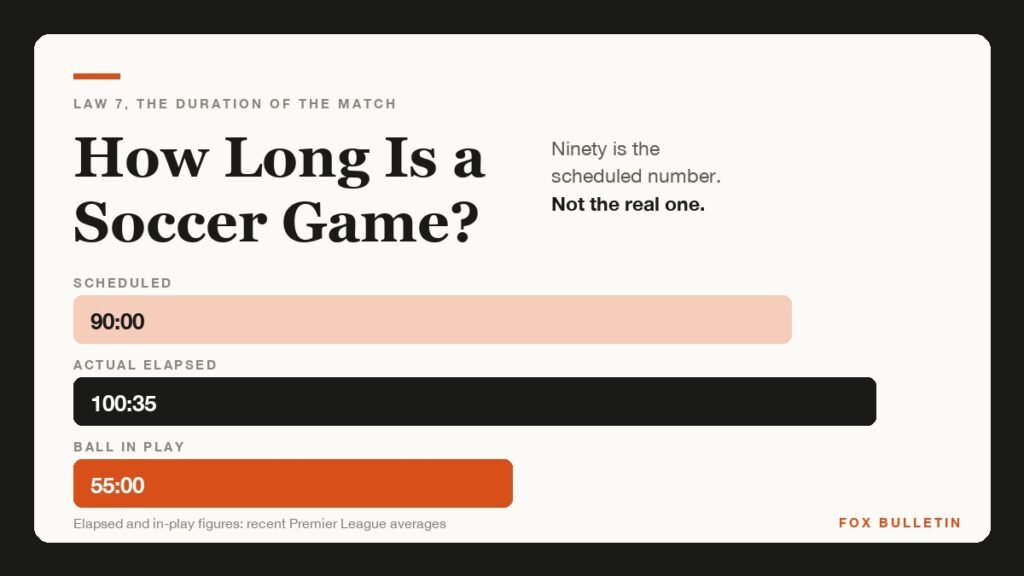
How Long Is a Soccer Game? Halves, Stoppage and Extra Time
Ninety minutes is the scheduled figure, not the real one. What the referee adds, when extra time applies, and how much of a match is actually live football.
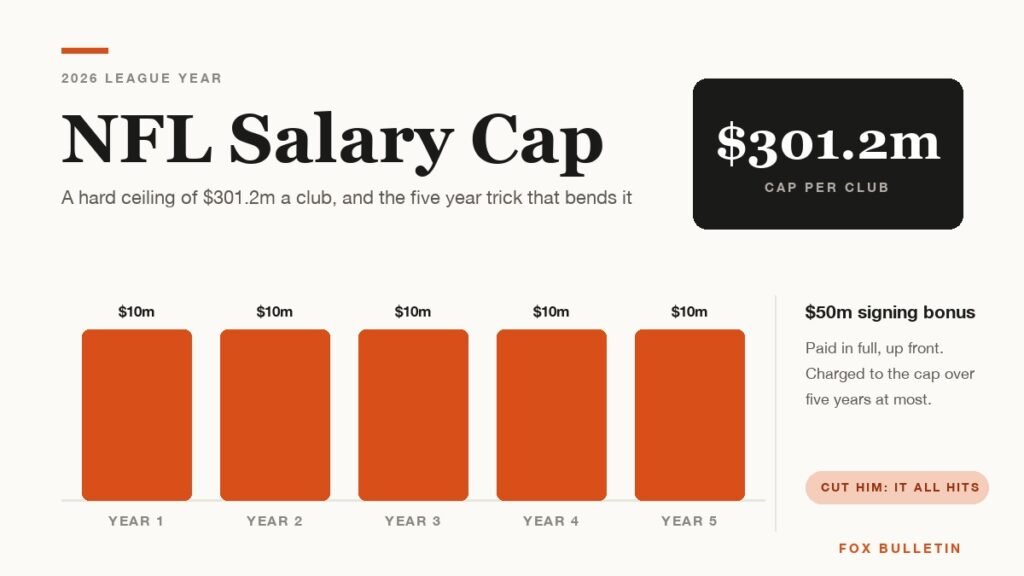
NFL Salary Cap: How It Works, Dead Money and Franchise Tags
The cap is a cash flow puzzle, not a spending limit. Proration, dead money, void years and the 89 percent floor, with the current numbers.
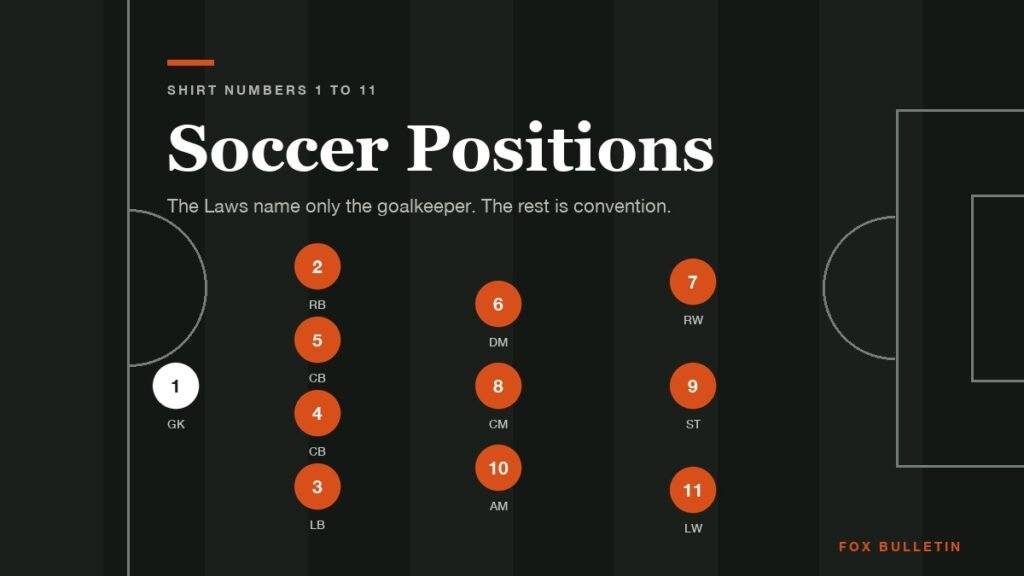
Soccer Positions: Every Role on the Pitch and What It Does
The Laws of the Game name only one position. Everything else, from the number 6 to the false nine, is a convention coaches built on top of it.