

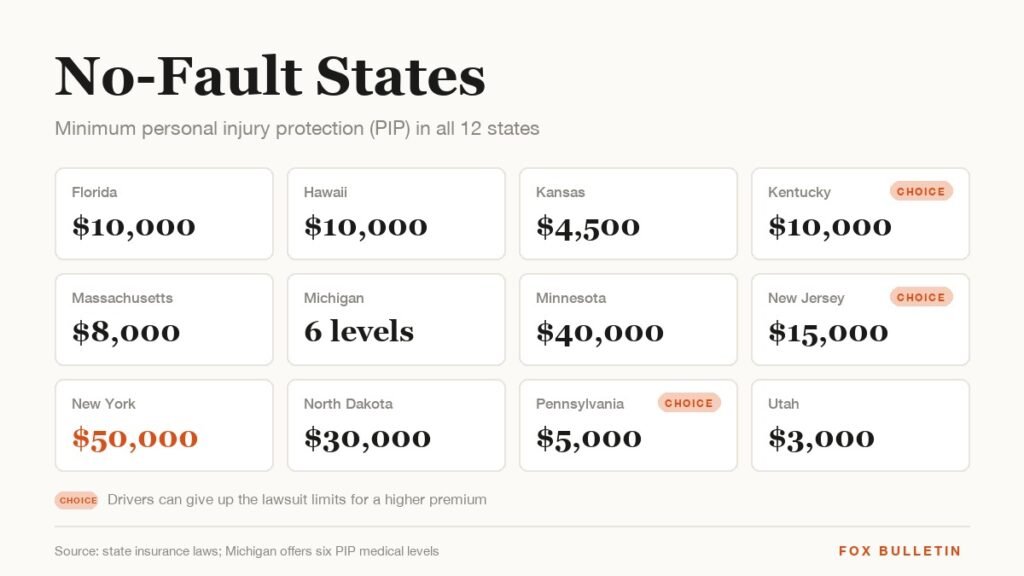
No-fault states are the 12 US states that require drivers to carry personal injury protection (PIP), which pays your own medical bills and lost wages after a crash no matter who caused it, and that limit when you can sue the other driver: Florida, Hawaii, Kansas, Kentucky, Massachusetts, Michigan, Minnesota, New Jersey, New York, North Dakota, Pennsylvania and Utah. Puerto Rico uses the system too.
Kentucky, New Jersey and Pennsylvania are choice no-fault states, where drivers can give up the limits on lawsuits in exchange for a higher premium. The table lists each state’s minimum PIP coverage, the threshold an injury has to cross before you can sue for pain and suffering, and whether drivers can opt out.
| # | State | Minimum PIP | When you can sue for pain and suffering | Can drivers opt out? |
|---|---|---|---|---|
| 1 | Florida | $10,000 | Permanent injury, significant scarring or death | No |
| 2 | Hawaii | $10,000 | $5,000 in PIP benefits, or a serious injury | No |
| 3 | Kansas | $4,500 medical | $2,000 in medical treatment, or a listed injury | No |
| 4 | Kentucky | $10,000 | $1,000 in medical expenses, or a listed injury | Yes, by written rejection |
| 5 | Massachusetts | $8,000 | $2,000 in medical expenses, or a listed injury | No |
| 6 | Michigan | Six levels, unlimited to opt-out | Serious impairment, permanent disfigurement or death | No |
| 7 | Minnesota | $40,000 | $4,000 in medical expenses, or a listed injury | No |
| 8 | New Jersey | $15,000 | Depends on the lawsuit option chosen | Yes, when buying the policy |
| 9 | New York | $50,000 | Serious injury, or losses above $50,000 | No |
| 10 | North Dakota | $30,000 | $2,500 in medical expenses, or a listed injury | No |
| 11 | Pennsylvania | $5,000 medical | Depends on limited or full tort choice | Yes, when buying the policy |
| 12 | Utah | $3,000 | $3,000 in medical expenses, or a listed injury | No |
How No-Fault Car Insurance Works
In the 38 other states, the driver who caused a crash, through their liability insurance, pays for the other people’s injuries. No-fault states replace that first step with your own policy: after a crash, you claim injury costs from your own insurer’s PIP coverage, and so does everyone else in the collision.
PIP generally covers:
- Medical and hospital bills for you and passengers on your policy
- Lost income while you cannot work, usually capped by week or month
- Essential services you can no longer do yourself, such as housework or childcare
- Funeral and burial costs after a fatal crash
The trade-off is the right to sue. Each no-fault state sets a threshold an injury must cross before you can claim pain and suffering from the at-fault driver. Seven states use a monetary threshold, a dollar amount of medical expenses, while Florida, Michigan, New Jersey, New York and Pennsylvania use a verbal threshold that describes how serious the injury must be. No-fault rules apply to injuries: damage to your car is still generally claimed from the driver at fault.
The 12 No-Fault States and Their PIP Rules
1. Florida
Minimum PIP: $10,000 · Threshold: verbal · Opt out: no
Florida PIP pays 80% of reasonable medical expenses, but only if you get initial treatment within 14 days of the crash. Benefits are capped at $2,500 unless a doctor finds an emergency medical condition, in which case the full $10,000 applies.
To sue for pain and suffering, the injury must involve a significant and permanent loss of an important bodily function, a permanent injury, significant and permanent scarring or disfigurement, or death.
2. Hawaii
Minimum PIP: $10,000 · Threshold: $5,000 in PIP benefits · Opt out: no
Hawaii requires $10,000 in PIP. Its threshold is measured in benefits rather than bills: you can sue once the PIP benefits incurred for your injury reach $5,000, or if the crash causes death, a significant permanent loss of use of a body part or function, or permanent and serious disfigurement.
3. Kansas
Minimum PIP: $4,500 medical · Threshold: $2,000 in medical treatment · Opt out: no
Kansas splits its PIP minimum into separate pieces: $4,500 per person for medical expenses, $4,500 for rehabilitation, $900 a month for one year of lost income, $25 a day for in-home services and $2,000 for funeral costs.
A lawsuit for pain and suffering opens once medical treatment reaches a reasonable value of $2,000, or with injuries such as permanent disfigurement, certain fractures, loss of a body member or permanent injury.
4. Kentucky
Minimum PIP: $10,000 · Threshold: $1,000 in medical expenses · Opt out: yes
Kentucky’s basic reparation benefits pay up to $10,000 per person for medical costs, lost income, replacement services and funeral expenses. The threshold for a pain and suffering claim is $1,000 in medical expenses, or an injury such as a fracture, permanent disfigurement or permanent injury.
Kentucky drivers can file a written rejection of the no-fault limits, which keeps their full right to sue, and to be sued, after any crash.
5. Massachusetts
Minimum PIP: $8,000 · Threshold: $2,000 in medical expenses · Opt out: no
Massachusetts requires $8,000 in PIP covering medical bills, lost wages and replacement services. Under state law, you can recover damages for pain and suffering only if reasonable and necessary medical expenses exceed $2,000, or the injury causes death, the loss of a body member, permanent and serious disfigurement, or certain loss of sight or hearing.
6. Michigan
Minimum PIP: choice of six medical levels · Threshold: verbal · Opt out: no
Michigan required unlimited lifetime PIP medical coverage until July 1, 2020. Under its reformed law, drivers choose among six PIP medical levels: unlimited, up to $500,000, up to $250,000, up to $250,000 with exclusions, up to $50,000 for named insureds on Medicaid, or an opt-out for those with Medicare Parts A and B.
Lawsuits for pain and suffering require death, serious impairment of a body function or permanent serious disfigurement. Picking a low PIP level saves premium but leaves health insurance, or your own savings, to cover anything above it.
7. Minnesota
Minimum PIP: $40,000 · Threshold: $4,000 in medical expenses · Opt out: no
Minnesota requires $40,000 in PIP, split into $20,000 for medical expenses and $20,000 for non-medical losses such as lost wages and replacement services.
You can sue once medical expenses exceed $4,000, with diagnostic X-ray costs left out of the total, or with permanent disfigurement, permanent injury, death or a disability lasting 60 days or more.
8. New Jersey
Minimum PIP: $15,000 · Threshold: your choice · Opt out: yes
New Jersey requires at least $15,000 in PIP. Standard policies offer PIP medical limits of $15,000, $50,000, $75,000, $150,000 or $250,000, while the cheaper Basic Policy carries $15,000.
Every New Jersey driver also picks a lawsuit option. The Limitation on Lawsuit option bars claims for pain and suffering unless the injury is permanent or involves a displaced fracture, significant disfigurement or scarring, or loss of a body part; the No Limitation option keeps full rights at a higher premium. Basic Policy holders are assigned the limitation.
9. New York
Minimum PIP: $50,000 · Threshold: serious injury · Opt out: no
New York’s no-fault coverage pays up to $50,000 per person in basic economic loss for medical expenses, lost earnings and other reasonable expenses, the highest fixed minimum among the 12 states.
To sue for pain and suffering, the injury must be a “serious injury” under Insurance Law section 5102(d), which includes death, dismemberment, significant disfigurement, a fracture and permanent loss of use of a body part. Economic losses above $50,000 can be sued for regardless.
10. North Dakota
Minimum PIP: $30,000 · Threshold: $2,500 in medical expenses · Opt out: no
North Dakota requires $30,000 in basic no-fault benefits per person for medical expenses and work loss. A lawsuit is allowed when medical expenses exceed $2,500, or for serious permanent disfigurement or a disability lasting more than 60 days.
11. Pennsylvania
Minimum PIP: $5,000 medical · Threshold: your choice · Opt out: yes
Pennsylvania requires $5,000 in first-party medical benefits, and every policyholder elects either limited tort or full tort. Limited tort lowers the premium but restricts claims for pain and suffering to serious injuries; full tort keeps the unrestricted right to sue.
12. Utah
Minimum PIP: $3,000 · Threshold: $3,000 in medical expenses · Opt out: no
Utah has the lowest fixed PIP minimum of the 12, at $3,000, and the same figure doubles as its threshold. Once reasonable medical expenses pass $3,000, or the crash causes death, dismemberment, permanent disability or permanent disfigurement, you can claim against the at-fault driver.
Choice No-Fault: Kentucky, New Jersey and Pennsylvania
In the three choice states, the lawsuit limit is a decision rather than a rule. The choice works differently in each:
- Kentucky: you are under the no-fault limits unless you file a written rejection, which keeps full tort rights for you and against you
- New Jersey: you choose Limitation on Lawsuit or No Limitation when you buy the policy
- Pennsylvania: you elect limited tort or full tort for everyone covered by the policy
The cheaper option gives up compensation for pain and suffering in most crashes, while medical bills are still paid through PIP. Anyone weighing it should compare the premium saving against what a serious but not permanent injury would leave uncompensated.
Florida’s No-Fault Law Has Survived Repeal Attempts
Florida has tried to leave the no-fault system more than once. Lawmakers passed a repeal in 2021, but the governor vetoed it. A 2025 House bill advanced through committees without becoming law, and in 2026 the Senate repeal bill, SB 522, died in the Banking and Insurance Committee on March 13, 2026.
That leaves the $10,000 PIP requirement and the 14-day treatment rule in force. Newcomers already face Florida’s steep home insurance bills, as our guide to the best places to live in Florida points out, and any car they register there needs PIP on top.
Proving Fault Still Matters in a No-Fault State
No-fault does not mean nobody is at fault. Insurers still decide who caused the crash, because fault affects property damage claims, lawsuits above the threshold and future premiums. Photos, witness details and a police report all help, and footage from a dash cam can settle a disputed account; our dash cam comparison covers models with automatic incident saving.
If that camera records cabin audio, check the recording law where you drive. Several states require everyone’s consent to record a conversation, as our guide to one-party consent states explains.
This guide summarizes state insurance law and is not legal or insurance advice. Coverage minimums change, so confirm the current requirement with your insurer or state insurance department before you buy.
Frequently Asked Questions
Is Florida a no-fault state?
Yes. Florida drivers must carry $10,000 in PIP, which pays 80% of medical bills if treatment starts within 14 days. Repeal bills failed in 2021, 2025 and 2026, so the requirement is still in force.
Is Texas a no-fault state?
No. Texas is an at-fault state, where the driver who caused the crash, through their liability insurance, pays for the other people’s injuries. Texas is not among the 12 no-fault states.
Can you sue in a no-fault state?
Yes, once the injury crosses the state’s threshold, either a dollar amount of medical expenses or a serious injury such as a fracture, permanent injury or disfigurement. In choice states, drivers who keep full tort rights can sue after any crash.
Does no-fault insurance cover damage to my car?
No. PIP covers injuries, lost income and related costs. Damage to vehicles is generally still claimed from the at-fault driver’s insurer or through your own collision coverage.
Related Articles

Get the Fox Bulletin briefing
The stories that matter, in your inbox. No spam, unsubscribe anytime.
Newsletter signup will be available soon.
Related stories
One-Party Consent States: Recording Laws in All 50 States
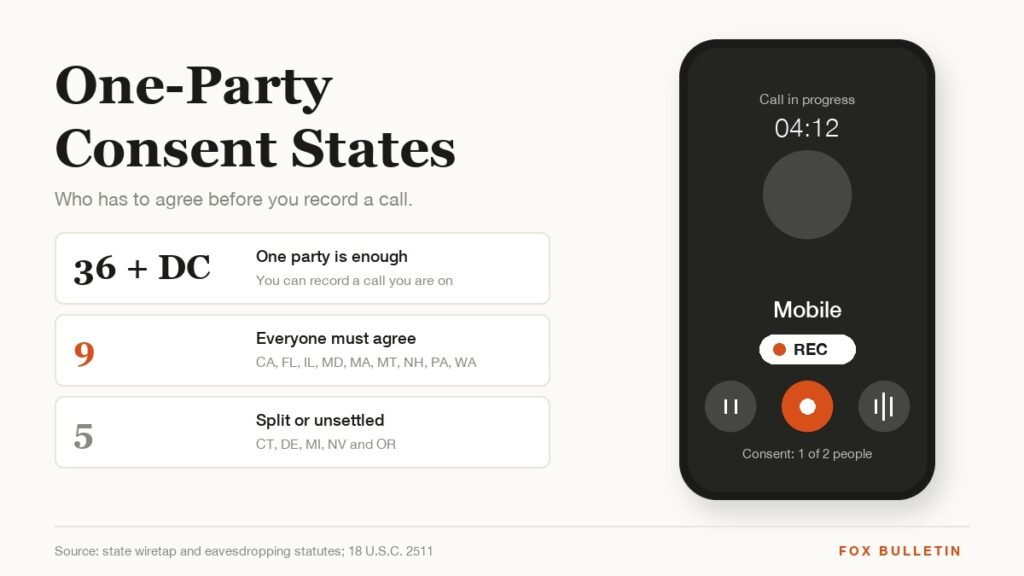
Thirty-six states and DC let you record a conversation you are part of. Nine require everyone's consent, three split the rule between calls and in-person talks, and two are unsettled.
Community Property States: All 9, Plus the 5 Opt-In States
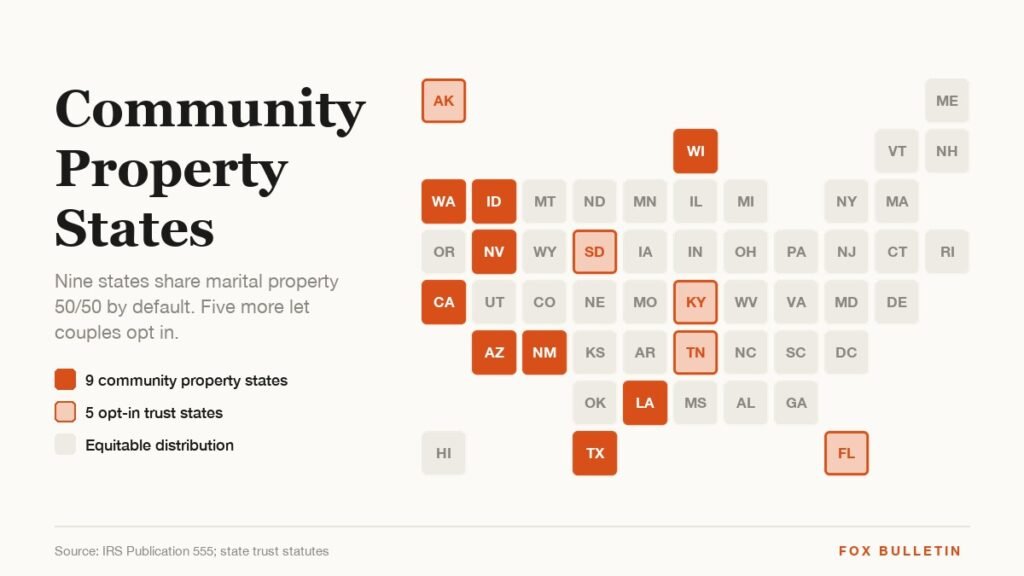
Nine US states are community property states: Arizona, California, Idaho, Louisiana, Nevada, New Mexico, Texas, Washington and Wisconsin. Five more let married couples opt in through a trust.
Employment at Will Explained by State: Which Exceptions Apply Where
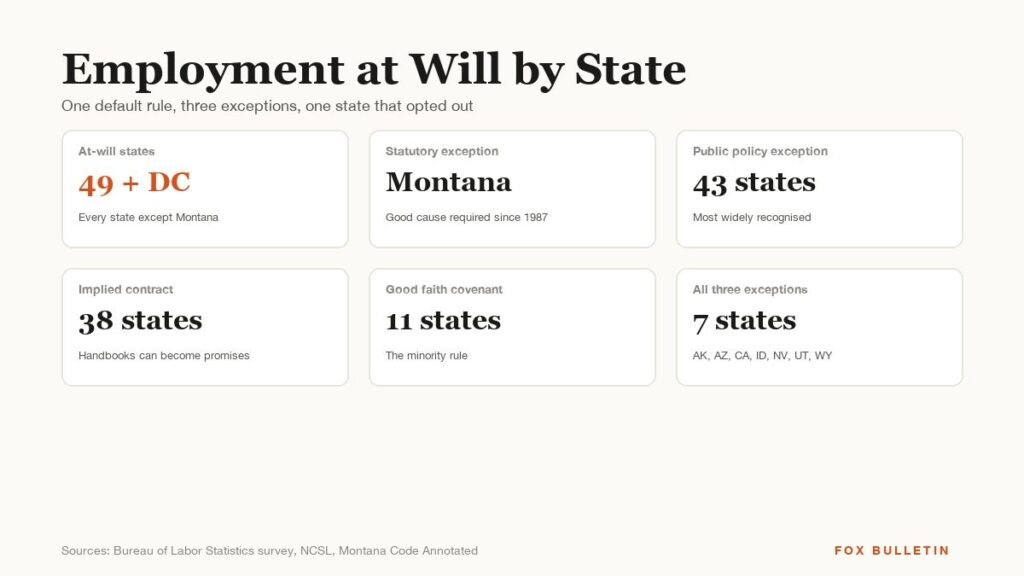
Every state but Montana presumes employment at will, yet most limit it through public policy, implied contract and good faith exceptions. A state-by-state table and what each exception means.