

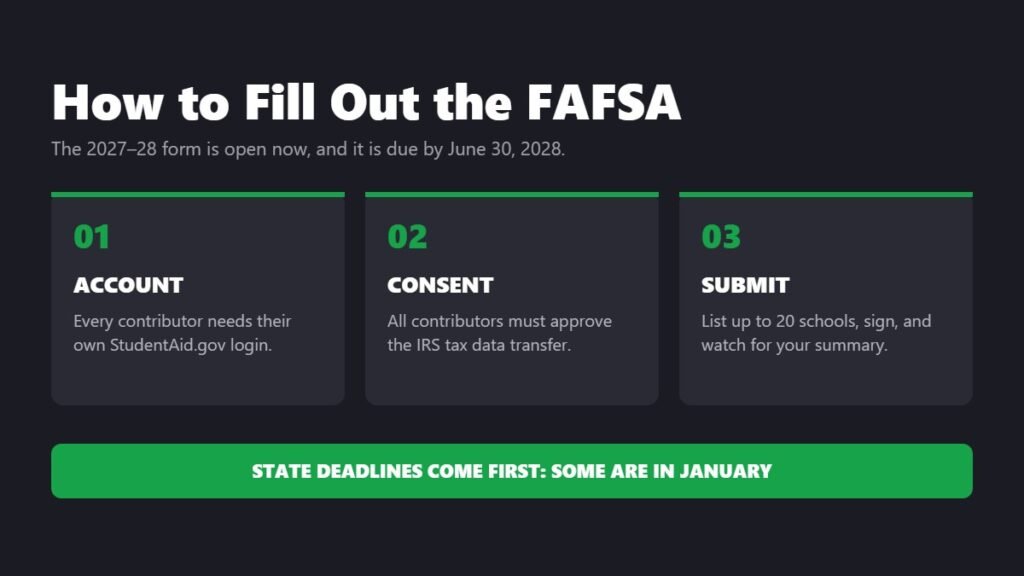
To fill out the FAFSA, create a StudentAid.gov account, go to fafsa.gov and start the 2027–28 form, answer the questions about you and your family, invite any parent or spouse who needs to contribute, give consent for your tax information to transfer from the IRS, list up to 20 schools, then sign and submit. Each contributor fills in their own section with their own account.
The 2027–28 FAFSA, for the school year running from 1 July 2027 to 30 June 2028, went live for everyone on 23 September 2026, ahead of the usual 1 October start, and the Education Department called it the earliest launch in the program’s history. The federal deadline is not until June 2028, but state and college deadlines come much sooner, and some state aid is handed out until the money runs out. The steps below come from Federal Student Aid’s own guidance on studentaid.gov and in its handbook for colleges.
When Does the FAFSA Open for 2027–28, and When Is It Due?
It is open now. The federal deadline is 11:59 p.m. Central time on 30 June 2028, and corrections can be made until 12 September 2028. But the date that matters for most students is their state’s, and several are months earlier. These are from studentaid.gov’s 2027–28 deadline list:
| State | 2027–28 FAFSA deadline |
|---|---|
| California | 2 March 2027 for most state aid, including Cal Grant (postmark date) |
| Texas | 15 January 2027 for priority consideration |
| Florida | 15 May 2027 (date processed) |
| Georgia | As soon as possible after 1 October 2026 |
| Illinois | As soon as possible after 1 October 2026; Monetary Award Program funds run out |
| Michigan | 1 July 2027 for priority consideration |
| New York | 30 June 2028 |
| North Carolina | As soon as possible for private colleges; 1 June 2027 for UNC schools and community colleges |
| Ohio | 1 October 2027 |
| Pennsylvania | 1 May 2027 for most students |
Colleges set their own deadlines too, often for institutional grants and scholarships, so check each school’s financial aid page. Filing early costs nothing: the Department says most FAFSA forms are processed immediately and some take one to three days.
What Do You Need to Fill Out the FAFSA?
Studentaid.gov’s FAFSA checklist lists six things:
- A StudentAid.gov account for you, and a separate one for each parent or spouse who contributes.
- Your parent or spouse’s details, including their email address to invite them.
- Federal tax information. Most of it transfers straight from the IRS once you consent, but keep your tax records handy for extra questions. The 2027–28 form uses 2025 tax information.
- Records of child support received in the last calendar year, if it applies.
- Records of your assets: current balances of cash, savings and checking accounts, plus the net worth of investments. You report amounts as of the day you sign, not the tax year.
- A list of schools you are interested in.
Some things do not count as assets: the home you live in, retirement plans, life insurance and ABLE accounts. Under the federal handbook, a small business your family owns and controls with 100 or fewer full-time employees, and a farm your family lives on, are excluded too. If your family’s finances have changed sharply since 2025, from job loss or high medical bills, fill out the form as instructed and then ask each school for an aid adjustment.
How to Create a StudentAid.gov Account
Go to StudentAid.gov and choose Create Account. You will need your name, date of birth, Social Security number, email address and phone number. Students must have an SSN to make an account, unless they are citizens of the Freely Associated States, but a parent or spouse without an SSN can still create one to complete their part of your form.
Your details are checked with the Social Security Administration, which usually happens right away but can take one to three days if the account shows as pending. That is the main reason to set up every account a few days before you plan to file. Your account is also your legal signature, so only you can use it: a parent cannot sign in as the student, or the other way round.
Who Needs to Be on Your FAFSA?
Anyone who has to provide information is called a contributor. Depending on your situation, that is:
- You, always.
- Your spouse, if you are married and filed taxes separately. If you filed jointly, you report their information yourself.
- Your parent or parents, if you are a dependent student. If your parents are married and filed separately, the parent you invite will need to invite the other.
- If your parents are divorced or separated, the parent who gave you more financial support over the last 12 months. If support was equal, the parent with more income and assets. A stepparent married to that parent is also a contributor.
Whether you are dependent is decided by a set of questions, not by whether your parents claim you on their taxes. You are generally independent for 2027–28 if you were born before 1 January 2004, are married, are a graduate student, are on active duty or a veteran, have children or other dependents you support, or were in foster care or a ward of the court. Colleges can also make a dependency decision for unusual circumstances.
How to Fill Out the FAFSA, Step by Step
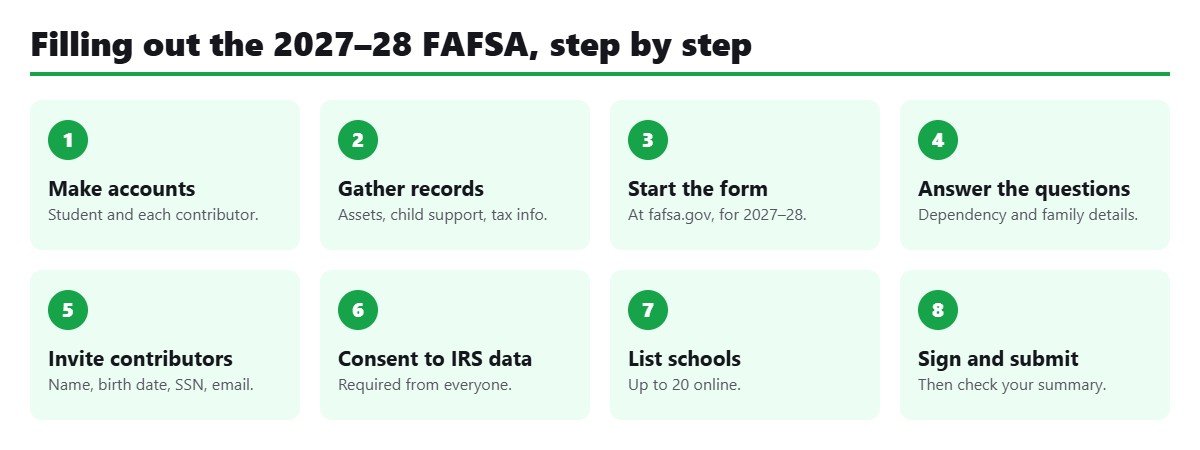
- Create StudentAid.gov accounts for you and every contributor.
- Gather your records: asset balances, child support records and your 2025 tax information.
- Start the 2027–28 FAFSA at fafsa.gov after signing in.
- Answer the student questions, including the dependency questions that decide who else must contribute.
- Invite your contributors. Enter each person’s name exactly as it appears on their Social Security card, their date of birth, SSN or ITIN, and email address. They get an email invitation and complete their own section.
- Give consent and approval for the IRS transfer. Every contributor must do this, even if they did not file a tax return.
- List up to 20 schools online, or up to 10 on the PDF form. You must list at least one.
- Sign and submit. Your form is only complete once every contributor has signed their section.
What Happens After You Submit the FAFSA?
You get a FAFSA Submission Summary, which shows your answers and your Student Aid Index, or SAI. The SAI is the number colleges use to work out your financial need; it replaced the old Expected Family Contribution. It is an eligibility index, not a bill, and it can be negative for students with the greatest need. The schools you listed receive your information and send financial aid offers, often after you are admitted. Read your summary carefully and use the correction window if anything is wrong.
What Changed for Pell Grants and Student Loans in 2026?
The One Big Beautiful Bill Act, signed in July 2025, changed several aid rules from the 2026–27 award year, and they carry into 2027–28:
- The maximum Pell Grant for 2026–27 is $7,395, and the minimum is $740, according to Federal Student Aid’s award letter to colleges. The 2027–28 amount has not been announced yet.
- Students with a high SAI no longer get Pell. Anyone whose SAI is at least twice the maximum Pell Grant is ineligible; for 2026–27 that cutoff is an SAI of $14,790.
- Workforce Pell now extends Pell Grants to eligible short workforce training programs, including for some students who already have a bachelor’s degree, from 1 July 2026.
- Grad PLUS loans ended for new borrowers on 1 July 2026, with exceptions for some students already borrowing.
- New loan caps: a lifetime limit of $257,500 in federal student loans, and Parent PLUS loans capped at $65,000 per dependent student, according to Federal Student Aid’s guidance to colleges. The Department says graduate students are now limited to $20,500 a year and $100,000 in total, and professional students to $50,000 a year and $200,000.
None of this changes how you fill out the form, but it does change what a financial aid offer may include, especially for graduate students and parents who planned to borrow.
Common FAFSA Mistakes That Delay Your Aid
- A contributor never consents or signs. Without every contributor’s approval of the IRS transfer, you are not eligible for federal aid until they provide it. Typing in tax figures by hand does not replace it.
- Contributor details that do not match Social Security records. Use the exact name on the Social Security card and the correct date of birth and SSN.
- Signing in with someone else’s account. Each person must use their own login.
- Inviting the wrong parent after a divorce or separation. It is the parent who provided more support, not the one you live with.
- Using the wrong year’s information, or reporting asset balances from the tax year instead of the day you sign.
- Waiting for the federal deadline when your state’s is months earlier.
Frequently Asked Questions
What tax year does the 2027–28 FAFSA use?
2025. The FAFSA uses tax information from two years before the award year begins, and most of it is transferred directly from the IRS once you and your contributors consent.
Can I fill out the FAFSA if my parent won’t provide their information?
You can submit the form, but if you are a dependent student and a required parent does not provide consent and their information, you will not be eligible for federal aid. If there is a serious reason you cannot contact your parents, such as abandonment or abuse, you can indicate that on the form and speak to your college’s financial aid office, which can make a dependency decision.
How many colleges can I list on the FAFSA?
Up to 20 on the online form and up to 10 on the PDF version. You can add or swap schools later through a correction.
How long does the FAFSA take to process?
Most forms are processed immediately, and some take one to three days, according to the Education Department. Schools then need time to build your aid offer.
Do I have to fill out the FAFSA every year?
Yes. The FAFSA covers one award year, so you file a new one for each year you want federal aid. If you submitted a 2027–28 form during the September beta test, you do not need to resubmit it.
Related Articles

Get the Fox Bulletin briefing
The stories that matter, in your inbox. No spam, unsubscribe anytime.
Newsletter signup will be available soon.
Related stories
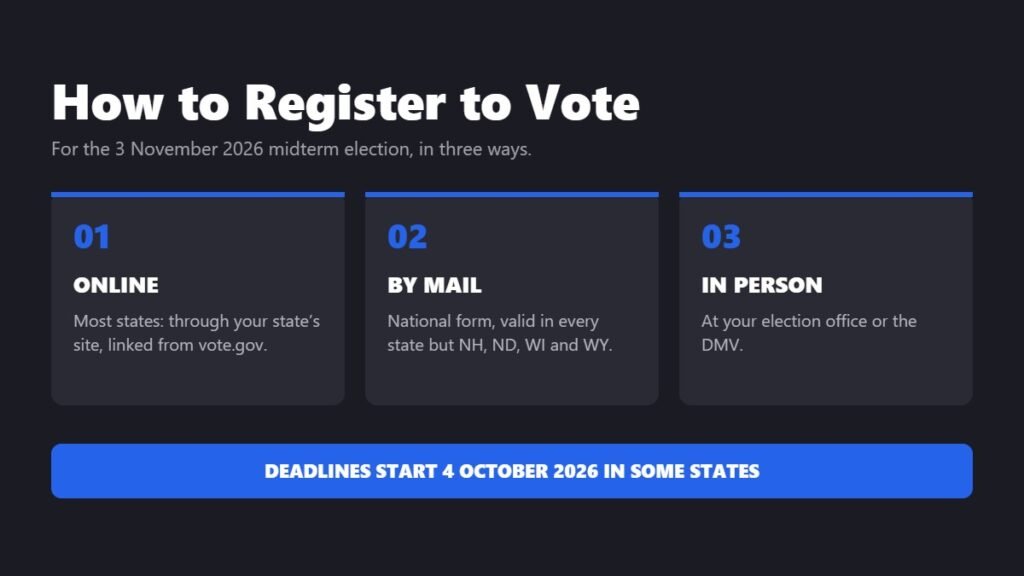
How to Register to Vote in 2026: Online, by Mail or in Person
How to register to vote for the 3 November 2026 midterm election: online, by mail or in person, what you need, when state deadlines fall, and how to check you are already registered.
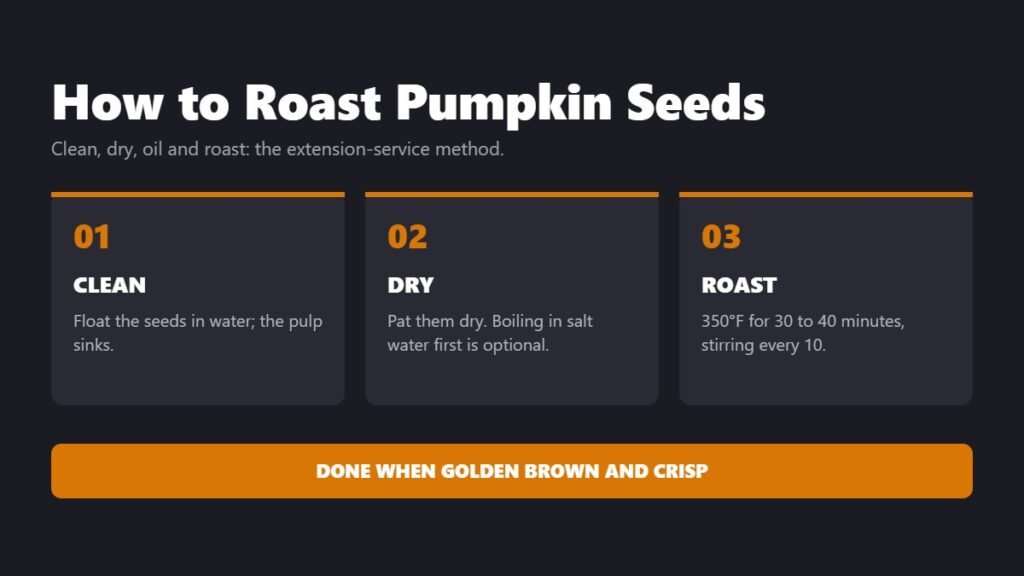
How to Roast Pumpkin Seeds: Oven Times, Temperatures and Seasonings
How to roast pumpkin seeds the way extension services do it: clean them in water, dry them, then roast at 350°F for 30 to 40 minutes, with five seasoning mixes and USDA nutrition figures.
How to Carve a Pumpkin: Step by Step, Plus How to Make It Last
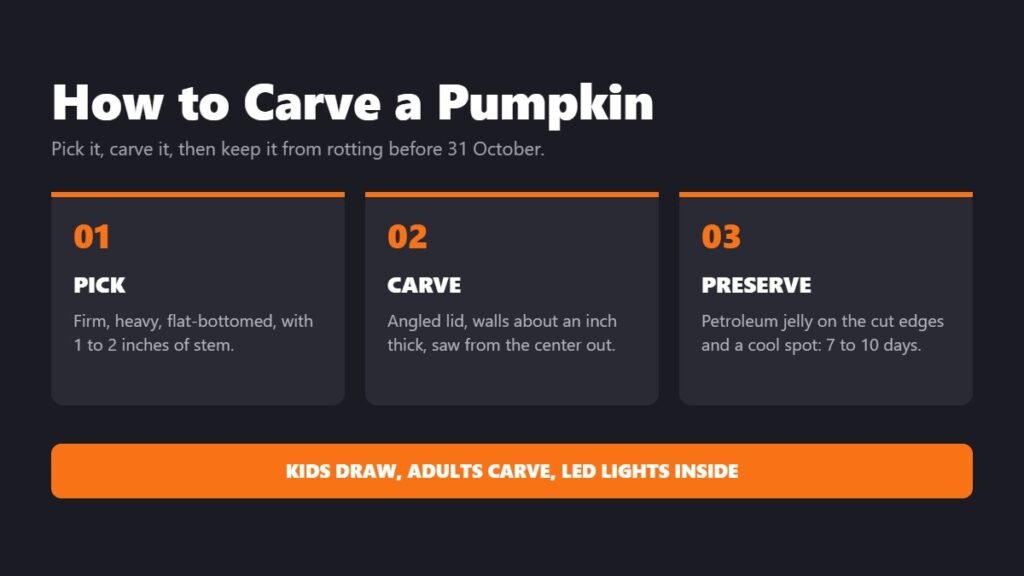
How to carve a pumpkin the way extension services teach it: pick a sound one, cut an angled lid, thin the wall to an inch, transfer a pattern, and keep it from rotting for 7 to 10 days.