

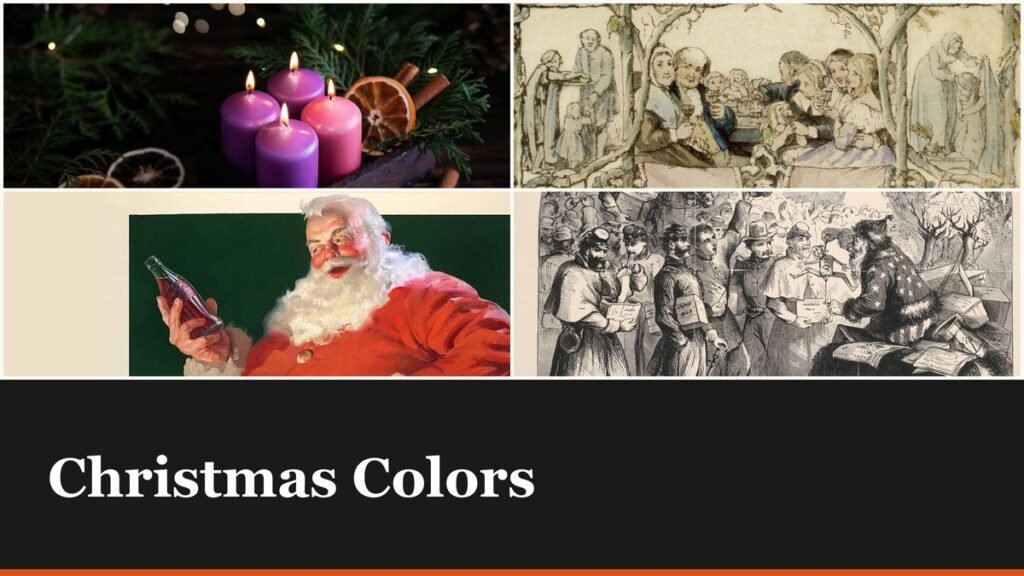
The traditional Christmas colors are red and green, with gold and white close behind. Each one has a separate history: green comes from evergreens, red is tied to poinsettias and Santa’s suit, gold goes back to the gifts of the Magi, and the church’s own Christmas color is white, not red or green.
Advent brings purple, pink and sometimes blue, the poinsettia has outgrown red, and the red-suited Santa is older than the 1931 soft drink ads people credit for him. Anyone planning decorations for Christmas Day on Friday, December 25 can match each color to its meaning when choosing a palette.
What Are the Colors of Christmas?
The main colors of Christmas are red, green, white and gold. Red and green are the popular pair, drawn from holiday plants and Santa’s suit. White and gold are the Christian Christmas colors, used in churches for the season itself. Purple and pink belong to Advent, the weeks before Christmas, and blue appears on some Advent wreaths.
Christmas Colors and What Each One Traditionally Means
Every color in the Christmas palette has a home, either in the church calendar or in household custom, and the two do not always agree.
| Color | Where it appears | What it traditionally stands for |
|---|---|---|
| Red | Poinsettia bracts, Santa’s suit | The household color of the season; in church, red marks Palm Sunday, Good Friday, Pentecost Sunday, apostles and martyrs rather than Christmas |
| Green | Evergreen trees, wreaths and garlands | Eternal life; in church, green is the color of Ordinary Time, not Christmas |
| White | The center Advent candle; the church color for Christmas Time | Purity and the light of Christ; white is the color of Christmas Time in the Catholic calendar |
| Gold | Tree ornaments; church use on more solemn occasions | The gold offered to the infant Jesus by the Magi; gold or silver is permitted in the U.S. for more solemn occasions |
| Purple (violet) | Advent candles and church cloths | Reflection and repentance before Christmas; also linked to royalty and the title King of Kings |
| Pink (rose) | The third Advent candle | Joy, on the third Sunday of Advent, called Gaudete Sunday |
| Blue | Advent candles in many Methodist and Lutheran churches | Hope and expectation |
Why Red and Green Became the Colors of Christmas
Green came first, and it came from trees. Wreaths, garlands and evergreen trees have stood for eternal life since the ancient Egyptians, Chinese and Hebrews, and Scandinavian households decorated house and barn with evergreens at the New Year. A medieval play about Adam and Eve used a fir tree hung with apples as its “paradise tree,” and German households set one up on December 24. By the 16th century that tree had merged with a wooden Christmas pyramid to become the Christmas tree.
Red arrived on the same branches and in the same houses. The Victorian tree carried candles, candies, popcorn strings and cakes hung from ribbons, and German-born Prince Albert helped popularize it in England in the mid-19th century. The pairing of red and green is traditionally linked to the evergreen customs of mid-winter festivals that came before Christmas, and in the 17th century Franciscan priests in southern Mexico decorated nativity scenes with the red and green of the poinsettia.
The red on a poinsettia is not made of petals. The colored parts are bracts, modified leaves, which are traditionally red but now come in white, pink, burgundy, orange, purple, marbled and speckled. National Poinsettia Day falls on December 12, the anniversary of the death of Joel Poinsett, the first U.S. ambassador to Mexico, who sent cuttings of the plant to his South Carolina greenhouse in 1828.
Santa’s Red Suit Is Older Than the 1931 Coca-Cola Ads

Santa wore red before Coca-Cola ever painted him. Coca-Cola did not create the legend of Santa Claus, and a red coat appeared on Santa before illustrator Haddon Sundblom painted his version. What the 1931 campaign did was fix a look: a warm, plump, human Santa with rosy cheeks, a white beard, twinkling eyes and laughter lines, inspired by Clement Clark Moore’s 1823 poem “A Visit From St. Nicholas.”
Before 1931 the picture varied widely. Santa had appeared as a tall gaunt man, a small elf and even a scary figure, and he had worn a bishop’s robe and a Norse huntsman’s animal skin. Sundblom’s first model was Lou Prentiss, a retired salesman and a friend of his, and his Santa appeared in magazine ads from 1931 to 1964, starting in The Saturday Evening Post. A department-store Santa drinking a Coke had already run in the same magazine in December 1930. The full story is in the history of Haddon Sundblom and the Coca-Cola Santas.
Thomas Nast Drew Santa in Harper’s Weekly

The cartoonist who did the most to shape the figure before 1931 was Thomas Nast. His first Santa Claus ran in Harper’s Weekly on January 3, 1863, and showed Santa handing out presents in a Union Army camp, wearing a jacket patterned with stars and striped pants. Nast drew Santa for Harper’s Weekly until 1886, 33 illustrations in all.
Those pages were printed in black and white, so the engravings do not show the color of any coat. His 1881 portrait “Merry Old Santa Claus” is probably the most famous. For more on the cartoonist’s career, see Ohio State University Libraries on Thomas Nast.
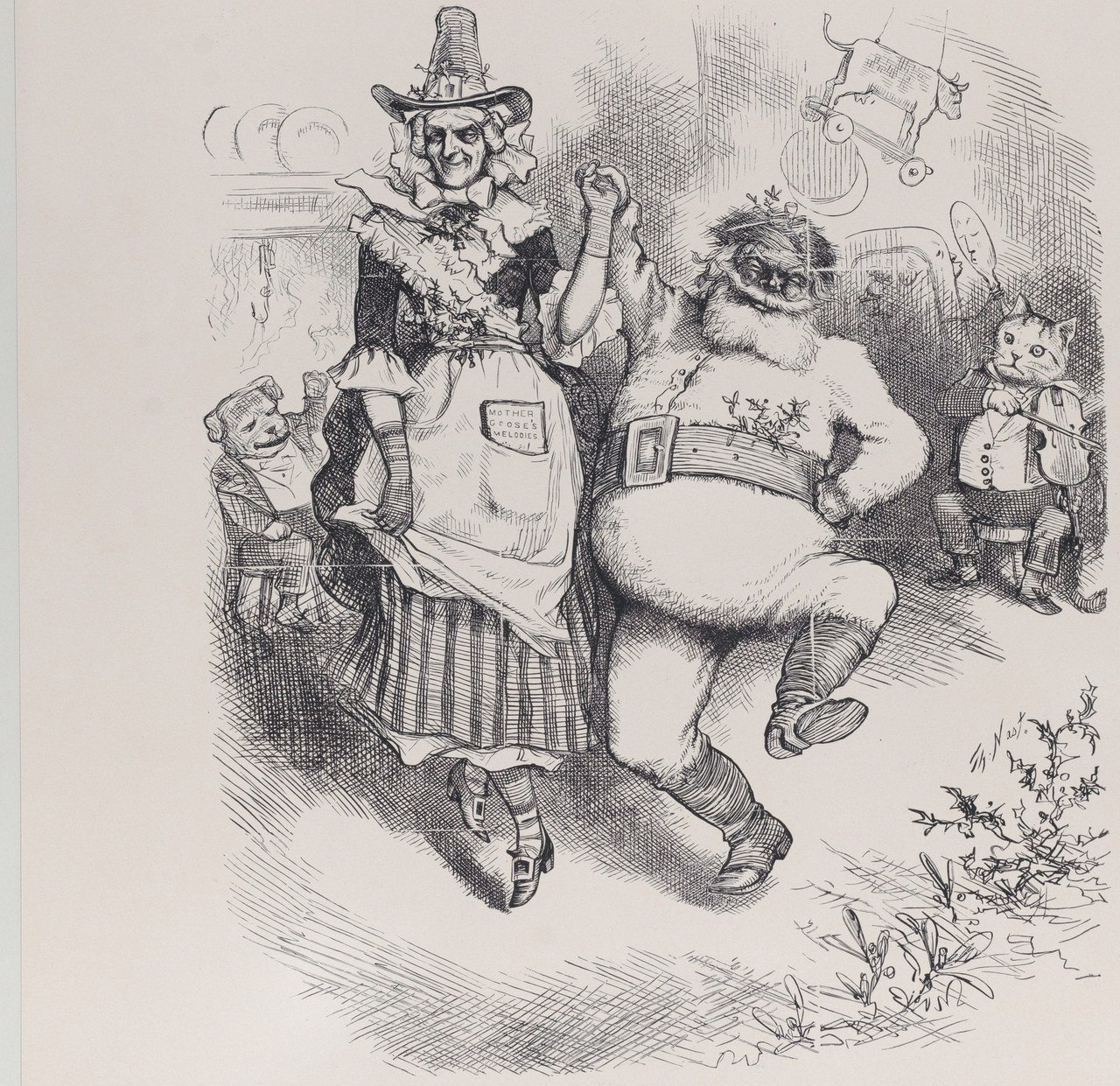
Nast kept returning to the character after the war. A Merry Christmas in 1880 shows Santa dancing, and A Stocking Full in 1879 shows him tucked inside an oversized stocking.

Nast’s imagery of reindeer, a sleigh and a sack of presents draws on Moore’s poem, the same poem Sundblom used. The animals themselves have names, which appear in the names of Santa’s reindeer.
The Church’s Christmas Colors Are White and Gold, Not Red and Green
In the Catholic liturgical calendar used in the U.S., white is the color of Christmas Time and Easter Time. It also marks celebrations of the Lord, of Mary and the angels, and the feast of St. John on December 27. Gold or silver may replace it on more solemn occasions.
The colors people tie to Christmas appear elsewhere in the church year. Green is Ordinary Time, and red belongs to Palm Sunday, Good Friday, Pentecost Sunday and the celebrations of martyrs and apostles. Violet is the color of Advent and Lent, and rose replaces it on the third Sunday of Advent and the fourth Sunday of Lent.
Gold has its own place in the Christmas story. The Magi opened their treasures and offered the child gifts of gold, frankincense and myrrh, and gold on a tree or in a church carries that tradition.
Advent Wreath Colors: Purple, Pink, Blue and White

Advent comes from the Latin adventus, meaning arrival, and the wreath that marks it is round, with no beginning or end, to symbolize eternal love. Evergreens keep their green in winter, so the wreath also stands for the promise of life.
The candle colors depend on the tradition:
- Catholic churches use purple for the first, second and fourth Sundays and pink for the third, with a white Christ candle sometimes in the center.
- Many Lutheran churches in the U.S. follow the same purple and pink pattern, and some use four blue candles for hope and expectation.
- Methodist churches treat purple or blue as the Advent colors, with blue standing for hope.
- Eastern Orthodox wreaths use green, blue, gold, white, purple and red across a six-week Advent, with a special white candle at the end.
- Home wreaths can be any color, because the practice began as a German and Scandinavian family devotion in which candle color did not matter.
Purple stands for reflection and repentance and has long been linked to royalty. Pink, on the third Sunday, stands for joy, and that Sunday takes its name from the Latin gaudete, meaning rejoice. The white candle in the center represents the purity and light of Christ and is lit on Christmas Eve or Christmas Day.
A Victorian Card That Skipped Red and Green
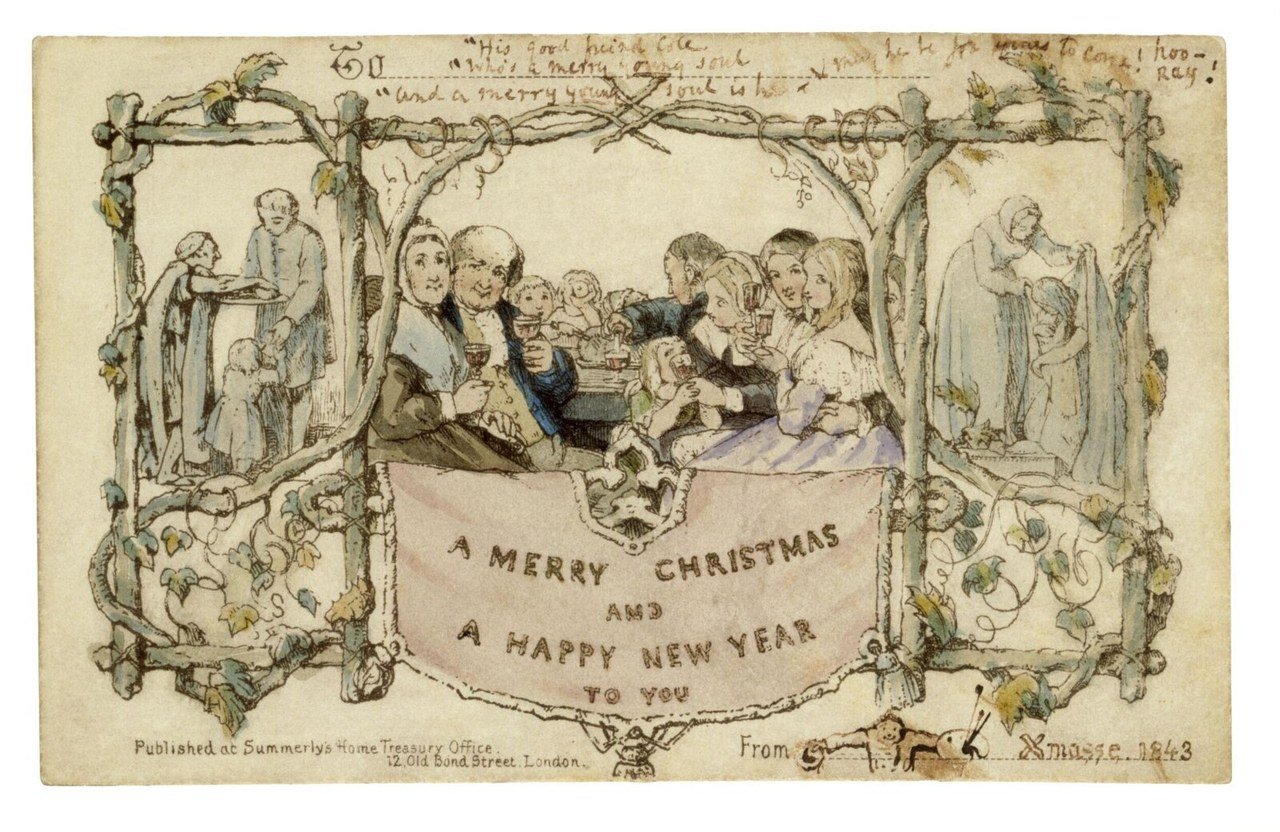
The first Christmas card, sent by Henry Cole in 1843, shows how little the palette was fixed. John Callcott Horsley designed it, and it shows three generations of the Cole family raising a toast in a hand-coloured central panel, framed by black-and-white scenes of acts of giving. Its colors are muted: a pale pink banner reading “A Merry Christmas and a Happy New Year to You,” a cream ground and brown-gold vines.
A thousand copies were printed and sold at a shilling each, and the venture was judged a commercial flop. Cards caught on in the decades that followed. The Victorian heyday ran from 1860 to 1890, when chromolithography and metallic inks made elaborate cards possible, and those cards established holly, robins, evergreens, snowy landscapes and Santa Claus as Christmas imagery. The V&A article on the first Christmas card covers how the tradition began.
How to Choose a Christmas Color Scheme
- Start with the traditional pair. Red and green work because both are tied to the season’s plants: evergreens for the tree and poinsettia for the table.
- Add white or gold for the church tradition. A white candle or gold ornaments echo the Christmas Time color without changing the overall look.
- Use purple and pink for an Advent display, with a pink candle for the third week.
- Pick a poinsettia in white, pink or burgundy if red feels too expected. Keep it between 60 and 70 degrees Fahrenheit, near a sunny window but out of direct sun, and water it thoroughly before letting it dry out.
- Keep any Advent wreath consistent with your own tradition. Blue suits Methodist and Lutheran practice, and any color is fine for a home wreath.
Frequently Asked Questions
What are the traditional Christmas colors?
Red, green, white and gold. Red and green are the popular pair, while white and gold are the colors the church uses for Christmas Time.
Did Coca-Cola make Santa wear red?
No. Santa appeared in a red coat before Haddon Sundblom painted him in 1931. The ads gave Santa a warm, human face, and the look spread through magazines from 1931 to 1964.
Why is purple used in Advent?
Purple stands for reflection and repentance before Christmas, and it has long been linked to royalty. It is also the color of Lent. The third Sunday of Advent uses pink or rose for joy.
Are poinsettias poisonous?
No. A study found a 50 pound child would need to eat more than 500 leaves to reach a harmful effect. The plant’s latex sap can irritate the skin of people with latex allergies, so handle it with care.
Related Articles

Get the Fox Bulletin briefing
The stories that matter, in your inbox. No spam, unsubscribe anytime.
Newsletter signup will be available soon.
Related stories

Merry Christmas in Different Languages: Say It Like a Local
Merry Christmas in different languages by region, with each greeting in its own script, a say-it-like guide and the countries where each is used.

What Stores Are Open on Christmas Day? Chain by Chain
What stores are open on Christmas Day? Walmart, Target, Home Depot and Lowe's are closed Friday, December 25, 2026, while Denny's and Waffle House stay open.

Is Starbucks Open on Christmas? Dec 24 and 25 Answers
Is Starbucks open on Christmas? Some coffeehouses open on Friday, December 25, 2026 and others close. See why hours vary and how many stores are licensed.