

Learning how to clean a TV screen properly takes two minutes, and getting it wrong is permanent. The glass cleaner and kitchen roll that work on a window will strip the anti-glare coating off a television, leaving cloudy patches that no amount of polishing removes.
Modern TV panels are coated, flexible and not covered by warranty for cleaning damage. The method below follows Samsung’s own published instructions, and covers the one thing people most often get wrong: what is safe on a phone or a laptop is not safe on a television.
What You Need
- A soft, clean, lint-free microfiber cloth. Samsung recommends exactly this and nothing else for routine cleaning.
- Distilled water, which dries without leaving mineral spots.
- A second dry cloth to take off any remaining moisture.
- Nothing else. No sprays, no wipes, no household cleaner.
Microfiber does the work here mechanically rather than chemically, which is why no product is needed. Any clean general-purpose cloth works, though the low-pile glass cloths in our comparison of microfiber towels leave the fewest streaks on a large panel.
How to Clean a TV Screen, Step by Step
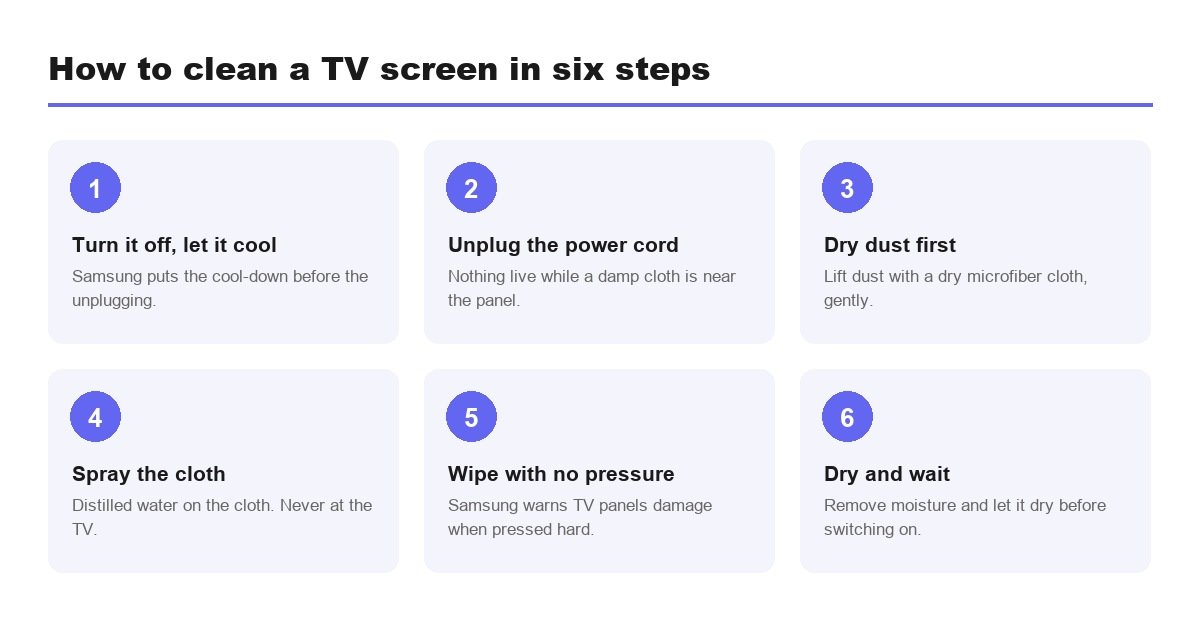
- Turn the TV off and let it cool for a few minutes. Samsung puts the cool-down before the unplugging, and a dark screen makes every smudge visible.
- Unplug the power cord. Nothing should be live while a damp cloth is anywhere near the panel or the ports behind it.
- Wipe dust away with a dry microfiber cloth first, gently, so grit is lifted rather than dragged across the coating.
- If smudges remain, spray distilled water onto the cloth, never onto the TV. Samsung warns that liquid entering the TV can cause failure, fire or electric shock.
- Wipe gently with no pressure. Samsung notes TV screens are fragile and can be damaged when pressed too hard.
- Remove remaining moisture with a dry cloth and leave it to dry fully before switching the TV back on.
Work across the panel in overlapping passes rather than scrubbing at one spot, and clean the frame and stand with the same cloth afterwards so dust does not fall back onto a screen you have just finished.
What Never to Use on a TV Screen
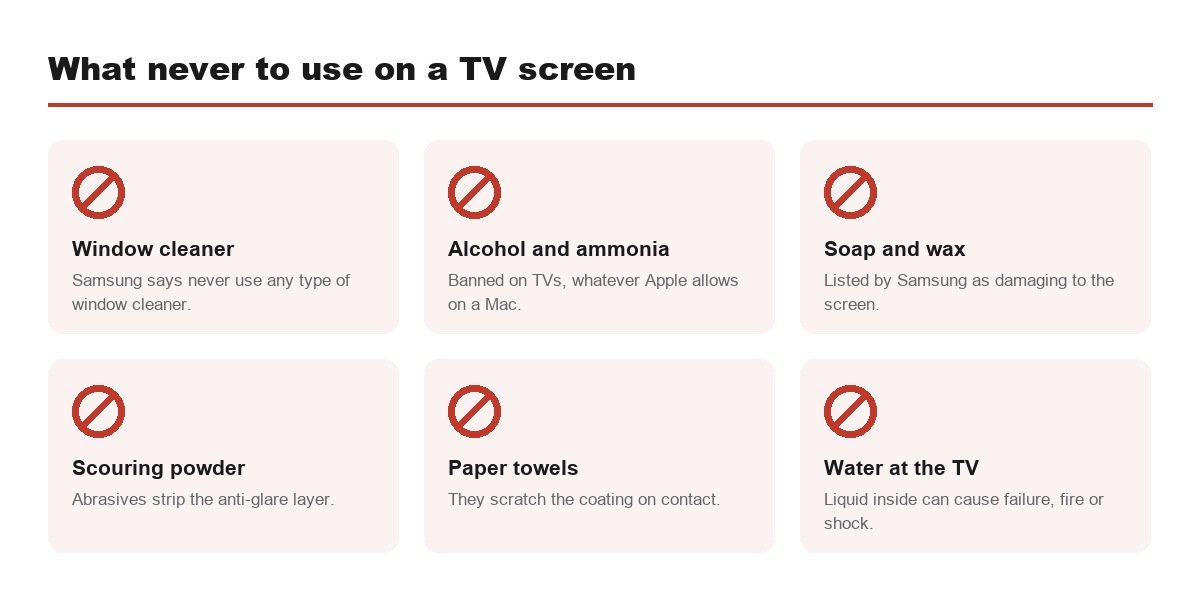
Samsung’s support guidance lists what causes permanent damage, and it is worth reading as a list of things that are probably in your cupboard right now.
- Window cleaner: the ammonia strips anti-glare coatings.
- Any cleanser with solvents such as alcohol, benzene, ammonia or acetone.
- Soap, wax and scouring powder, all named in the same warning.
- Paper towels and abrasive pads: both scratch coated panels.
- Water sprayed directly at the TV, which can run inside the casing.
Samsung states the outcome without hedging: doing this can scratch the screen or strip the anti-glare coating off and cause permanent damage. That damage looks like dull, cloudy patches under bright scenes, and replacing the panel usually costs more than the television is worth.
Why Phone and Laptop Rules Do Not Apply to a TV
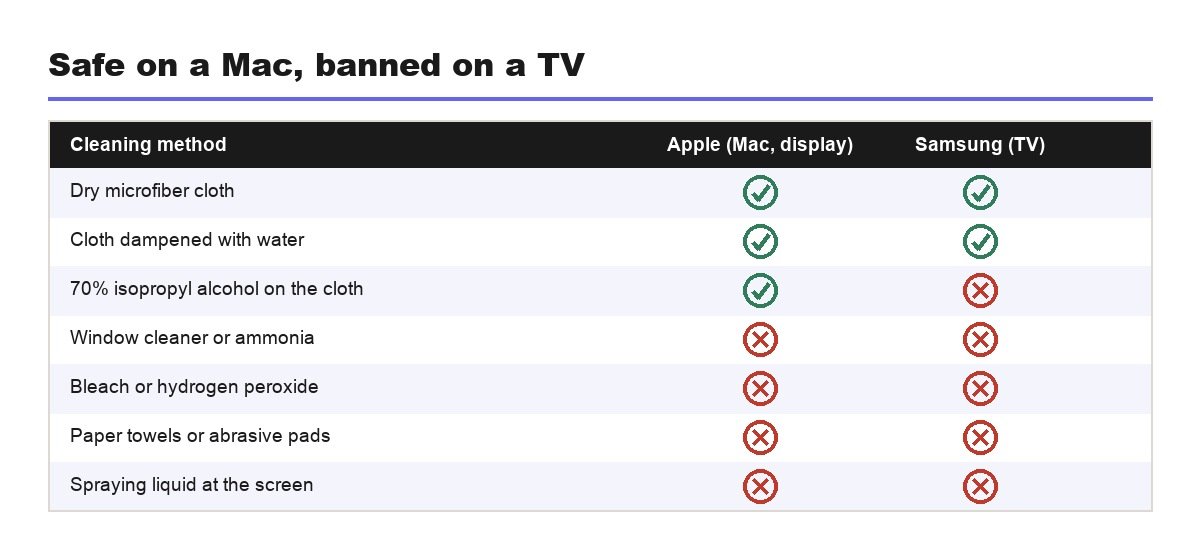
This is where most people go wrong, and understandably so. Apple publishes cleaning guidance that permits something Samsung explicitly forbids, and both are correct about their own products.
- Apple permits alcohol: a 70 percent isopropyl alcohol wipe or a 75 percent ethyl alcohol wipe may be used gently on hard, nonporous surfaces including the display.
- Samsung forbids it on televisions: never use a cleanser containing solvents such as alcohol.
- Both ban the same things: bleach and hydrogen peroxide, abrasives, and spraying liquid at the panel.
A phone screen is toughened glass built to be handled constantly. A television panel is a large, thin, coated sheet that nobody is meant to touch at all. Apple’s own instructions apply to Apple hardware, not to your TV, so use distilled water on a cloth and nothing stronger.
If Liquid Gets Into the TV
This is the reason every instruction above says to spray the cloth rather than the screen. Samsung states the consequence plainly: any liquid entering the TV may cause a failure, fire or electric shock, and it tells you not to spray water or any other liquid directly onto the set.
- Unplug it immediately and do not switch it on to check whether it still works.
- Stand it upright so liquid drains away from the boards rather than across them.
- Leave it to dry for a day or more before power goes anywhere near it.
- Expect it not to be covered. Liquid damage is normally excluded from a TV warranty.
The risk is not the panel so much as the electronics behind the bottom bezel, where the power board and connectors sit. A screen sprayed from arm’s length sends liquid straight down the glass into that strip, which is why a damp cloth is both safer and, in practice, more effective.
OLED, QLED and Matte Screens
Panel technology changes how careful you need to be, and the newer matte finishes are the most delicate surfaces in the average living room.
- OLED: very thin and flexible. Pressure is the main risk, so use almost none.
- QLED and LCD: more rigid, but still coated. The coating remains the fragile part.
- Matte and anti-glare finishes: the least forgiving. Water only, and no solvents ever.
- Glossy screens: the most robust, and the ones that show every fingerprint.
Whatever the panel, the failure mode is the same. It is almost never the water that causes damage, it is pressure, grit dragged across the surface, or a solvent that dissolves a coating measured in microns. The same caution applies to the lens and filters on a home projector, where a single wipe with a dry tissue can leave marks that show up in every bright scene.
The Frame, the Serif and Other Matte Samsung TVs
Samsung’s matte-finish sets get their own instructions, and they are the one place the company sanctions something that would ruin an ordinary television. The anti-glare surface that kills reflections also holds fingerprints more stubbornly than glass does.
- Start with a microfiber cloth, exactly as on any other set.
- If that fails, Samsung says a melamine foam sponge, the kind sold as a magic eraser, may be used on these models.
- Turn the TV off and unplug it, then lightly dampen a microfiber cloth with a few drops of water and wipe the mark.
- Use the sponge before the water dries, on the spot itself rather than the whole panel.
Read that as a model-specific exception and nothing more. A melamine sponge is a very fine abrasive, which is exactly why it lifts marks, and on a glossy panel or a coated anti-glare layer it does the damage the rest of this article is about avoiding. If your set is not one Samsung names, the answer stays a damp microfiber cloth and patience.
How Often to Clean a TV
Dust regularly and wet clean rarely. Each wet clean carries a small risk, so the goal is to avoid ever needing to scrub.
- Dust every week or two with a dry microfiber cloth, which prevents buildup.
- Wet clean only when needed, for fingerprints or splashes rather than on a schedule.
- Deal with splashes straight away, before they dry onto the coating.
- Wash cloths without fabric softener, which coats the fibres and stops them working.
Frequently Asked Questions
Can you use Windex on a TV screen?
No. Samsung says never to use any type of window cleaner, and that cleansers containing solvents such as alcohol, benzene, ammonia or acetone can strip the anti-glare coating and cause permanent damage. A dry microfiber cloth, or one dampened with distilled water, is the safe option.
Can you clean a TV screen with water?
Yes, provided it goes on the cloth and not on the TV. Samsung recommends spraying distilled water onto a microfiber cloth for smudges a dry cloth will not shift, and warns that liquid entering the TV can cause failure, fire or electric shock.
Are screen cleaning wipes safe for a television?
Only if they are sold specifically for TV screens and contain no alcohol or ammonia. Many wipes marketed for electronics are alcohol based, which Samsung advises against for its TVs. Check the ingredients, and when in doubt use distilled water on a microfiber cloth.
Why does my TV screen look streaky after cleaning?
Usually tap water or too much of it. Minerals in tap water dry into visible streaks, which is why Samsung specifies distilled water, and a cloth that is wet rather than barely damp leaves more behind than it lifts. Finish with a dry cloth, and wash your cloths without fabric softener, which coats the fibres and stops them absorbing anything.
How do you get scratches out of a TV screen?
You generally cannot. A scratch through the anti-glare coating is permanent, and the polishes sold for the purpose tend to remove more coating and make the patch more visible. Prevention is the only real answer, which is why the no-paper-towels rule matters.
Related Articles

Get the Fox Bulletin briefing
The stories that matter, in your inbox. No spam, unsubscribe anytime.
Newsletter signup will be available soon.
Related stories

Best Microfiber Towels for Cars: 7 Compared on Pile and Weave
Seven microfiber towels for cars compared on pile, weave and size, covering plush for paintwork and waffle weave for drying.
Best Mechanical Pencil for Drawing: 7 Compared by Lead Size
Seven drawing pencils compared from a 0.3mm technical pencil to a 2mm clutch lead holder, with sleeve design and lead grades explained.

Best SUV Under 50000 in the US: 7 Compared on Price and MPG
Seven SUVs under $50,000 in the US compared on starting MSRP and official EPA mpg, including which three-row models stay under forty thousand dollars.