

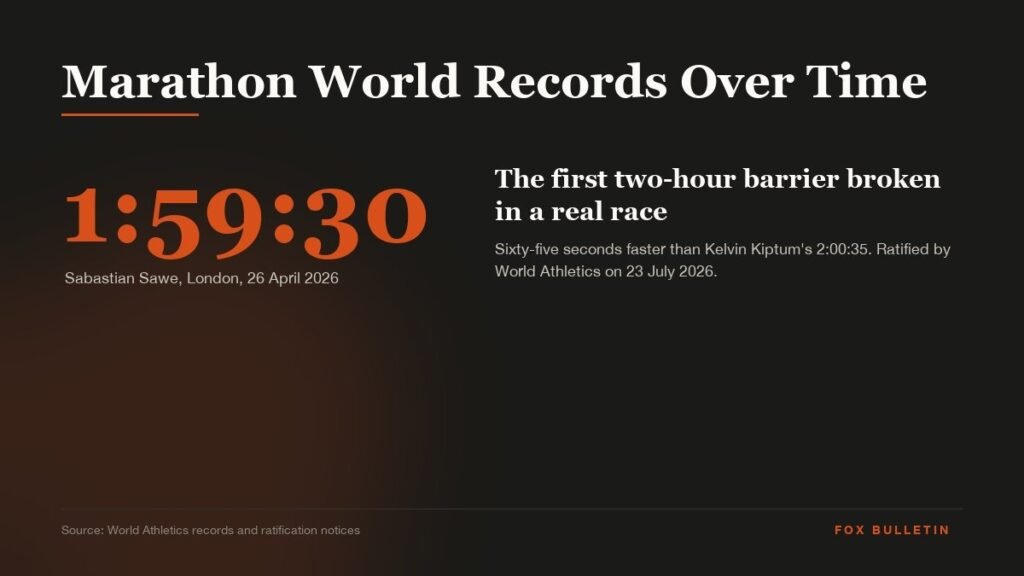
The marathon world record is 1:59:30, set by Sabastian Sawe of Kenya at the London Marathon on 26 April 2026 and ratified by World Athletics on 23 July. It is the first time a man has broken two hours in a race that counts, 65 seconds faster than Kelvin Kiptum’s previous mark and more than five minutes quicker than the record of 2003.
This list ranks the ten most recent men’s marathon world records in order, newest first, and shows how the distance has been chipped away over 23 years. Nine of the ten are official world records; the tenth, Paul Tergat’s 2003 run, was a world best, because World Athletics only began ratifying marathon records in 2004. The women’s records, which are tracked separately for mixed and women-only races, follow the table.
| Rank | Athlete | Country | Time | Race | Date |
|---|---|---|---|---|---|
| 1 | Sabastian Sawe | Kenya | 1:59:30 | London | 26 April 2026 |
| 2 | Kelvin Kiptum | Kenya | 2:00:35 | Chicago | 8 October 2023 |
| 3 | Eliud Kipchoge | Kenya | 2:01:09 | Berlin | 25 September 2022 |
| 4 | Eliud Kipchoge | Kenya | 2:01:39 | Berlin | 16 September 2018 |
| 5 | Dennis Kimetto | Kenya | 2:02:57 | Berlin | 28 September 2014 |
| 6 | Wilson Kipsang | Kenya | 2:03:23 | Berlin | 29 September 2013 |
| 7 | Patrick Makau | Kenya | 2:03:38 | Berlin | 25 September 2011 |
| 8 | Haile Gebrselassie | Ethiopia | 2:03:59 | Berlin | 28 September 2008 |
| 9 | Haile Gebrselassie | Ethiopia | 2:04:26 | Berlin | 30 September 2007 |
| 10 | Paul Tergat | Kenya | 2:04:55 | Berlin | 28 September 2003 |
The 10 Most Recent Men’s Marathon World Records
1. Sabastian Sawe, 1:59:30: London, 2026
Improvement: 65 seconds | Ratified: 23 July 2026 | Note: First sub-two-hour record
Sawe’s run is the one everybody will remember. Eliud Kipchoge had gone under two hours in Vienna in 2019, but that was a staged event with rotating pacemakers and did not qualify. Sawe did it in an ordinary race on a record-eligible course, and World Athletics’ ratification notice describes him as the first man to break two hours in a record-eligible marathon. London had never hosted a men’s record before; every one of the previous seven had been set in Berlin or Chicago.
2. Kelvin Kiptum, 2:00:35: Chicago, 2023
Improvement: 34 seconds | Ratified: 6 February 2024 | Note: First sub-2:01
Kiptum broke Kipchoge’s record in only his third marathon, at 23, and ran the second half of Chicago faster than the first. World Athletics ratified the time on 6 February 2024. He died in a road accident in Kenya five days later, and the record stood for two and a half years until Sawe beat it.
3. Eliud Kipchoge, 2:01:09: Berlin, 2022
Improvement: 30 seconds | Age: 37 | Note: Second record by the same runner
Kipchoge’s second official record came four years after his first, on the same Berlin course, and made him the first man to hold the mark twice since Gebrselassie. He went through halfway in 59:51, the fastest half in any record run to that point, and faded only slightly in the final ten kilometres.
4. Eliud Kipchoge, 2:01:39: Berlin, 2018
Improvement: 78 seconds | Note: Largest single cut on this list | Previous record: Kimetto, 2:02:57
The 2018 run took a minute and 18 seconds off Dennis Kimetto’s record, the biggest single improvement in the modern era, and Kipchoge ran the last 17 kilometres alone after his final pacemaker dropped out. It was also the first record set in carbon-plated shoes, a technology the sport has argued about ever since.
5. Dennis Kimetto, 2:02:57: Berlin, 2014
Improvement: 26 seconds | Note: First sub-2:03 | Held: Four years
Kimetto’s record was the first under 2:03 and stood longer than any other mark on this list. He never ran another marathon of note, and his time is now remembered mostly as the target Kipchoge chased.
6. Wilson Kipsang, 2:03:23: Berlin, 2013
Improvement: 15 seconds | Ratified: 12 November 2013 | Held: One year
Kipsang cut 15 seconds from Patrick Makau’s record and held it for just twelve months before Kimetto, his training partner, took it on the same course. It was the fourth consecutive record set in Berlin, a run that would reach seven.
7. Patrick Makau, 2:03:38: Berlin, 2011
Improvement: 21 seconds | Note: First sub-2:04 | Held: Two years
Makau ended Gebrselassie’s four-year hold on the record, beating the Ethiopian in the same race after Gebrselassie dropped out with breathing problems. His 2:03:38 was the first time under 2:04.
8. Haile Gebrselassie, 2:03:59: Berlin, 2008
Improvement: 27 seconds | Note: First sub-2:04 | Age: 35
Gebrselassie’s second record, a year after his first, was the first marathon under 2:04. He was 35 and had already held world records at 5,000 and 10,000 metres, making him the only man on this list to have held world records from 5,000 metres to the marathon.
9. Haile Gebrselassie, 2:04:26: Berlin, 2007
Improvement: 29 seconds | Previous record: Tergat, 2:04:55 | Held: One year
Gebrselassie took 29 seconds off Paul Tergat’s mark on the Berlin course that would become the sport’s record factory. It was the first record ratified under the rules World Athletics introduced in 2004, and the first of seven straight Berlin records.
10. Paul Tergat, 2:04:55: Berlin, 2003
Improvement: 43 seconds | Status: World best, pre-ratification | Note: First sub-2:05
Tergat’s run was the first marathon under 2:05 and the last of the era when marathon times were called world bests rather than world records. Khalid Khannouchi’s 2:05:38 in London in 2002 had been the previous best. From 2004 World Athletics began ratifying marathon records formally, which is why the men’s table above begins here.
The Women’s Records and Why There Are Two
World Athletics keeps two women’s marathon records. The mixed-race record, set with male pacemakers, is 2:09:56 by Ruth Chepngetich of Kenya in Chicago on 13 October 2024, ratified in December that year. The women-only record, for races without men in the field, is 2:15:41 by Tigst Assefa of Ethiopia, set in London on 26 April 2026, the same morning as Sawe’s run, and ratified alongside it.
Assefa’s time beat her own women-only record of 2:15:50 from London 2025, and three women broke 2:16 in that 2026 race, a first for a women-only field. The split dates from a 2011 rule change and is shown on the official world records table, where nothing marathon-related is currently pending ratification.
Five Minutes and 25 Seconds in 23 Years
Between Tergat’s 2:04:55 in 2003 and Sawe’s 1:59:30 in 2026 the record fell by 325 seconds, an average of about 14 seconds a year, but the cuts were uneven. Four records between 2007 and 2013 took off 92 seconds combined; the four from 2014 to 2023 took off 168, with Kipchoge’s 78-second leap in 2018 the largest of all. Sawe’s 65 seconds is the second biggest single improvement on the list.
Two things drove the acceleration: carbon-plated racing shoes, which arrived in 2017 and were on every record-setter’s feet from 2018 onwards, and course selection, with Berlin, Chicago and London now competing to stage record attempts with deep pacing teams. Whether the next cut is as large depends on how much more the shoes can give, and on whether World Athletics tightens the rules around them.
What Makes a Marathon Record Count
A record-eligible course must start and finish no more than half the race distance apart, so that a tailwind cannot carry runners the whole way, and it must not drop more than one metre per kilometre overall. Boston fails both tests, which is why its fast times never count. Kipchoge’s 1:59:40 in Vienna in 2019 failed on pacing and drinks rules instead: rotating pacemakers and a car with a laser line are not allowed in competition.
Berlin’s flat loop and cool September weather explain seven consecutive records there between 2007 and 2022, and Chicago and London have since joined it as record courses. Records in other sports have their own eligibility disputes, as our rankings of the most goals in football history and the most Premier League titles both show.
Frequently Asked Questions
What is the current marathon world record?
1:59:30 for men, set by Sabastian Sawe in London on 26 April 2026 and ratified by World Athletics on 23 July 2026. For women it is 2:09:56 by Ruth Chepngetich in a mixed race, and 2:15:41 by Tigst Assefa in a women-only race.
Has anyone run a marathon under two hours?
Yes. Eliud Kipchoge ran 1:59:40 in Vienna in 2019, but under conditions that did not qualify for a record. Sawe’s 1:59:30 in London in 2026 is the first sub-two-hour time in a record-eligible race.
Why does the marathon have a mixed and a women-only record?
Because male pacemakers can pull women to faster times. Since 2011 World Athletics has ratified a separate record for races in which women run without men, which is why Assefa’s 2:15:41 and Chepngetich’s 2:09:56 are both current records.
Why were records before 2004 called world bests?
Marathon courses vary, so until 2004 World Athletics did not ratify marathon times as records. Paul Tergat’s 2:04:55 in 2003 was the last world best; Haile Gebrselassie’s 2:04:26 in 2007 was the first ratified world record.
Related Articles

Get the Fox Bulletin briefing
The stories that matter, in your inbox. No spam, unsubscribe anytime.
Newsletter signup will be available soon.
Related stories
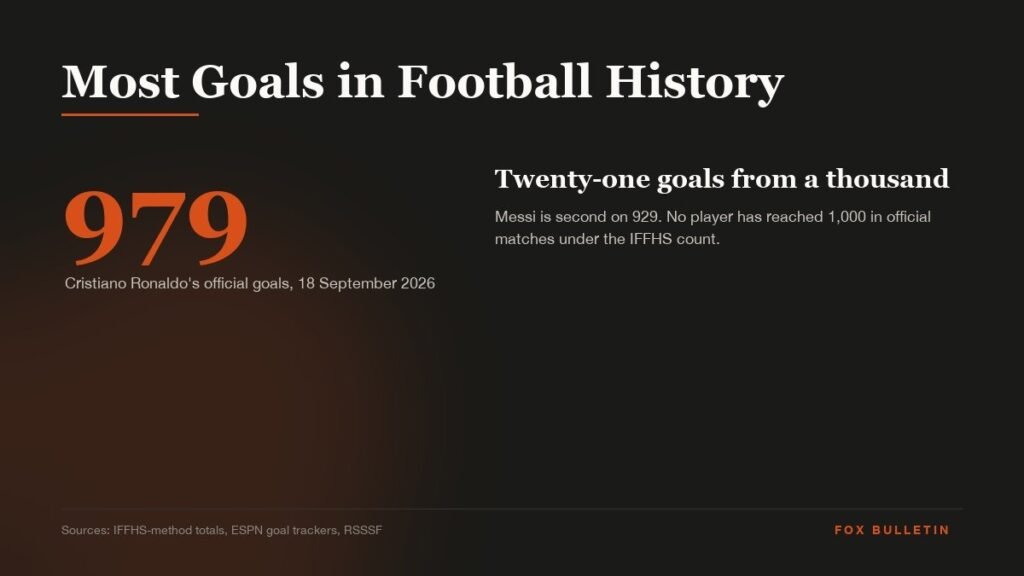
Most Goals in Football History: Top 10 Ranked
Cristiano Ronaldo has 979 official goals and is 21 short of 1,000. Here are the 10 highest scorers in football history on the official-match count, and how the alternative count reorders them.
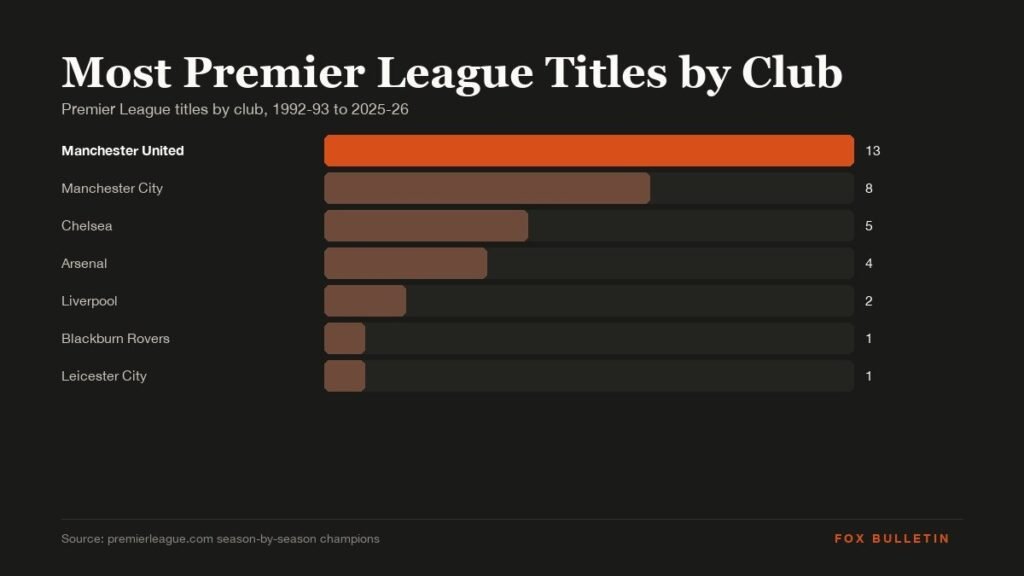
Most Premier League Titles by Club: Top 10 Ranked
Manchester United's 13 Premier League titles still lead, but Arsenal's 2025-26 championship reshuffled the chasing pack. Every winner ranked, with all-time English titles alongside.

Most Ballon d’Or Wins: All 10 Multiple Winners Ranked
Lionel Messi has won the Ballon d'Or eight times, three more than Cristiano Ronaldo and five more than anyone else in the award's history.