

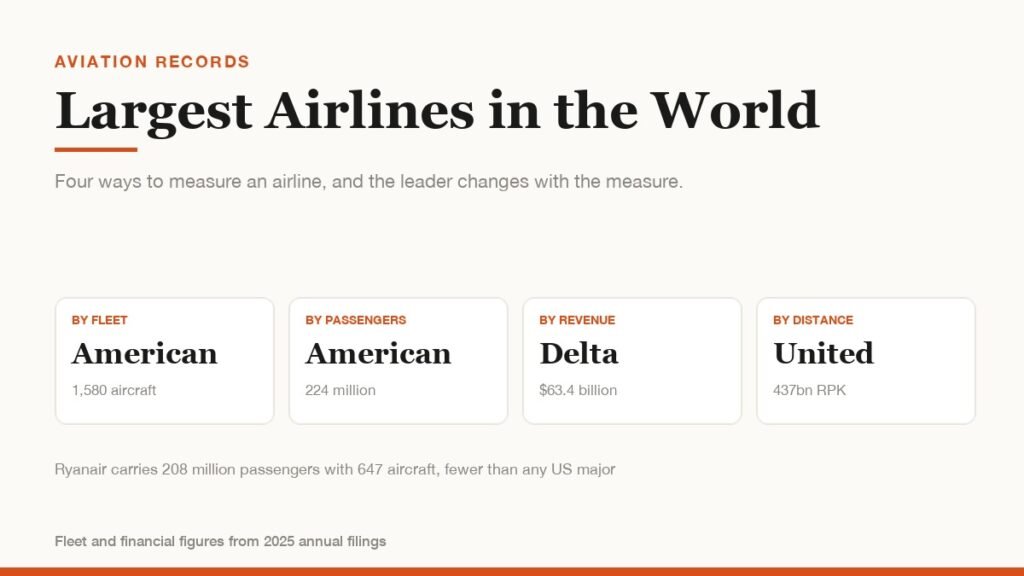
The largest airline in the world by fleet size is American Airlines, which operated 1,580 aircraft at the end of 2025 once its regional partners are counted. United is second on 1,490 and Delta third on 1,314.
Change the measure and the answer changes with it. By passengers carried, Ryanair flies more people than any airline outside the United States. By revenue, Delta leads. The word largest hides four different rankings, and no airline tops all of them.
The 10 Largest Airlines by Fleet Size
| # | Airline | Country | Aircraft |
|---|---|---|---|
| 1 | American Airlines | United States | 1,580 |
| 2 | United Airlines | United States | 1,490 |
| 3 | Delta Air Lines | United States | 1,314 |
| 4 | China Southern | China | 972 |
| 5 | Air China | China | 964 |
| 6 | China Eastern | China | 826 |
| 7 | Southwest Airlines | United States | 803 |
| 8 | Lufthansa Group | Germany | 737 |
| 9 | Ryanair | Ireland | 647 |
| 10 | IAG | UK and Spain | 627 |
Figures are as at 31 December 2025 and include regional aircraft flown by partner carriers on the mainline brand.
Every Airline in the Top 10, in Order
1. American Airlines: 1,580 Aircraft
United States · 1,580 aircraft · about 224 million passengers · $54.6 billion revenue
American operates 1,013 mainline aircraft and 567 regional jets under the American Eagle brand, flying from hubs at Dallas Fort Worth, Charlotte and Phoenix.
It leads on fleet and passengers but ranks third on revenue, which is the clearest single illustration of how far the four measures diverge.
2. United Airlines: 1,490 Aircraft
United States · 1,490 aircraft · 181.1 million passengers · $59.1 billion revenue
United reported 1,066 mainline and 424 regional aircraft in its 2025 annual report. Its hubs at San Francisco, Newark and Chicago anchor the largest Pacific and transatlantic network of the three.
It carries 43 million fewer passengers than American and flies them further, which is why it leads on revenue passenger kilometres.
3. Delta Air Lines: 1,314 Aircraft
United States · 1,314 aircraft · more than 200 million passengers · $63.4 billion revenue
Delta runs 989 mainline aircraft and 325 regional, with Atlanta as the busiest hub in the world by passenger numbers.
It earns more than either rival from a smaller fleet. Premium seating and its co-branded credit card produce a yield per passenger the other two have not matched.
4. China Southern: 972 Aircraft
China · 972 aircraft · 173.7 million passengers
Based in Guangzhou, China Southern is the largest airline in Asia by fleet and passengers, operating mainly within China and across Southeast Asia.
It was the launch operator in China for the Airbus A380 and retired the type ahead of schedule, as most carriers outside the Gulf did.
5. Air China: 964 Aircraft
China · 964 aircraft · 160.6 million passengers
Air China is the national flag carrier, based in Beijing, and the only Chinese airline with that designation. It flies the widest international network of the three.
Its fleet sits eight aircraft behind China Southern, a gap narrow enough that the order between them changes from year to year.
6. China Eastern: 826 Aircraft
China · 826 aircraft · 149.9 million passengers
China Eastern operates from Shanghai, both from Pudong and Hongqiao, giving it the strongest position in the country’s busiest business market.
It took delivery of the first Comac C919, the Chinese-built narrow-body intended to compete with the A320 and 737, and began commercial service with it in 2023.
7. Southwest Airlines: 803 Aircraft
United States · 803 aircraft · 134.1 million revenue passengers · $28.06 billion revenue
Southwest flies a single aircraft type, the Boeing 737, across an entirely point-to-point domestic network with no hubs in the conventional sense.
It is the largest domestic carrier in the United States by passengers boarded, and the only airline in this top ten that has never operated a wide-body.
8. Lufthansa Group: 737 Aircraft
Germany · 737 aircraft · 135.0 million passengers
The group covers Lufthansa itself plus Swiss, Austrian, Brussels Airlines, Eurowings and ITA Airways, with main hubs at Frankfurt and Munich.
It is the largest airline group in Europe by fleet, and the only one in this list assembled from national flag carriers of several different countries.
9. Ryanair: 647 Aircraft
Ireland · 647 aircraft · 208.4 million passengers · EUR 15.54 billion revenue
Ryanair carries more passengers than any airline outside the United States, on a fleet smaller than every carrier above it except IAG.
It flies one aircraft type on short sectors with fast turnarounds, and at 94 percent it fills a higher share of its seats than any other airline of comparable size.
10. IAG: 627 Aircraft
United Kingdom and Spain · 627 aircraft
International Airlines Group holds British Airways, Iberia, Aer Lingus, Vueling and LEVEL, with its main bases at London Heathrow and Madrid.
It is the smallest group in this top ten by fleet but holds the largest share of slots at Heathrow, which is the most capacity-constrained major airport in Europe.
The Four Ways to Measure an Airline
Each measure answers a different question, and each produces a different winner.
By Fleet Size: American Airlines, 1,580 Aircraft
American’s total splits into 1,013 mainline aircraft and 567 regional jets flown by partners under the American Eagle brand. That regional operation is what puts it ahead of United.
The three US majors lead this measure because of the hub-and-spoke model. Feeding a connecting hub needs a large fleet of small aircraft, which inflates the count without adding much capacity.
By Passengers Carried: American Airlines, 224 Million
American carried about 224 million passengers in 2025. Ryanair is second with 208.4 million in the year to 31 March 2026, according to Ryanair’s own results, and Delta states that it carried more than 200 million.
Ryanair is the outlier. It is the only airline in the top three that flies short-haul point to point, with no long-haul network and no connecting traffic at all.
By Revenue: Delta Air Lines, $63.4 Billion
Delta reported $63.4 billion in revenue for 2025, ahead of United on $59.1 billion and American on $54.6 billion. The order inverts the fleet ranking.
Premium cabins and the credit card partnership explain most of the gap. Delta carries fewer passengers than American and earns more from them.
By Distance Flown: United Airlines, 437 Billion RPK
Revenue passenger kilometres multiply each passenger by the distance flown, which is the measure IATA’s World Air Transport Statistics uses to size the industry. United leads on roughly 437 billion, ahead of American on 403 billion and Delta on 402 billion.
United wins this one on its Pacific network. Long-haul flying generates far more RPK per passenger than short-haul, which is why Ryanair does not appear despite carrying 208 million people.
Ryanair and Southwest: The Same Idea, Different Numbers
The two biggest low-cost model carriers both built on one aircraft type and point-to-point flying, and their figures diverge sharply.
| Measure | Ryanair | Southwest |
|---|---|---|
| Passengers | 208.4 million | 134.1 million revenue passengers |
| Revenue | EUR 15.54 billion | $28.06 billion |
| Revenue per passenger | about $84 | about $209 |
| Fleet | 647 | 803 |
| Load factor | 94 percent |
Ryanair carries 74 million more passengers than Southwest with 156 fewer aircraft, and earns about 40 percent as much per passenger. Its 94 percent load factor is among the highest of any large airline.
Southwest sits in between the two models. It charges more than Ryanair, flies longer sectors inside a large domestic market, and has moved towards assigned seating and bag fees since 2025.
Why China Has Three Airlines in the Top 10
China Southern, Air China and China Eastern hold three of the top six places by fleet, and all three are state-controlled.
- A domestic market built in twenty years. China went from a minor aviation market to the second largest by passengers in two decades, and the big three absorbed most of that growth.
- Three state carriers by design. The 2002 consolidation of the industry produced exactly three national groups, each with a regional base: Guangzhou, Beijing and Shanghai.
- Domestic flying dominates. Their networks are mostly internal, so they carry large passenger numbers without the long-haul flying that drives revenue per passenger.
- Fleet growth tracked GDP. Orders were placed against national traffic forecasts rather than quarterly demand, which is how all three reached 800 aircraft and more.
They rank lower on revenue than on fleet for the same reason Ryanair does. Short domestic sectors fill aircraft without generating the yields that long-haul premium cabins produce, a pattern visible across the largest economies in the world.
How Airline Size Has Shifted
The current order is the product of consolidation rather than growth. All three US leaders are merged entities.
- Delta and Northwest merged in 2008, which gave Delta its Pacific network.
- United and Continental merged in 2010, combining a Pacific and a Latin American network.
- American and US Airways merged in 2013, producing the fleet that still leads this ranking.
- IAG was formed in 2011 from British Airways and Iberia, and later added Aer Lingus and Vueling.
Four US carriers became three in five years, and those three now fly the majority of domestic capacity in the largest aviation market on earth. The same concentration shows up in the traffic rankings at the busiest airports in the world.
Aircraft size moved the opposite way. The four-engined wide-bodies that once defined a flagship fleet have mostly gone, and the Airbus A380 was retired by most operators well before its airframes were worn out.
Frequently Asked Questions
What is the largest airline in the world?
American Airlines, by both fleet size and passengers carried. It operated 1,580 aircraft at the end of 2025 and carried about 224 million passengers that year.
Which airline carries the most passengers?
American Airlines, at about 224 million in 2025. Ryanair is second with 208.4 million in the year to 31 March 2026, and Delta states it carried more than 200 million.
Which airline has the most revenue?
Delta Air Lines, with $63.4 billion in 2025, ahead of United on $59.1 billion and American on $54.6 billion. The revenue order is the reverse of the fleet-size order.
Which is the largest airline outside the United States?
China Southern by fleet size, with 972 aircraft, and Ryanair by passengers carried, with 208.4 million. Lufthansa Group is the largest in Europe by fleet at 737.
Related Articles

Get the Fox Bulletin briefing
The stories that matter, in your inbox. No spam, unsubscribe anytime.
Newsletter signup will be available soon.
Related stories

Most Expensive Colleges: 10 Ranked by Yearly Total Cost
Harvey Mudd College posts the highest total cost of attendance for a first-year student living on campus, $104,512 for the 2026-27 year. This ranking covers ten colleges with tuition, housing, food and the full budget, and explains why the price on the page is rarely what a family pays.

Binance Hack Becomes the Biggest Crypto Theft Yet
About $6.3bn left Binance wallets on 29 October across ten blockchains, most of it inside twenty minutes. The exchange says user funds are covered.

Calendly Alternatives: 10 Scheduling Tools Compared
Calendly is free for one event type and $10 a seat beyond it. Ten Calendly alternatives compared on seat price, free tiers and one that costs $29 once.