

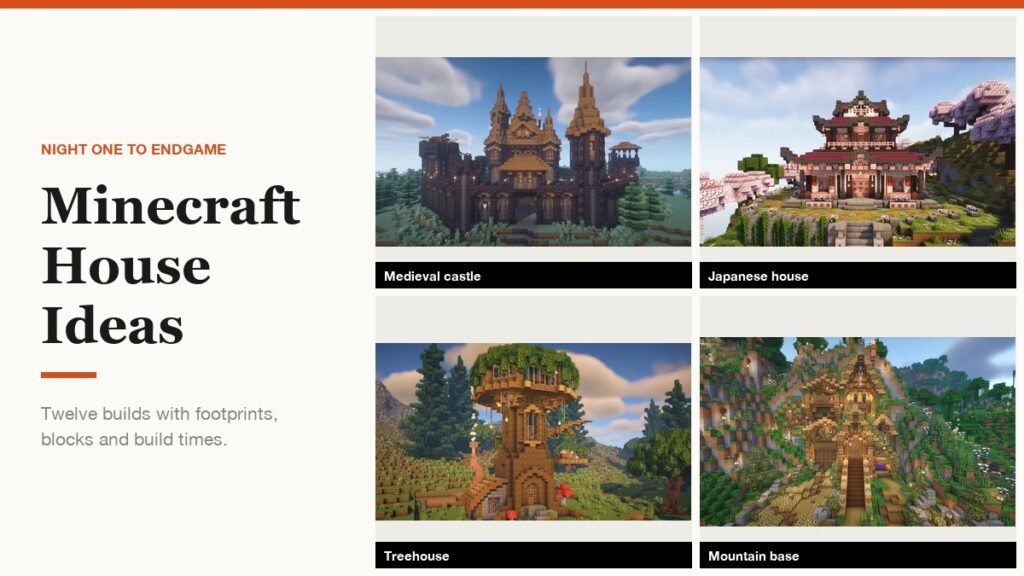
The best Minecraft house ideas change with the clock. A 3×3 cell cut into a cliff takes a few minutes, a 13×10 hobbit hole takes 15 to 20, and a 23×50 castle takes two to three hours. Below are 12 builds sorted by the stage of a survival world where you can actually afford them, each with a footprint, a build time, the blocks it leans on and one placement trick.
Everything here is current for Java Edition 26.3 “Wilderness Bound”, released on 15 September 2026. Footprints are the clear area you need before placing a block, counted in blocks, so you can pace out a spot and know in advance whether the house fits.
Minecraft House Ideas Sorted by Stage, Footprint and Build Time
The table lists every headline build in the order you are likely to need it. Stage is when the materials become realistic, not when the build becomes allowed, so nothing stops you building a castle on day two if you have the patience.
| Stage | House | Footprint | Build time | Leans on | Where to build |
|---|---|---|---|---|---|
| Night one | Mountainside cell | 3×3 | A few minutes | Glass, door, bed | Cliff face |
| Night one | Hobbit hole | 13×10 | 15 to 20 minutes | Planks, trapdoors, bricks, lanterns | Hillside |
| Night one | Underwater glass base | 8×9 | 15 to 20 minutes | Glass, stripped logs, sea lanterns | Cliff above water |
| Night one | Witch hut | 11×8 | 20 minutes | Pale oak logs, terracotta, pumpkins | Flat ground |
| First week | Survival farmhouse | 7×11 | 25 minutes | Logs, planks, glass panes, seeds | Flat ground |
| First week | Log cabin | 19×17 | 15 minutes | Oak and dark oak logs, campfire | Woodland |
| First week | Houseboat | 14×7 | 20 to 30 minutes | Acacia and oak planks, lanterns | River |
| Weekend | Brick cottage | 9×7 | 40 to 50 minutes | Bricks, granite, slabs, terracotta | Flat ground |
| Weekend | Treehouse | 14×9 | About 1 hour | Logs, leaves, planks, ladders | Large tree |
| Weekend | Lake house on stilts | 20×24 | 45 minutes | Fences, planks, logs, lily pads | Calm pond or swamp |
| Endgame | Medieval castle | 23×50 | 2 to 3 hours | Stone and wood | Flat ground |
| Endgame | Space base | 40×40 | 20 to 30 hours | Your own palette, built in modules | Flat ground |
Footprint predicts build time less than you would expect. The 19×17 log cabin takes about 15 minutes while the 9×7 brick cottage takes 40 to 50, because the cottage spends its time on detail and the cabin is mostly repeated logs. If a clock matters more than a floor plan, pick by the time column.
What Java 26.3 Adds to an Early Shelter
Version 26.3 added poplar trees with a full poplar wood set, abandoned camps, cushions and straw beds. It also added stairs and slabs for all 16 concrete colours and all 16 wool colours, which makes a camp-style tent outline possible in any colour you can dye.
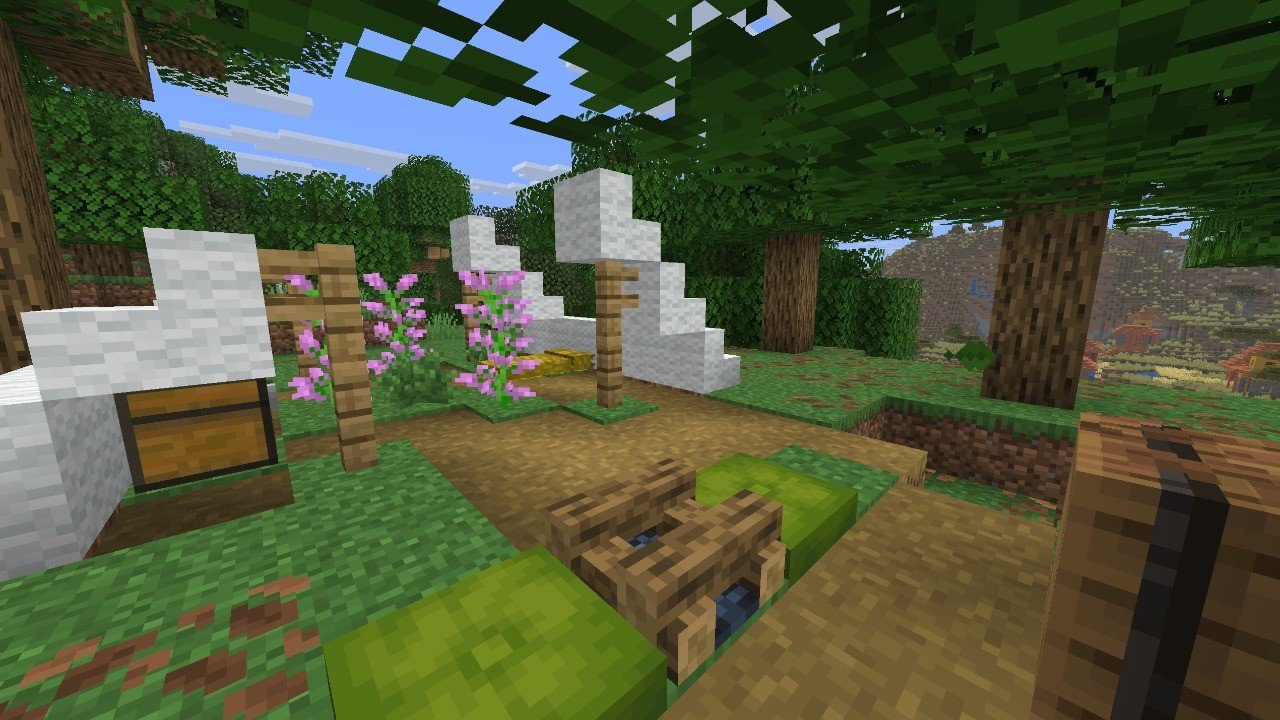
Wool is the cheaper route on night one when sheep are nearby, and concrete suits a tent you plan to keep. Straw beds are crafted four to a recipe from three hay bales, so one small wheat patch outfits a whole camp.
Wood choice has also widened. Java now has 12 wood types and 13 plank types, the extra plank being bamboo, which has no matching wood. Every starter box in this guide can take whichever of them grows closest to your spawn, so there is no reason to travel for oak.
Night One: Four Houses Built in Under 30 Minutes
Night one is about a sealed room with a bed. These four meet that bar and leave you something to expand rather than demolish.
1. Mountainside cell
Footprint: 3×3, two or three blocks tall. Time: a few minutes. Leans on: six sand smelted into glass, one door and one bed.
Dig a 3×3 room into a cliff, put the glass across the opening and hang the door in it. Nothing else is needed, because the room only has to fit a bed. The glass front can later become a window in a proper house built around the cell.
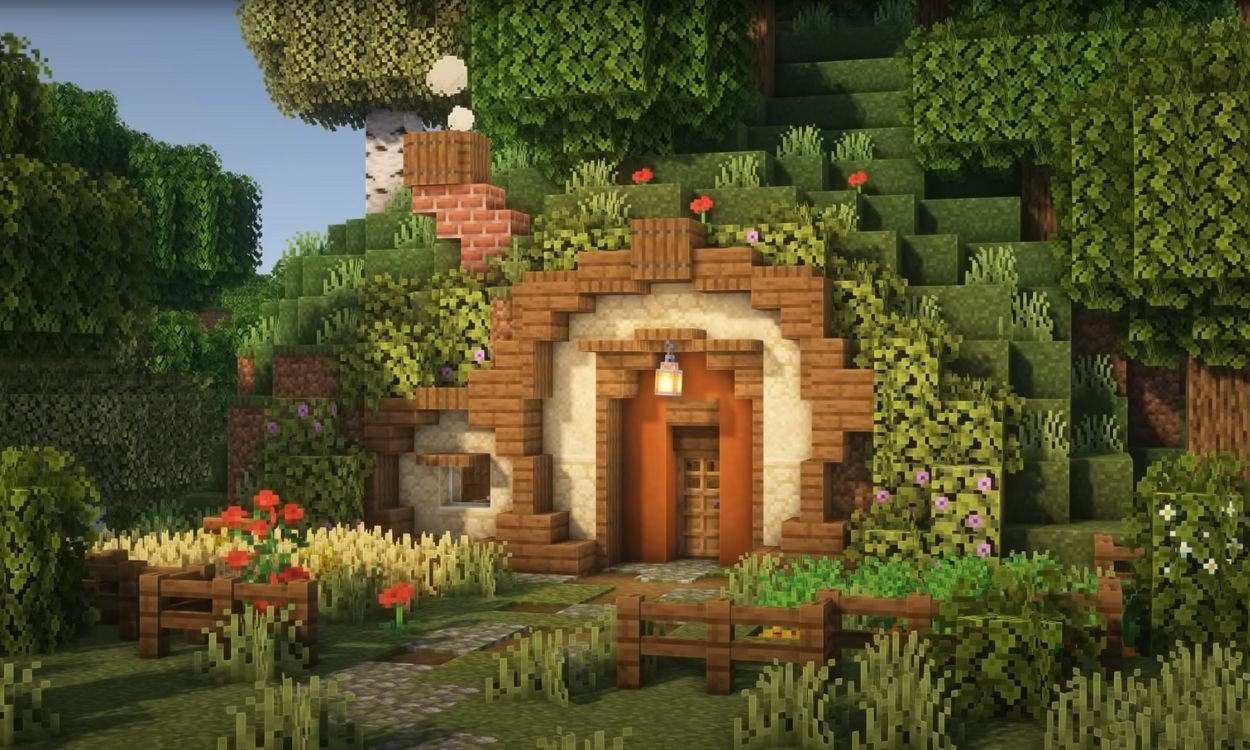
2. Hobbit hole
Footprint: 13×10. Time: 15 to 20 minutes. Leans on: planks, trapdoors, doors, fences, terracotta, bricks, lanterns and vines.
The hill does most of the work, so the build is a round wooden entrance and a lot of digging. Hillside rooms are dark, so set lanterns into the ceiling and run vines and flower beds along the front to make the doorway look planted.
3. Underwater glass base
Footprint: 8×9. Time: 15 to 20 minutes. Leans on: glass, stripped logs, planks, sea lanterns, white concrete and carpets.
Start from a cliff that drops into water, because the rock gives you a free back wall. Build the base in sealed layers, with storage and enchanting on one level and a small farm on another, and light it with sea lanterns.
4. Witch hut
Footprint: 11×8. Time: 20 minutes. Leans on: pale oak logs, pumpkins and terracotta in several shades.
Round the outline instead of squaring it, and step the terracotta through several shades from one end of the wall to the other. The gradient is what makes the hut look grown rather than built.
First Week: Houses With a Farm, a Mine Entrance or a Hull
By the end of week one you own a stack of planks, a furnace and a seed supply. A first-week house stops being a bedroom and starts holding the things you walk back to every day.
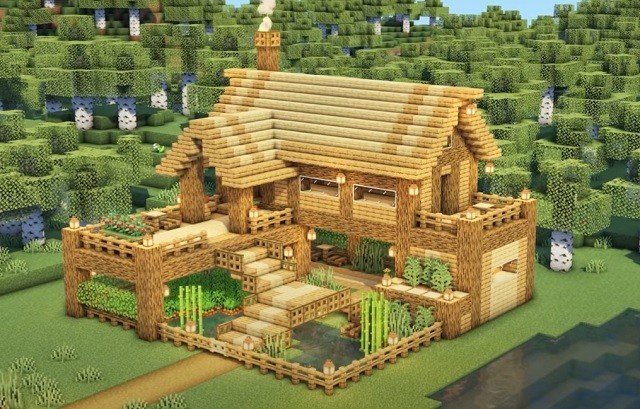
5. Survival farmhouse
Footprint: 7×11. Time: 25 minutes. Leans on: logs, planks, stripped logs, lanterns, trapdoors, stairs, glass panes and seeds.
Plant the crop beds inside the footprint instead of beside it, so the farm shares the house walls. Every block is common, which makes this the best first-week plan for a world that has not found much yet. If villagers will share the farm, read how villager trades work before you size the doors.
6. Log cabin
Footprint: 19×17. Time: about 15 minutes. Leans on: oak and dark oak logs, planks, stripped logs, a campfire, leaf blocks and flower pots.
The cabin is a wood-only build, so it asks for nothing you cannot punch out of a tree. The real danger is fire, so keep the campfire a block or more away from every wall and trapdoor, and give it a stone or dirt hearth.
7. Houseboat
Footprint: 14×7. Time: 20 to 30 minutes. Leans on: planks, logs, stairs, lanterns, and a mix of acacia and oak.
Anchor it in a river and the water keeps mobs off the deck. Alternating acacia and oak along the hull gives a rustic two-tone side without any dye or rare block.
Five more first-week layouts depend on your terrain more than on a fixed size, so plan each one on the ground before you commit:
- Raised farmhouse. Put the crafting and growing area under a raised floor and use scaffolding as small display tables for potted plants.
- Barn house. Keep animals on the ground level and put enchanting, sleeping and storage in the loft above.
- Mine-entrance house. Run a rail line from the cellar to the mine, and put crafting, storage and brewing below the cottage. Swap copper minecart stops for stone if you have not found copper yet.
- Walled survival house. Fence the farm, the house and the mine mouth inside one stone wall with no door. If the wall is too high to jump, make the top layer a slab.
- Two-player house. Build an L-shaped or U-shaped plan so each player owns a wing, with a shared landing and a sofa in the middle.
Weekend Builds That Look as Good as They Work
A weekend house is the first one built for how it looks. It costs a clay run, a stack of stripped logs or an afternoon of leaves, and you will still be using it a month later.
8. Brick cottage
Footprint: 9×7. Time: 40 to 50 minutes. Leans on: bricks, granite, stone slabs, terracotta, trapdoors, a campfire and rose bushes.
Keep the footprint small, because a large plain wall of orange brick looks garish. Break it with stone slab trim and a few wood trapdoor shutters. You also need to mine clay and smelt it, so start the furnace before you start the walls.
9. Treehouse
Footprint: 14×9. Time: about 1 hour. Leans on: logs, leaves, planks and ladders.
Build the staircase inside the trunk so the climb is hidden, then wrap a deck around the room for a 360-degree lookout. For night lighting, hang lanterns and glow berry vines from the deck rail rather than placing torches on the leaves.
10. Lake house on stilts
Footprint: 20×24. Time: 45 minutes. Leans on: oak and spruce fences, planks, logs, stairs, slabs, lily pads and redstone lamps.
Set it over a calm pond. A shallow swamp pond lowers the drowned risk, and the lower deck works as a dock and a farm at once. Fishing from the deck gives you an easy AFK food supply once the house is finished.

Endgame Showpieces and How to Split the Work
Endgame builds are measured in sessions, not minutes. The Overworld offers 384 buildable layers, from Y -64 up to Y 320, so height is never the limit. Your patience is.
11. Medieval castle
Footprint: 23×50. Time: 2 to 3 hours. Leans on: stone and wood.
Lay a single line of cobblestone around the full 23×50 outline first and walk it. Seeing the long axis on the ground tells you where the towers and gate belong before a single wall goes up.
12. Space base
Footprint: 40×40. Time: 20 to 30 hours. Leans on: whatever palette you choose, built in modules.
Treat it as sixteen 10×10 rooms rather than one 40×40 project. Each session ends with a finished module, and the base is always livable partway through.
Two more showpieces sit at the extremes. A full kingdom runs 24 to 48 hours, and a haunted house takes a 20×17 plot.
Light, Roofs and Mob Rules for Every Stage
One rule covers every house above. Overworld monsters spawn when the block light is 0 and the sky light is 7 or lower in Java, so a light source close enough to give every floor block a light level above zero stops spawns on that block. Check under stairs and inside corners, because those are the squares people miss.
Test a layout before you commit to it. Mark the footprint in a creative copy of the world with the commands in our Minecraft commands list, and walk the outline first. A mod that adds more block types will change what you can build, so see the best Minecraft mods if you want a wider palette.
Frequently Asked Questions
What is the easiest Minecraft house to build?
The 3×3 mountainside cell. It needs six sand smelted into glass, a door and a bed, and it takes a few minutes. The 5×5 box is the next step up, and every block in it can be swapped for whatever your biome gives you.
How big should a Minecraft house be?
For a first base, aim for something near the 7×11 survival farmhouse, which is large enough to hold crops. A 13×10 footprint fits a hobbit hole with room for storage. Go above 20×24 only when you have a stack of planks and a reason.
What is the best Minecraft house for survival?
The survival farmhouse or the mine-entrance house, because both fold the farm or the mine into the walls. You leave the base less often and the base is easier to defend.
How do you stop mobs spawning inside your house?
Light every floor block. In Java, Overworld monsters spawn when block light is 0 and sky light is 7 or lower. Place lanterns or torches until no walkable block inside is at zero, including under stairs.
Related Articles

Get the Fox Bulletin briefing
The stories that matter, in your inbox. No spam, unsubscribe anytime.
Newsletter signup will be available soon.
Related stories

Fortnite Festival: Modes, Music Pass and What Epic Cut
What Fortnite Festival is on 5 November 2026: Main Stage and Jam Stage, the removed Battle Stage, how songs are kept, and what the Music Pass costs.

LEGO Fortnite Modes: Odyssey, Brick Life and Islands
LEGO Fortnite is a hub of separate experiences. Here is what Odyssey, Brick Life and LEGO Islands do, how they differ, and which one to start with.

Fortnite Crew: What You Get and What You Keep If You Cancel
What Fortnite Crew includes at $11.99 a month on 5 November 2026, what Epic changes on 5 December 2026, and exactly what stays yours if you cancel.