

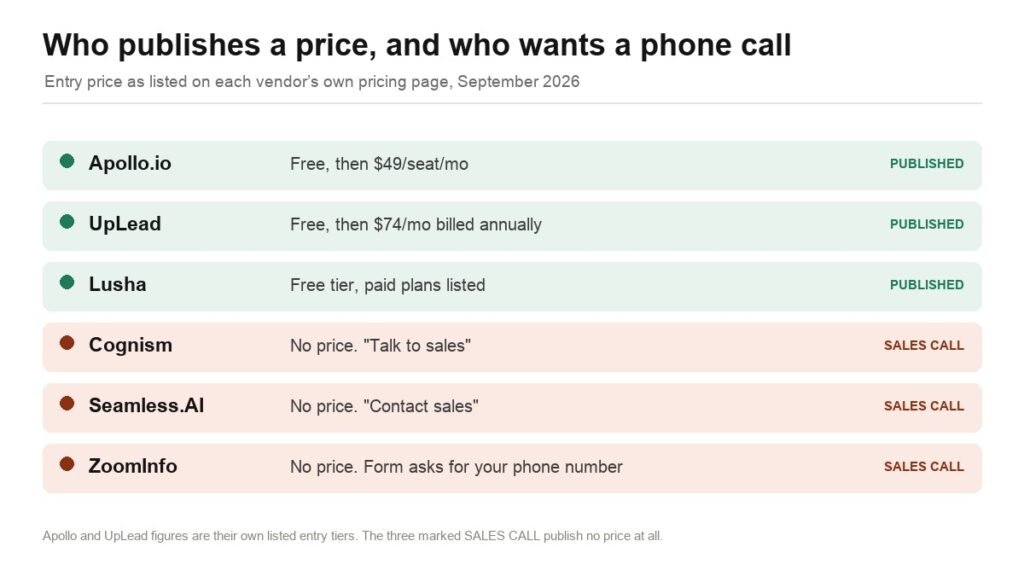
Search for ZoomInfo competitors and the first thing you notice is that you cannot compare them on price, because half of them will not tell you one. ZoomInfo’s own pricing page is a form that asks for your phone number. Cognism says talk to sales. Seamless.AI says contact sales. Apollo.io and UpLead simply print the number.
That difference is not cosmetic. It determines whether you can evaluate a tool on a Tuesday afternoon or whether you are entering a procurement process with a quota-carrying rep on the other end. This guide compares the five most credible alternatives on what they actually publish, and explains the credit model that makes all of this pricing harder to compare than it looks.
Who Publishes a Price and Who Does Not
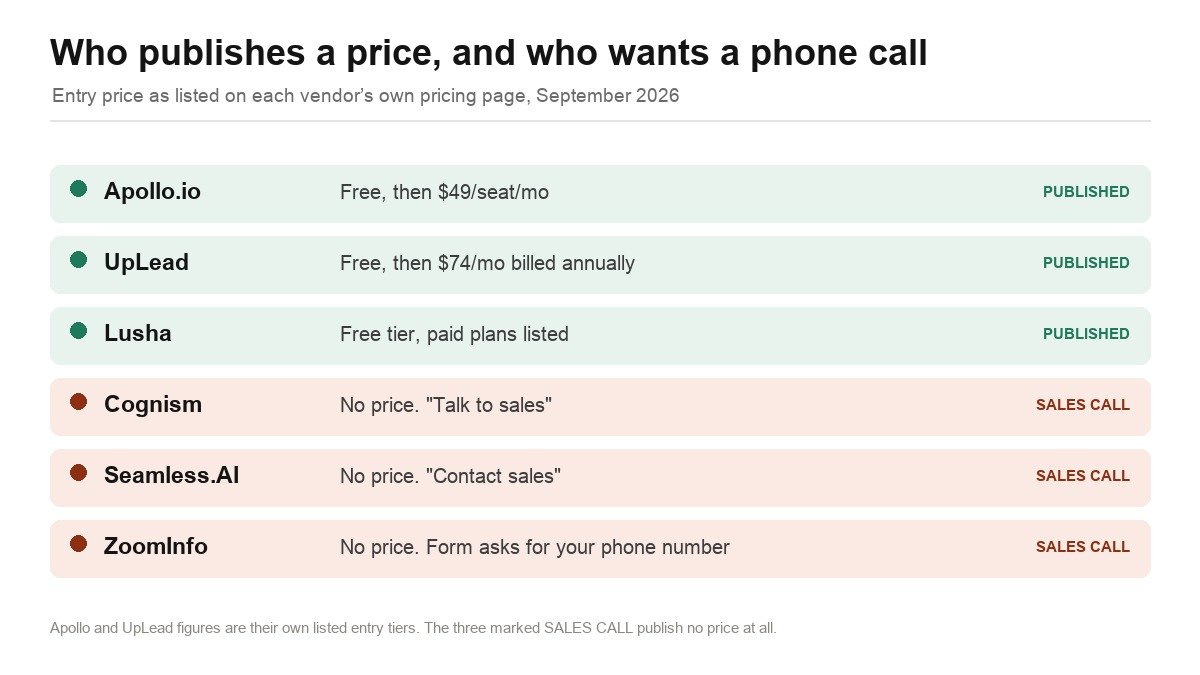
Everything in that chart comes from each vendor’s own pricing page, checked in September 2026. The three marked as a sales call publish no figure at all, at any tier.
| Platform | Entry price as published | Free tier | Pricing model |
|---|---|---|---|
| Apollo.io | $49 per seat per month, annual | Yes | Per seat plus credits |
| UpLead | $74 per month, annual billing | Yes | Per plan plus credits |
| Lusha | Published tiers | Yes | Per plan plus credits |
| Cognism | Not published | No | Quote only |
| Seamless.AI | Not published | Yes | Quote only |
| ZoomInfo | Not published | Free trial | Licences plus credit usage |
What ZoomInfo Actually Sells, and Why the Price Is Hidden
It helps to understand the thing you are replacing. ZoomInfo’s pricing page splits its catalogue into Sales, Marketing and Talent, and within Sales there are three tiers: ZoomInfo Professional for contact and company data, Copilot Advanced which adds intent signals, account prioritisation and website visitor data, and Copilot Enterprise which adds real-time buyer intent, earnings call signals, competitor alerts and a dedicated customer service manager.
On the marketing side it runs Marketing Demand with 75,000 included credits and 25 intent topics, ABM Lite with 100 intent topics and advertising integrations, and ABM Enterprise with 150,000 credits and unlimited intent topics.
There is one more wrinkle worth knowing: ZoomInfo describes its customer base as 35,000 companies in one place on that page and over 30,000 in another, which is a reminder to treat vendor-stated figures of every kind as marketing rather than accounting.
ZoomInfo is direct about why no price appears. Its own FAQ states that pricing is based on features and functionality, the number of licences, and credit usage, with add-ons like Streaming Intent priced separately according to expected usage. Integrations carry a base cost and require a minimum purchase of bulk credits. In other words, there is no list price to publish, because every deal is assembled from four or five variables.
The credit mechanic is the part to internalise before you compare anything. In ZoomInfo’s model, one credit equals one export of a contact or company profile, whether that export comes from the web app, the Chrome extension or an API call from your CRM. Every competitor below uses some version of the same idea, and the credit allowance matters far more than the headline seat price.
1. Apollo.io: The One That Prints the Number
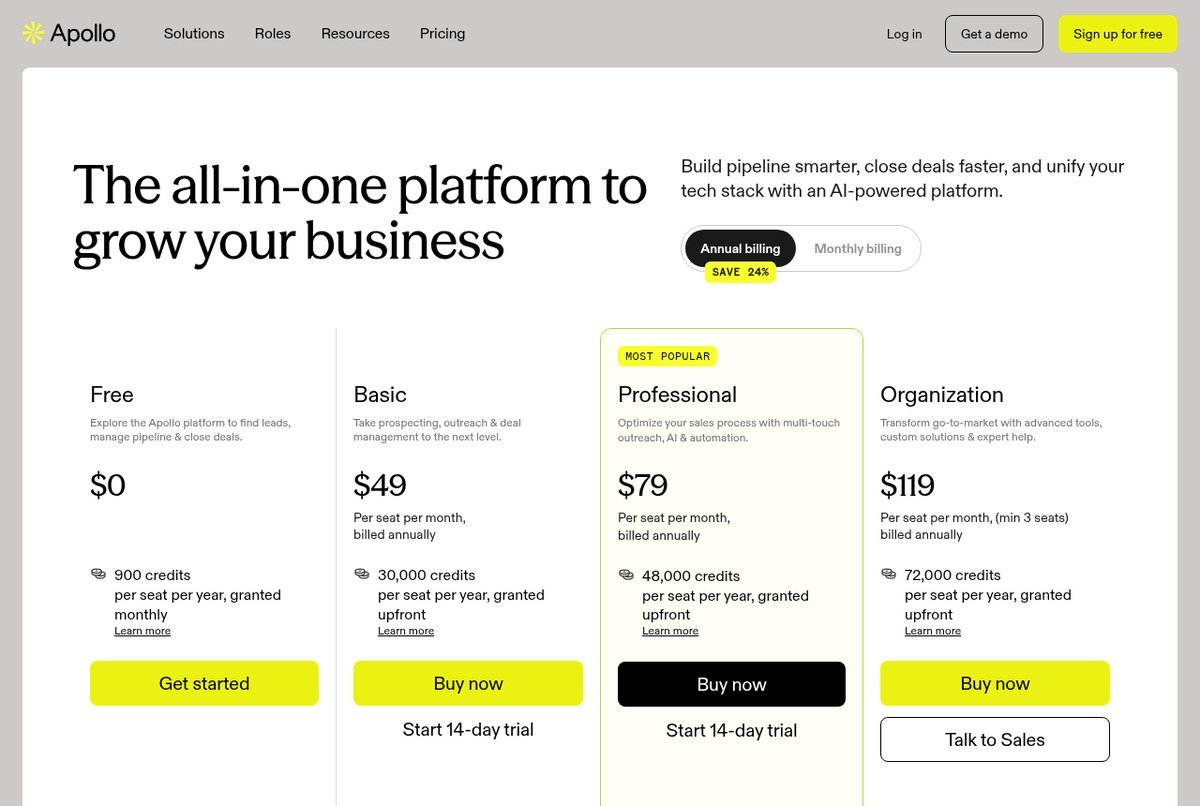
Apollo publishes four tiers on its pricing page and does not require a conversation to see them: a free plan at $0, Basic at $49 per seat per month, Professional at $79 per seat per month, and Organization at $119 per seat per month with a three-seat minimum. Those are the annual rates.
That three-seat minimum on the top tier is worth doing the arithmetic on, because it means the Organization tier has a real entry point of $357 a month rather than $119. The free tier is genuinely usable for evaluation rather than a demo in disguise, which is the practical reason Apollo shows up in so many of these comparisons: you can test the data quality against your own target accounts before spending anything.
What it does well
- Four tiers published openly, including a free plan.
- Lowest paid entry point of any platform here.
- Combines the database with sequencing and dialling in one product.
- You can evaluate data quality before talking to anyone.
What to know
- The top tier has a three-seat minimum, so it is $357 a month, not $119.
- Monthly billing costs roughly 20% more than annual.
- Credits expire, so unused allowance does not roll forward indefinitely.
2. UpLead: Priced Per Plan Rather Than Per Seat
UpLead publishes its pricing too, and structures it differently in a way that matters for small teams. Where Apollo charges per seat, UpLead charges per plan: the Essentials plan is $74 a month billed annually or $99 billed monthly, and Plus is $149 annually or $199 monthly. The Professional tier moves to a team account.
For a solo founder or a two-person sales team, per-plan pricing is usually cheaper than per-seat. The trade is that the lower tiers include a single user, so the maths flips as soon as you add people. UpLead leans on verified emails as its selling point, and like everyone here it meters usage in credits where one credit equals one contact revealed.
What it does well
- Published pricing with a free tier to start.
- Per-plan rather than per-seat, which suits solo users.
- Annual billing saves roughly 25% against monthly.
- Credit model is simple: one credit, one contact.
What to know
- Lower tiers include only one user.
- Costs more than Apollo once you add several seats.
- A smaller database than ZoomInfo or Apollo.
3. Lusha: A Free Tier and Published Plans, With a Ceiling
Lusha publishes its plans and runs a free tier, which puts it in the transparent camp alongside Apollo and UpLead. Its paid structure tops out at a Scale plan, and Lusha confirms on its own pricing page that credit usage limits per user are a Scale feature and that teams larger than five users are directed to its sales team.
That five-user threshold is the thing to note. Lusha is straightforward to buy for a small team and becomes a sales conversation above that size, which places it between the fully self-serve tools and the quote-only platforms. It is most often used as a contact-data layer with a browser extension rather than a full outreach platform, so it pairs with a separate sequencing tool rather than replacing one.
What it does well
- Free tier and published paid plans.
- Simple to buy and deploy for a small team.
- Per-user credit limits available on the Scale plan.
- Browser extension workflow suits recruiters and founders.
What to know
- Teams over five users are routed to sales.
- Narrower product than Apollo: data rather than data plus outreach.
- Credits expire monthly on the lower tiers.
4. Cognism: Quote Only, Aimed Squarely at European Compliance
Cognism publishes no price. Its pricing page is a talk-to-sales page, which puts it in the same procurement bracket as ZoomInfo rather than the self-serve tools above.
What it sells against ZoomInfo is coverage and compliance outside the United States. Cognism’s pitch is built around European and international mobile data and around notified contacts, which matters if your outbound touches the EU and UK and you need a defensible answer on GDPR. If your market is entirely domestic US, the case for it over a cheaper published-price tool is weaker, and you will spend a sales cycle finding out what it costs.
What it does well
- Strong international and European coverage.
- Built around GDPR-conscious data practices.
- A genuine enterprise alternative rather than a budget one.
What to know
- No published pricing at any tier.
- No free tier to evaluate with.
- Requires a sales process before you see a number.
5. Seamless.AI: A Free Tier, Then a Sales Call
Seamless.AI sits awkwardly between the two camps. There is a free tier you can sign up for, but the pricing page carries a contact sales call to action rather than a published figure for the paid plans.
Its positioning is real-time search: rather than serving a static database, it presents itself as building and verifying contact records at query time. Whether that produces better data than a maintained database depends heavily on your target market, and it is exactly the kind of claim you should test on your own account list during the free tier before entering a pricing conversation.
What it does well
- Free tier available to test the data.
- Real-time verification approach rather than a static list.
- Positioned directly against ZoomInfo on data freshness.
What to know
- Paid pricing is not published.
- Free tier credits run out quickly.
- Data quality varies by industry, so test before committing.
How to Compare These Without Being Misled
Compare credits, not seat prices. A $49 seat with 30,000 annual credits and a $79 seat with 48,000 are not 60% apart in real terms. Work out your cost per exported contact, because that is the unit you actually consume.
Check whether credits expire. Most of these platforms expire unused credits monthly or annually. If your outbound is seasonal, an allowance that resets every month is worth less to you than the headline suggests.
Watch for seat minimums. Apollo’s Organization tier looks like $119 until you notice the three-seat minimum. Enterprise quotes from ZoomInfo and Cognism carry their own minimums, usually larger.
Test on your own list, not their demo. Every one of these platforms looks excellent against the accounts a sales engineer chooses. Export fifty contacts in your actual target segment during a free tier and check the bounce rate and the mobile number hit rate yourself. That single exercise tells you more than any feature comparison.
Which ZoomInfo Alternative to Choose
For most teams leaving ZoomInfo, Apollo.io is the default answer. It publishes its prices, it has a free tier that lets you verify data quality before paying, and at $49 per seat it is a fraction of an enterprise contract while bundling the sequencing and dialling you would otherwise buy separately.
Choose UpLead instead if you are one or two people, because per-plan pricing beats per-seat at that size. Choose Lusha if you want contact data as a browser extension alongside tools you already have, and your team is under five people. Choose Cognism if your outbound is European and you need a compliance story you can defend, and accept that you will go through a sales process to get a number. Try Seamless.AI free before paying, because its real-time approach either suits your market or does not.
And if you are evaluating the wider stack at the same time, our comparison of accounting software for small business and the payment processor guide cover the two other line items that tend to appear on the same procurement list.
Frequently Asked Questions
How much does ZoomInfo cost?
ZoomInfo does not publish a price. Its pricing page is a form requesting your phone number, and its own FAQ states that cost depends on features, the number of licences and credit usage, with add-ons and integrations priced separately. You will not get a figure without speaking to sales.
What is the cheapest ZoomInfo alternative?
Of the platforms that publish prices, Apollo.io has the lowest paid entry point at $49 per seat per month on annual billing, with a free tier below that. UpLead starts at $74 a month billed annually but charges per plan rather than per seat, which can work out cheaper for a single user.
What are credits in a sales intelligence tool?
A credit is consumed each time you export or reveal a contact or company record. ZoomInfo counts one credit per export whether it comes from the web app, the Chrome extension or an API call. Comparing credit allowances matters more than comparing seat prices.
Is there a free ZoomInfo alternative?
Apollo.io, UpLead, Lusha and Seamless.AI all run free tiers. They are limited by credits rather than by time, so they work well for testing data quality against your own target accounts before committing to a paid plan.
Related Articles

Get the Fox Bulletin briefing
The stories that matter, in your inbox. No spam, unsubscribe anytime.
Newsletter signup will be available soon.
Related stories
TurboTax Alternative: 3 Ways to File Free or Close to It
IRS Free File, Fillable Forms and FreeTaxUSA compared against TurboTax, including the $89,000 income threshold and the upsell rules the IRS bans inside Free File.
Dropshipping Marketing: The Numbers That Decide Every Channel
Dropshipping marketing is arithmetic, not creativity. The two numbers that decide everything, what each channel costs and delivers, and why scaling is usually an order-value problem.
Dropshipping Apps: What Each One Does and What It Costs
Dropshipping apps do four different jobs and most stores need one, not four. Five apps compared on current pricing, what each is actually for, and how many you really need.