

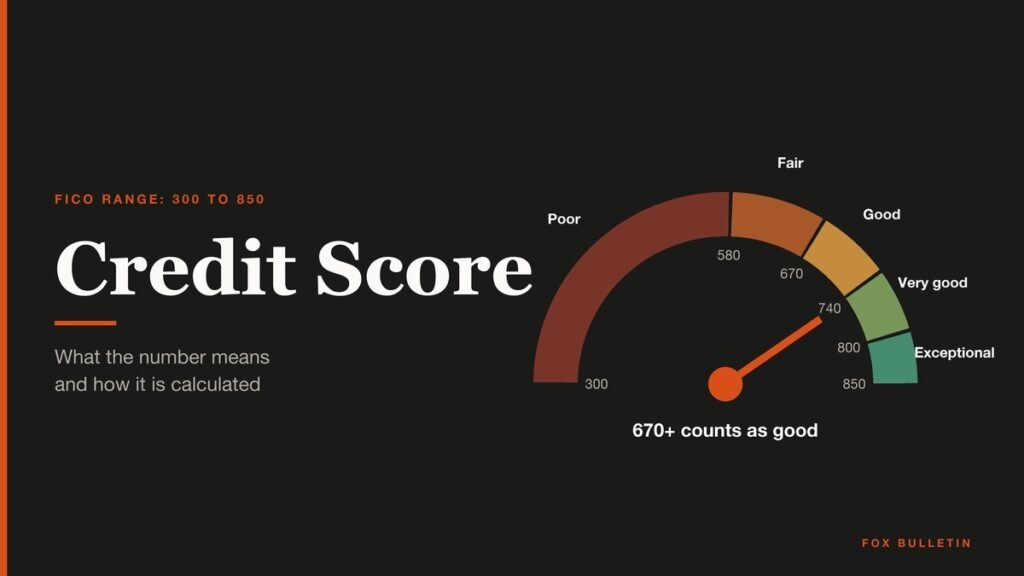
A credit score is a three-digit number, usually between 300 and 850, that predicts how likely you are to repay borrowed money on time. It is calculated from the data in your credit reports, and in 2026 lenders use it to decide whether to approve you, what interest rate to charge and how much credit to extend.
The number is not a single fixed grade. Two companies, FICO and VantageScore, build the models, each bureau holds slightly different data, and new versions keep arriving, including the scores Fannie Mae and Freddie Mac began accepting this year. This guide breaks down what each band means, how the five FICO factors are weighted, and which version a mortgage, auto or card lender is likely to pull. It is general information, not financial advice.
What Is a Credit Score?
A credit score is a prediction of your credit behavior, such as how likely you are to pay a loan back on time, built from the information in your credit reports. The Consumer Financial Protection Bureau (CFPB) says companies use it to decide on mortgages, credit cards, auto loans, tenant screening and insurance, and to set your interest rate and credit limit.
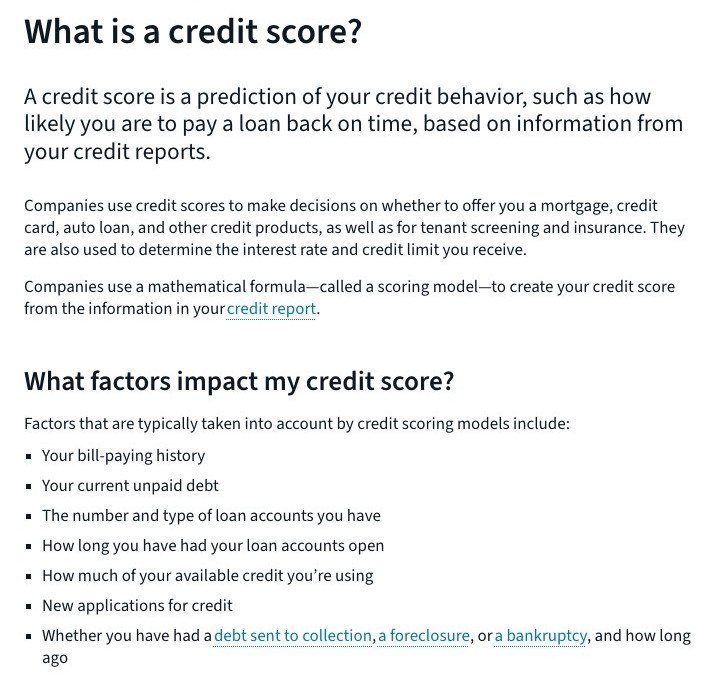
A scoring model is the mathematical formula that turns report data into the number. The CFPB stresses that you do not have one score: each depends on the data used, the model (which can vary by loan type), the bureau that supplied the file and even the day it was calculated. USA.gov adds that a higher score can make it easier to rent an apartment or get a lower insurance rate.
Credit Score Ranges: FICO and VantageScore Tiers Side by Side
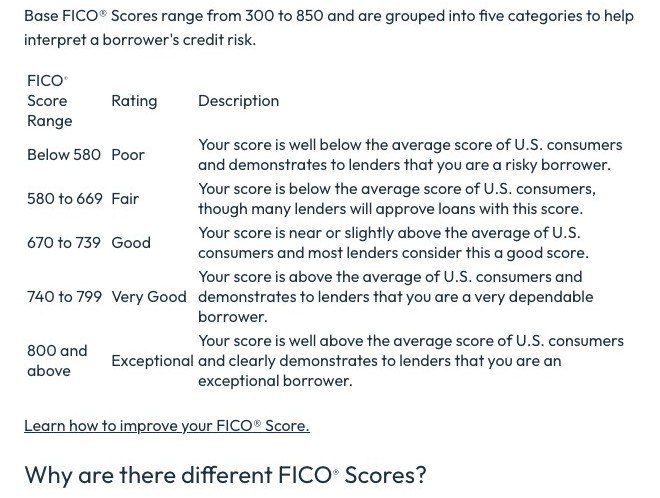
Both main models now run from 300 to 850, but they cut the scale at different points. FICO uses five named bands, with the descriptions FICO attaches to each:
| FICO range | Tier | What it signals to lenders |
|---|---|---|
| 800 to 850 | Exceptional | Well above the U.S. average |
| 740 to 799 | Very Good | Above average; a very dependable borrower |
| 670 to 739 | Good | Near or slightly above average; most lenders call this good |
| 580 to 669 | Fair | Below average, though many lenders still approve loans |
| 300 to 579 | Poor | Well below average; seen as a risky borrower |
VantageScore 3.0 and 4.0, the current versions, split the same 300 to 850 scale into four bands:
| VantageScore range | Tier |
|---|---|
| 781 to 850 | Superprime |
| 661 to 780 | Prime |
| 601 to 660 | Near Prime |
| 300 to 600 | Subprime |
The cutoffs do not line up. A 665 is Fair to FICO but already Prime to VantageScore, while a 605 is Fair to FICO and Near Prime to VantageScore. VantageScore was created in 2006 by the three bureaus as a rival to FICO.
For context, Experian puts the 2025 average FICO Score in the U.S. at 713. About a third of consumers sit between 600 and 750, and another 48% score higher. VantageScore’s first two models used a 501 to 990 scale, which lenders rarely use today.
How a FICO Credit Score Is Calculated: The Five Weights
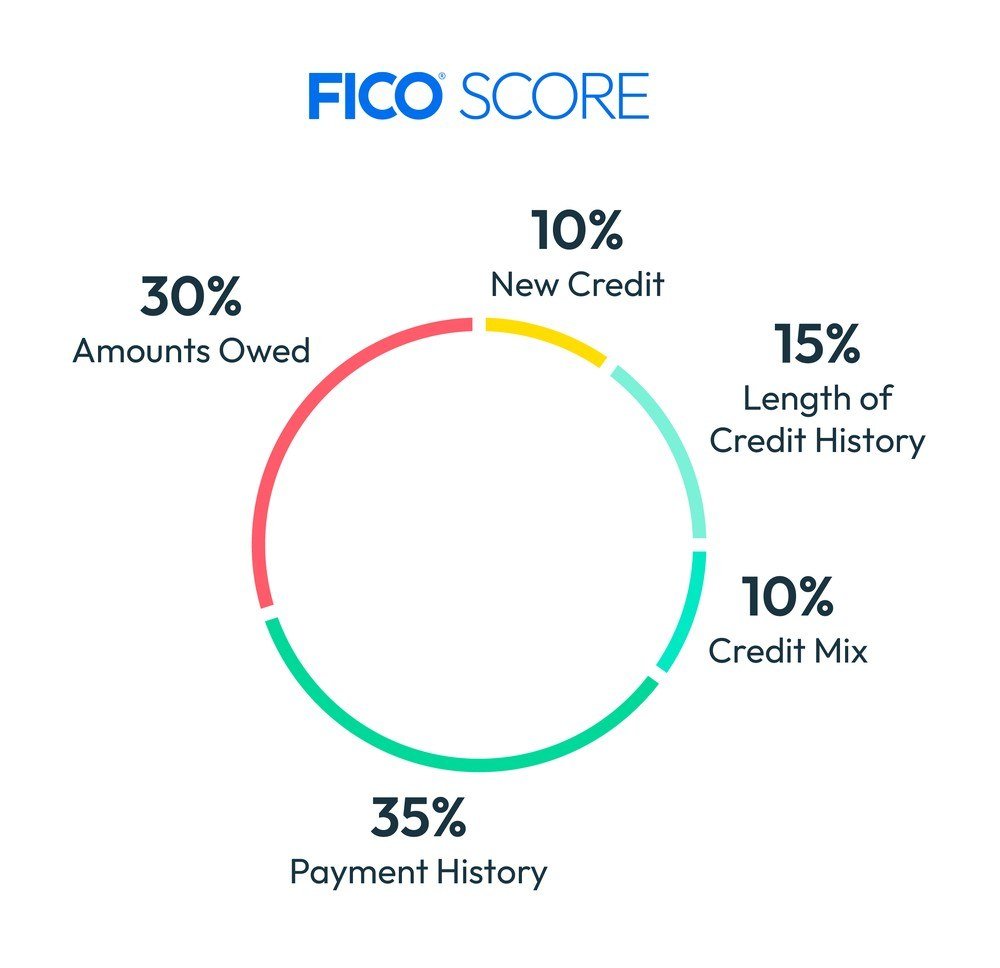
FICO publishes the general importance of each category, though the exact mix varies with every credit report. The five weights, in order:
- Payment history, 35%: whether past accounts were paid on time. A payment reported just 30 days late can pull the score down.
- Amounts owed, 30%: total debt, how many accounts carry balances, and above all credit utilization, the share of revolving limits in use. FICO also compares installment balances with the original loan: owe $8,000 on a $10,000 car loan and you still owe more than 80% of it.
- Length of credit history, 15%: the age of your oldest account, your newest account and the average of all of them.
- New credit, 10%: how often you apply for or open accounts. For most people one extra hard inquiry costs fewer than five points.
- Credit mix, 10%: the variety of accounts, such as cards, mortgages and auto loans.
Two details catch people out. The balance FICO sees is usually the one on your last statement, so a card paid in full each month can still show a balance. And a low utilization rate can help more than using none of your available credit at all.
VantageScore ranks its factors by influence instead of percentages. Experian lists payment history as extremely influential, total credit usage and credit mix as highly influential, new accounts as moderately influential, and balances and available credit as less influential.
What Scoring Models Leave Out
Neither FICO nor VantageScore reads everything a lender might ask about. The scores do not consider:
- Where you live, now or in the past.
- Age, race, color, religion, national origin, sex or marital status, which the Equal Credit Opportunity Act bars lenders from using.
- Income, job title, employer or employment history, though a lender can weigh these separately.
- Soft inquiries, such as checking your own report or a card issuer reviewing your existing account.
That last point matters for anyone who checks often: pulling your own report or score never lowers it. The rules behind these reports date to the Fair Credit Reporting Act, signed by President Richard Nixon on October 26, 1970, which requires the bureaus to keep data accurate and let you dispute mistakes.
One Person, Many Scores: FICO 8, Bureau Versions and Industry Scores
Bill Fair and Earl Isaac built their first scoring system in 1958, and lenders started using FICO Scores in 1989. FICO has revised the formula repeatedly since, and each lender chooses if and when to upgrade, so several generations run at once. The FICO Score versions chart shows which ones each bureau sells:
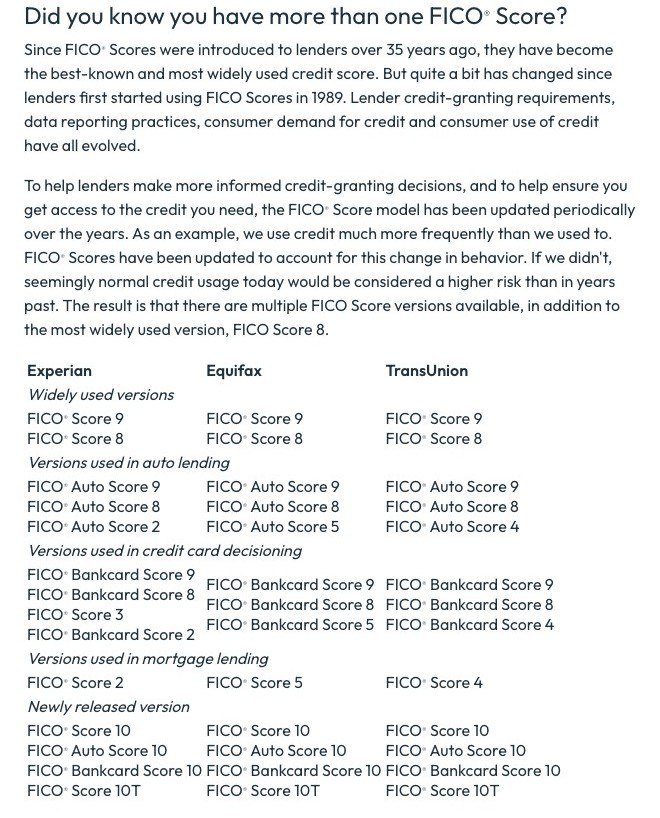
- FICO Score 8: the most widely used version, and the one for personal loans, student loans and retail credit.
- FICO Score 9: ignores paid third-party collections, gives unpaid medical collections less weight and counts rent history when it is reported.
- FICO Score 10 and 10T: 10 reflects newer habits such as personal loans for debt consolidation; 10T adds trended data, looking at 24 months or more of balances to see whether debt is rising or falling.
- Industry scores: FICO Auto and Bankcard scores run from 250 to 900, though 670 to 739 still counts as good.
How Lenders Use Your Score for Mortgages, Auto Loans and Cards
myFICO says lenders use the score for three calls: whether to approve, what rate to offer and how much to lend. Which score they pull depends on the product:
- Mortgages: lenders typically use FICO Score 5 from Equifax, FICO Score 4 from TransUnion and FICO Score 2 from Experian. With all three reports, they take the middle score; on a joint application, the lower of the two middle scores.
- Auto loans: most financing decisions use FICO Auto Scores.
- Credit cards: issuers often use FICO Bankcard Scores or FICO Score 8 or 9.
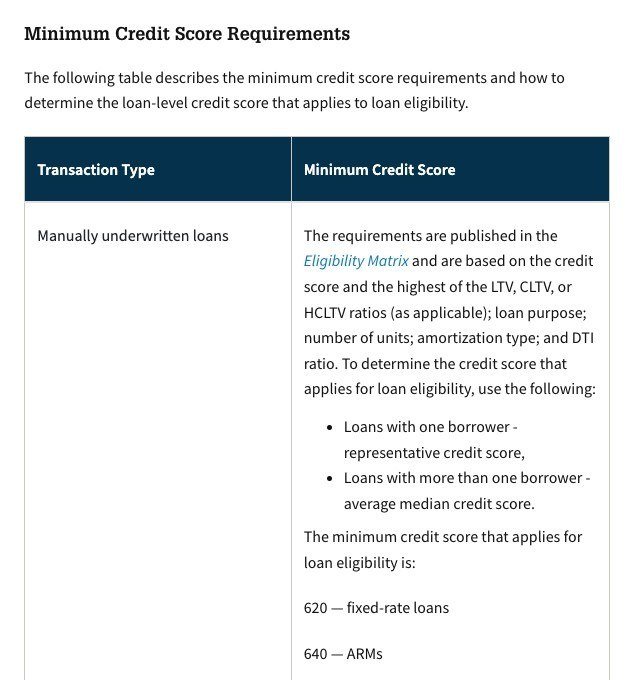
Fannie Mae’s Selling Guide sets a 620 minimum for manually underwritten fixed-rate loans and 640 for adjustable-rate loans. Loans run through its Desktop Underwriter system have no minimum score; the software weighs the borrower’s overall risk factors instead. The score sets the loan terms; local prices set the rest of a home budget, compared in our list of the cheapest states to live in.
If a lender denies you or takes another unfavorable action based on your report, you receive an adverse action notice naming the bureau. The FTC says you can then get a free report from that bureau if you ask within 60 days.
Mortgage Scoring Changes in 2025 and 2026: VantageScore 4.0 and FICO 10T
For decades Fannie Mae and Freddie Mac accepted only Classic FICO. The Federal Housing Finance Agency, now styled U.S. Federal Housing, has been opening that up in stages under its credit score modernization policy:
- October 24, 2022: FHFA validated FICO 10T and VantageScore 4.0, models that can count rent payment history.
- July 8, 2025: an interim policy let lenders choose VantageScore 4.0 or Classic FICO for loans sold to the two companies.
- April 22, 2026: VantageScore 4.0 went live through a limited rollout.
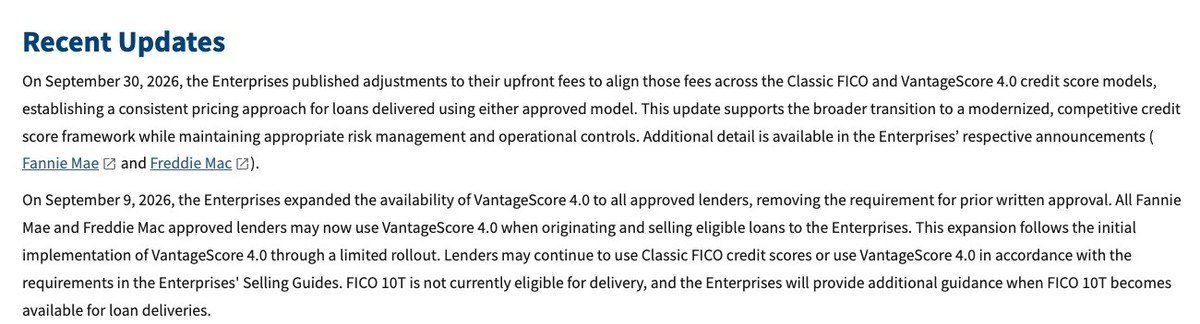
- September 9, 2026: every approved lender could use VantageScore 4.0 without prior written approval.
- September 30, 2026: upfront fees were aligned so pricing matches under either model.
FICO 10T is approved but not yet eligible for loan delivery. Lenders must use one model for every borrower on a loan, the three-report requirement stays in place, and no retirement date has been set for Classic FICO.
How Long Negative Items Affect a Credit Score
The CFPB says credit reporting companies can report most negative information for seven years, while positive history can stay longer, even after an account closes. The main limits:
| Item | How long it can be reported |
|---|---|
| Late payments and most other negative items | Up to 7 years |
| Collection accounts, even after you pay them | 7 years |
| Lawsuits and judgments | 7 years or until the statute of limitations ends, whichever is longer |
| Bankruptcy | Up to 10 years |
| Hard inquiries | Up to 2 years on the report, 1 year in FICO Scores |
| Paid medical collections | Removed from reports since July 1, 2022 |
| Medical collections under $500 | Removed from reports since April 2023 |
Judgments tie back to state deadlines, explained in our guide to the statute of limitations. The limits do not apply when a report is pulled for a job paying more than $75,000 a year or for more than $150,000 of credit or life insurance.
Credit Score Myths the Rules Contradict
- “Checking my score lowers it.” Your own requests are soft inquiries, which the CFPB says do not affect scores.
- “You need to carry a balance.” The CFPB says you need no outstanding debt at all; paying in full each month helps get the best scores.
- “Closing old cards helps.” myFICO warns closing cards can cut available credit and raise utilization, and closed accounts still appear on the report.
- “Paying a collection erases it.” A paid collection stays on the report for seven years.
- “A repair company can delete bad marks.” No one can remove accurate negative information, and you can dispute real errors yourself for free.
- “A higher salary means a higher score.” Income is not part of FICO or VantageScore.
Frequently Asked Questions
What is a good credit score?
On the FICO scale, 670 to 739 is good, 740 to 799 very good and 800 or higher exceptional. On VantageScore 3.0 and 4.0, 661 to 780 is Prime and 781 to 850 is Superprime.
What is the highest credit score possible?
Base FICO Scores and current VantageScore models top out at 850. FICO’s industry-specific Auto and Bankcard scores run up to 900.
Is a credit report the same as a credit score?
No. The report is the record of your accounts and payments held by Equifax, Experian and TransUnion. The score is a number a model calculates from that record.
How often does a credit score change?
Report data changes as lenders send new balances and payments, so FICO says your score updates frequently. Building gains takes longer: myFICO says small changes often appear within three to six months.
Related Articles

Get the Fox Bulletin briefing
The stories that matter, in your inbox. No spam, unsubscribe anytime.
Newsletter signup will be available soon.
Related stories

Best Free Video Interview Software: 8 Ranked by Free Limit
Eight free ways to interview candidates on video, ranked by how far each free plan stretches for a small team hiring one role at a time.

Richest People in the World: All 10 Ranked
Elon Musk is the richest person in the world at $936 billion, more than double second-placed Jeff Bezos. All 10 of the wealthiest people are American, six are worth more than $200 billion, and together they hold $3.1 trillion.

Amazon Business Prime: What Each Plan Costs and Who Needs One
Amazon Business Prime runs from free to $10,099 a year across five plans. What each tier costs, how it differs from the free Amazon Business account, and when the shipping alone pays for it.