

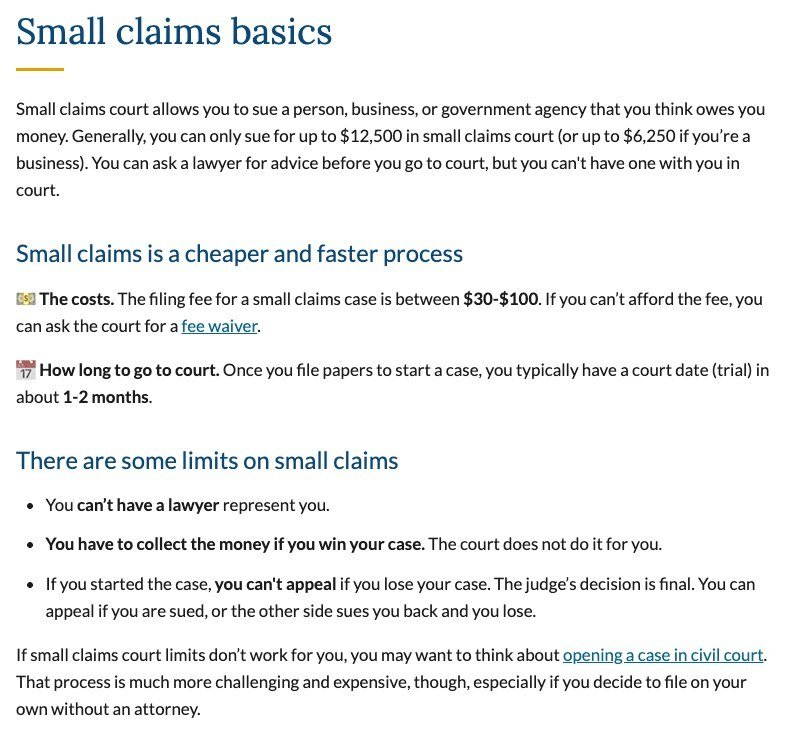
Small claims court is a simplified state court for money disputes, where people and businesses argue their own cases in front of a judge without the cost and paperwork of a regular lawsuit. Filing fees are often under $100, and a hearing can come within weeks.
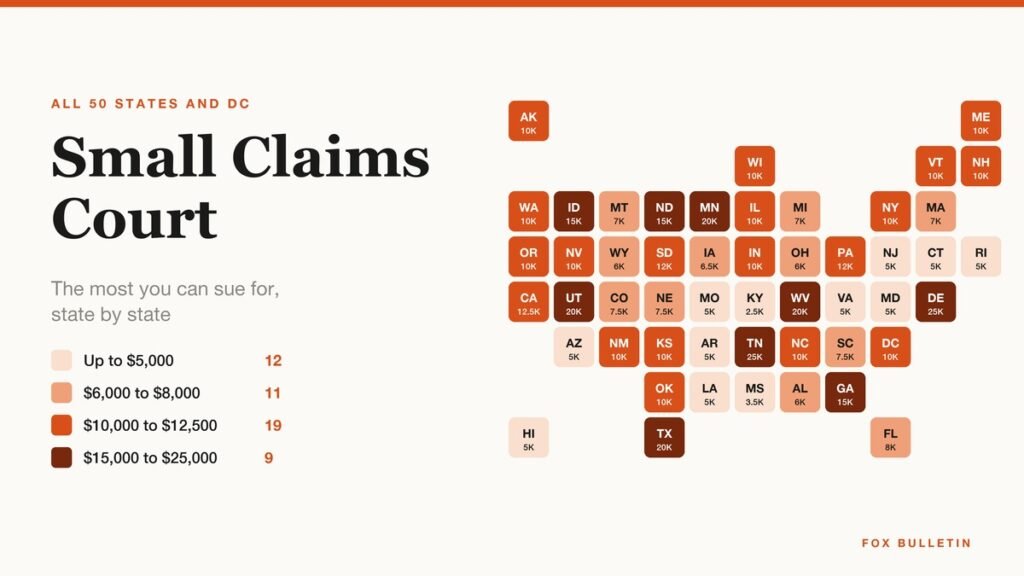
The catch is the cap. Each state limits how much you can ask for, from $2,500 in Kentucky to $25,000 in Delaware and Tennessee. This guide lists the limit in every state, explains what cases fit, and covers lawyers, fees, serving papers, collecting the money and appealing.
What Small Claims Court Handles
Small claims courts deal mainly with money. California's court system describes them as the place to sue a person, business or government agency you think owes you money. Cases are generally about money rather than orders to do or stop doing something.
Some disputes do not belong there at all. A court in Lake County, Illinois, lists what is off-limits:
- Divorce, guardianship, name changes and bankruptcy.
- Requests for emergency relief, such as an order to stop someone immediately.
- Claims against the federal government or a federal agency.
The federal exclusion is set by federal law. Under 28 U.S.C. 1346, federal district courts have exclusive jurisdiction over money claims against the United States for harm caused by a federal employee on the job, and a separate section, 28 U.S.C. 2675, requires the claim to go to the agency first. State and local agencies are different: California lets you sue them in small claims after filing a written claim with the agency, usually within six months.
A few states let small claims judges go beyond money. California allows a conditional judgment, such as an order to take down a fence or pay.
Small Claims Court Limits by State
The limit is the most you can claim in a single case. Each figure below comes from the state's judiciary or statute. Several states set a lower limit for businesses or a higher one for particular courts.
| State | Limit | Notes |
|---|---|---|
| Alabama | $6,000 | District Court small claims docket |
| Alaska | $10,000 | $20,000 for wage claims brought by the state labor department |
| Arizona | $5,000 | Raised from $3,500 in September 2025 |
| Arkansas | $5,000 | Lawyers not allowed; collection agencies and lenders cannot file |
| California | $12,500 | $6,250 for businesses; no more than two claims over $2,500 a year |
| Colorado | $7,500 | No more than two claims a month and 18 a year per county |
| Connecticut | $5,000 | $15,000 for home improvement contract claims |
| Delaware | $25,000 | Justice of the Peace Court |
| District of Columbia | $10,000 | Counterclaims are not capped |
| Florida | $8,000 | County court |
| Georgia | $15,000 | Magistrate Court; $25,000 for cases filed from January 1, 2027 |
| Hawaii | $5,000 | Security deposit cases have no stated cap |
| Idaho | $15,000 | Raised from $5,000 on July 1, 2026 |
| Illinois | $10,000 | Money claims only |
| Indiana | $10,000 | Includes the Marion County township courts |
| Iowa | $6,500 | District Court sitting in small claims |
| Kansas | $10,000 | Raised from $4,000 on July 1, 2024 |
| Kentucky | $2,500 | No libel or slander claims |
| Louisiana | $5,000 | City court small claims divisions and justice of the peace courts |
| Maine | $10,000 | Raised from $6,000 on January 1, 2026 |
| Maryland | $5,000 | Includes landlord rent claims up to $5,000 |
| Massachusetts | $7,000 | No cap on property damage from a car accident |
| Michigan | $7,000 | Anything above the limit is given up |
| Minnesota | $20,000 | Conciliation Court; $4,000 for consumer credit claims |
| Mississippi | $3,500 | Justice Court |
| Missouri | $5,000 | You can give up the excess to file |
| Montana | $7,000 | Justice Court small claims |
| Nebraska | $7,500 | Raised from $6,000 on July 1, 2025 |
| Nevada | $10,000 | Justice Court; claims cannot be split |
| New Hampshire | $10,000 | Claims over $5,000 go to mandatory mediation |
| New Jersey | $5,000 | Special Civil Part hears claims up to $20,000 |
| New Mexico | $10,000 | Magistrate Court |
| New York | $10,000 in New York City | $5,000 in City Courts and Nassau and western Suffolk District Courts; $3,000 in Town and Village Courts |
| North Carolina | $10,000 | Each county sets $5,000 to $10,000 by local rule |
| North Dakota | $15,000 | No appeal; the decision is final |
| Ohio | $6,000 | No libel, slander or malicious prosecution claims |
| Oklahoma | $10,000 | No libel or slander claims |
| Oregon | $10,000 | Claims of $750 or less must be filed in small claims |
| Pennsylvania | $12,000 | Magisterial district courts and Philadelphia Municipal Court |
| Rhode Island | $5,000 | The plaintiff gives up the right to appeal by choosing small claims |
| South Carolina | $7,500 | Magistrates court |
| South Dakota | $12,000 | Same limit for individuals and businesses |
| Tennessee | $25,000 | General Sessions Court |
| Texas | $20,000 | Justice court |
| Utah | $20,000 | Rises to $25,000 on January 1, 2030 |
| Vermont | $10,000 | $5,000 for consumer credit or medical debt collection |
| Virginia | $5,000 | General District Court hears claims up to $50,000 |
| Washington | $10,000 | $5,000 for businesses and other non-individuals |
| West Virginia | $20,000 | Magistrate court; raised from $10,000 in July 2025 |
| Wisconsin | $10,000 | $15,000 for cases from January 1, 2027; $5,000 for personal injury and other tort claims |
| Wyoming | $6,000 | Circuit court |
Limits have been rising quickly. Kansas went from $4,000 to $10,000 in 2024, Minnesota from $15,000 to $20,000 the same year, Nebraska and West Virginia raised theirs in 2025, and Maine and Idaho followed in 2026. Georgia and Wisconsin have increases already set for January 1, 2027. The highest caps are $25,000 in Delaware and Tennessee; the lowest is $2,500 in Kentucky.
If your claim is bigger than the limit, California's courts point you to regular civil court, which they warn is much more challenging and expensive, especially if you file on your own without an attorney.
Can You Bring a Lawyer to Small Claims Court?
It depends on the state. California bans attorneys from taking part in the conduct or defense of a small claims case. An attorney can still advise you before or after filing, and can represent you on appeal or when enforcing the judgment. A corporation appears through a regular employee, officer or director, not someone hired just to argue the case.
Other states take a softer line:
- Washington: no attorney may appear without the judge's consent, and a corporation may not be represented by an attorney.
- Illinois: lawyers are allowed, though the Lake County court notes that hiring one is rarely cost-efficient.
- Texas: parties can represent themselves or hire an attorney.
California also requires counties to offer free small claims advisory services, which in most counties include one-on-one help in person or by phone.
Filing Fees and How Long a Case Takes
Fees are low compared with ordinary civil court. Three examples:
- California: $30 for claims up to $1,500, $50 up to $5,000 (up to $6,250 for cases filed from January 1, 2027), $75 above that up to $12,500, and $100 if you filed more than 12 claims in the past 12 months. Fee waivers are available.
- New York City: $15 for claims up to $1,000 and $20 above that, paid by cash, certified check or money order.
- Massachusetts: $40 for claims of $500 or less, rising to $150 for claims of $5,001 to $7,000.
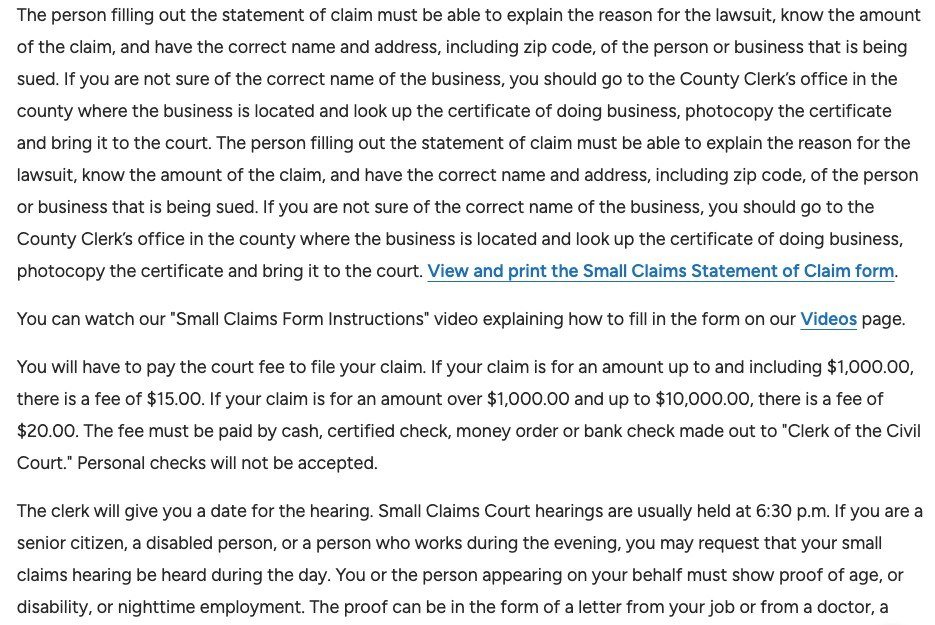
Cases move quickly. California law sets the hearing between 20 and 70 days after filing, and the court tells filers to expect a trial date in about one to two months. New York City holds most hearings at 6:30 p.m., and seniors, people with disabilities and night workers can ask for a daytime slot.
Repeat filers face extra limits. California lets a person file no more than two claims over $2,500 anywhere in the state in a calendar year.
How Small Claims Court Works From Filing to Judgment
The process follows the same basic path in most states:
- Ask for payment first. California treats a demand as a step you must take before filing, by letter, email or in person.
- Name the defendant correctly. For a business, use its legal name. New York City suggests checking the certificate of doing business at the County Clerk. Our guide to business structures explains why an LLC or corporation, not its owner, is usually the one you sue.
- File the claim. The clerk stamps the form, assigns a case number and sets the date.
- Serve the papers. In California you cannot serve them yourself, and the state court's service guide requires delivery at least 15 days before the hearing, or 20 if the defendant lives in another county.
- Present your case. Bring three copies of everything: one for you, one for the judge and one for the other side.
Evidence wins these cases. New York City's court suggests photographs, the written agreement, itemized bills, receipts, at least two written repair estimates, canceled checks and letters. If you plan to rely on a recording of a phone call, check the recording consent rules in your state first. In California, expect to spend four hours or more at court on the hearing day.
Missing the hearing is costly. In New York City, a claimant who does not show up has the claim dismissed, while an absent defendant can lose by default.
Collecting the Money After You Win
Winning does not mean getting paid. California's courts say plainly that the court does not collect the money for you. In California you must wait at least 30 days after the Notice of Entry of Judgment is handed or mailed to you before you can start enforcing it.
The main collection tools are:
- Wage garnishment: part of the debtor's paycheck goes to you.
- Bank levy: money is taken from the debtor's account.
- Property lien: a claim against real estate that must be paid when it sells.
- Debtor's exam: a court hearing where the debtor must answer questions about income and assets.
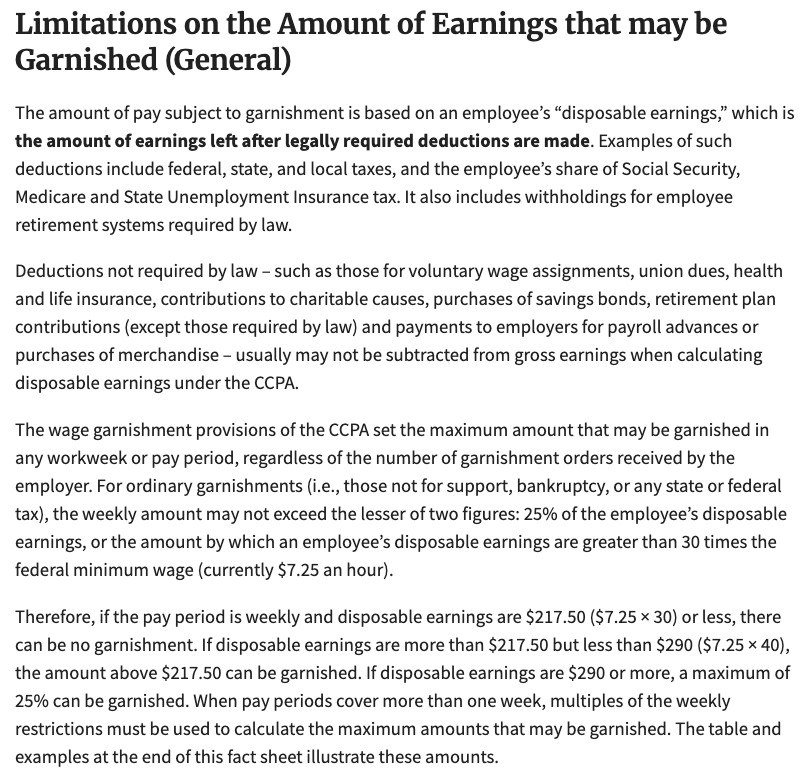
Federal law caps garnishment for ordinary debts at the lesser of 25% of disposable earnings or the amount above 30 times the federal minimum wage. Nothing can be taken from weekly disposable earnings of $217.50 or less.
Judgments last for years. California judgments last 10 years and earn 10% interest a year. Judgments for medical debt under $200,000 or personal debt under $50,000 earn 5% and can be renewed only once, for five years; other judgments can be renewed for 10 years at a time. Texas judgments are generally valid for 10 years and can also be renewed.
Appealing a Small Claims Decision
Appeal rights vary sharply. In California, the person who started the case cannot appeal a loss on their own claim. A defendant who came to the hearing can, within 30 days of the Notice of Entry of Judgment, and the appeal is a brand new trial in superior court where lawyers are allowed. A defendant who missed the hearing has to ask the court to vacate the judgment instead.
Texas allows an appeal when the judgment or amount in dispute is over $250, within 21 days, and the case is tried again from scratch in county court. In New York City, a decision by an arbitrator cannot be appealed, so choosing a judge keeps that option open. Whatever the court, the claim must still be filed within the statute of limitations for that type of dispute.
Frequently Asked Questions
What is the most you can sue for in small claims court?
It depends on the state. Delaware and Tennessee allow the most at $25,000, and Georgia joins them for cases filed from January 1, 2027. Texas allows $20,000, California $12,500 for individuals, and Kentucky only $2,500.
Can I sue a business in small claims court?
Yes. Use the business's exact legal name and sue the company itself rather than its officers. Businesses face tighter rules as plaintiffs: in New York City a corporation cannot sue in Small Claims Court and uses the Commercial Claims part instead.
Do I need a lawyer for small claims court?
No. The process is built for people representing themselves. California bars lawyers from the hearing, and Washington allows them only with the judge's consent.
What happens if the other side does not show up?
In New York City, an absent defendant faces an inquest, and the claimant wins a default judgment by proving the case. If the claimant is the one who misses the hearing, the claim is dismissed.
Related Articles

Get the Fox Bulletin briefing
The stories that matter, in your inbox. No spam, unsubscribe anytime.
Newsletter signup will be available soon.
Related stories

Lemon Law: How a Car Qualifies and What You Get Back
A lemon law makes the manufacturer buy back or replace a new car it cannot fix. Here are the real tests in nine states, the refund formulas, and the steps to file a claim.
Statute of Limitations: What It Means and How Long You Have
A statute of limitations is the legal deadline to sue or bring charges. Here are the real time limits in four big states, the crimes with no limit, and how old debts work.

Living Will: What It Covers and How to Make One
A living will tells doctors which treatments you want if you cannot speak for yourself. Here is what it covers, how signing rules differ by state, and how to make one.