

Netflix movies are ranked by views, and a view is not a person. Netflix divides the hours a film was watched during the week by that film runtime, then rounds the result to the nearest 10,000. A two hour film watched for 20 million hours is reported as 10 million views, whether that was 10 million people watching once or five million watching twice.
That one division sum shapes everything about the list people see. It decides which films look like hits, it quietly favours short runtimes, and it is the reason the chart is dominated by titles that look nothing like the prestige releases Netflix advertises. The measurement rules below are the ones Netflix applies to every country list it publishes.
| Rule | How it works |
|---|---|
| Ranking metric | Views, not hours viewed |
| How a view is counted | Weekly hours viewed divided by the title runtime |
| Measurement week | Monday to Sunday, published the following Tuesday |
| Qualifying window | 91 days from the date a title becomes eligible |
| Country lists | More than 90, matching the Top 10 rows inside the app |
| Global list categories | Films (English), Films (Non-English), TV (English), TV (Non-English) |
| What is eligible | Any genre, kids and family included, licensed films alongside originals |
| Rounding | Weekly figures are rounded to the nearest 10,000 |
How Netflix Movies Are Ranked Each Week
The week runs Monday to Sunday and the lists appear the following Tuesday. Netflix measures hours viewed first, then converts that total into views by dividing by runtime. Ranking on the converted figure rather than the raw one is a deliberate choice: hours alone would put a nine hour series above a 90 minute film every time, and would flatter any long film over a tight one.
The conversion is exact and easy to check. In the week ending 27 September 2026, UNABOMBER recorded 27.4 million hours against a runtime of one hour 40 minutes, which Netflix published as 16.4 million views. The same week, Monster: The Lizzie Borden Story recorded 95.9 million hours, far more, but across a season running six hours 38 minutes that came to 14.5 million views. The film outranked the series on views while losing heavily on hours.
Netflix separates its global lists into four: Films in English, Films not in English, TV in English and TV not in English. Country lists are not split that way. Each of the 90 plus national lists carries one film top ten and one television top ten, with everything competing together.
The language split on the global lists exists because the two populations are not comparable in scale. In the week ending 27 September 2026 the leading English language film recorded 16.4 million views worldwide, while the leading non-English film, the Indian release Irumudi, recorded 3.4 million. Run as one list, a non-English title would rarely appear at all, and the separate chart is what keeps it visible.
What the 91 Day Window Changes
A title stays eligible for the lists for 91 days, roughly three months, counted from the point it becomes eligible. Before this window was widened it stood at about 28 days, which meant a film that found its audience slowly fell off the chart before the audience arrived.
Three months is long enough for word of mouth to do its work, and the effect is visible in the data. Films now commonly leave the list, return weeks later and leave again, which is why a title can accumulate far more weeks than a single continuous run would allow. It also means the chart is not a release schedule. A film in this week top ten may have arrived in July.
The 91 day rule governs the weekly lists only. Netflix ranks its all time most popular titles on a different and much stricter basis, counting only the hours a title collected in its first 28 days on the service. A film can therefore spend a year drifting in and out of the weekly top ten and still miss the all time list entirely, because the all time list stopped counting four weeks after release.
Why the Film Chart Turns Over So Fast
Film is the volatile half of Netflix. Across 274 weeks of United States lists the pattern is unmistakable:
- 190 different films have held the number one spot on the United States film list.
- No film has ever held it for more than four consecutive weeks, and only Carry-On and KPop Demon Hunters have managed four in a row.
- KPop Demon Hunters has spent the most weeks at number one in total, with eight, spread across a run that began in June 2025.
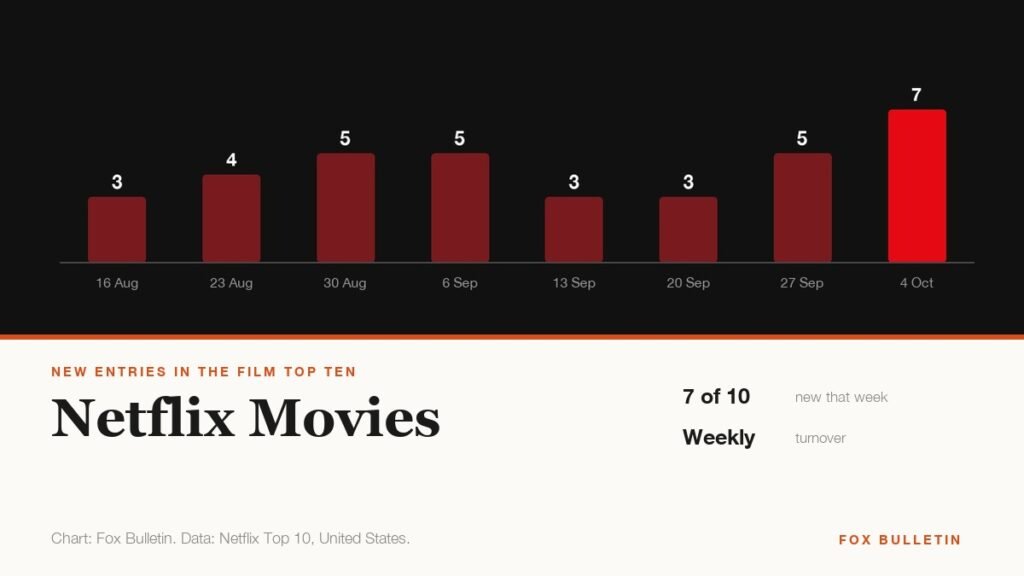
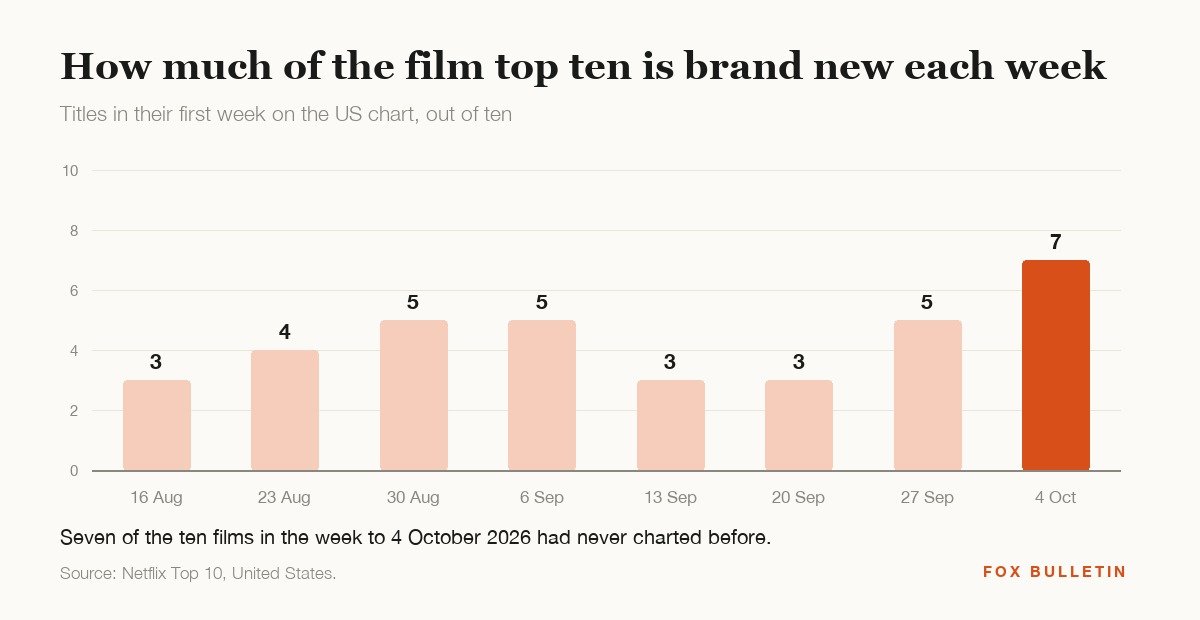
- A median of five of the ten places change hands every week, and in the most volatile weeks nine do.
Television behaves in the opposite way. A season arrives, is consumed over several weeks and holds its place, so the same titles persist. Films are closer to a weekend box office in that respect, which is worth knowing before treating any film top ten as a verdict rather than a snapshot. For a sense of how differently theatrical performance is distributed, the all time highest grossing movies list is concentrated in a handful of franchises rather than spread across 190 different leaders.
The Titles That Refuse to Leave
Ranked by total weeks spent in the United States film top ten since July 2021, the leaders are almost entirely animation:
| Film | Weeks in the US top 10 |
|---|---|
| KPop Demon Hunters | 50 |
| The Super Mario Bros. Movie | 38 |
| Sing 2 | 32 |
| Despicable Me 2 | 24 |
| Shrek | 22 |
| The Boss Baby | 21 |
| Minions | 19 |
| Despicable Me 4 | 19 |
All eight are animated. There is no live action film anywhere near the top of this list. That is not a quirk of one year. It holds across five years of data, and the reasons are structural rather than a matter of taste:
- Children rewatch, and every rewatch counts again the following week.
- A 90 minute animated film divides into a large number of views, because the runtime denominator is small.
- Family titles are chosen by a parent for a room rather than by one person for themselves, so a single decision can produce several hours.
- School holidays and sick days concentrate that viewing into measurable weekly spikes.
The commercial logic follows from the measurement. A studio chasing weeks on the chart would commission family animation rather than a three hour drama, because the format wins on every term of the equation at once. It is also why the box office and the streaming chart disagree so often, something the highest grossing animated movies figures show from the other direction.
Licensed Films Sit on the Same List as Originals
Netflix makes no distinction on the chart between a film it financed and one it rents from another studio. Shrek, the Despicable Me sequels, Minions and Sing 2 are all licensed titles, and between them they occupy most of the longevity table above. Netflix commissions originals, but the films that hold the list are largely ones it pays to borrow.
This matters when a title vanishes. Originals stay indefinitely, while licensed films leave when the deal ends, which is why a film can be in the top ten one month and gone the next without ever being unpopular. Licensing terms are also regional, so the same video on demand catalogue differs country by country, and a title trending in one national list may not exist in the next one.
How Much America Actually Watches
Netflix reports engagement across the whole service twice a year, and the figures put the weekly lists in proportion. Members watched more than 97 billion hours in the first half of 2026, which the company states is its highest total for any half year so far. The most watched film in that period reached 147 million views and the most watched series reached 104 million.
Those two titles alone dwarf anything on a single weekly list, which is the point: the top ten measures one week of attention, not a title career. The reporting is also about to get thinner. Netflix has said it will move from a six month snapshot to a yearly one starting in the first quarter of 2027, so the half year comparisons that made it possible to see trends inside a year are ending.
None of this transfers to a rival service. Netflix is unusual in publishing weekly country lists at all, and the services that do publish figures define a view on their own terms, over different windows and with different rounding. A film described as the most watched of the week on one platform and a film at the top of this chart have not been measured by the same instrument, so placing them side by side produces a comparison that does not mean anything.
Frequently Asked Questions
Does one view mean one person watched a Netflix film?
No. A view is weekly hours viewed divided by runtime. Two people who each watch half a film produce one view between them, while one person who watches the same film twice produces two. It measures completed watching rather than distinct people.
Why do short films rank higher than long ones?
Because runtime is the denominator. A 90 minute film needs 90 minutes of watching per view, while a three hour film needs three hours. Given equal hours, the shorter film reports twice as many views, so short runtimes are rewarded by the formula itself.
How long can a film stay on the Netflix top 10?
Eligibility lasts 91 days, and within that window a film can leave and return. KPop Demon Hunters has recorded the most weeks on the United States film list at 50, while no film has held the number one position for more than four weeks in a row.
Are licensed films and Netflix originals ranked separately?
No. Both compete on the same list, in any genre, kids and family included. Most of the longest staying films on the United States chart are licensed rather than original, and they disappear when the licence expires.
Related Articles

Get the Fox Bulletin briefing
The stories that matter, in your inbox. No spam, unsubscribe anytime.
Newsletter signup will be available soon.
Related stories
Amazon Prime Video Subscription: What It Costs and What You Get
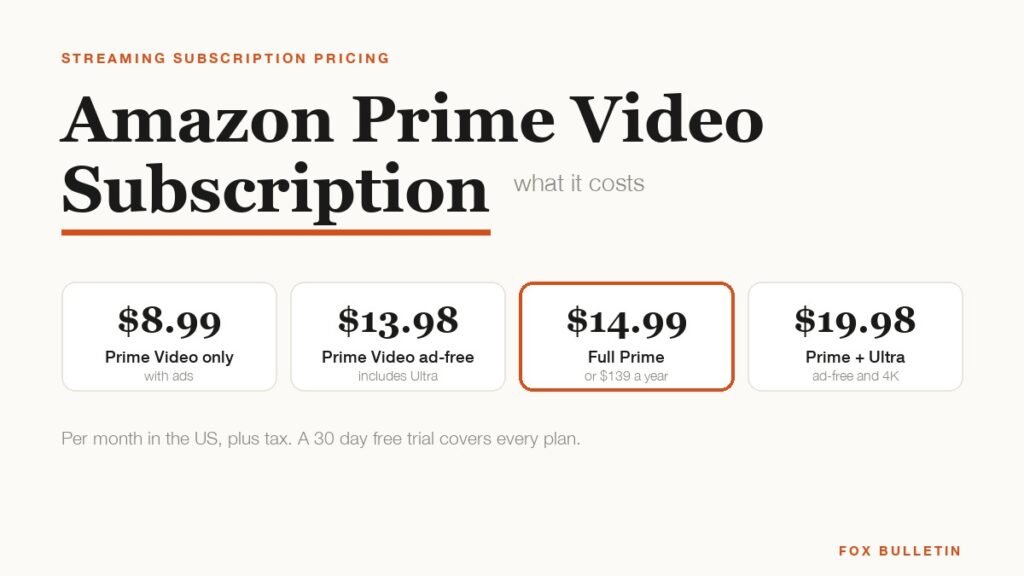
An Amazon Prime Video subscription costs $8.99 standalone or $14.99 with full Prime, plus $4.99 for ad-free Ultra and 4K. Every plan, the discounted tiers and what the trial covers.
How Much Is Kindle Unlimited? Price, Trial and What You Get
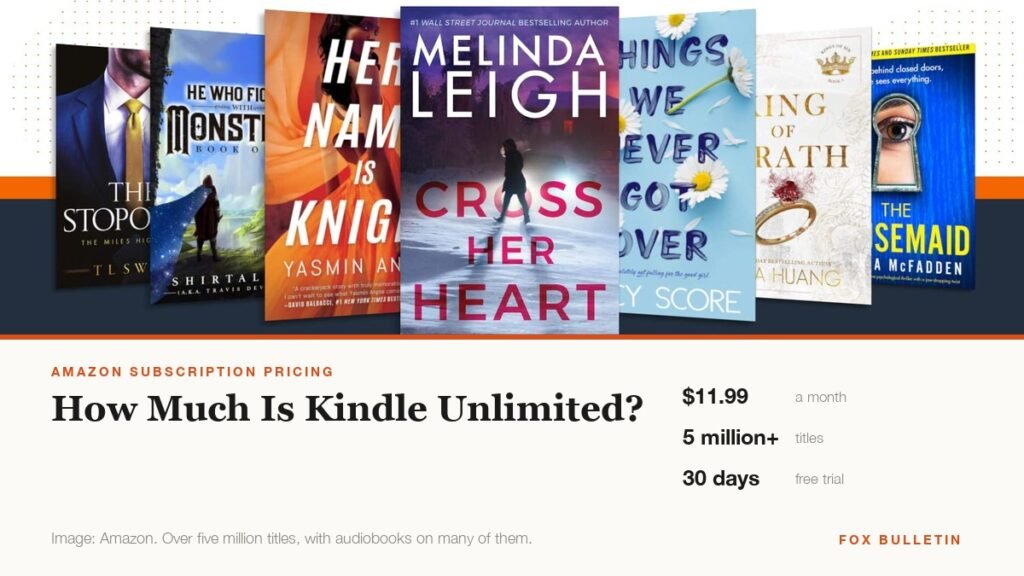
Kindle Unlimited costs $11.99 a month plus tax with a 30 day free trial. What the fee covers, how it differs from Prime Reading, and how to tell whether it pays for itself.
Best Audiobook Apps: 7 Compared on Price and Catalog
Audible, Libro.fm, Spotify, Kobo Plus, Libby, hoopla and LibriVox compared on monthly price, catalog size and whether the audiobook stays yours after you cancel.