

The best gacha games give you the entire game for nothing and sell you only the characters. There is no level gate, no paid campaign and usually no advertising. What there is instead is a banner: a randomised draw where a fixed sum of in-game currency buys one attempt at a character you want, and the odds are published because several countries now require it.
That structure is why the genre earns more than any other on mobile, and why it is worth understanding before you start rather than three months in. The mechanics are not hidden. Pity, soft pity and the fifty-fifty are all documented, and once you can do the arithmetic the decision about whether to spend becomes a straightforward one.
How a Gacha Banner Actually Works
Take the published rates for the permanent banner of the biggest game in the genre, which are typical of how the whole category is built.
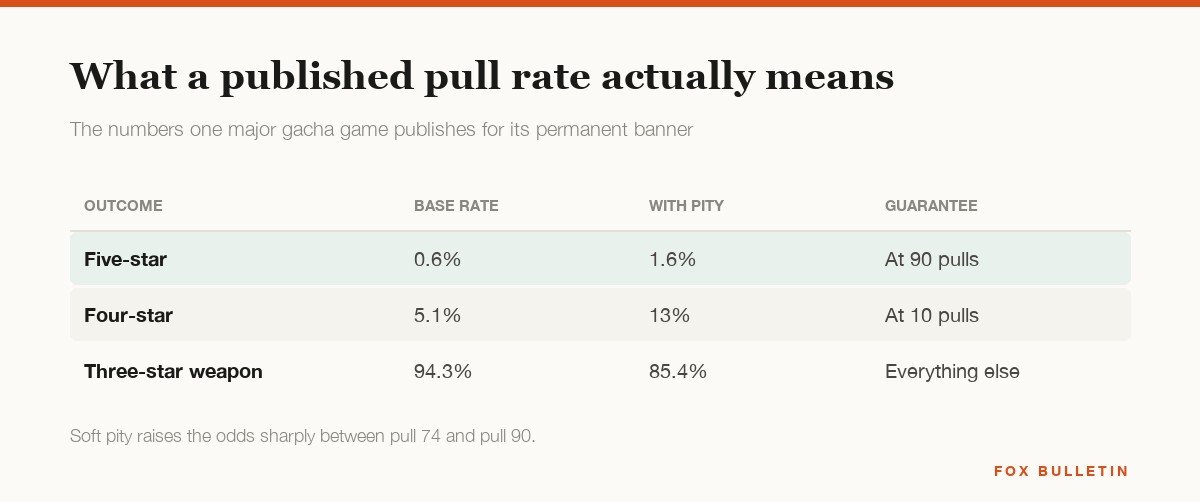
A 0.6 per cent base rate sounds hopeless and is not the number that matters, because the system has a floor. If you have not seen a five-star in 89 pulls, the 90th is guaranteed to be one. That is hard pity, and it turns an unbounded gamble into a purchase with a known ceiling.
Soft pity is the part people miss. The odds do not stay at 0.6 per cent until pull 90 and then jump; they climb sharply from around pull 74, which is why the average five-star arrives well before the guarantee and why the effective rate including pity is quoted at 1.6 per cent rather than 0.6. There is a parallel guarantee on four-stars at every tenth pull.
What One Character Really Costs
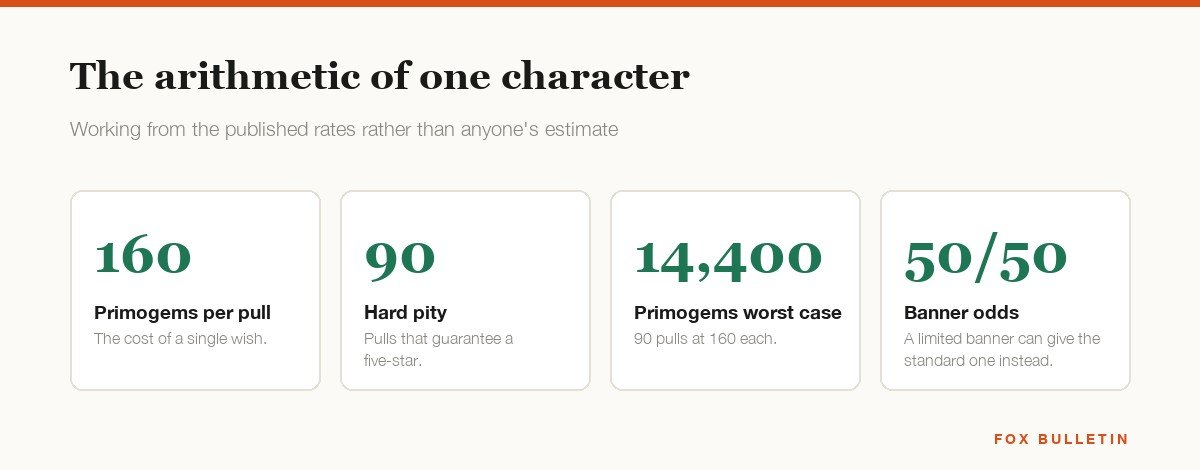
One pull costs 160 units of the premium currency, so hard pity at 90 pulls is 14,400 units in the worst case. Soft pity means the realistic average is closer to 60 to 70 pulls. That is the number to hold in your head, because every free reward the game hands you can be measured against it: a daily login that pays 60 is roughly a third of a pull.
Then there is the fifty-fifty, which is the mechanic that surprises people. On a limited banner, winning a five-star does not guarantee you get the featured character. Half the time you receive a character from the permanent pool instead, and only then is the next five-star guaranteed to be the one you wanted. In practice the worst case for a specific limited character is roughly double the single-pity figure.
- Hard pity: the pull at which a five-star is guaranteed, usually 80 to 90.
- Soft pity: the window before it where the odds climb steeply.
- The fifty-fifty: whether a five-star is the featured character or a standard one.
- Guaranteed next: losing the fifty-fifty makes the following five-star certain.
- Carry-over: pity counters usually persist between banners, so nothing is wasted.
None of this is a secret, and all of it is published. What the game relies on is that most people never do the sum, which is also the difference between a gacha system and the loot boxes that several countries have restricted or banned outright.
The Eight Best Gacha Games, Compared
| Game | Type | Out since | Download |
|---|---|---|---|
| Genshin Impact 6th Anniversary | Open-world action RPG | 2020 | 3766 MB |
| Honkai: Star Rail | Turn-based RPG | 2023 | 3779 MB |
| Zenless Zone Zero | Action brawler | 2024 | 3712 MB |
| Wuthering Waves | Open-world action RPG | 2024 | 3390 MB |
| Fate/Grand Order (English) | Turn-based RPG | 2017 | 155 MB |
| Fire Emblem Heroes | Tactics RPG | 2017 | 123 MB |
| Arknights | Tower defence | 2020 | 3381 MB |
| Blue Archive | Real-time tactics | 2021 | 447 MB |
1. Genshin Impact
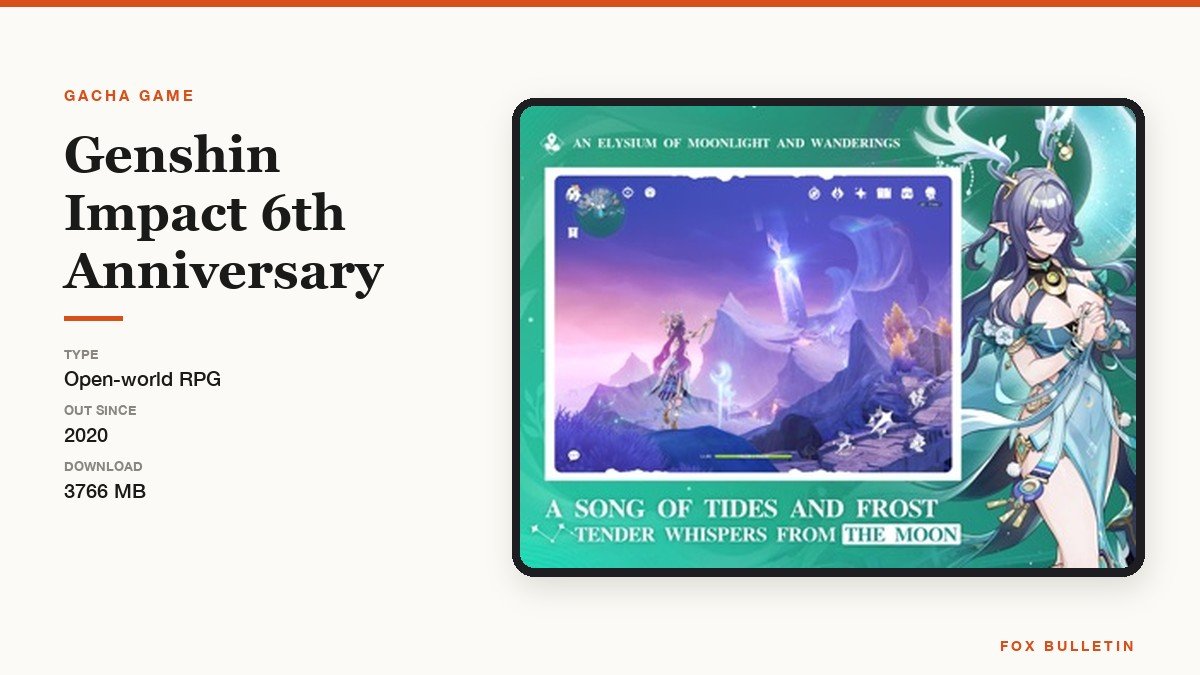
The one that took the format mainstream. A full open world with no paywall anywhere in it, funded entirely by character and weapon banners. It is also the benchmark for how generous a gacha can be while still earning: the story, the map and the events are free, and spending only ever buys you a faster route to a specific character.
Genshin Impact is free from COGNOSPHERE PTE. LTD., on the store since 2020, around 3766 MB before updates.
What it asks of you
- Banners only, with the map, story and events free.
- 160 currency per pull, and roughly 60 to 70 pulls to a guarantee.
- The heaviest install here and the hardest on a phone.
2. Honkai: Star Rail
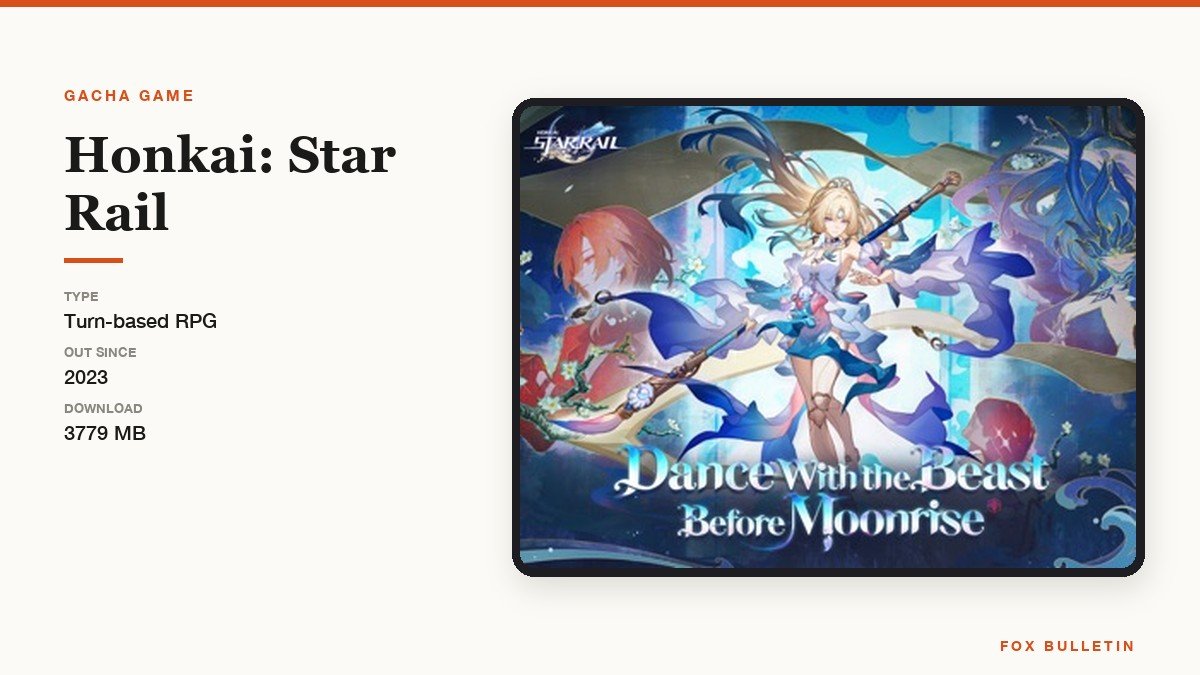
The same publisher applying the same model to turn-based combat, which suits a phone better than real-time action does because nothing is lost to touch controls. Shorter sessions, a heavier story and a reputation for handing out pull currency more freely than its sibling.
Honkai: Star Rail is free from COGNOSPHERE PTE. LTD., on the store since 2023, around 3779 MB before updates.
What it asks of you
- Turn-based, so touch controls cost you nothing.
- A reputation for handing out pull currency more freely than its sibling.
- Shorter sessions, which suits a commute.
3. Zenless Zone Zero
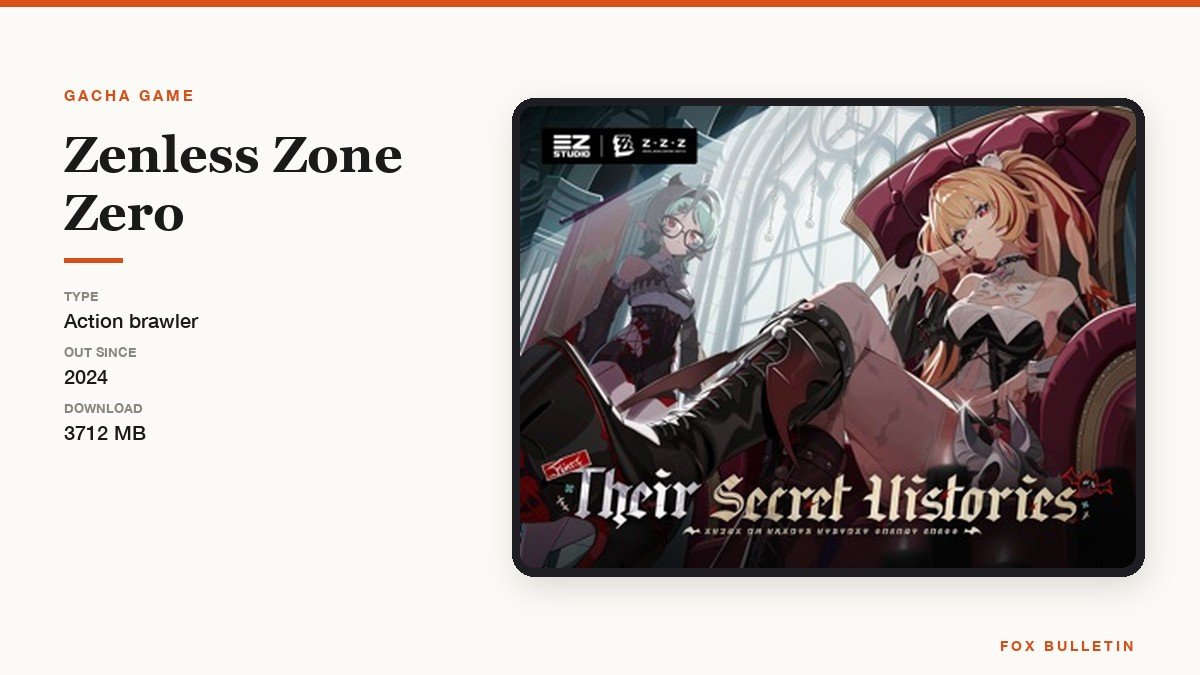
The most mechanically demanding of the three from this publisher, built on fast combo-based combat in an urban setting. Sessions are short by design and the roster is smaller, which makes the banner economy feel less overwhelming than a game with a hundred characters.
Zenless Zone Zero is free from COGNOSPHERE PTE. LTD., on the store since 2024, around 3712 MB before updates.
What it asks of you
- Smaller roster, so the banner economy feels less relentless.
- Short sessions by design.
- Combo-based combat that rewards practice over spending.
4. Wuthering Waves
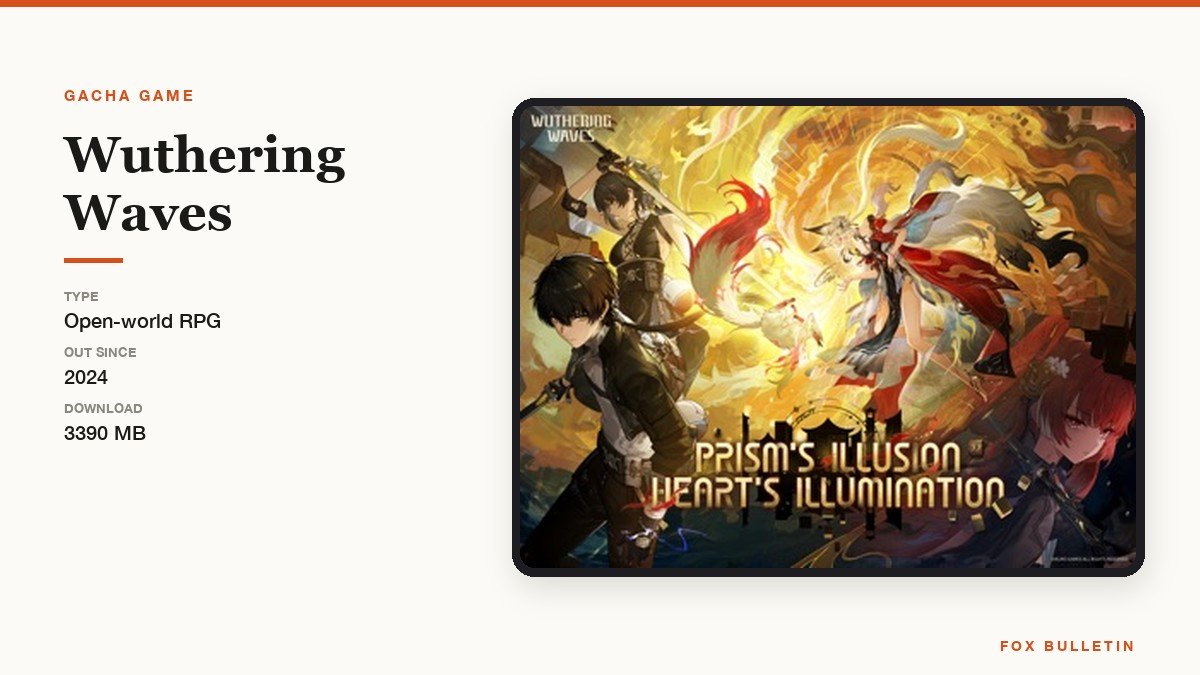
The most direct competitor to the genre leader, with a faster and more technical combat system built around parrying and dodge-counters. It leans harder on execution than on team composition, which suits players who found the alternative too forgiving.
Wuthering Waves is free from HK KURO GAMES LIMITED, on the store since 2024, around 3390 MB before updates.
What it asks of you
- Execution over roster, with parries and dodge-counters.
- Open world and story free, same model as its main rival.
- Demanding on hardware, so expect throttling on older phones.
5. Fate/Grand Order
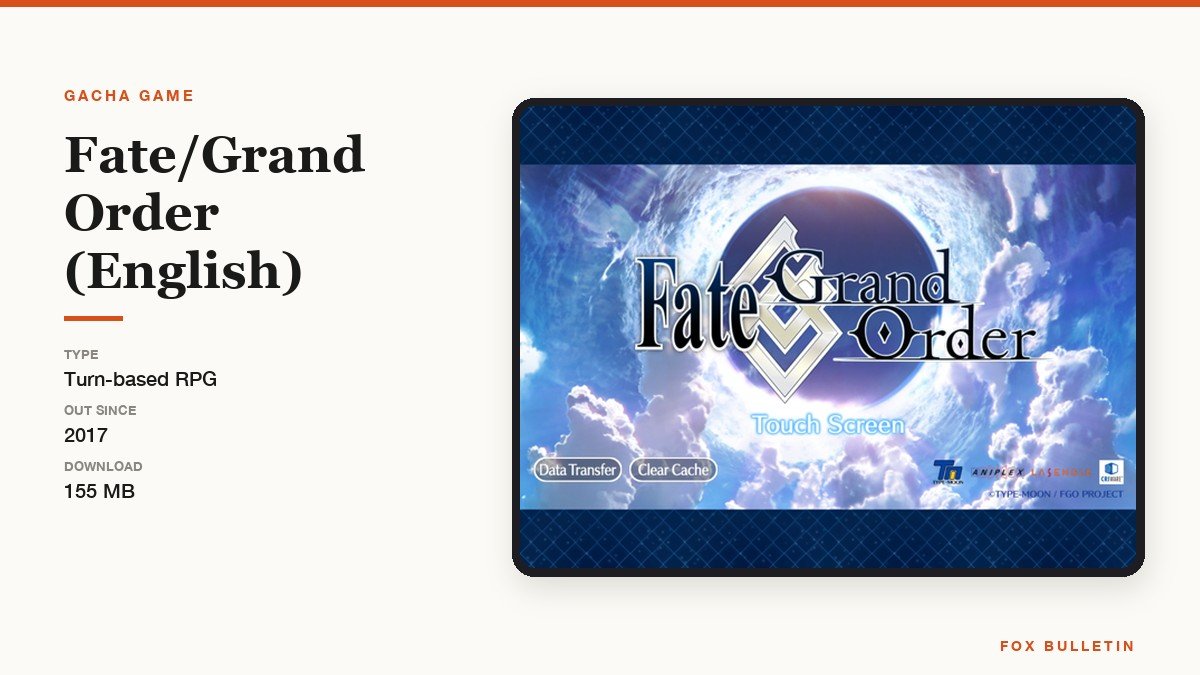
The old guard, running since 2017 in English and still one of the highest-grossing mobile games ever made. The presentation is dated and the story is enormous, and it has a reputation as one of the harshest economies in the genre, which has never dented its revenue.
Fate/Grand Order is free from Aniplex Inc., on the store since 2017, around 155 MB before updates.
What it asks of you
- One of the harshest economies in the genre, and it has never hurt revenue.
- An enormous story that is free to read.
- Dated presentation which keeps the install small.
6. Fire Emblem Heroes
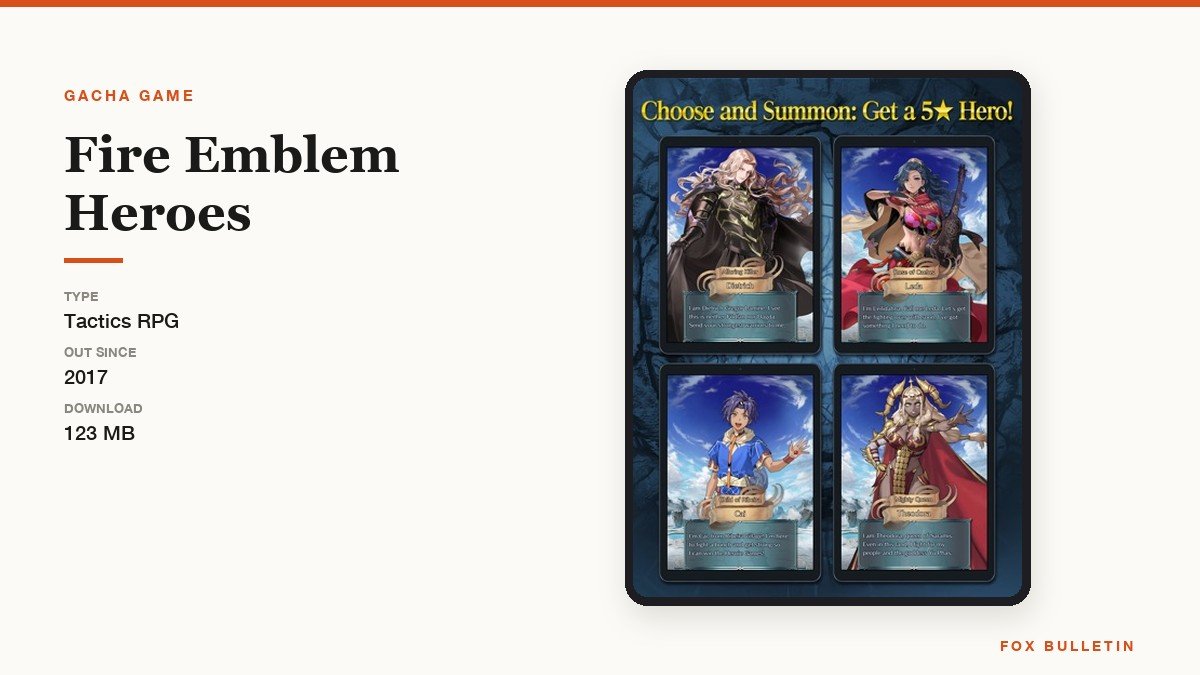
Nintendo’s entry, and the one that proved a first-party publisher would do this. Grid-based tactical battles in bite-sized maps, with a steady flow of free summoning currency and a roster drawn from three decades of the series.
Fire Emblem Heroes is free from Nintendo Co., Ltd., on the store since 2017, around 123 MB before updates.
What it asks of you
- A steady flow of free summoning currency.
- Bite-sized grid battles, a few minutes each.
- A roster drawn from three decades of the series.
7. Arknights
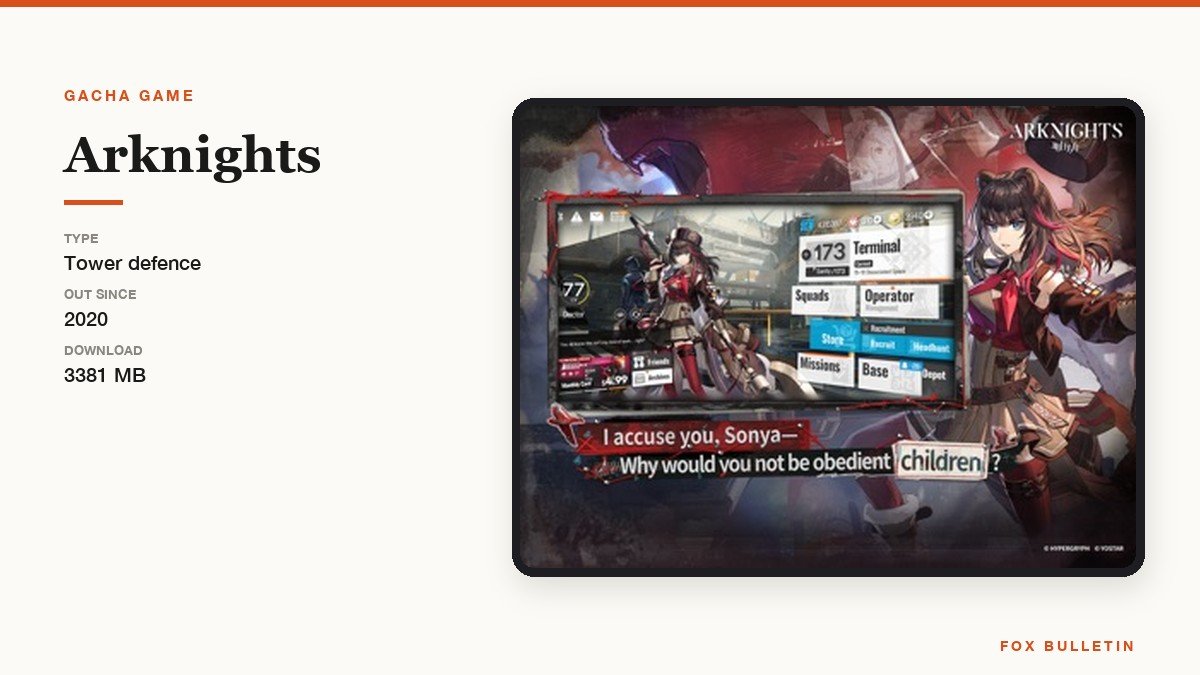
Tower defence rather than a party RPG, which makes it the outlier here and the one with the clearest skill ceiling. Characters are units you place on a map, and a well-planned low-rarity squad genuinely beats an unplanned expensive one.
Arknights is free from YOSTAR (HONG KONG) LIMITED, on the store since 2020, around 3381 MB before updates.
What it asks of you
- Planning beats spending, because it is tower defence.
- Low-rarity squads genuinely clear content.
- The clearest skill ceiling of anything here.
8. Blue Archive
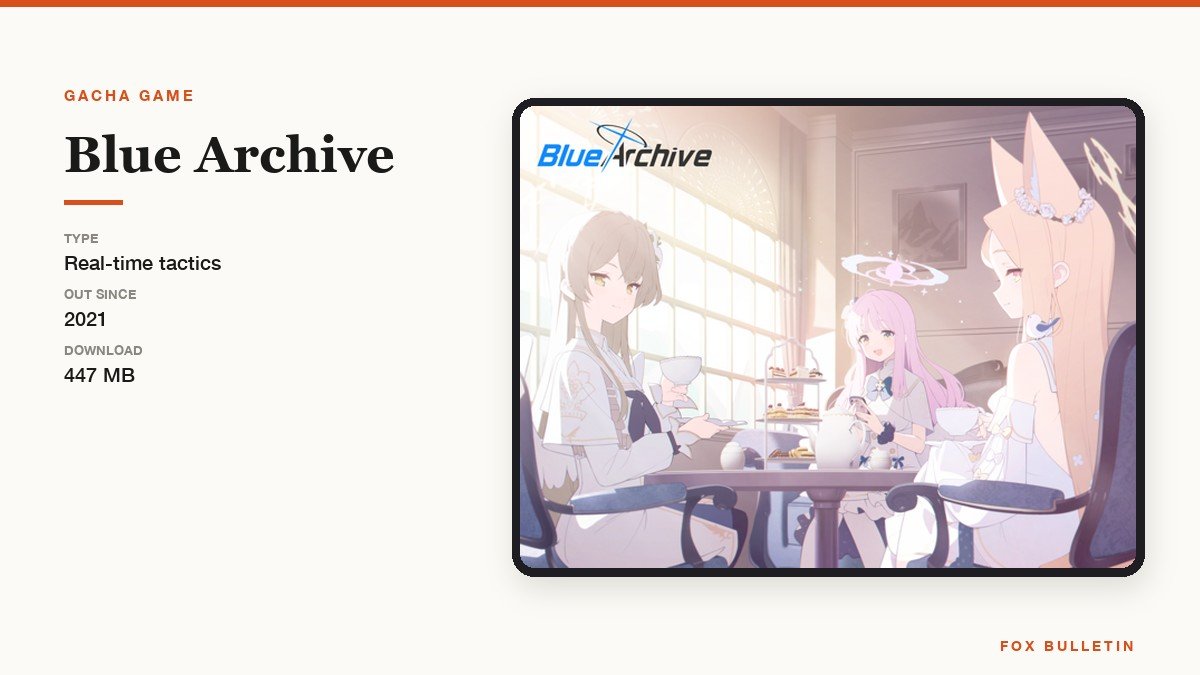
Squad-based real-time combat with a strong art identity and a famously relaxed economy. It is the usual recommendation for someone who wants the character-collection loop without the pressure, because the pull currency accumulates faster than the banners consume it.
Blue Archive is free from NEXON Korea Corporation, on the store since 2021, around 447 MB before updates.
What it asks of you
- Pull currency accumulates faster than the banners consume it.
- The usual recommendation for collecting without pressure.
- Strong art identity, which is most of the appeal.
Playing One Without Spending
Every game here is completable without paying, and a large majority of players never do. What free play costs you instead is selectivity: you cannot have every character, so the skill is in choosing which banners to ignore.
- Decide on one character per patch at most, and skip everything else regardless of how good it looks.
- Never pull below the pity you need. Starting a banner with 20 pulls saved is how people end up with nothing.
- Claim every free source. Dailies, events, mail and the rotating codes add up to more than most players realise.
- Build the low-rarity characters you already own, since a well-built four-star clears almost everything.
- Treat the fifty-fifty as the real cost, and budget for roughly double the pity number when you want one specific character.
The free currency in the biggest title here comes partly from redemption codes, which rotate every livestream and are worth a few hundred units between them. We keep a current list of the Genshin Impact codes, and the full character roster is useful for working out which elements your account is short of before you commit to a banner.
What These Games Do to a Phone
Four of the eight are 3D games with real-time combat, and they are among the heaviest things you can install. Expect the download to double after the first round of updates, expect a sustained frame rate well below the peak, and expect the handset to get warm within twenty minutes.
Capping the frame rate at 30 or 60 rather than letting the game chase the display refresh rate is the single most effective setting, and it costs less visually than dropping the resolution does. Beyond that, our guide to a phone that keeps overheating covers what actually helps, and a clip-on mobile cooler is the hardware answer for long sessions.
Frequently Asked Questions
What does pity mean in a gacha game?
Pity is a counter that guarantees a rare result after a set number of unsuccessful pulls. Hard pity is the guarantee itself, usually at 80 to 90 pulls, and soft pity is the window before it where the published odds climb steeply. Pity normally carries over between banners.
Are gacha games gambling?
Legally it depends where you are. Several countries treat randomised paid rewards as gambling and regulate them, which is why publishing the odds became standard. The usual distinction drawn is that nothing you win can be converted back into money, though the psychological mechanics are the same.
Can you play gacha games without paying?
Yes, and most people do. The games hand out enough premium currency through dailies, events and story progress to pull regularly, and the content is tuned so that well-built common characters clear it. What you give up is the ability to get every character you want.
Which gacha game is the most generous?
Among the titles here, the squad-based and tactics games tend to hand out pull currency faster relative to what their banners cost, while the oldest title in the genre has the opposite reputation. The more useful question is how often a game releases characters, because a slower release schedule makes the same income go further.
Related Articles

Get the Fox Bulletin briefing
The stories that matter, in your inbox. No spam, unsubscribe anytime.
Newsletter signup will be available soon.
Related stories

Amazon Luna: What Prime Includes and How the Free Games Work
Amazon Luna streams games with nothing to download, and Luna Standard is included with Prime. What Prime covers, how the monthly game claims work, and where the free tier stops.
Best Mobile Games: The 8 Genres That Own the Charts
The best mobile games are rarely the ones topping the free chart, because that chart is a list of the best businesses. Eight genres, and what each one really wants.
Genshin Impact Characters: All 122 by Element, Weapon and Region
The roster passed 120 this year and the names blur together fast. This is every playable character sorted the three ways that actually help: element, weapon and where they are from.