

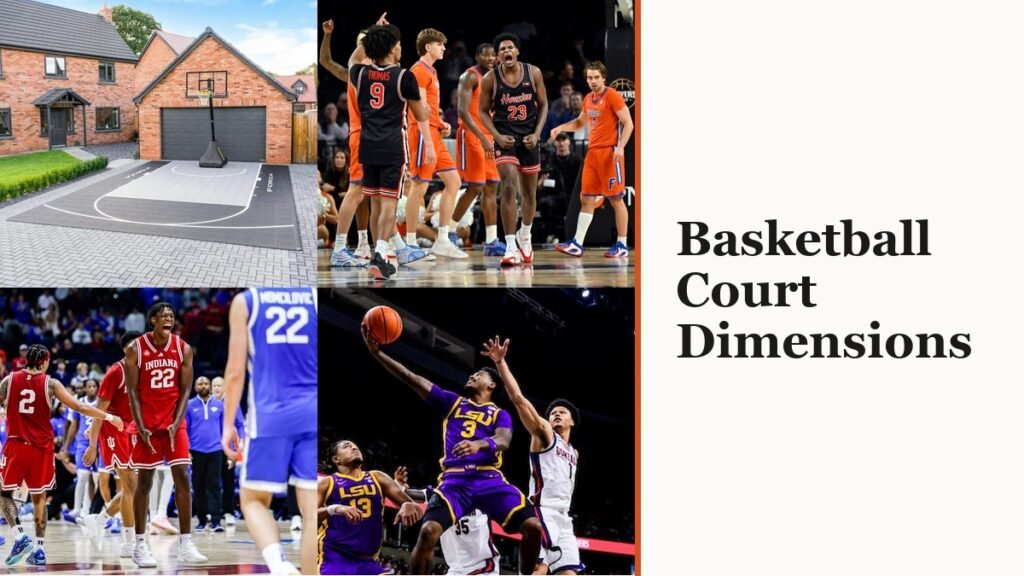
Full-size basketball court dimensions are 94 feet by 50 feet in the NBA, the WNBA and the NCAA, and 28 meters by 15 meters under FIBA, which is about 92 feet by 49 feet. A high school court is shorter at an optimum 84 feet by 50. The rim sits 10 feet above the floor at every one of them.
Length and width barely move. What actually changes from level to level is the three-point line, and to a lesser extent the width of the lane. This guide gives every figure by level, from the arc and the key down to the backboard and the ring, and ends with what will realistically fit on a driveway.
Basketball Court Dimensions by Level: NBA, WNBA, NCAA, FIBA and High School
Every governing body measures to a slightly different edge, so the figures below follow each rulebook’s own convention. Metric equivalents for the American levels are conversions; FIBA publishes its own.
| Level | Court (imperial) | Court (metric) | Three-point arc | Corner three | Lane width | Rim |
|---|---|---|---|---|---|---|
| NBA | 94 x 50 ft | 28.65 x 15.24 m | 23 ft 9 in | 22 ft | 16 ft | 10 ft |
| WNBA | 94 x 50 ft | 28.65 x 15.24 m | 22 ft 1.75 in | 22 ft | 16 ft | 10 ft |
| NCAA (men and women) | 94 x 50 ft | 28.65 x 15.24 m | 22 ft 1.75 in | 21 ft 7.875 in | 12 ft | 10 ft |
| FIBA | 92 ft 2 in x 49 ft 3 in | 28 x 15 m | 22 ft 2 in (6.75 m) | 21 ft 8 in (6.60 m) | 16 ft 1 in (4.90 m) | 10 ft (3.05 m) |
| High school (NFHS) | 84 x 50 ft | 25.6 x 15.24 m | 19 ft 9 in | 19 ft 9 in | 12 ft | 10 ft |
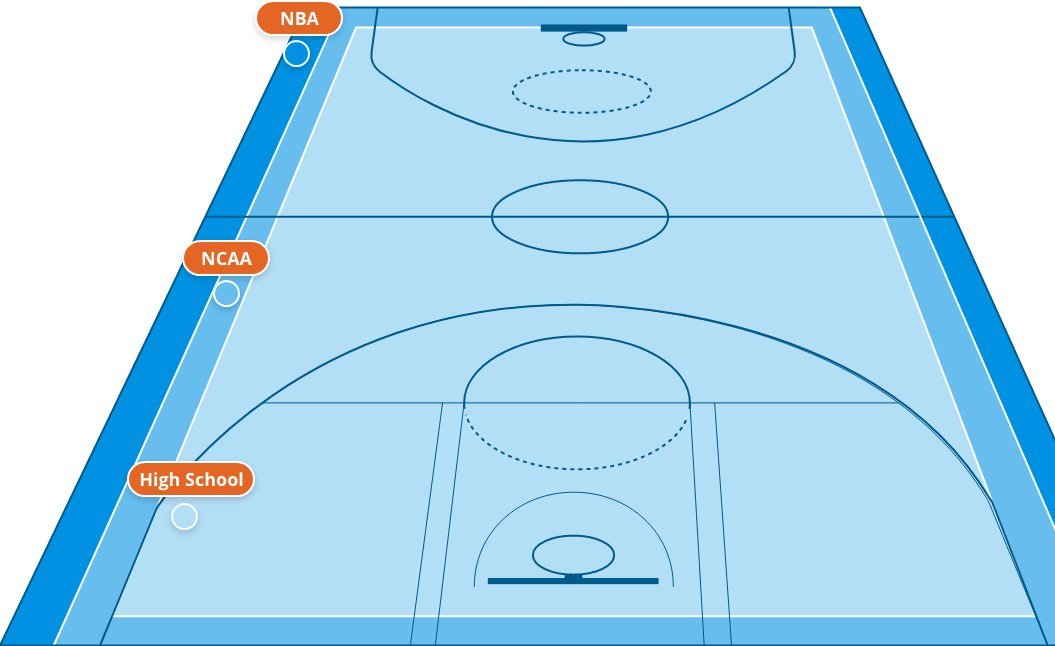
The surprise for most people is the NCAA row. Men and women now shoot from the same distance: both current rules books put the arc at 22 feet 1.75 inches from the center of the basket, with 21 feet 7.875 inches in the corners. The old 20 foot 9 inch college line is history, and any diagram still showing a separate women’s line at 19 feet 9 inches is out of date.
The NBA Court, Line by Line
The NBA measures its 94 by 50 feet to the inside of the boundary lines. Inside that rectangle the key numbers are fixed by Rule 1.
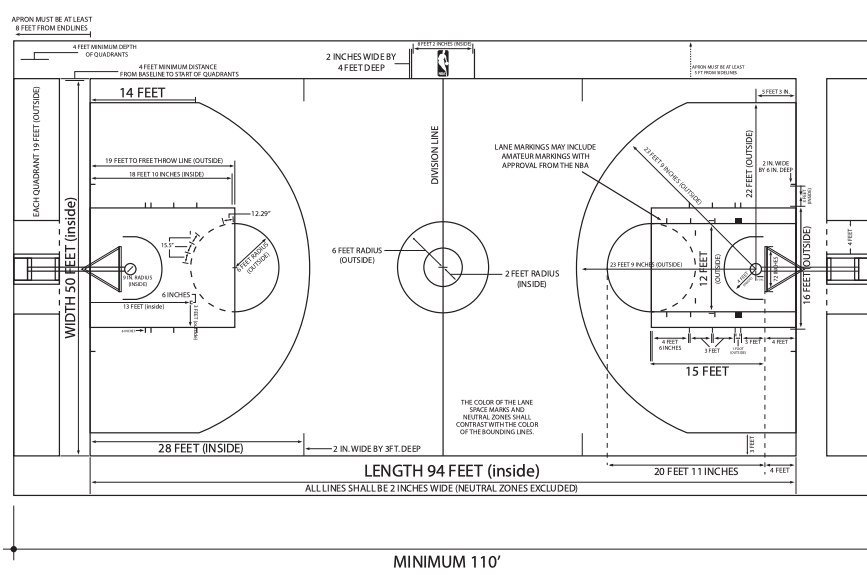
- Free-throw lane: 16 feet wide, measured to the outside of the lane lines
- Free-throw line: 15 feet from the face of the backboard, which puts it 19 feet from the baseline to its outside edge
- Three-point arc: 23 feet 9 inches from the middle of the basket, dropping to 22 feet in the corners where the line runs straight, 3 feet in from each sideline
- Restricted area: an arc 4 feet from the center of the ring, running back to the face of the backboard
- Center circle: 6 foot radius, with a 2 foot inner circle
- Backboard: 6 feet wide by 3.5 feet high, with the ring 6 inches out from its face
- Substitution box: hash marks 4 feet either side of midcourt
The ring itself is 18 inches across on the inside and its top edge is 10 feet off the floor. Around the playing area the league diagram asks for a minimum floor of 110 by 60 feet, which is why arenas built for basketball feel so much bigger than the court. The venues that house them are a different scale again, as our list of the biggest stadiums in the world shows.
Why the Three-Point Line Is the Only Line That Moves
Court length, court width and rim height are effectively settled across the sport. The arc is not, and the gap between the shortest and longest is more than four feet.
The NBA sits furthest out at 23 feet 9 inches. The WNBA, the NCAA and FIBA cluster within an inch of each other at a touch over 22 feet. High school is far closer at 19 feet 9 inches. A shooter moving from a high school gym to a college court gains nearly two and a half feet of distance on the same shot.
Corner threes are shorter everywhere the line goes straight, because the arc would otherwise run off the floor. The NBA corner is 22 feet, NCAA 21 feet 7.875 inches, FIBA 6.60 meters. High school is the exception with no corner shortening at all: the NFHS arc is a plain 19 foot 9 inch radius with straight sections 63 inches from the end line. The history of the three-point shot explains why the distances were never standardized in the first place.
FIBA Courts Are Metric, and Measured Differently
FIBA sets the court at 28 meters by 15 meters, measured from the inner edge of the boundary line, which makes it roughly two feet shorter and nine inches narrower than an NBA floor. Lines are 5 centimeters wide.
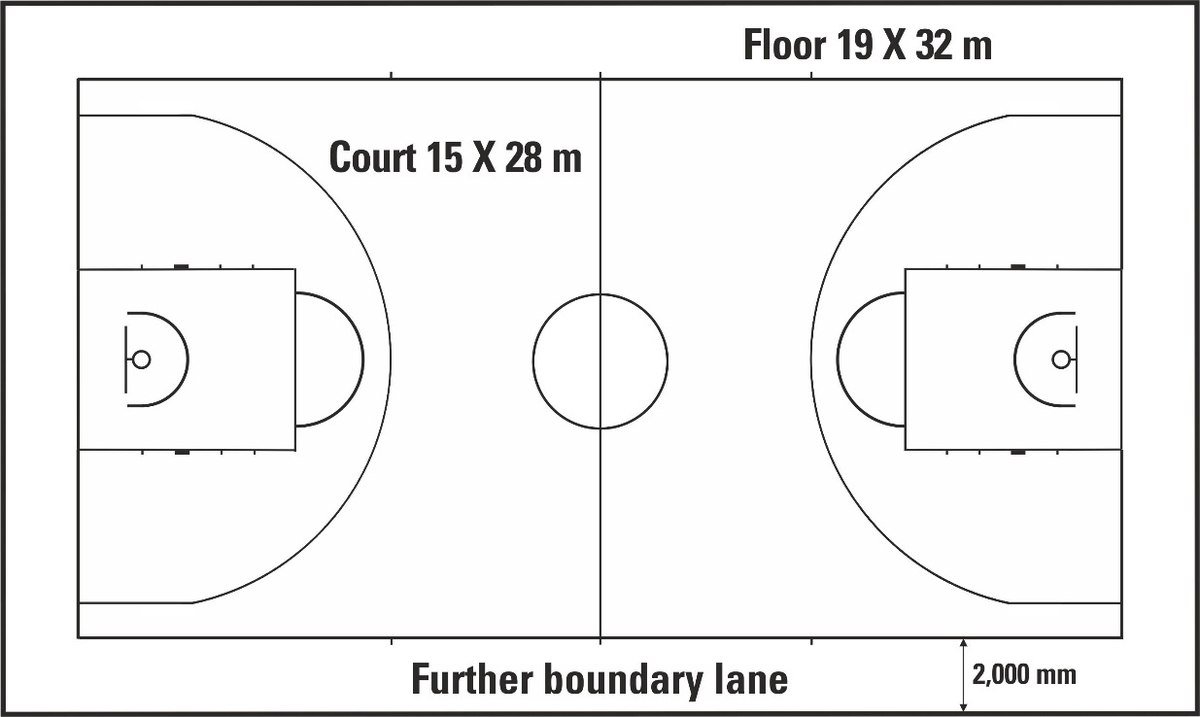
- Three-point arc: 6.75 m radius from the point beneath the center of the basket, which is 1.575 m from the endline; the straight sections sit 0.90 m from each sideline, giving 6.60 m in the corners
- Lane: rectangular, with outer edges 2.45 m either side of the endline midpoint, so 4.90 m across
- Free-throw line: furthest edge 5.80 m from the inner edge of the endline, and 3.60 m long
- No-charge semicircle: 1.30 m radius, the FIBA name for the restricted area arc
- Center and free-throw circles: 1.80 m radius
- Backboard and ring: 1,800 by 1,050 mm, ring 450 to 459 mm inside diameter, top edge 3,050 mm up
FIBA also specifies the space around the court, not just the court: a clear boundary lane of at least 2 meters, giving a minimum floor of 32 by 19 meters.
High School and Youth Courts
The current NFHS court diagram gives an optimum 84 feet long by 50 feet wide inside the sidelines, with the three-point arc at 19 feet 9 inches to the outside edge of the line and the free-throw line 15 feet from the backboard, as everywhere else. A court may not exceed 94 by 50. The NFHS notes on its own diagram that the drawings are suggestive unless the rules say otherwise.
Below high school, the NBA and USA Basketball publish youth guidelines that shrink the court and lower the rim by age band rather than keeping one standard.
- Ages 7 to 8: 8 foot rim, 50 by 42 foot court, no three-point line, free-throw line at 14 feet
- Ages 9 to 11: 9 foot rim, 74 by 50 foot court, no three-point line, free-throw line at 14 feet
- Ages 12 to 14: 10 foot rim, 84 by 50 or 94 by 50, three-point line at 19 feet 9 inches
Those are recommendations rather than rules, and the guidelines themselves allow modifications where baskets cannot be lowered or lines repainted. The ages 7 to 8 game is normally played across a full court.
Rim Height Does Not Change
Ten feet, everywhere that matters. The NBA, the WNBA, the NCAA and the NFHS all set the top of the ring at 10 feet; FIBA writes the same figure as 3,050 millimeters. The only departures are the youth recommendations above, at 8 feet for under-nines and 9 feet to age 11.
Ring diameter is just as settled: 18 inches inside across the American levels, and 450 to 459 millimeters under FIBA, which is the same thing to within a third of an inch. The NBA ring sits 6 inches out from the backboard face. Fixed targets are part of why scoring records compare across eras at all, something our piece on the most NBA championships leans on, and the same logic that makes a fixed field matter in football positions.
What Fits on a Driveway or in a Backyard
Home courts are not governed by anyone, so the numbers below are what builders typically work to rather than a standard.
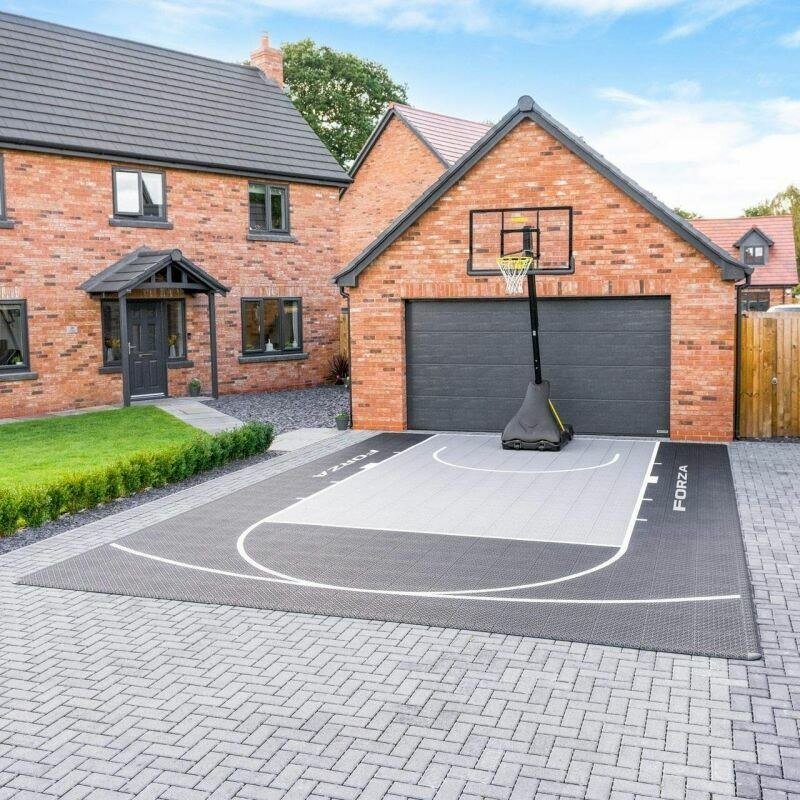
A half court is usually quoted at 47 by 50 feet, which is simply half a full floor. Most driveways cannot take that. Court builders suggest roughly 30 by 50 feet as a comfortable backyard half court, with 27 by 35 feet or 27 by 27 feet workable for three-on-three. The limiting measurement is depth: you need about 27 feet from the hoop to clear a high school three-point line, and the lane alone is 12 feet wide by 15 feet deep from the backboard.
Builders also recommend leaving 6 to 10 feet of clear space beyond every line, and note that painted markings last one to three years outdoors against five to seven indoors. FIBA’s 3×3 game, by contrast, does have a fixed size: 15 meters wide by 11 meters long, with the same 6.75 meter arc as the full game.
Frequently Asked Questions
How big is a basketball court in feet?
An NBA, WNBA or NCAA court is 94 feet long and 50 feet wide. A FIBA court is 28 by 15 meters, about 92 by 49 feet. A high school court has an optimum size of 84 by 50 feet and may not exceed 94 by 50.
Is the NBA three-point line the same as college?
No. The NBA arc is 23 feet 9 inches from the center of the basket and 22 feet in the corners. The NCAA arc, for both men and women, is 22 feet 1.75 inches, with 21 feet 7.875 inches in the corners. That is a difference of about 20 inches at the top of the key.
How wide is the key in basketball?
Sixteen feet in the NBA and WNBA, and 12 feet in the NCAA. FIBA’s rectangular lane works out at 4.90 meters, or about 16 feet 1 inch, so it is close to the NBA rather than the college figure.
How high is a basketball hoop?
Ten feet from the floor to the top of the ring, at every level of the adult game including FIBA, which writes it as 3,050 millimeters. Youth guidelines lower it to 9 feet for ages 9 to 11 and 8 feet for ages 7 to 8.
Related Articles

Get the Fox Bulletin briefing
The stories that matter, in your inbox. No spam, unsubscribe anytime.
Newsletter signup will be available soon.
Related stories
Baseball Positions: All 9 Roles and Their Numbers
Pitcher is 1 and shortstop is 6. The nine baseball positions, the numbering behind every scorecard, and the rule that limits where infielders can set up.

Hockey Positions: All 6 Roles on the Ice Explained
Center, two wingers, two defensemen and a goaltender. What each of the six hockey positions does, and which parts of the job the rulebook sets.

Most Centuries in Cricket: Top 10 Batters Ranked
Sachin Tendulkar has the most centuries in cricket at international level, with 100 across formats. The split is 51 in Tests and 49 in one-day internationals, and he reached the hundredth in…