

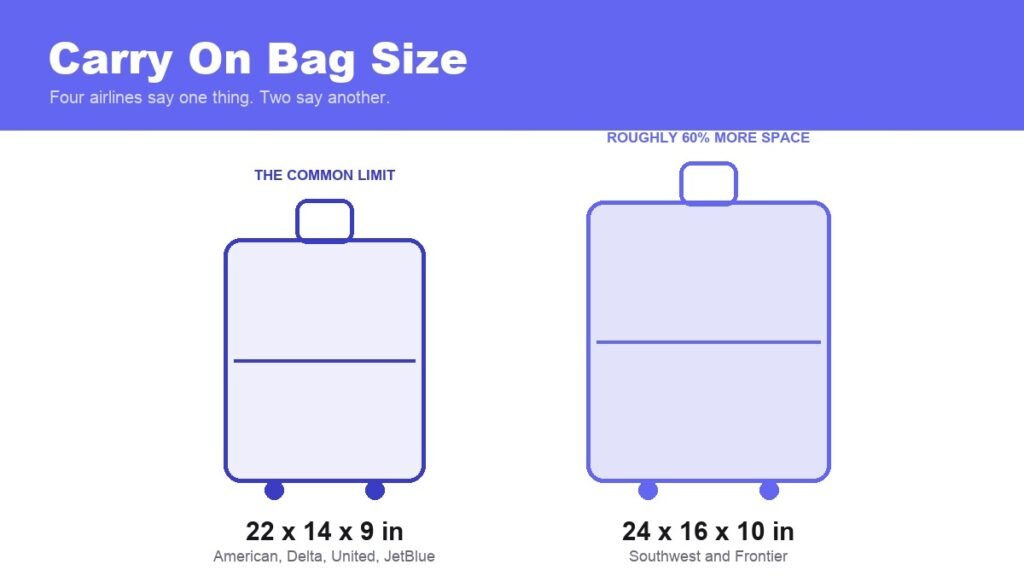
Carry on bag size is not one number in the United States, and the gap between the strictest and the most generous airline is bigger than most travellers assume. Four of the six carriers below use the same cabin bag limit. The personal item, the thing that goes under the seat, is where they diverge.
These figures come from each airline’s published baggage policy rather than a third-party summary. They are the numbers a gate agent is working from, and they all include wheels and handles.
Carry On Bag Size Limits, Airline by Airline
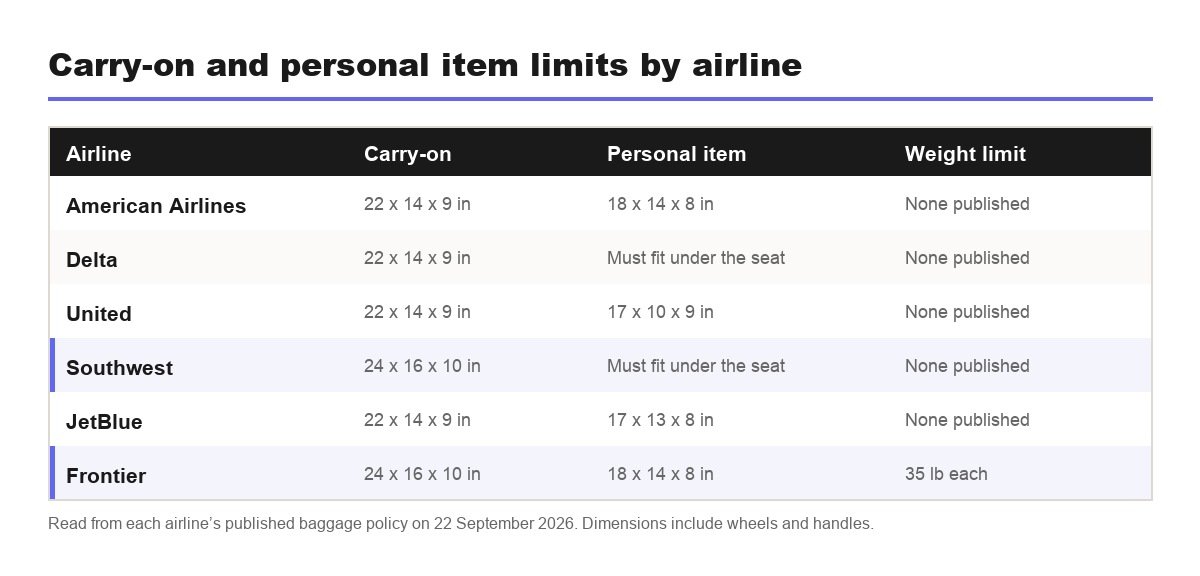
| Airline | Carry-on | Personal item | Weight limit |
|---|---|---|---|
| American Airlines | 22 x 14 x 9 in | 18 x 14 x 8 in | None published |
| Delta | 22 x 14 x 9 in | Must fit under the seat | None published |
| United | 22 x 14 x 9 in | 17 x 10 x 9 in | None published |
| Southwest | 24 x 16 x 10 in | Must fit under the seat | None published |
| JetBlue | 22 x 14 x 9 in | 17 x 13 x 8 in | None published |
| Frontier | 24 x 16 x 10 in | 18 x 14 x 8 in | 35 lb each |
American, Delta, United and JetBlue converge on 22 x 14 x 9 inches. Southwest and Frontier both publish 24 x 16 x 10, which sounds like a small difference and is not: it is about 60 percent more packing volume than the common limit, and a bag built for Southwest will not clear a United sizer.
Delta layers a second rule on top. The bag must also stay within 45 linear inches, meaning length plus width plus height combined. A bag at exactly 22 x 14 x 9 hits 45 on the nose, so a compliant case passes, but unzip the expansion panel and it fails the linear test while every individual side still looks legal.
Personal Item Rules Vary More Than the Cabin Bag
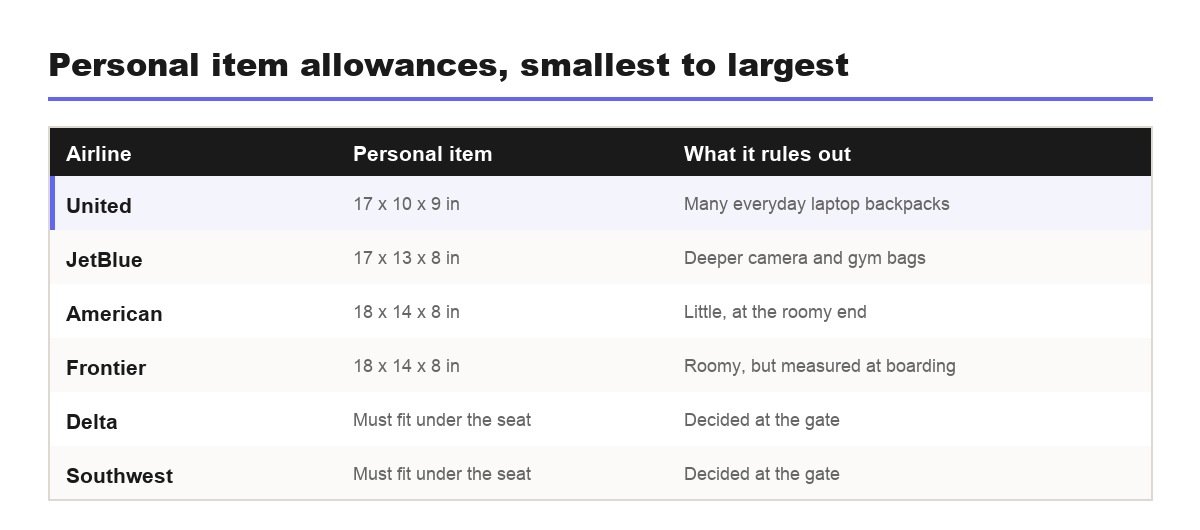
If you are going to be stopped, this is where it happens. Cabin cases are a solved problem because luggage makers build to the standard. Backpacks and tote bags are not built to anything.
- United: 17 x 10 x 9 inches, the smallest here, and tighter than plenty of laptop backpacks.
- JetBlue: 17 x 13 x 8 inches, three inches wider than United but an inch shallower.
- American and Frontier: 18 x 14 x 8 inches, the roomiest published allowances in the group.
- Delta and Southwest: no published dimensions, only the requirement that it fits under the seat in front of you.
No published number is good news until it is not. It means a gate agent decides, and Frontier is explicit that personal item size is checked during boarding, with oversized items subject to an additional charge. On a fare that was cheap because the bag was not included, that charge is the point.
Wheels, Handles and Why a 22 Inch Bag Measures 23
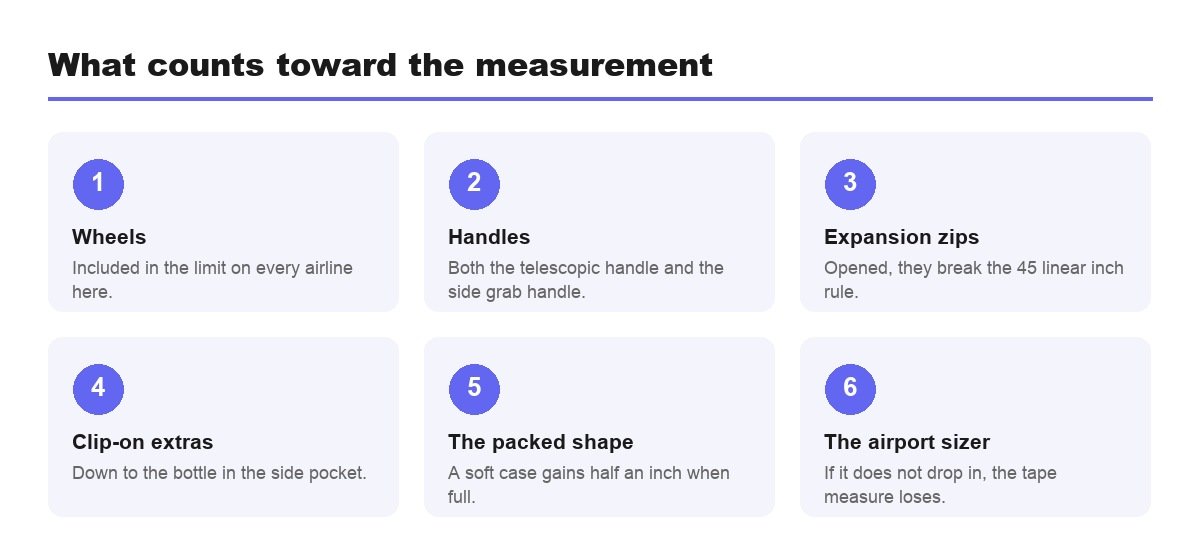
Airlines measure the object you hand them, not the shell the manufacturer described. That single difference explains most of the bags that fail a sizer.
- Wheels are included. Southwest says so, naming wheels, handles and any attachments.
- Handles are included, retracted telescopic handle and side grab handle alike.
- Expansion zips count when open, which is what breaks the Delta linear rule.
- Clip-on extras count, down to the water bottle in the mesh pocket.
- The sizer settles it. American requires the bag to fit the airport sizer, whatever your tape measure says at home.
The practical fix is to shop a size down. A case sold as a 22 inch carry-on has usually been measured body-only, with the wheels adding another inch underneath. Buying a 21 inch case gives you a bag that genuinely measures 22 and drops into a sizer without being forced.
Weight: Five Airlines Do Not Care, One Does
Cabin bag weight is a European obsession that has largely not crossed the Atlantic. JetBlue puts it in writing, saying there is no weight restriction as long as you can lift the bag into the bin.
- No published cabin weight limit on American, Delta, United, Southwest or JetBlue.
- Frontier caps both bags at 35 pounds, cabin bag and personal item.
- Frontier checked bags cap at 40 pounds, not the 50 pounds you may be used to.
- Overweight fees run $75 for 41 to 50 pounds and $129 for 51 to 99.99 pounds on bookings made on or after 4 April 2026.
So the practical advice splits by carrier. On a legacy airline, pack the cabin bag as heavy as you can comfortably lift. On an ultra low cost ticket, weigh everything at home, because the allowance is lower and the penalty is higher at the same time.
It is worth reading the checked bag numbers alongside the cabin ones before you book. A fare that looks $40 cheaper stops being cheaper once a 42 pound suitcase costs $75 in overweight charges on top of the bag fee itself, and that is before the personal item gets measured at the gate. Comparing the total for the bags you actually travel with, rather than the headline fare, is the only way the numbers mean anything.
The Fares and Aircraft That Remove Your Carry-On
- Basic Economy. United states you get a carry-on bag and a personal item if you are not travelling in Basic Economy, which is a meaningful exclusion on the cheapest fare bucket.
- Regional jets. Delta notes that on Delta Connection flights, including aircraft with 50 seats or fewer, only personal items may be carried on board.
- American Eagle valet. Anything larger than a personal item is tagged at the gate at no charge and handed back on the jetbridge when you land.
- Full overhead bins. Late boarding groups get gate checked regardless of size, which is free but slow.
In every one of those cases, move your medication, documents, keys and any lithium batteries into the bag that stays with you before you hand anything over. Power banks and spare batteries are not allowed in the hold at all, so a gate check with a battery still inside is a problem waiting at the other end.
What to Keep in the Bag That Stays With You
Whatever the size rules say, one bag may leave you at the aircraft door, so the split between the two matters as much as the dimensions do.
- Medication, documents and keys belong in the personal item, always.
- Power banks and spare lithium batteries are barred from the hold entirely.
- Anything fragile or expensive travels better under the seat than in a bin.
- A change of clothes is worth the space if you have a tight connection.
That includes the charging case for earbuds, which holds a lithium cell like any other battery. A set like the AirPods should go in the personal item rather than a bag you might be asked to hand over at the gate, along with the cable you will want during the flight.
One Bag That Clears Every Airline
- 22 x 14 x 9 inches including wheels passes all six carriers here.
- A personal item under 17 x 10 x 9 passes even United.
- Soft-sided cases compress into the tight bins on regional aircraft.
- Under 35 pounds keeps a low cost carrier out of the equation.
Packing light has a second payoff at the checkpoint. Keep toiletries inside the liquid limits, put chargers and cables in an outer pocket, and the bag goes through the scanner once. A tightly packed case full of cables is the one that gets pulled for a hand search, which costs more time than the extra jumper was worth.
Frequently Asked Questions
Which US airline has the biggest carry-on allowance?
Southwest and Frontier, both at 24 x 16 x 10 inches. Southwest is the more useful of the two for most travellers, because it applies that limit with no cabin bag weight restriction, while Frontier caps the same size bag at 35 pounds and checks personal item size at boarding.
What size bag can I carry on a plane?
On American, Delta, United and JetBlue, 22 x 14 x 9 inches including wheels and handles. Southwest and Frontier allow 24 x 16 x 10. Buying to the smaller figure means one bag works on all of them.
Is a backpack a personal item or a carry-on?
Either, depending on its size. A backpack that fits under the seat within the airline’s personal item dimensions counts as your personal item. A larger travel backpack counts as your carry-on and has to meet the cabin bag limit instead.
Do airlines actually measure carry-on bags?
Sometimes at the gate, and more often on low cost carriers where bag fees are a major revenue source. Frontier states that personal item size is checked during boarding. Legacy carriers typically only check when the flight is full and bin space is short.
What if my bag is slightly over the limit?
A soft bag half an inch over usually goes through, because it compresses into the sizer. A hard case over the limit does not, and gets gate checked. Gate checking is free, so the cost is waiting at baggage claim rather than a fee.
Related Articles

Get the Fox Bulletin briefing
The stories that matter, in your inbox. No spam, unsubscribe anytime.
Newsletter signup will be available soon.
Related stories
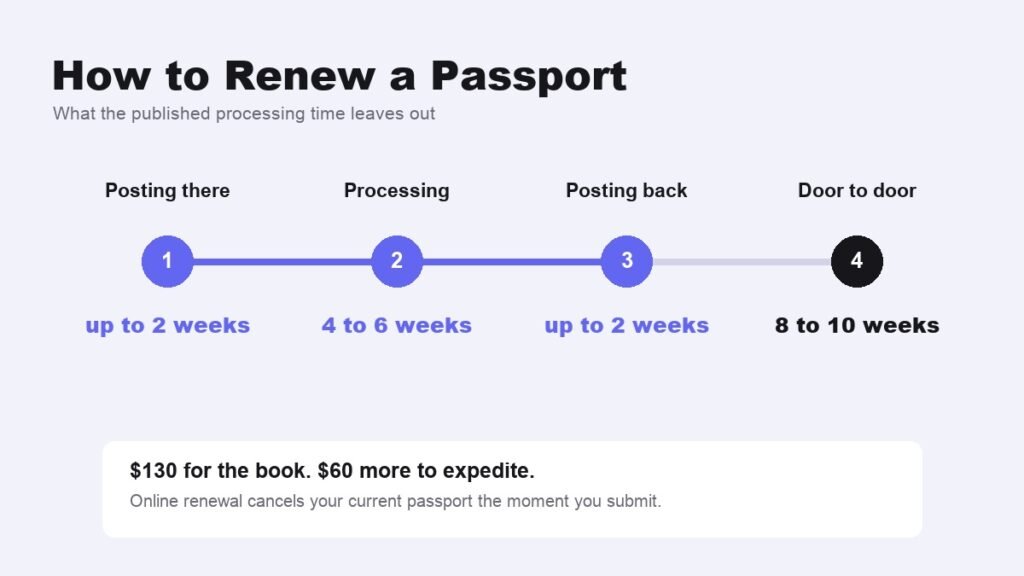
How to Renew a Passport: Fees, Timings and the Online Catch
Five conditions decide whether you can renew at all. Then the fees, the real door-to-door timings, and the online step that leaves you without a passport.
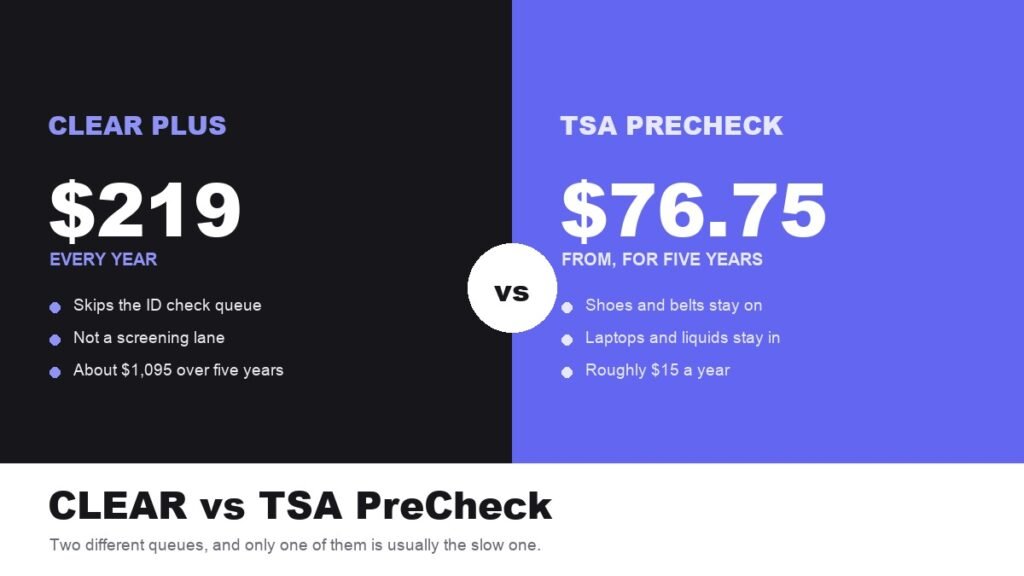
CLEAR vs TSA PreCheck: Which Airport Queue You Are Actually Skipping
CLEAR skips the ID check, PreCheck changes how you are screened. One costs $219 a year, the other as little as $76.75 for five.
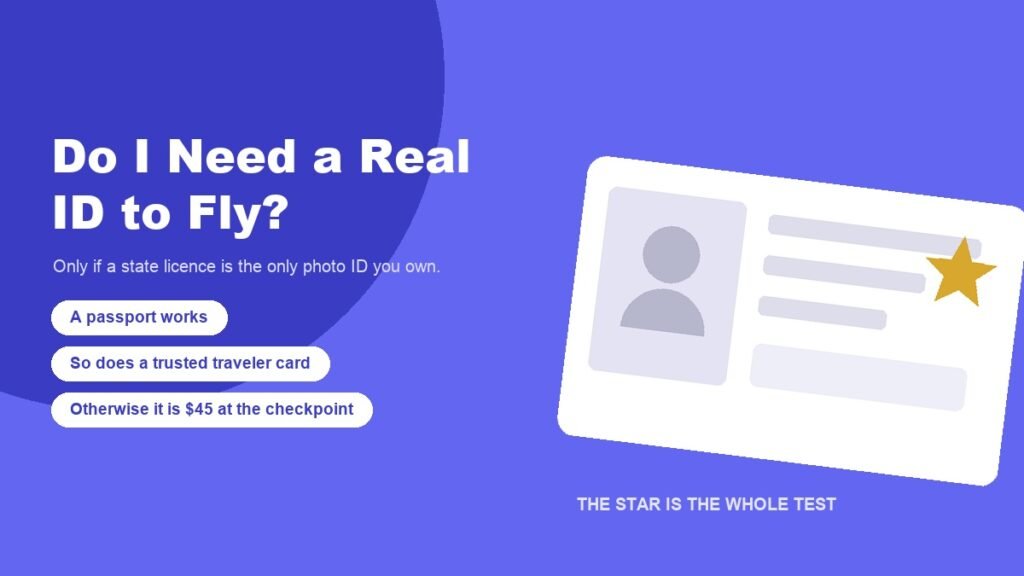
Do I Need a Real ID to Fly? What TSA Accepts Instead
Only if a state licence is the only photo ID you own. A passport, a trusted traveler card or a military ID all work instead.