


Everything sold as a ceramic coating for cars is doing the same basic thing: leaving a layer of silica behind that water will not wet, so rain beads up and dirt has less to hold onto. What separates the bottle that costs a few pounds from the kit that costs many times more is not really the chemistry. It is how long the layer lasts and how much work you have to do before you can apply it.
That is the only question worth answering before buying. A spray can go on a clean car in an hour and will want redoing within the year. A bonded coating can last several years, but it bonds to whatever is underneath, so swirl marks and embedded dirt get sealed in permanently unless you correct the paint first. The seven below are ordered by exactly that trade, starting with the ones that ask most of you.
Ceramic Coating Comparison: Durability, Volume and Prep
| # | Coating | Maker durability claim | Prep needed |
|---|---|---|---|
| 1 | Gtechniq Crystal Serum Light | Up to 5 years | Full paint correction |
| 2 | CARPRO CQUARTZ UK 3.0 kit | 24 hour cure, 70 percent SiO2 | Full paint correction |
| 3 | Adam’s Advanced Graphene | More than 7 years | Full paint correction |
| 4 | Nasiol ZR53 kit | Up to 3 years, single layer | Decontamination |
| 5 | CLEAN. Ceramic Coating | 3 year, 7 day full cure | Decontamination |
| 6 | Turtle Wax Hybrid Solutions | Up to 12 months | Clean and dry only |
| 7 | XPEL Ceramic Boost | Topper for film and coatings | Clean and dry only |
1. Gtechniq Crystal Serum Light: The coating the detailing trade actually uses
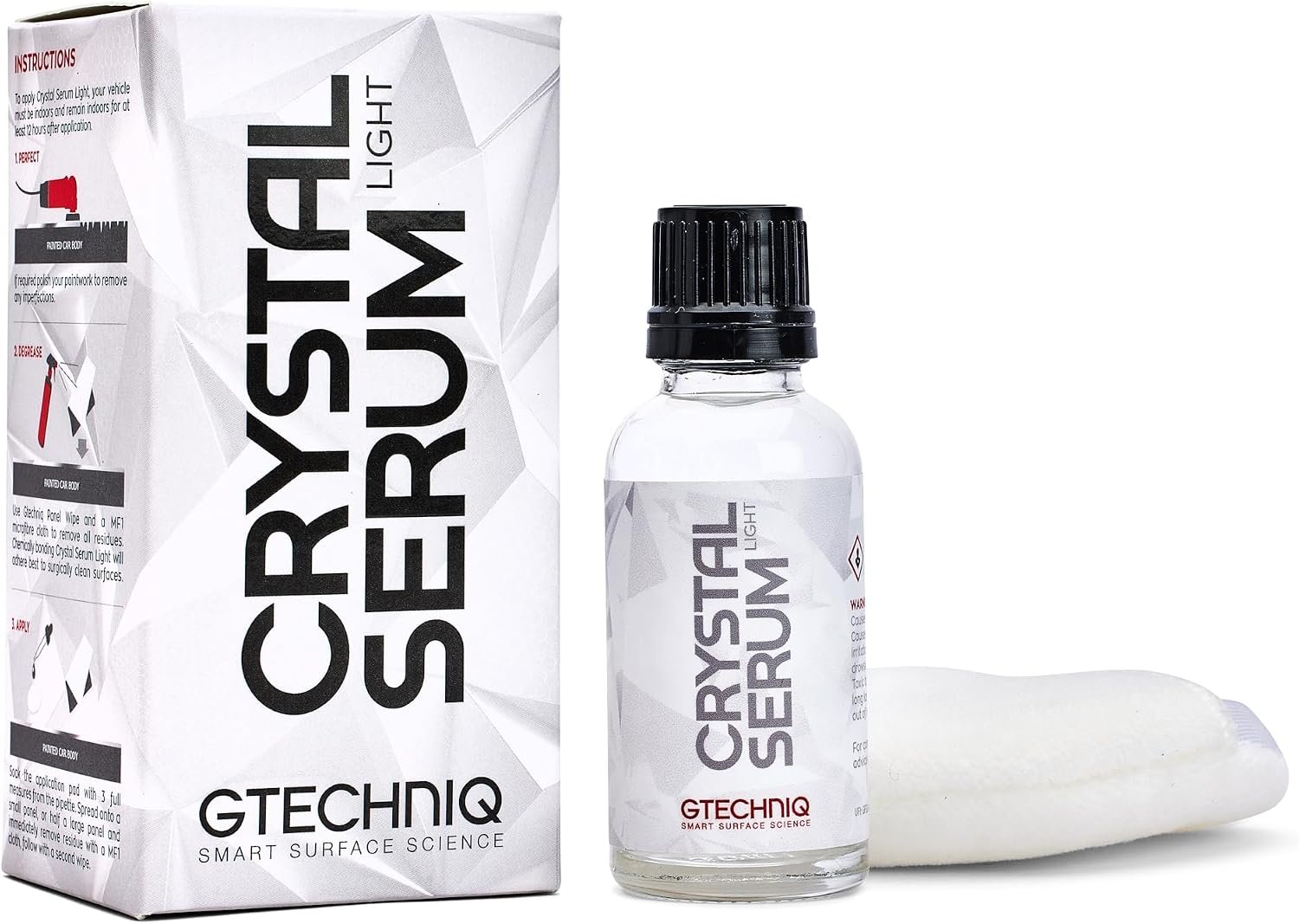
Crystal Serum Light, sold as CSL and part number CSL 0.05, is the one to buy if you want the result a professional detailer would hand back. Gtechniq is explicit about the mechanism and it is the important distinction in this whole category: waxes and polymer sealants sit on top of the paint, while this bonds chemically to the paintwork. That is why it survives washing in a way a wax never does.
The company quotes up to 5 years of durability from a 1.7 fluid ounce bottle, which is enough for a car because the layer is microscopically thin. Application is wipe on and buff off, and the formulation is described as non smearing, which matters because the usual failure with a bonded coating is leaving high spots that cure hard. Gtechniq also lists swirl resistance and protection against tree sap and hazing.
What it does well
- Chemically bonds to the paint rather than sitting on top of it
- Gtechniq quotes up to 5 years of durability from one application
- Non smearing formulation, which makes high spots less likely
- Listed as effective against tree sap, swirl marks and hazing
What to know before buying
- A bonded coating seals in whatever is under it, so correct the paint first
- The bottle is small and there is no margin for a wasted panel
- Buffing off at the right moment is a learned skill, not a forgiving one
2. CARPRO CQUARTZ UK 3.0 Kit: The kit that includes everything to apply it
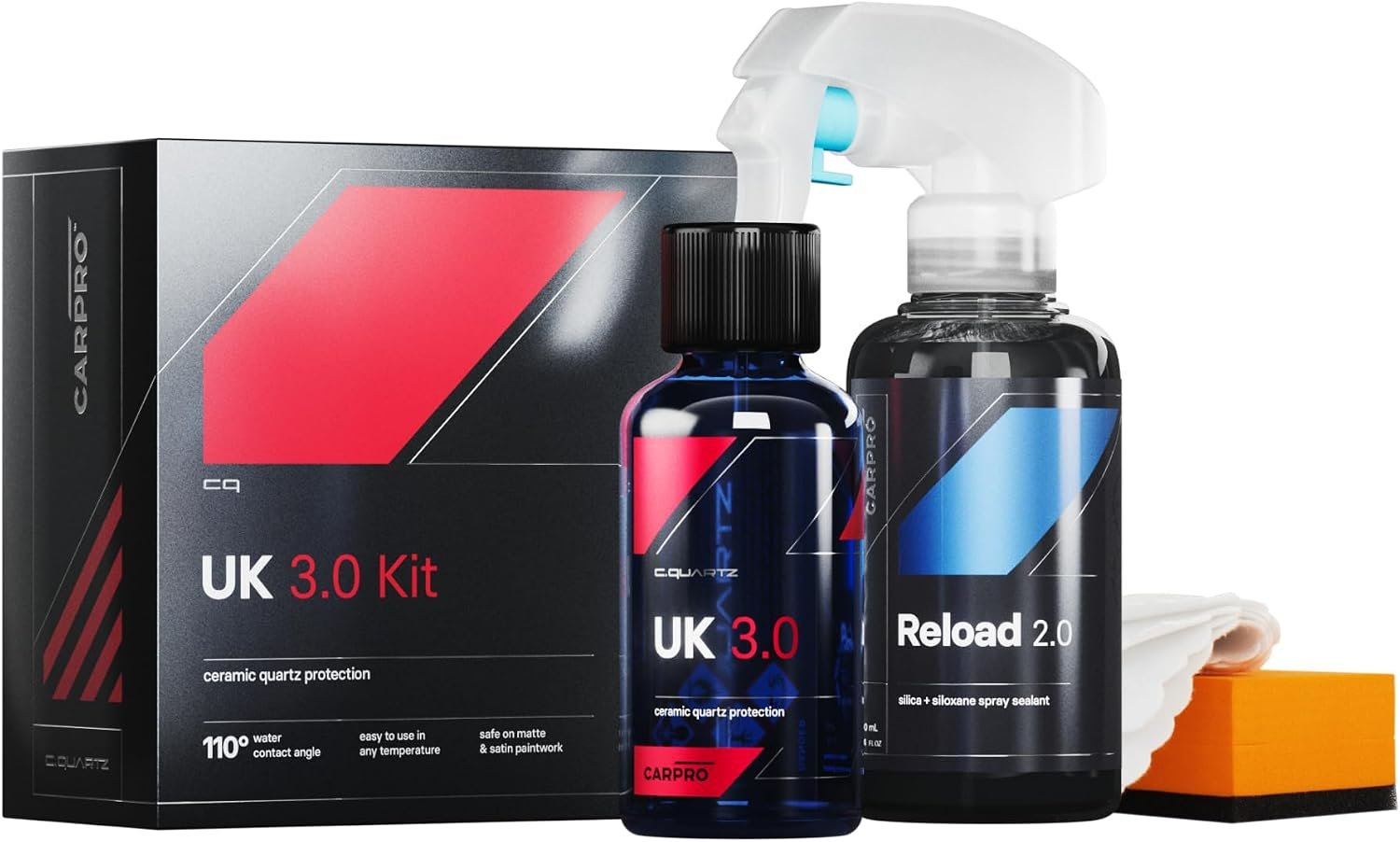
This is the pick if you have never coated a car and do not want to discover halfway through that you are short an applicator. The kit, part number CP10CQK50K, holds a 50ml bottle of CQUARTZ UK 3.0, a 100ml bottle of Reload 2.0, four suede applicators, an applicator block and a 16 inch suede levelling towel. Having the levelling towel in the box is the detail that matters, because that is the tool that takes the high spots off.
CARPRO publishes real numbers rather than adjectives. The formula is 70 percent SiO2 at 99.9 percent purity, coverage is around 15ml per coat on an average car, cure time is 24 hours and the recommended application temperature is 40 to 100 degrees Fahrenheit. That last figure is the one people ignore and then wonder why the coating flashed off too fast in a hot garage. Reload 2.0 is the topper you use afterwards to refresh the water beading.
What it does well
- Complete kit: coating, topper, four applicators, block and levelling towel
- CARPRO states 70 percent SiO2 content at 99.9 percent purity
- Published coverage of around 15ml per coat on an average car
- Includes Reload 2.0, so maintenance is covered from the first day
What to know before buying
- CARPRO specifies a 40 to 100 degree Fahrenheit application range
- The 24 hour cure means the car cannot get wet overnight
- Still a bonded coating, so paint correction comes first
3. Adam’s Advanced Graphene Coating: Graphene, and a trick that stops you missing a panel
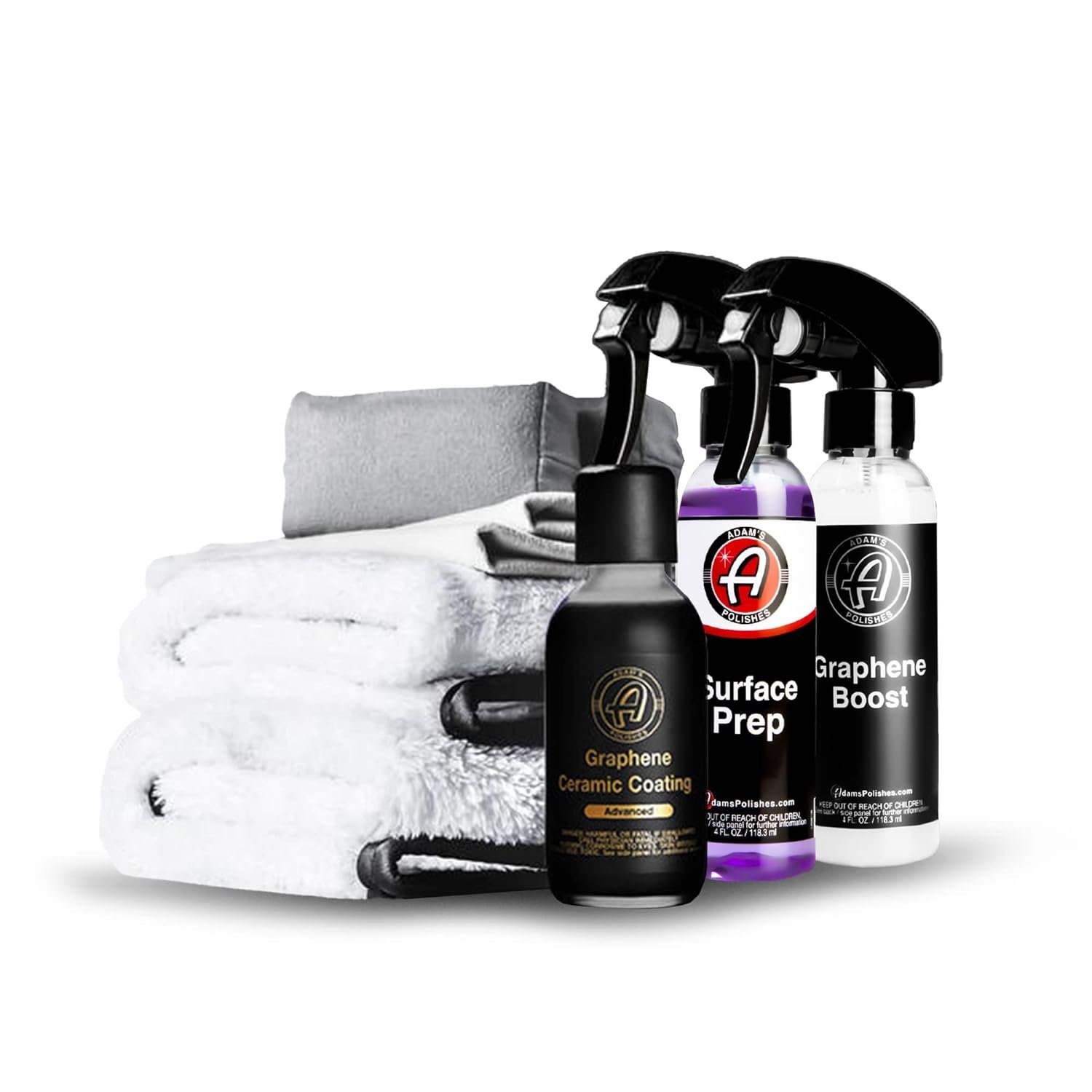
Adam’s uses graphene in place of a pure silica formula and claims more than 7 years of protection from it, alongside the usual water and dirt rejection. Whether graphene outperforms a good silica coating is genuinely contested, so treat the durability figure as the manufacturer’s own. What is not contested is the second feature, and it is the reason to pick this one.
The coating is infused with what Adam’s calls Ceramic Glow Technology, a patent pending ultraviolet tracer. Under a UV light the coated areas glow, so you can see exactly where you have been. Anyone who has coated a dark car in a dim garage knows that missing a strip is the easiest mistake to make and the hardest to spot until the coating has cured. Adam’s also states the formula carries 50 percent more coating resin than the previous version.
What it does well
- Ultraviolet tracer makes missed areas visible before the coating cures
- Adam’s states more than 7 years of protection from one application
- Rated by the company for paint, glass, headlights, chrome, wheels and trim
- Adam’s says the formula holds 50 percent more coating resin than the previous one
What to know before buying
- The graphene durability claim is the maker’s, and the category is contested
- You need a UV light to use the tracer feature at all
- As with any bonded coating, paint correction has to happen first
4. Nasiol ZR53 Kit: One layer, three years, less ceremony
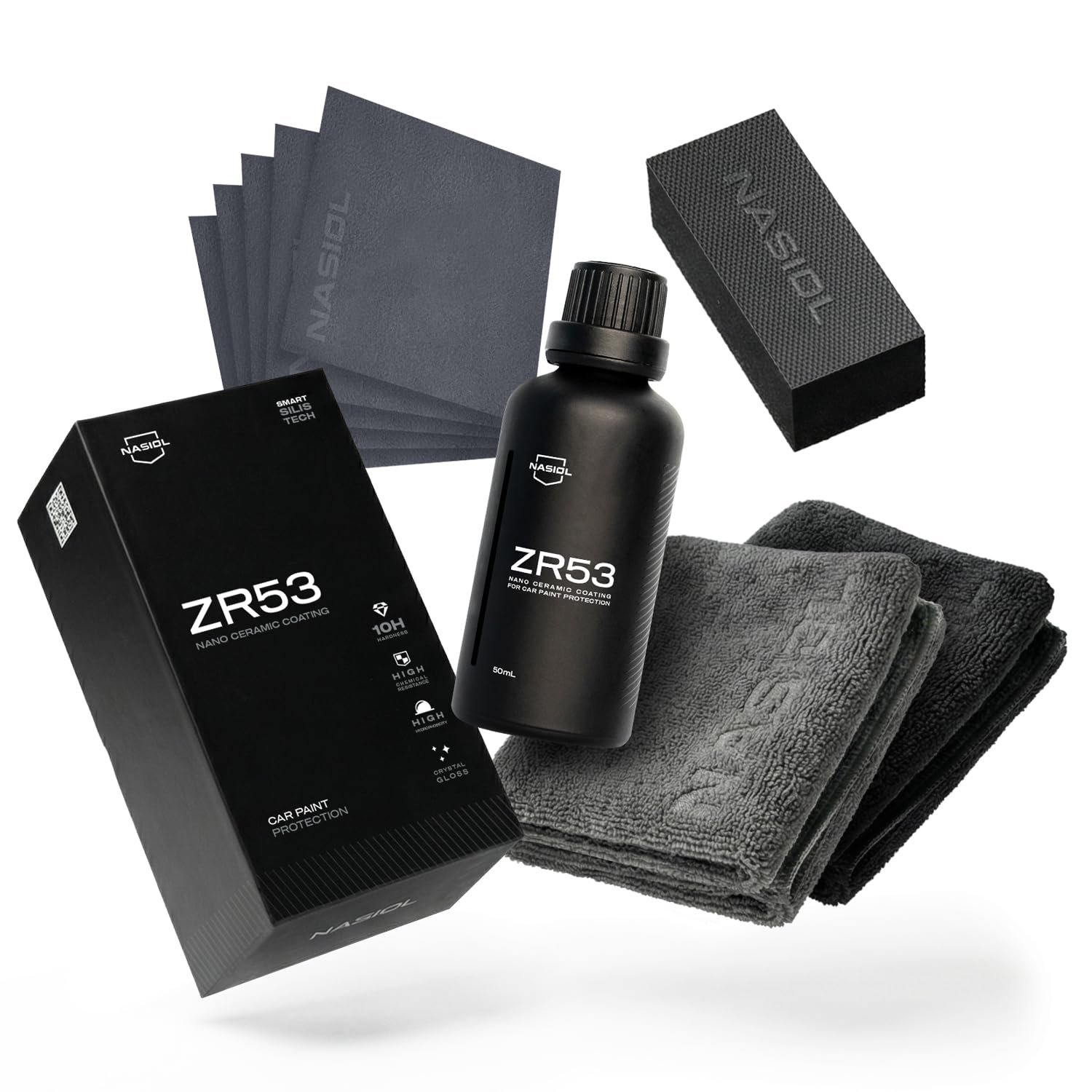
ZR53 sits deliberately between the professional coatings above and the sprays below. Nasiol quotes up to 3 years of durability from a single layer, which is the useful part: there is no two coat process, no second application window to get right, and no waiting between layers. For a first bonded coating on a daily driven car, one layer that lasts three years is a sensible target.
The kit is sold as a complete set with a guide, the bottle holds 53 grams, and Nasiol lists it for paintwork, exterior plastics, rims, headlights and taillights. The company describes it as a single layer hybrid coating with simple buffing, which is a fair description of a DIY product rather than a trade one. Expect the same water beading and dirt rejection story as the others, with less process to get wrong.
What it does well
- Nasiol quotes up to 3 years of durability from one single layer
- No multi coat process, so there is one application window rather than several
- Rated for paint, exterior plastics, rims, headlights and taillights
- Sold as a complete kit with an application guide included
What to know before buying
- Three years is less than the professional coatings claim
- Still needs the paint decontaminated before it goes on
- A small bottle, so there is little room for error on a large vehicle
5. CLEAN. Ceramic Coating: The fastest bonded coating to get back on the road
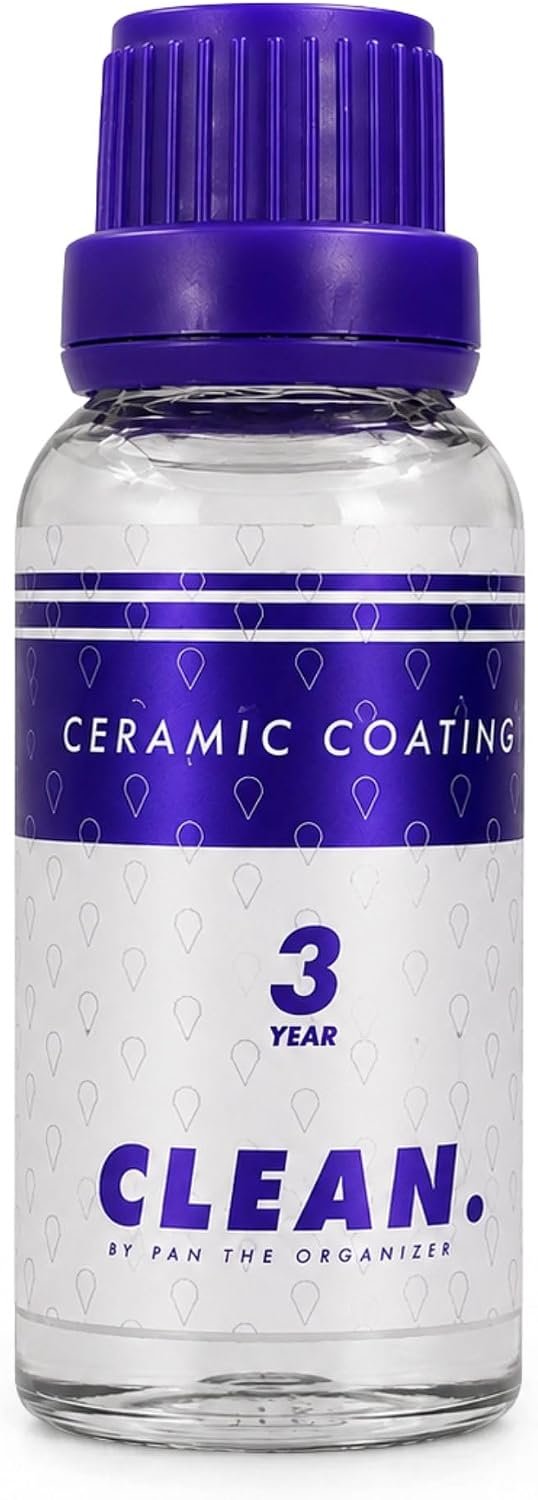
The practical problem with a bonded coating is the car being unusable while it cures. CLEAN. attacks exactly that. The company states the coating is ready for light water contact in about an hour, with full chemical resistance after 7 days, so you can move the car and dodge the weather rather than standing guard over it overnight. For anyone without a garage, that single figure decides the purchase.
It is a 3 year coating in a 30ml bottle, which the company says treats an average sized car, and it is listed as safe on paint, glass, wheels, trim, lights, vinyl, paint protection film and matte finishes without staining or hazing. Two unusually honest practical notes from the maker: the formula is free of PFAS, and an opened bottle can be stored in the freezer, which is the standard trick for keeping a part used coating from curing in the neck.
What it does well
- Ready for light water contact in about an hour according to the maker
- Listed as safe on matte finishes and paint protection film, not just paint
- A 30ml bottle that the company says covers an average sized car
- PFAS free, and the maker says an opened bottle can be frozen for storage
What to know before buying
- Full chemical resistance takes 7 days even though it is water safe in an hour
- The 3 year figure is shorter than the professional coatings claim
- Paint still has to be decontaminated first or the coating locks the dirt in
6. Turtle Wax Hybrid Solutions Ceramic Spray: Spray on, no correction, under a year
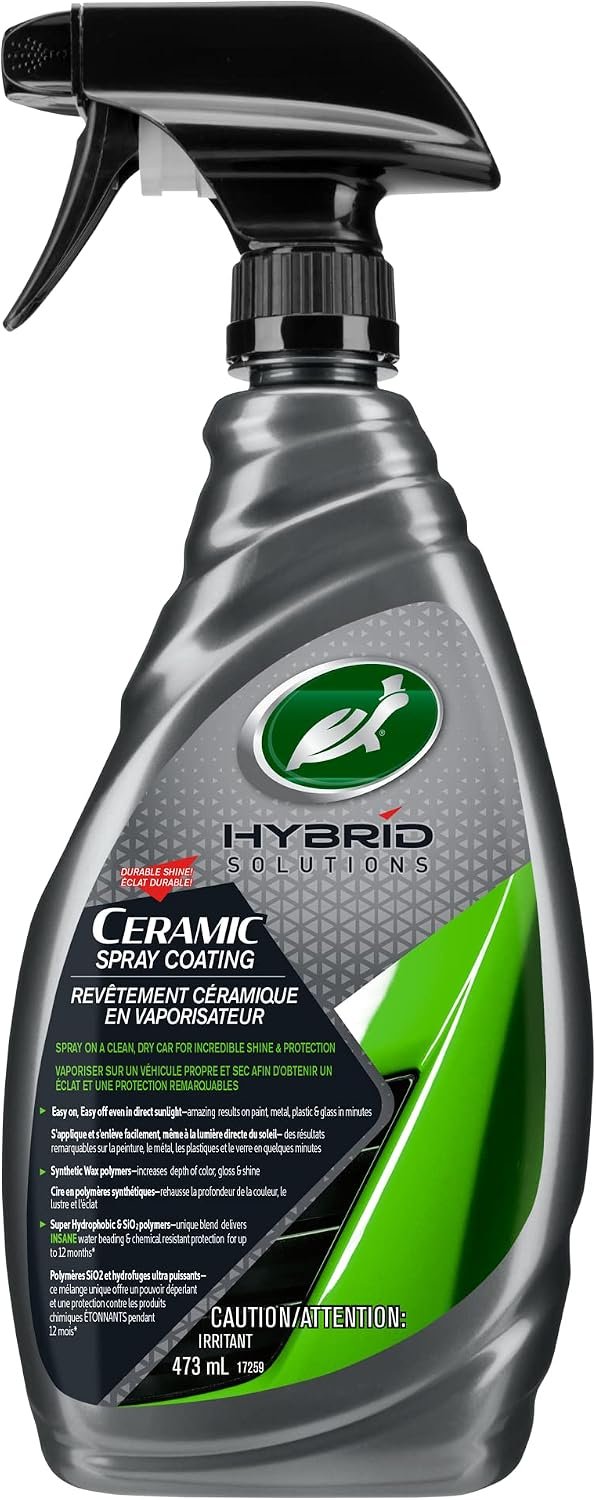
This is where the category becomes genuinely easy. Part number 53416 is a 473ml spray that goes on a clean, dry car, gets spread out and comes off with a folded microfibre cloth. Turtle Wax quotes up to 12 months of protection from its super hydrophobic SiO2 polymers. That is a fraction of what a bonded coating claims, and it takes a fraction of the afternoon.
Two things make it more useful than its outlay suggests. Turtle Wax says it can be used in direct sunlight, which almost nothing else here allows and which removes the need for shade or a garage. And it is rated for all exterior surfaces including glass, headlights, trim and wheels, so one bottle covers the whole car. The company does advise claying or compounding the paint first for best performance, and it specifically does not recommend it on soft convertible roofs.
What it does well
- Turtle Wax quotes up to 12 months of protection from one application
- Can be applied in direct sunlight, which most coatings forbid
- Rated for glass, headlights, trim and wheels as well as paint
- A 473ml bottle, so there is plenty for several applications
What to know before buying
- Not recommended on soft side convertible roofs
- Turtle Wax advises claying or compounding first for best performance
- Twelve months means an annual job rather than a one off
7. XPEL Ceramic Boost: A topper for paint protection film
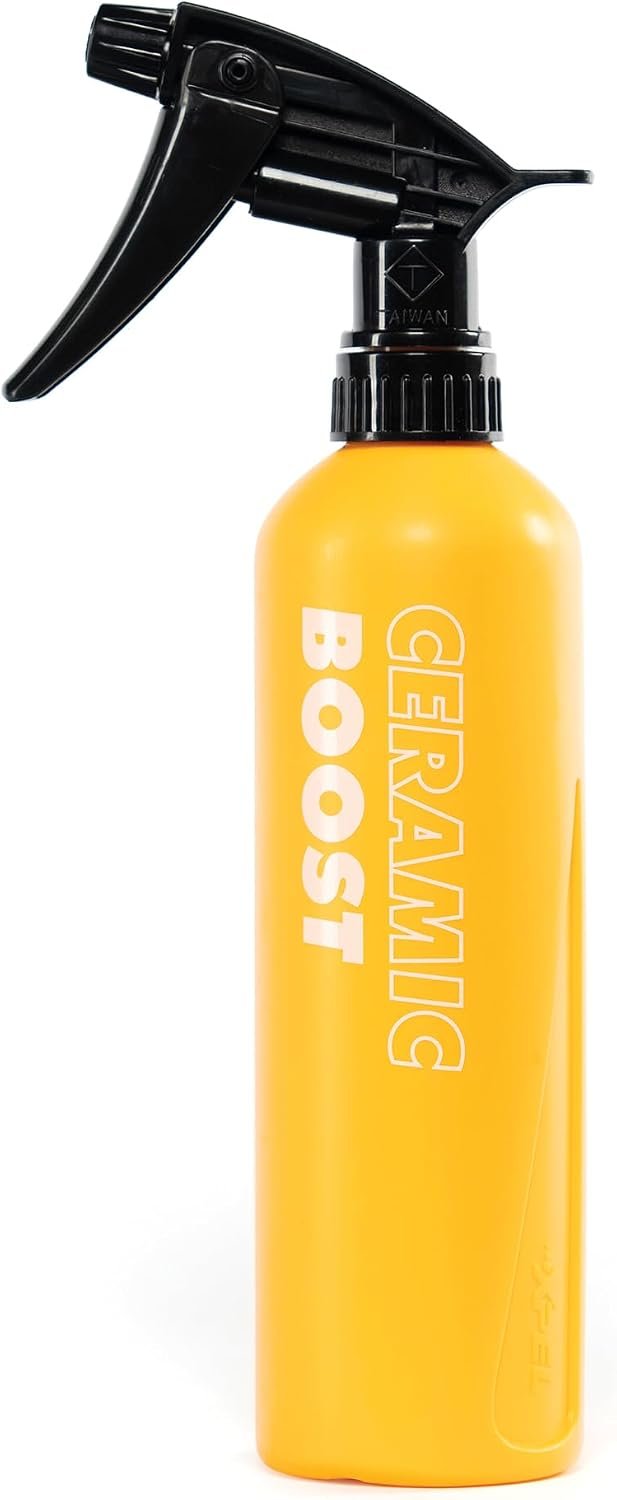
Ceramic Boost, part number R1390, is not really competing with the coatings above. It is a 16 ounce SiO2 spray designed to go on top of protection you already have, and XPEL formulated it specifically to work with its own paint protection films and coatings such as Fusion Plus. If your car has film on the front end, this is the maintenance product for it.
Used on its own it behaves like any good SiO2 detailer: spray on, wipe off, and you get a micro thin hydrophobic layer that repels dust and lint and keeps the car cleaner between washes. XPEL is careful in how it describes the product, calling it a boost to existing film and paint protection rather than a standalone coating, and that is the honest way to buy it.
What it does well
- Formulated to top up paint protection film, not just paint
- Spray on and wipe off, with no cure time to plan around
- A 16 ounce bottle with a trigger spray included
- Adds water beading and dust rejection to an existing coating
What to know before buying
- XPEL positions it as a booster rather than a standalone coating
- Shortest lived option here, so it is a routine rather than a project
- Most valuable if you already own XPEL film or coatings
What a Ceramic Coating Does and What It Does Not
The claims in this category run well ahead of the physics, so it is worth separating what reliably happens from what does not.
- It makes the surface hydrophobic. This is real and immediately visible. Water beads instead of sheeting, the car dries faster with fewer spots, and light dirt rinses off rather than needing to be rubbed.
- It resists chemicals and ultraviolet light. Also real. Bird droppings, sap and road salt get less time in contact with the clear coat, and the coating takes the ultraviolet exposure instead of the paint.
- It does not stop scratches. A coating is a few microns thick. It improves resistance to the fine marring a wash mitt causes, which is worth having, but a stone chip or a key will go straight through it into the paint.
- It does not hide existing damage. This is the expensive misunderstanding. A coating is clear and it bonds to what is there, so swirls and embedded contamination are sealed under it and become harder to remove, not easier.
That last point is why prep dominates the work. Washing with a car wash soap that leaves no wax behind, claying the paint and drying it with a microfiber towel for cars is most of the job. On a car with real swirl marks, a machine polish comes before any coating, or you are paying to preserve the swirls for several years.
Bonded Coatings, Spray Coatings and Toppers
Three different products share the word ceramic on the shelf, and the gap between them is measured in years and in hours of work.
- Bonded coatings. Gtechniq, CARPRO, Adam’s, Nasiol and CLEAN. all chemically bond to the paint and are measured in years. They demand corrected, decontaminated paint, a controlled temperature, and a cure window where the car stays dry. Get it wrong and fixing it means machine polishing the coating off.
- Spray coatings. Turtle Wax Hybrid Solutions is the example here. Months rather than years, an hour rather than a weekend, and no correction required. For most people with a daily driver parked outside, this is the realistic answer.
- Toppers. CARPRO Reload and XPEL Ceramic Boost refresh something already there. They restore the water beading on a coating that has started to wet out, which extends the useful life of the layer underneath rather than replacing it.
A sensible plan for a car you keep is one bonded coating applied properly, then a topper every few months to keep the beading sharp. A sensible plan for a lease or a car parked on the street is a spray coating once a year and no more ceremony than that.
Which Ceramic Coating to Buy
If you are coating a car for the first time, buy CARPRO CQUARTZ UK 3.0 as the kit. Everything needed is in the box including the levelling towel and the Reload topper, and CARPRO publishes the numbers that let you get it right: 70 percent SiO2, 15ml per coat, a 24 hour cure and a stated temperature range. If you want the longest lasting result and you are confident buffing a bonded coating off cleanly, Gtechniq Crystal Serum Light is the one the trade reaches for, at up to 5 years.
For most people reading this, though, the honest recommendation is Turtle Wax Hybrid Solutions Ceramic Spray. It asks for a clean car and an hour, it can be applied in direct sunlight, and up to 12 months of water beading is genuinely most of the benefit for a tiny fraction of the effort. Pick CLEAN. if you want a bonded coating but have nowhere dry to leave the car overnight, Nasiol ZR53 if you want three years from one simple layer, Adam’s Advanced Graphene if the ultraviolet tracer appeals, and XPEL Ceramic Boost only if you already have film to maintain. If this is a present rather than a project, gifts for car lovers is an easier place to start than a bottle that needs a weekend.
Frequently Asked Questions
How long does a ceramic coating actually last?
It depends entirely on which kind you bought, and each maker publishes a different number. Gtechniq quotes up to 5 years for Crystal Serum Light, Adam’s states more than 7 years for its graphene coating, Nasiol quotes up to 3 years from a single layer of ZR53 and Turtle Wax quotes up to 12 months for its spray. Real life sits below the claim, because durability depends on how the car is washed and whether it lives outside.
Do you need to polish the paint before coating it?
On any bonded coating, yes, and it is the step people skip. The coating is clear and it bonds to the surface it is applied to, so swirl marks, water spots and embedded contamination end up sealed underneath for the life of the coating. Spray coatings are more forgiving: Turtle Wax recommends claying or compounding first for best results but the product will still work on a simply clean car.
Will a ceramic coating prevent scratches?
No, and this is the most common misunderstanding in the category. A coating is only a few microns thick. It genuinely reduces the fine marring that washing causes, and it makes the surface slicker so a mitt drags less, but stone chips, car park dents and deliberate scratches go through it into the clear coat. Paint protection film is the product for physical impact, which is why XPEL sells both.
Can you apply a ceramic coating in the sun?
Almost never, with one exception on this list. A bonded coating flashes off too quickly in heat, leaving high spots that cure hard and need polishing out, which is why CARPRO specifies an application range of 40 to 100 degrees Fahrenheit. Turtle Wax Hybrid Solutions is the outlier here and is stated to be usable in direct sunlight, which is a genuine convenience if you have no garage.
Related Articles
- Best Dash Cam for Cars
- Best USB-C CarPlay Cables
- Best Vacuum Cleaner
- Best Windshield Wipers
- Best Car Seat Covers
As an Amazon Associate, Fox Bulletin earns from qualifying purchases.

Get the Fox Bulletin briefing
The stories that matter, in your inbox. No spam, unsubscribe anytime.
Newsletter signup will be available soon.
Related stories
Best Car Seat Covers: 7 Picks for Airbags, Pets and Wear
Seven car seat covers compared on side airbag clearance, how much of the seat they actually cover, material and whether they are universal or vehicle specific.
Best Car Vacuum: 7 Handhelds and Shop Vacs Compared
Seven car vacuums across cordless handhelds, corded wet and dry shop vacuums and dual function inflators, compared on suction, runtime and reach.
Best Windshield Wipers: 7 Beam and Silicone Blades Compared
Seven windshield wiper blades across beam, silicone and ceramic coated designs, sorted by the wiper arm each one actually clips onto.