

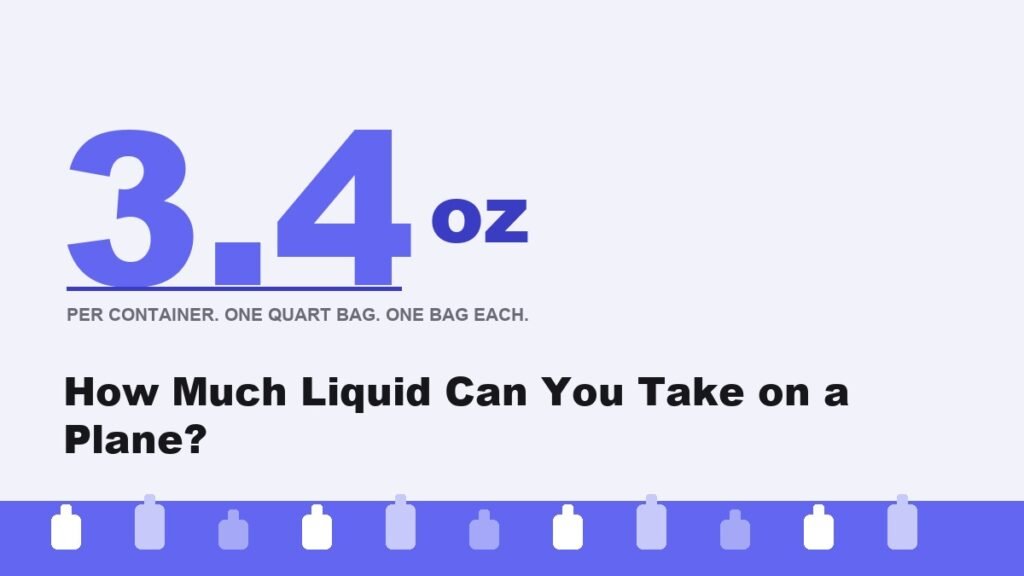
How much liquid can you take on a plane comes down to one number and one bag: 3.4 ounces per container, all of it inside a single quart-sized bag. What trips people up is everything that quietly counts as a liquid, and the three categories that are allowed through in far larger amounts.
The rules below are the Transportation Security Administration’s own, taken from its published guidance rather than from airport folklore. They apply to every US checkpoint regardless of airline, and they have not changed in the ways people on flights often claim they have.
How Much Liquid You Can Take on a Plane: 3.4 Ounces per Container
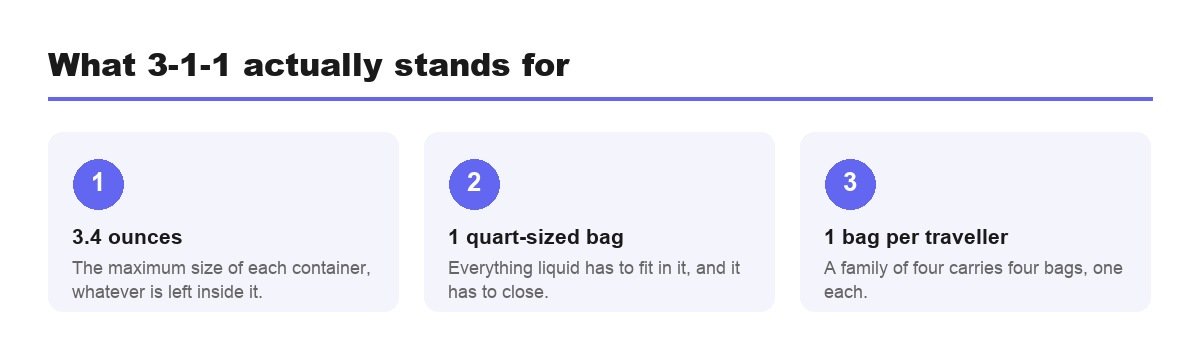
TSA allows one quart-sized bag of liquids, aerosols, gels, creams and pastes through the security checkpoint, with every container limited to 3.4 ounces or 100 millilitres. Anything larger belongs in a checked bag.
- The container size is the test, not how much liquid is in it.
- One bag each, so two adults travelling together get two quart bags.
- It has to close, and an overstuffed bag that will not seal gets repacked at the belt.
- A gallon bag is not a quart bag, and officers do check.
That second point is worth spelling out because of how often people misread it. A 12 ounce bottle of conditioner with an inch of product left is still refused, because the bottle is over the limit. Decanting into a 3 ounce refillable bottle solves it for a couple of dollars.
Things You Would Not Think Are Liquids
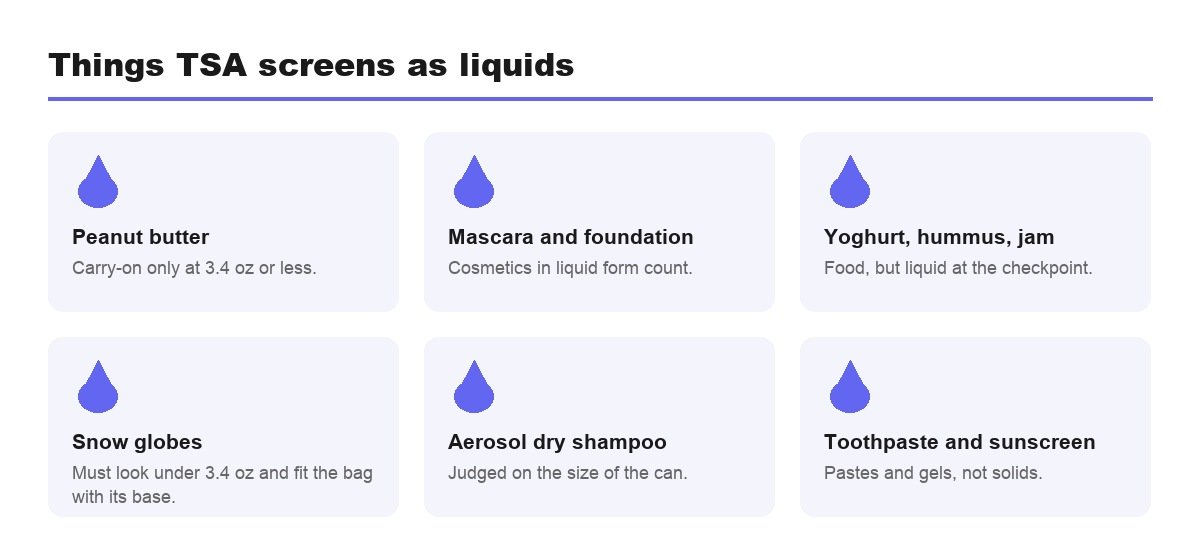
TSA publishes its rulings item by item, and several of them put solid-seeming things in the liquids category. The working test is whether it can be spread, poured, sprayed or squeezed.
- Peanut butter is a liquid, and only clears a carry-on at 3.4 ounces or less.
- Mascara, liquid foundation and lip gloss all count and belong in the bag.
- Soft cheese, hummus, yoghurt and jam are liquids even when they are lunch.
- Snow globes need to look like they hold under 3.4 ounces, about tennis ball size, and the globe and base together must fit inside the quart bag.
- Aerosol dry shampoo is a liquid by volume, so the can size decides it.
Going the other way, solids are free. A bar of soap, a solid stick deodorant, a shampoo bar and a powdered supplement all travel outside the bag in any size. Swapping two or three products for solid versions is usually the difference between a bag that closes and one that does not.
Medication and Baby Liquids Are Exempt
This is the part of the rule that saves parents and anyone carrying prescriptions, and it is more generous than the signage suggests. TSA guidance for families sets it out plainly.
- Formula, breast milk, toddler drinks and baby food, including puree pouches, are allowed in quantities over 3.4 ounces.
- They do not have to fit in the quart bag, and they are screened separately.
- Your child does not have to be with you to carry breast milk through a checkpoint.
- Ice packs, freezer packs and gel packs are allowed whether or not breast milk is present.
- Medically necessary liquids are permitted in reasonable quantities for the trip.
Tell an officer before your bag goes on the belt rather than waiting for the X-ray to find it. Liquids in pouches may get alternate screening such as explosive trace detection or vapour analysis, and TSA states that screening will not involve putting anything into the liquid itself. If you would rather your milk or medicine were not X-rayed, say so, and expect a slower manual process instead.
How Much Liquid Goes in a Checked Bag
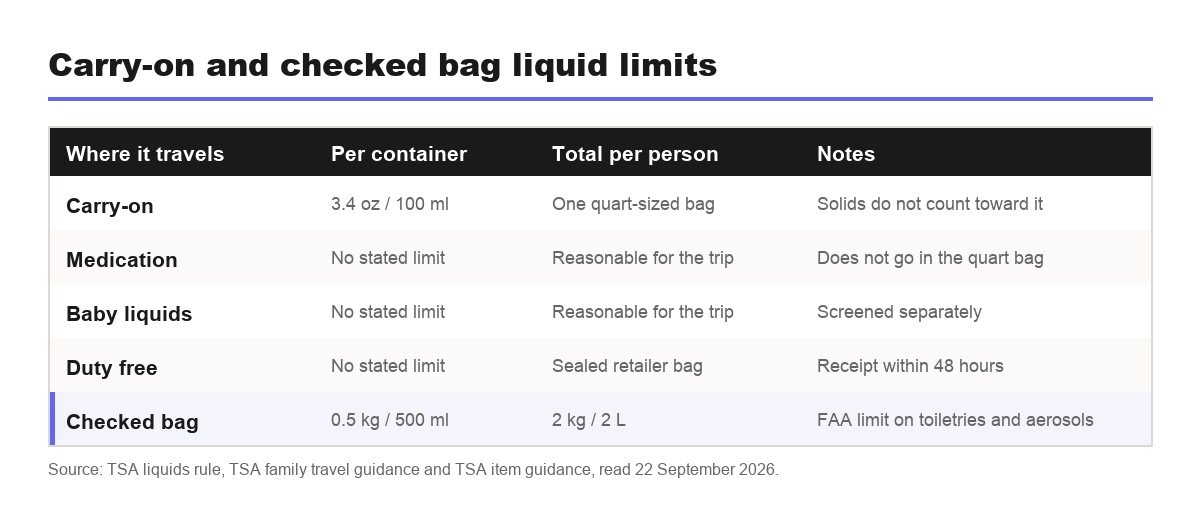
The hold is not unlimited either. The FAA caps toiletries and medicinal articles, aerosols included, and TSA’s own item guidance quotes the figures.
- 2 kilograms or 2 litres per passenger in total, around 70 ounces or 68 fluid ounces.
- 0.5 kilograms or 500 millilitres per container, about 18 ounces or 17 fluid ounces.
- Release caps must be protected so an aerosol cannot discharge in the hold.
Nobody weighs your shampoo on a normal trip. The limit bites when you are relocating, taking a season of supplies somewhere remote, or packing professional products, and a single salon-size bottle can break the per-container rule by itself.
Duty Free Bought Abroad on a US Connection
Buying a bottle airside overseas is fine until you re-clear security for a domestic leg in the United States. TSA permits duty free liquids over 3.4 ounces in your carry-on only when four things are true.
- The liquids were bought internationally and you are flying into the US with a connecting flight.
- The retailer sealed them in a transparent, secure, tamper-evident bag.
- The bag shows no sign of tampering when you hand it over.
- The original receipt is present and the purchase was within the last 48 hours.
Even then the contents get screened, and anything that alarms is not coming into the cabin. TSA recommends putting duty free liquids in checked baggage regardless, which is the sensible call on an expensive bottle or a short connection.
Souvenirs Count, and That Is Where Trips Go Wrong
The outbound journey is easy because you packed it. The return leg is where people lose things, because holiday shopping is mostly liquid and nobody thinks of it that way at the time.
- Olive oil, vinegar, honey and maple syrup are liquids by volume, however solid the jar looks.
- Wine and spirits bought in a shop rather than airside have to be checked.
- Jam, sauces and soft local cheese fall on the liquid side of the line.
- Perfume and cosmetics gift sets are usually well over 3.4 ounces per bottle.
- Sunscreen bought mid-trip is the classic one, because the big bottle is the cheap bottle.
If you are travelling carry-on only, buy the liquid souvenirs on the last day and accept that you will need to check a bag, or buy them airside after security instead. Wrapping a bottle in clothing does nothing for the rule and only makes the search take longer. A hard-sided case and a sealed bag are worth it for anything glass, because a broken bottle in the hold ruins everything packed around it.
The same logic applies to the things you already own. An electric toothbrush travels fine, but the toothpaste next to it does not, and a full-size bottle of mouthwash is over the limit several times over. Our roundup of electric toothbrushes covers which models come with a travel case, which is the part that matters once the paste is decanted.
Getting Through Security Faster
The quart bag itself is rarely the delay. What slows a lane down is a bag that has to be dug out from under a laptop, a jacket and a pair of shoes while the queue waits.
- Pack the bag at the very top of your carry-on where you can lift it straight out.
- Keep medication and baby liquids separate and declare them first.
- Put spare batteries and power banks in the cabin bag, never in the hold.
- Empty your water bottle completely before the checkpoint and fill it after.
TSA PreCheck removes most of the choreography, because liquids and electronics stay inside the bag and your shoes and belt stay on. If you fly more than twice a year it is the single change that makes the biggest difference, and the enrolment prices are not all the same.
One more thing belongs in the cabin rather than the hold, and it is not a liquid at all. Spare lithium batteries and power banks have to fly with you, which means the same bag as your quart bag. That includes the charging case for a pair of earbuds, so the case for AirPods or any similar set stays with you rather than going into a suitcase you hand over at the desk.
Finally, drink or empty anything left in a bottle before you reach the front of the queue. A half-inch of water in a reusable bottle is a liquid over 3.4 ounces in a container over 3.4 ounces, and it will send you back to the start of the line to deal with it. Water fountains and bottle fillers are standard past security in every large US airport.
Frequently Asked Questions
Can I take a 100ml bottle on a plane?
Yes. One hundred millilitres is exactly the limit TSA uses, stated as 3.4 ounces, so a 100 ml container is allowed as long as it fits in your quart-sized bag with everything else.
How many 3.4 oz bottles can I bring?
As many as physically fit in one quart-sized bag that still closes. TSA sets no separate limit on the number of containers, only on the size of each one and the single bag per passenger.
Does toothpaste count toward the liquid limit?
Yes. Toothpaste is a paste, so it is subject to the same 3.4 ounce container limit and has to go in the quart bag. Toothpaste tablets are a solid and do not count at all.
What happens if my liquid is too big?
You surrender it at the checkpoint and it is disposed of. There is no fine, but there is no way to get it back either, so anything expensive is better placed in a checked bag before you leave home.
Related Articles

Get the Fox Bulletin briefing
The stories that matter, in your inbox. No spam, unsubscribe anytime.
Newsletter signup will be available soon.
Related stories
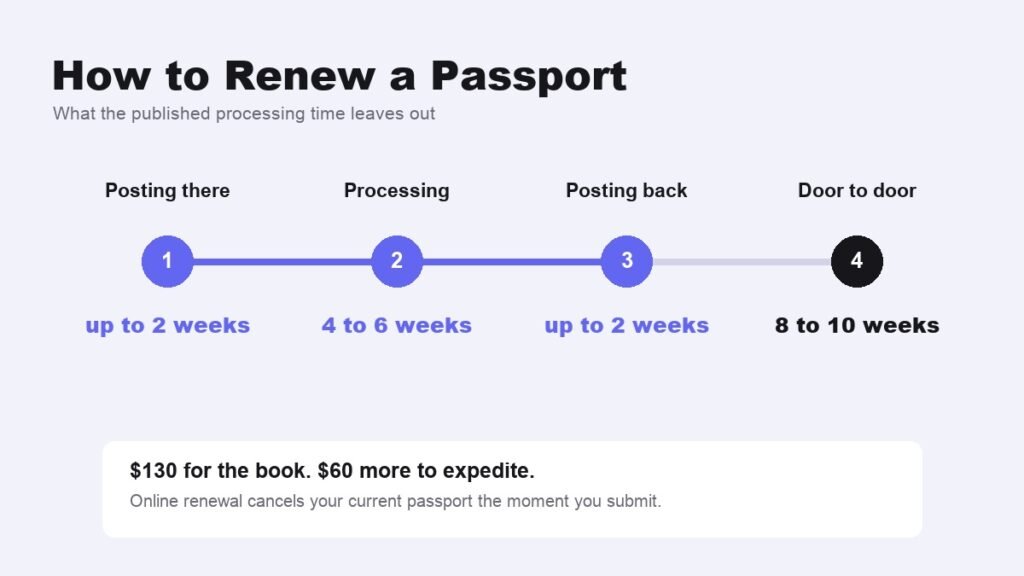
How to Renew a Passport: Fees, Timings and the Online Catch
Five conditions decide whether you can renew at all. Then the fees, the real door-to-door timings, and the online step that leaves you without a passport.
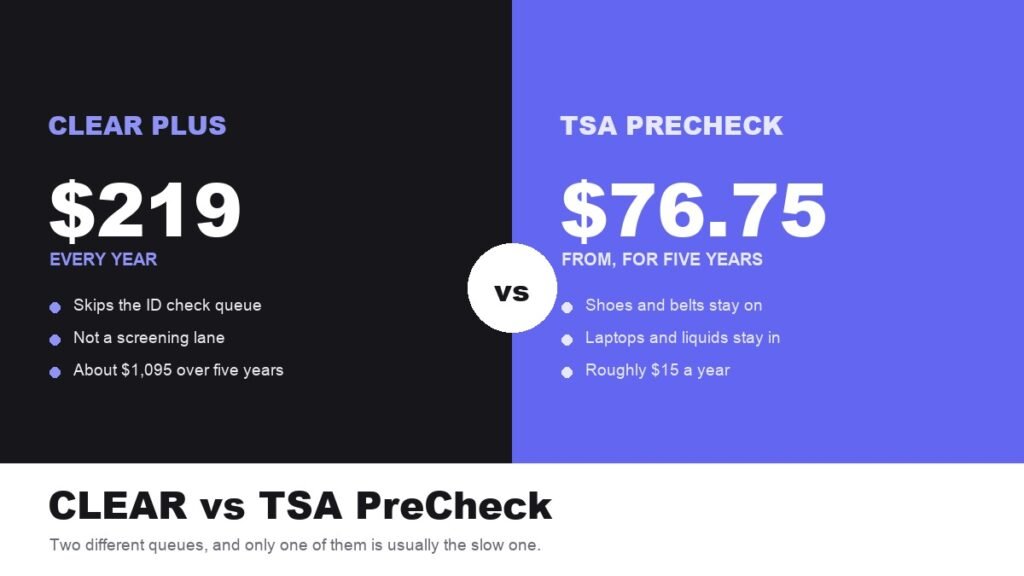
CLEAR vs TSA PreCheck: Which Airport Queue You Are Actually Skipping
CLEAR skips the ID check, PreCheck changes how you are screened. One costs $219 a year, the other as little as $76.75 for five.
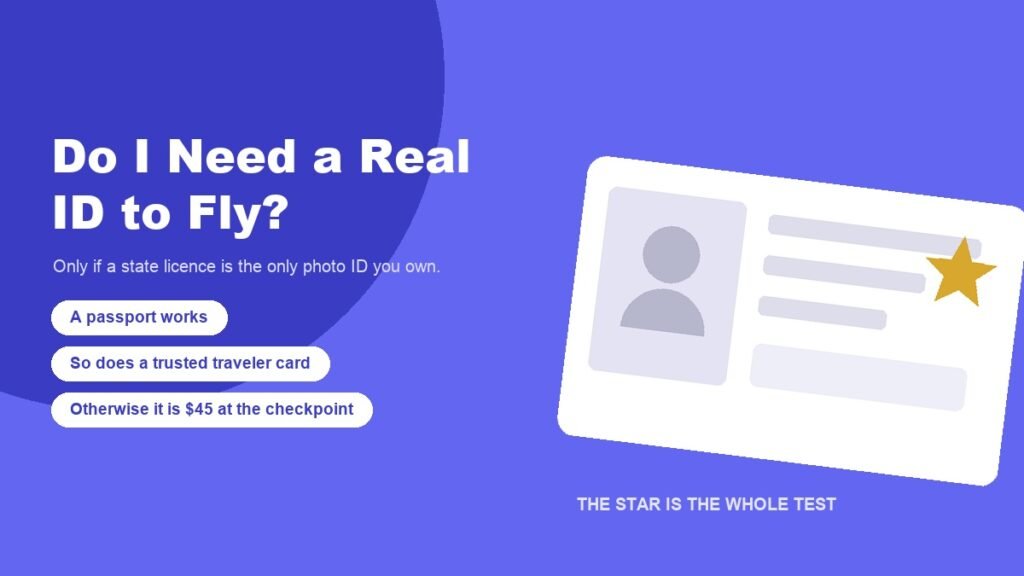
Do I Need a Real ID to Fly? What TSA Accepts Instead
Only if a state licence is the only photo ID you own. A passport, a trusted traveler card or a military ID all work instead.