
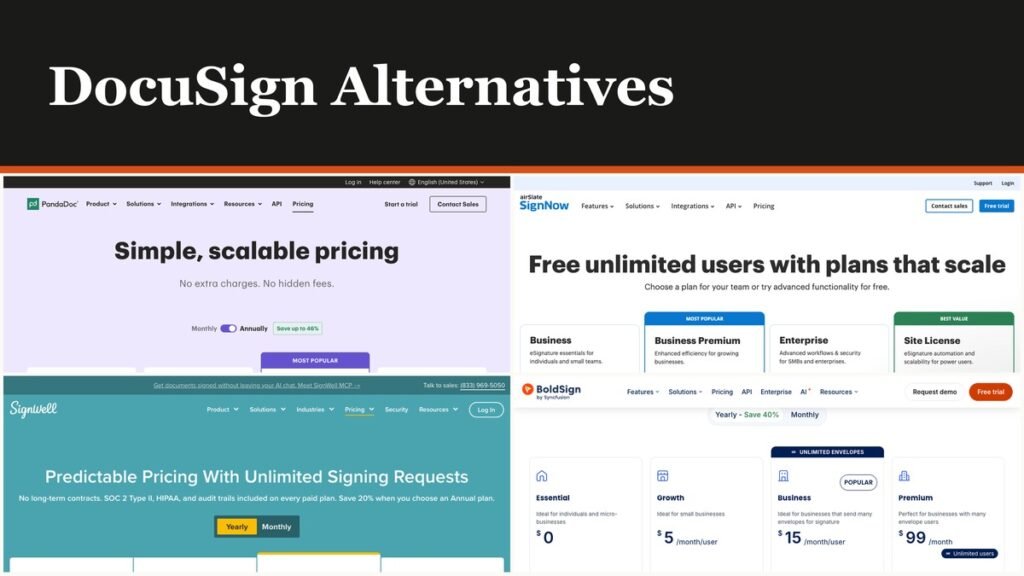
DocuSign alternatives are usually compared on features when the binding limit is volume. DocuSign Personal costs $11 a month and allows five envelopes in that month. Send a sixth and the plan does not stretch.
Standard is $30 per user a month and Business Pro $45, both on annual commitments. The ten platforms below are compared on what they let you send, because that is the number that decides the bill once more than one person starts using it.
What DocuSign Charges and What It Limits
The published plans are straightforward until you reach the allowances. Personal is a single user with a monthly envelope cap. The team plans lift the cap but charge per seat, and several common actions are billed separately on top.

| Plan | Price | What it covers |
|---|---|---|
| Personal | $11 a month | 1 user, 5 envelopes a month |
| Standard | $30 per user a month | Shared templates and branding |
| Business Pro | $45 per user a month | Payments, bulk send, advanced fields |
Two add-ons catch people out. SMS delivery starts at $0.36 a message and recipient identity verification at $2.40 an attempt. On a high-volume contract flow those line items can exceed the subscription, and neither appears in the plan comparison most buyers read.
DocuSign Alternatives Compared on Price and Sending Limit
All ten, with the cheapest paid tier and the unit each one actually meters. The metering column is the one to read first, because it decides whether your cost grows with people, with documents or not at all.
| # | Platform | Best for | Entry price | Free tier | Metered by |
|---|---|---|---|---|---|
| 1 | BoldSign | The most generous free envelope allowance | $5 per user a month | Yes, 25 envelopes a month | Envelopes per user |
| 2 | SignNow | Unlimited users on every paid plan | $8 per month billed yearly | No, free trial | Flat, users unlimited |
| 3 | DocHub | Editing and signing in one cheap tool | $8 a month | Yes | Per user |
| 4 | Signeasy | Unlimited contracts at a fixed seat price | $10 per seat a month | No, free trial | Per seat, unlimited sends |
| 5 | SignWell | Paying for senders rather than signers | $10 a month billed yearly | Yes | Per sender |
| 6 | PandaDoc | Proposals and quotes, not just signatures | $19 per seat a month | Yes | Per seat |
| 7 | Documenso | Open source, self-hostable signing | $25 a month | Yes, self-hosted | Per account, then per user |
| 8 | Signaturely | A simple tool with a hard request cap | $25 a month | Yes, 3 requests | Signature requests |
| 9 | Jotform Sign | Forms that end in a signature | $34 a month | Yes, limited | Signed documents a month |
| 10 | eSignatures.io | Occasional sending with no subscription | $0.49 per contract | No, free trial | Per contract sent |
The Ten Platforms in Detail
1. BoldSign: The most generous free envelope allowance

Entry price: $5 per user a month. Free tier: Yes, 25 envelopes a month. Metered by: Envelopes per user.
BoldSign gives away 25 envelopes a month on a free plan that does not expire, which is five times what DocuSign Personal allows for $11. Growth is $5 a user a month for 50 envelopes per user, and Business is $15 for unlimited.
That free allowance covers a great many small businesses outright. The paid ladder is the cheapest serious one here: five users sending without limit costs $75 a month, against $150 for the same five on DocuSign Standard.
2. SignNow: Unlimited users on every paid plan

Entry price: $8 per month billed yearly. Free tier: No, free trial. Metered by: Flat, users unlimited.
SignNow prices by plan rather than by head. Business is $8 a month billed yearly and Business Premium $15, and both include unlimited users, which is close to unique in this category.
Month to month those become $20 and $30, so the advertised figure assumes a year up front. For a team of eight that all need to send, the arithmetic is hard to beat: the whole team costs what one DocuSign Standard seat costs.
3. DocHub: Editing and signing in one cheap tool

Entry price: $8 a month. Free tier: Yes. Metered by: Per user.
DocHub does PDF editing and signing in the same place, which suits anyone who spends as much time fixing documents as signing them. Free is a working tier, Basic is $8 a month and Pro $12.
It is the cheapest paid entry on this list after BoldSign, and the editing side is genuinely capable rather than a token feature. The trade is a thinner audit trail and fewer enterprise controls than the dedicated signature platforms.
4. Signeasy: Unlimited contracts at a fixed seat price

Entry price: $10 per seat a month. Free tier: No, free trial. Metered by: Per seat, unlimited sends.
Signeasy removes the envelope question entirely: every paid seat sends unlimited contracts. Personal is $10 a seat a month billed yearly, Business $20 and Business Pro $30.
That makes budgeting simple in a category where it usually is not. A five-person team on Business pays $100 a month and never thinks about an allowance again, where the same team on DocuSign Standard pays $150 and still has per-envelope add-ons for SMS and identity checks.
5. SignWell: Paying for senders rather than signers

Entry price: $10 a month billed yearly. Free tier: Yes. Metered by: Per sender.
SignWell charges for senders rather than seats, which matters because most organisations have far more people signing than sending. Light is $10 a month billed yearly for one sender, Business $30 for three.
Extra senders are $10 each on Light and $12 on Business. If two people in a forty-person company issue all the contracts, this pricing shape is the one that reflects reality, and the free tier covers the occasional one-off.
6. PandaDoc: Proposals and quotes, not just signatures

Entry price: $19 per seat a month. Free tier: Yes. Metered by: Per seat.
PandaDoc is a document platform that happens to sign. Proposals, quotes and contract templates are the product, with signature as the final step. Free covers unlimited signatures, Starter is $19 a seat and Business $49.
The free tier is unusually strong for e-signature alone. The paid tiers buy template logic, approval routing and CRM integration, which is worth it only if you are actually building documents rather than circulating finished ones.
7. Documenso: Open source, self-hostable signing

Entry price: $25 a month. Free tier: Yes, self-hosted. Metered by: Per account, then per user.
Documenso is open source, which means the whole thing can run on your own server with no per-signature cost at all. The hosted version is $25 a month for an individual and $40 for a team of five, with extra users at $8.
For organisations that cannot send contracts through a third party, self-hosting is the only real answer in this list. The hosted pricing is mid-range rather than cheap, so the appeal is control rather than cost.
8. Signaturely: A simple tool with a hard request cap

Entry price: $25 a month. Free tier: Yes, 3 requests. Metered by: Signature requests.
Signaturely is the simplest tool here and prices accordingly: Personal is $25 a month for five signature requests, Business $50 a user for unlimited. The free tier allows three requests.
Five requests for $25 works out at $5 a contract, which only makes sense if the documents matter more than the volume. Read the request cap before the feature list, because it is the line most people hit in week two.
9. Jotform Sign: Forms that end in a signature

Entry price: $34 a month. Free tier: Yes, limited. Metered by: Signed documents a month.
Jotform Sign is the right answer when the signature is the end of a form rather than a document emailed back and forth. Bronze is $34 a month for 100 signed documents, Silver $39 for 250 and Gold $99 for 1,000.
Pricing is by completed document rather than by user, so an unlimited number of staff can send. For onboarding, waivers and intake paperwork that starts life as a web form, nothing else here fits as neatly.
10. eSignatures.io: Occasional sending with no subscription

Entry price: $0.49 per contract. Free tier: No, free trial. Metered by: Per contract sent.
eSignatures.io charges $0.49 a contract and no monthly fee whatsoever. For a business that sends a handful of agreements a quarter, that is the entire bill, and the money stops when the sending stops.
Add-ons are priced the same way, at $2.99 for a live photo identity check and $0.09 for an SMS. Volume discounts begin at $500 of credit. Past roughly forty contracts a month a flat seat price wins, but below that nothing here comes close.
What Twenty Contracts a Month Costs
Twenty signed agreements a month is a realistic small-business figure, and it separates these platforms more sharply than any feature table.
- BoldSign Essential: $0, since the free plan carries 25 envelopes a month.
- eSignatures.io: $9.80, being twenty contracts at 49 cents with no subscription underneath.
- SignNow Business: $8 a month billed yearly, with unlimited users sending.
- DocuSign Personal: not possible, because the plan stops at five envelopes. The cheapest DocuSign route is Standard at $30.
- Signaturely Personal: not possible either, at five requests for $25.
The pattern holds at low volume and reverses at high volume. Past about forty contracts a month the per-contract pricing loses to a flat seat, and past a few hundred the unlimited plans win outright. Work out your real monthly count before reading a single feature comparison.
An Electronic Signature Is Already Legally Binding
A recurring worry is that the cheaper tools are somehow less valid. In the United States that is not how the law works. Validity comes from the statute, not from the brand on the envelope.
The federal Electronic Signatures in Global and National Commerce Act states that a signature may not be denied legal effect merely because it is electronic. Most states have also adopted the Uniform Electronic Transactions Act, which does the same at state level. Both set conditions about intent and consent rather than about software.
What the platform contributes is evidence: a tamper-evident record, a timestamped audit trail and proof of who opened what. Every tool here produces one. The differences are in how much identity assurance sits behind it, which is what DocuSign charges $2.40 an attempt for and why some sectors pay it.
- Certain documents stay outside the statute, including wills, some trusts and particular family law and court filings.
- Consumer disclosures carry their own consent requirements before an electronic record can replace a paper one.
- A signature is only as good as the audit trail behind it, so keep the completed file rather than relying on the vendor to hold it forever.
Reading a Plan Before You Commit to a Year
Almost every advertised figure in this category assumes annual billing, and the monthly premium is steep. SignNow is $8 a month on a year and $20 month to month, a difference of 150 percent for the same product.
The second thing to check is who the licence covers. SignWell bills senders, SignNow includes unlimited users, PandaDoc and Signeasy bill every seat. A forty-person company where two people issue contracts pays wildly different amounts depending on which of those models it picks, and the feature lists look nearly identical. Businesses auditing their recurring tools usually find the same trap in their payment management system.
Finally, check what leaves with you. Completed agreements are business records and should be exported and stored independently of whichever platform produced them. If you are reviewing document tooling generally, our guide to the best PDF editors covers the editing side that signing tools mostly do not.
How to Choose a DocuSign Alternative
Pick on volume and on who sends, in that order. Features separate these products far less than pricing shape does.
- Under 25 envelopes a month: BoldSign free, or eSignatures.io at 49 cents a contract.
- Everyone needs to send: SignNow, where users are unlimited on every paid plan.
- Two or three people send everything: SignWell, which bills senders rather than seats.
- You build proposals, not just contracts: PandaDoc.
- The documents cannot leave your infrastructure: self-hosted Documenso.
If the reason for leaving is cost rather than capability, start by counting last quarter’s signed documents. Most teams discover they are on a per-seat plan sized for a volume they have never reached. The same audit is worth running across every subscription, which is where the QuickBooks alternatives question usually starts too.
Frequently Asked Questions
Is there a free DocuSign alternative?
BoldSign Essential is the most generous, with 25 envelopes a month at no cost and no expiry. PandaDoc, DocHub, SignWell, Documenso and Signaturely all publish free tiers too, though with tighter caps on requests or senders.
How many documents can I send on DocuSign Personal?
Five envelopes a month, for $11 billed as an annual commitment of $132. Sending more means moving to Standard at $30 per user a month. That cap is the single most common reason people look for an alternative.
Are cheaper e-signature tools legally valid?
Yes. The federal ESIGN Act and state adoptions of UETA give an electronic signature legal effect regardless of which product created it, provided intent and consent requirements are met. What varies between tools is the strength of the audit trail and identity verification, not the underlying validity.
Which alternative is cheapest for a whole team?
SignNow, because Business at $8 a month billed yearly includes unlimited users. For teams that need unlimited sending per person, Signeasy Business at $20 a seat or BoldSign Business at $15 a user are the next cheapest.
Related Articles

Get the Fox Bulletin briefing
The stories that matter, in your inbox. No spam, unsubscribe anytime.
Newsletter signup will be available soon.
Related stories

HubSpot Competitors: 10 CRM Platforms Priced Per Seat
A HubSpot Professional seller costs $150 a seat once both seats are counted. Ten HubSpot competitors compared on what a five-person team actually pays.
QuickBooks Alternative: 10 Options Priced and Ranked
QuickBooks Online starts at $38 a month. Every QuickBooks alternative here is compared on list price, free tier and what each one quietly withholds.
Cross-Border Payments: How Businesses Cut Cost and Delay
The average business-to-business cross-border payment costs 1.6% of the amount sent and only 2.2% land within an hour. Where the friction comes from and how a finance team removes it.