

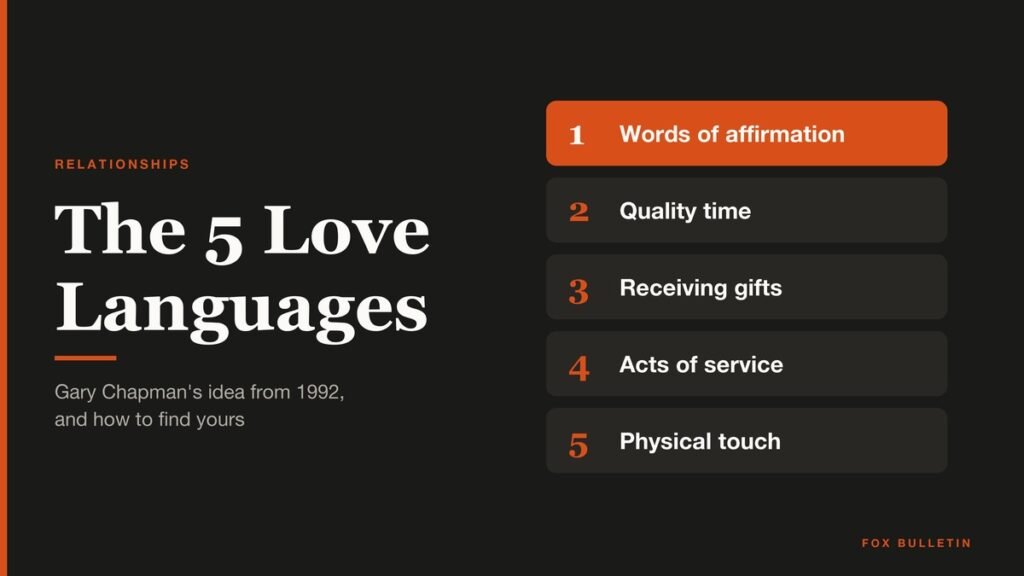
The five love languages are the ways people most naturally give and receive love: words of affirmation, quality time, receiving gifts, acts of service and physical touch. Counselor Gary Chapman introduced the idea in 1992, arguing that each person has one primary language that speaks to them more deeply than the other four.
More than three decades later, the idea is everywhere. The book has sold more than 20 million copies, and more than 30 million people have taken the online quiz. This guide covers what each language means in 2026, with Chapman’s own examples, how to work out yours and your partner’s, and what relationship researchers have found when they put the theory to the test.
What Are the 5 Love Languages?
Chapman’s central claim is simple: people tend to show love the way they want to receive it, and partners rarely share the same language. Here is what each one looks like, with the kind of slight that hurts most, as summarized by Singapore’s Ministry of Social and Family Development from Chapman’s 2015 edition:
| # | Love language | What it means | Example | What hurts most |
|---|---|---|---|---|
| 1 | Words of affirmation | Spoken or written appreciation, compliments and encouragement | “Really appreciate what you did” | Insults and harsh criticism |
| 2 | Receiving gifts | A visible token that says “they were thinking about me” | A flower picked from the yard | A forgotten birthday or a careless gift |
| 3 | Acts of service | Doing something useful so the other person does not have to | Cooking dinner or washing the dishes | Never helping, or creating more work |
| 4 | Quality time | Undivided attention: TV off, phone down, talking | A walk after dinner | Distraction and postponed plans |
| 5 | Physical touch | Affectionate contact, from holding hands to intimacy | An arm around the shoulder | Coldness, or inappropriate touch |
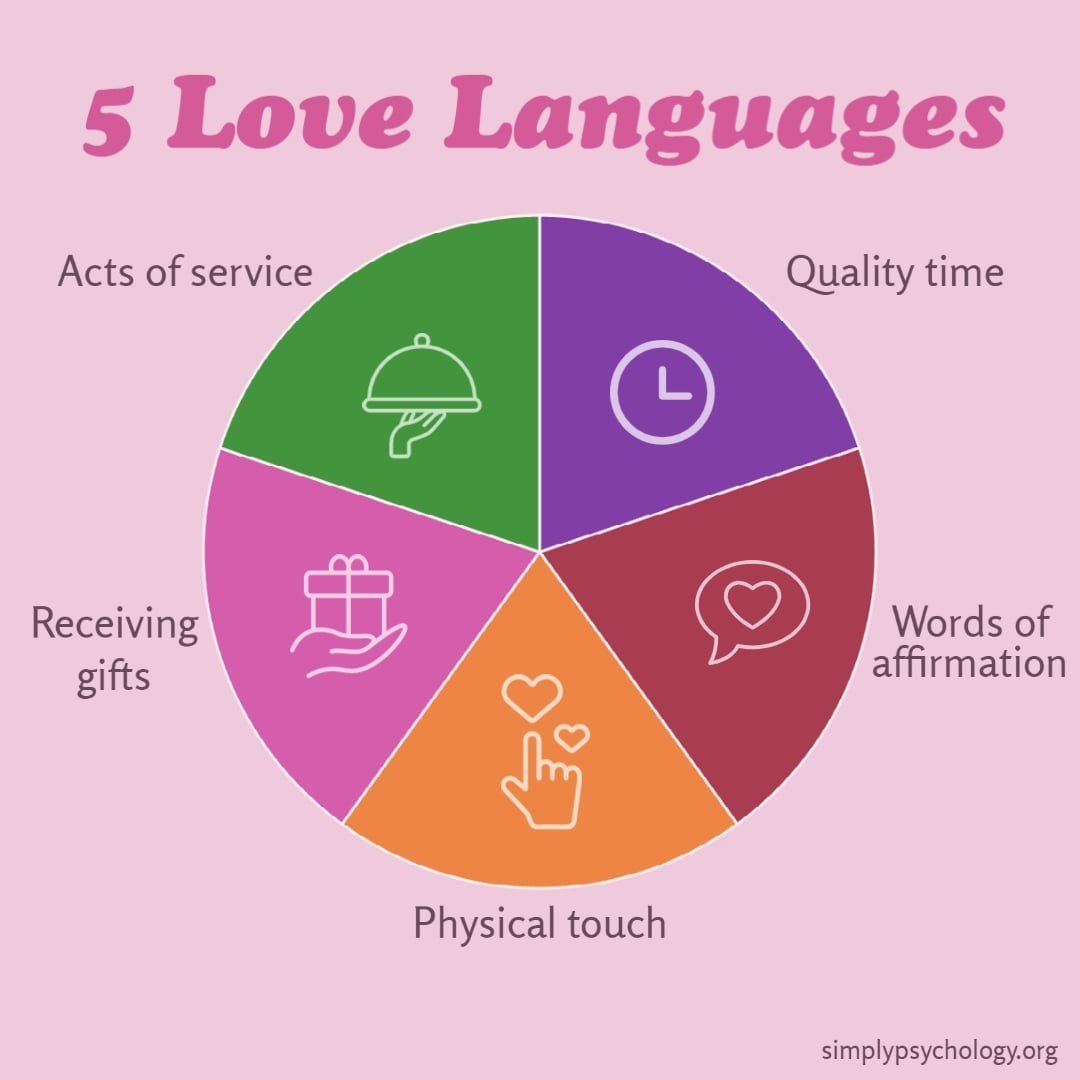
Chapman says most people have a primary language and a secondary one, and everyone can receive love in all five. When two seem equally strong, his answer is: “We’ll call you bilingual.”
The Five Love Languages, One by One
1. Words of Affirmation: Saying It Out Loud
Looks like: compliments, thank-yous, encouragement, a note in a lunch bag. Hurts: insults and criticism, which “are not easily forgotten.”
Chapman defines this language as “using words to affirm the other person.” His examples are deliberately small: “You look nice in that outfit,” or “Really appreciate what you did.” Praise can target appearance, effort, personality or character.
For someone with this language, a harsh word lands harder than it would on others. Chapman quotes the proverb that life and death are in the power of the tongue. He tells of a wife who could think of nothing good to say about her husband, and advised her to start by appreciating that he showered every day.
2. Receiving Gifts: Proof of Being Thought About
Looks like: small, thoughtful tokens and remembered occasions. Hurts: a missed birthday or anniversary, or a gift that shows no thought.
This is the most misunderstood language, because it sounds materialistic. Chapman says the point is the evidence of attention: “It’s not the thought left in your head that counts. It’s the gift that came out of the thought in your head.” Drawing on his anthropology training, he says researchers have never found a culture where gift-giving is not an expression of love.
Price is beside the point. Chapman suggests a flower picked from the yard, and the Singapore ministry notes a meaningful gift can be something you make. A favorite scent from our guide to the best perfume for daily use works when it reflects what the person actually wears.
3. Acts of Service: Love as Something You Do
Looks like: cooking, cleaning, errands, fixing things unasked. Hurts: a partner who never helps at home, or who creates more work.
Chapman ties this language to the line “love not only in word but in deed.” His list is household-specific: cooking a meal, washing dishes, vacuuming, getting the white spots off the mirror, mowing the grass, changing a diaper. For these people, he says, actions speak louder than words.
It is Chapman’s own wife’s language. Karolyn Chapman’s primary language is acts of service, while his is words of affirmation. He says he hated vacuuming as a teenager and vacuums for her now, and that doing what does not come naturally is a greater expression of love.
4. Quality Time: Undivided Attention
Looks like: focused conversation, shared activities, planned time together. Hurts: being half-listened to, or having plans repeatedly pushed back.
Chapman is precise here: quality time is not sitting together watching television, “because someone else has your attention.” It means the TV off, looking at each other and talking. He says just 20 minutes of “looking, listening, interacting” is a powerful message.
In practice that can be a walk after dinner, a weekend away, or simply leaving the phone in another room. In a 2022 study of 100 couples, quality time was the most common primary language, chosen by 42 percent of men and 41 percent of women.
5. Physical Touch: Contact That Says You Are Close
Looks like: holding hands, hugs, kisses, a back rub, sexual intimacy. Hurts: physical coldness, and above all inappropriate touch or abuse.
Chapman’s list runs from holding hands, kissing and embracing to “the whole sexual part of marriage,” plus small gestures like an arm around the shoulder or a hand on the leg while driving. He also cautions men who assume touch is their language to check whether they enjoy nonsexual touch, since physical touch does not necessarily mean sex.
Within any language there are “dialects.” Chapman tells of a widow whose two husbands both had physical touch as their language, yet the back rubs her first husband loved put off the second. The language matched; the specific gesture did not.
Where the Love Languages Came From
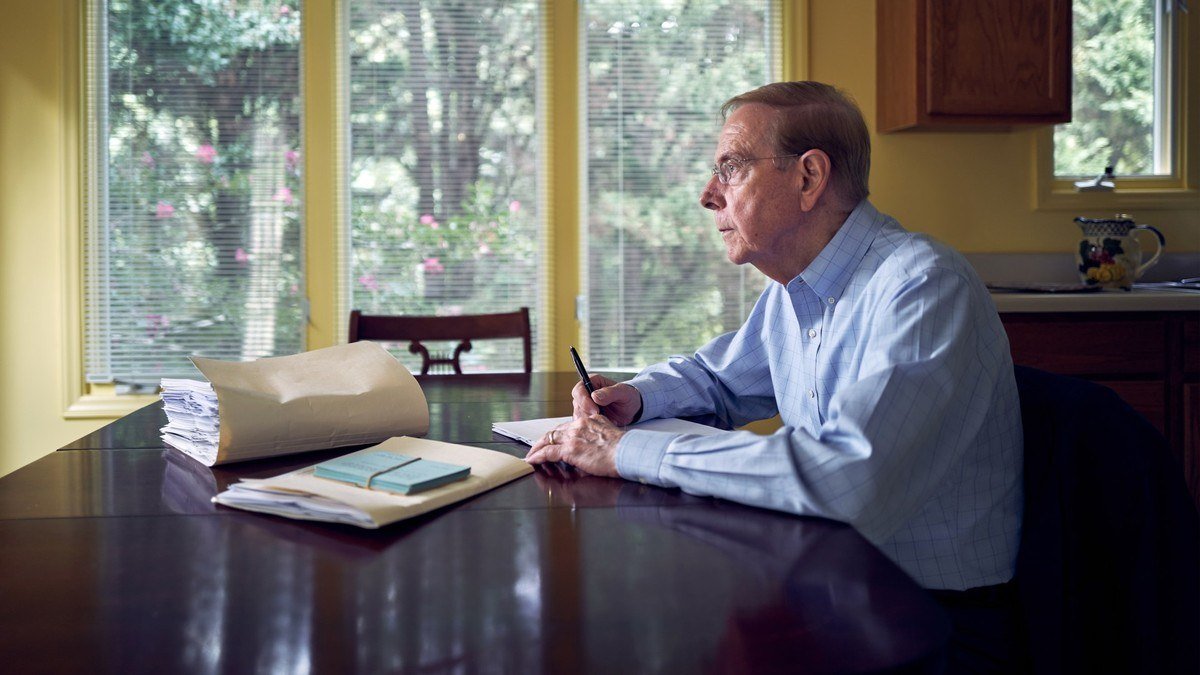
Gary Chapman spent 50 years as an associate pastor at Calvary Baptist Church in Winston-Salem, North Carolina, counseling couples throughout. He studied anthropology at Wheaton College, earned a master’s in anthropology from Wake Forest University and a PhD from Southwestern Baptist Theological Seminary, and retired from the church in summer 2021.
The idea started with one couple married 30 years. The wife said they lived “like two roommates,” even though her husband cooked, vacuumed every Thursday and mowed on Saturdays. What she wanted was conversation. Chapman then reread 12 years of counseling notes, asking what people who felt unloved wanted, and says their answers “fell into five categories.”
The Book That Made Love Languages a Household Phrase
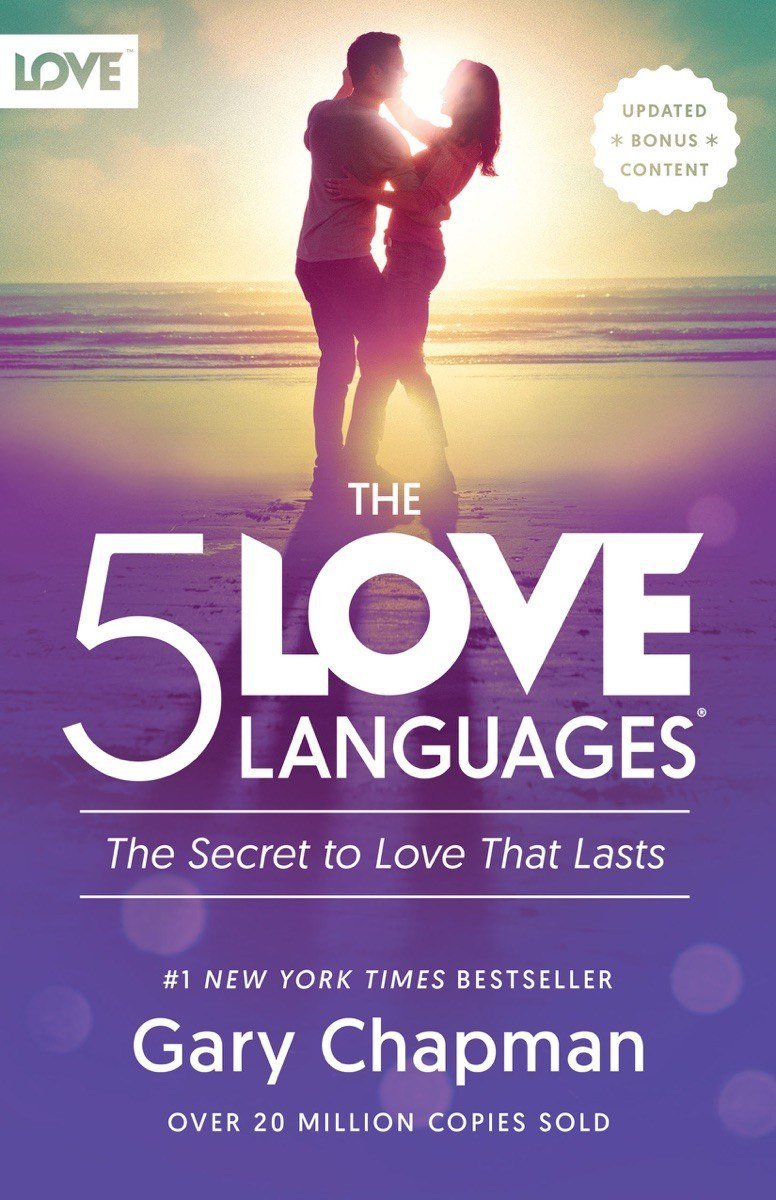
The first edition appeared in 1992 from Northfield Publishing in Chicago as The Five Love Languages: How to Express Heartfelt Commitment to Your Mate. Its start was slow: 8,500 copies in the first year, 137,000 by the fourth. Editions since 2010 carry the subtitle The Secret to Love That Lasts.
Moody Bible Institute, parent of Northfield’s publisher Moody Publishers, says the book has sold more than 20 million copies and been translated into 50 languages. Chapman wrote it, he says, “in the language of the common person,” leaving out psychological jargon and keeping non-Christian readers in mind.
How the Love Language Test Works
The official quiz, known as the Love Language Personal Profile, is free and has 30 forced-choice items. Each one asks which of two statements is more meaningful to you, such as holding hands versus receiving a gift. Your highest count becomes your primary language.
That format has a known quirk. Because every item forces a choice, the quiz always produces a winner, even for people who value all five about equally. Researchers note that when people instead rate each language on a 1 to 5 scale, the averages hover around 4 for all five, and receiving gifts jumps from 0 to 4 percent of people as a primary language to more than half.
Three Clues to Your Partner’s Love Language
Chapman says you can usually identify someone’s love language without a quiz by watching three things:
- How they treat other people. Someone who hugs everyone leans toward touch; someone always encouraging others leans toward words; someone forever taking friends to lunch leans toward quality time.
- What they complain about. “We never have any time together” points to quality time. “You didn’t bring me anything?” points to gifts. Chapman’s advice is to get past defensiveness, because the complaint names the language.
- What they ask for. A walk after dinner, a surprise, a back rub: requests reveal what fills the “love tank,” Chapman’s term for the need to feel loved.
Put the three together, Chapman says, and the answer is usually clear. Try the same clues on yourself: what you most often do for others is a strong hint at what you want back.
Do Love Languages Hold Up in Research?
Partly. A 2022 PLOS ONE study of 100 couples from the University of Warsaw found that people whose partners expressed love the way they preferred reported higher relationship and sexual satisfaction. The mismatch was not related to how long couples had been together, which suggests partners do not adjust to each other automatically.
Other work is less kind. Bunt and Hazelwood’s 2017 study of 67 couples found “limited evidence” that matching languages raised satisfaction; self-regulation mattered more. In 2024, Emily Impett and colleagues at the University of Toronto reviewed the evidence and concluded that none of the studies they examined supported Chapman’s core claims. Their summary: people are happier when they receive any of these expressions of love.
Chapman’s response was gracious. He said he appreciated researchers taking the work seriously, and that he never meant people should speak only a partner’s primary language.
How to Use Love Languages Without Boxing Anyone In
Impett’s team offers a better metaphor: love as a balanced diet, where people need a full range of nutrients rather than one favorite food. That fits the research and still keeps the useful part of Chapman’s idea. Some practical ways to apply it:
- Ask directly which gestures mean the most, instead of relying only on a quiz result.
- Keep speaking all five, and give extra weight to the one your partner responds to most.
- Treat a complaint as information about a need, not an attack.
- Expect dialects: two people with the same language can want very different gestures.
- Remember that the five omit things researchers consider important, like supporting a partner’s own goals.
Love Languages for Children, Friends and Coworkers
Chapman has applied the idea well beyond marriage. The Five Love Languages of Children, written with Ross Campbell, came out in 1997, followed by editions for teenagers (2000), singles (2004), military couples (2013) and the workplace, The 5 Languages of Appreciation in the Workplace with Paul White (2011).
His question for parents is “Do the children feel loved?” rather than “Do you love your child?” For younger children he suggests speaking all five and watching which one they respond to, a sensible approach for families weighing where to settle, as in our look at the best states to raise a family. At work, the same idea becomes appreciation: some colleagues value praise in front of the team, others a hand with a deadline.
Frequently Asked Questions
What is the most common love language?
In a 2022 study of 100 couples, quality time was the most common primary language (42 percent of men and 41 percent of women), followed by physical touch. Receiving gifts was the rarest, chosen by no men and 4 percent of women on the forced-choice quiz.
Can you have more than one love language?
Yes. Chapman says most people have a primary and a secondary language, and if two are equally strong, you are “bilingual.” Everyone can receive love through all five.
Who created the 5 love languages?
Gary Chapman, a counselor and associate pastor at Calvary Baptist Church in Winston-Salem, North Carolina. He published the idea in 1992 after reviewing 12 years of counseling notes.
Are love languages scientifically proven?
Not fully. One 2022 study found matching preferences linked to higher satisfaction, but a 2024 University of Toronto review found little support for the claim that each person has one primary language or that matching is necessary.
Related Articles

Get the Fox Bulletin briefing
The stories that matter, in your inbox. No spam, unsubscribe anytime.
Newsletter signup will be available soon.
Related stories
Birthstones by Month: Every Stone, Color and Meaning
Every month's birthstone, its color and Mohs hardness, where it comes from, how to care for it, and how jewelers built the list in 1912 and kept adding to it.
When Is Thanksgiving? This Year’s Date and the Next 10 Years
Thanksgiving 2026 falls on Thursday, November 26. Here is every date through 2035, the 1941 law behind the fourth-Thursday rule, and what happens that week.
Zodiac Signs: All 12 Dates, Meanings and Constellations
The 12 zodiac signs from Aries to Pisces: dates, elements, modalities and rulers, the constellation behind each sign, and why the Sun is no longer where the signs say.